
You’ll achieve professional-grade titanium jewelry through DMLS printing by mastering three critical elements: optimizing your design files for dimensional accuracy within 2%, selecting the appropriate finish based on wearability requirements, and maintaining structural integrity with proper wall thickness specifications. Focus on organic curves over sharp angles, guarantee minimum 1mm walls for durability, and choose between matte or satin finishes depending on your aesthetic goals. These fundamentals will elevate your titanium jewelry production considerably.
Optimize Your Design Files for DMLS Technology
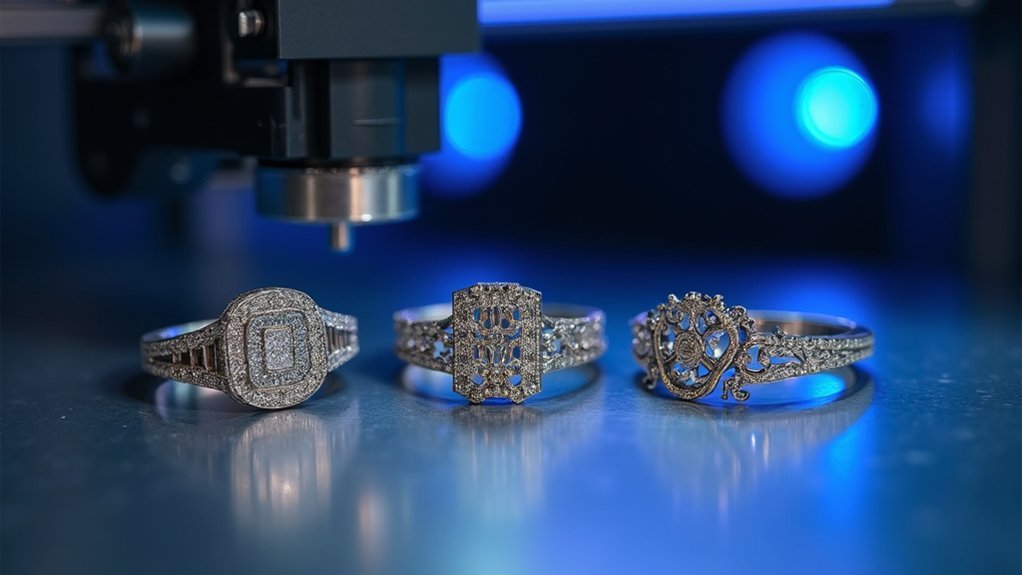
Five critical design parameters determine whether your titanium jewelry will emerge from the DMLS printer with professional quality or costly defects.
First, maintain a minimum wall thickness of 1mm throughout your digital design to guarantee structural integrity during the metal laser sintering process.
A 1mm minimum wall thickness ensures your titanium jewelry maintains structural integrity throughout the DMLS printing process.
Second, space intricate designs at least 0.25mm apart from wall surfaces for precise detail resolution.
Third, jewelry designers should favor organic curves over sharp angles, as they produce superior surface quality in the powder bed environment.
Fourth, design angles exceeding 35° to avoid rough finishes that compromise your titanium jewelry’s aesthetics.
Finally, optimize your production process files for dimensional accuracy within 2%, enabling exceptional customization options and professional-grade results that meet client expectations consistently.
Choose the Right Finish for Your Titanium Jewelry
After optimizing your design files for dimensional accuracy, you’ll face another important decision that greatly impacts your titanium jewelry’s final appearance and market appeal.
You’ll need to choose between matte finish and satin finish options for your pieces.
Matte finish delivers a grayer, understated look that you can achieve directly from 3D printing without additional steps.
Satin finish requires post-processing through blasting, creating a shinier, more reflective surface that enhances visual appeal and perceived value.
Consider wearability when deciding—satin finishes show scratches more easily than forgiving matte surfaces.
However, both options are jewelry-safe and won’t cause allergic reactions, making your titanium jewelry suitable for sensitive skin regardless of your finish choice.
Meet Minimum Requirements for Wall Thickness and Detail
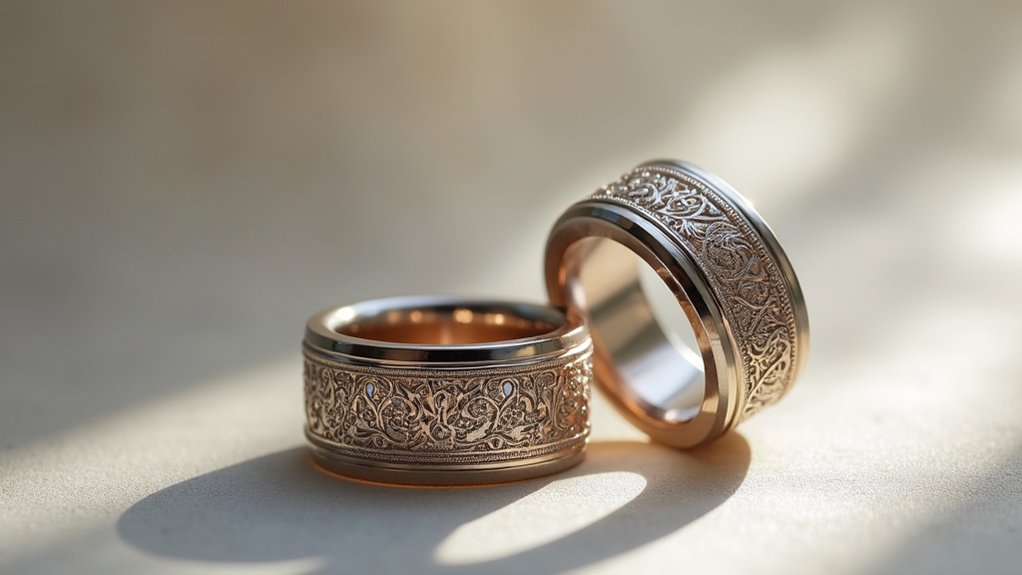
When designing titanium jewelry for 3D printing, you’ll need to meet specific structural requirements that guarantee your pieces won’t crack or break during the printing process or everyday wear.
Your minimum wall thickness should be at least 1mm for ideal structural integrity, though some jewelry pieces can work with 0.4mm walls.
For optimal durability, maintain 1mm minimum wall thickness in titanium jewelry designs, though experienced designers can achieve 0.4mm walls successfully.
Metal 3D printing technology allows intricate designs with just 0.25mm distance between wall and detail surface.
You’ll achieve dimensional accuracy exceeding 2% with proper planning.
Focus on organic shapes rather than sharp angles, as printing technology produces better surface quality with curved forms.
Avoid angles less than 35° since they compromise detail surface finish.
These requirements guarantee your titanium jewelry maintains both durability and aesthetic appeal.
Frequently Asked Questions
How Do You Print Titanium?
You’ll use Direct Metal Laser Sintering, where a laser sinters fine titanium powder layer by layer. You’ll need 0.4mm minimum wall thickness, though 1mm’s better for strength. Post-processing with surface blasting creates attractive finishes.
Is 3D Printing Titanium Expensive?
You’ll find 3D printing titanium expensive, typically costing $100-500 per jewelry piece. The specialized DMLS equipment exceeds $100,000, titanium powder’s costly, and post-processing adds more expense to your final product.
What Is the Best Material for 3D Printed Jewelry?
You’ll find titanium’s the best material for 3D printed jewelry. It’s incredibly strong, lightweight, and corrosion-resistant while allowing intricate details down to 0.25mm through DMLS technology for professional results.
Can You 3D Print Pure Titanium?
You can 3D print pure titanium using Direct Metal Laser Sintering technology. It’ll sinter titanium powder layer by layer, creating durable pieces with 0.25mm precision that’re biocompatible and safe for wearing.