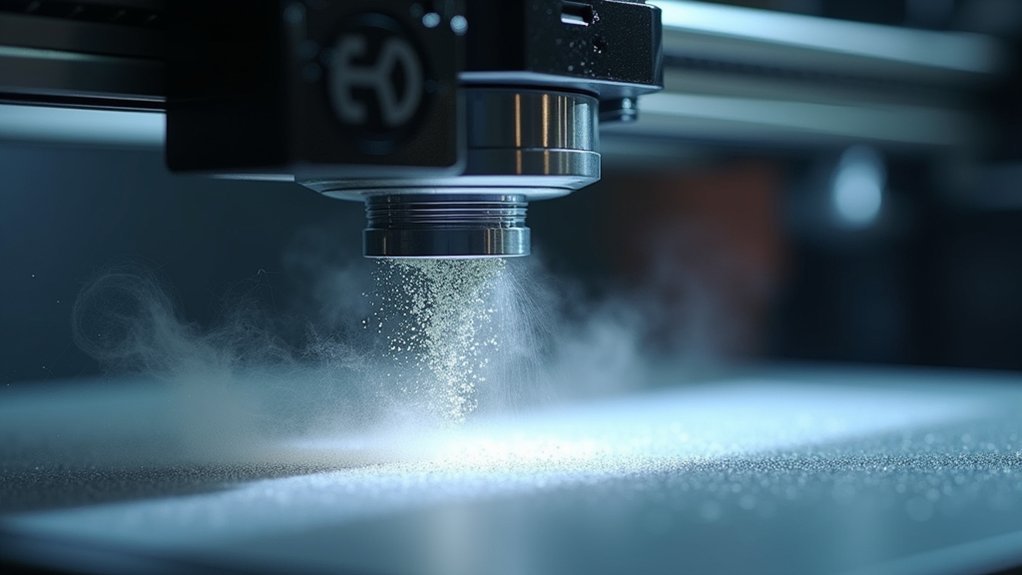
Your 3D printer releases toxic ultrafine particles because heating thermoplastic filaments causes thermal decomposition that breaks down polymer chains into microscopic particles smaller than 100 nanometers. When you heat ABS to 240°C or PLA to 180°C, the materials degrade and emit dangerous compounds like carcinogenic styrene and methyl methacrylate. These emissions peak during startup, reaching concentrations of 10^4 to 10^6 particles per cubic centimeter that can penetrate deep into your lungs and bloodstream, creating serious health risks you’ll want to understand completely.
What Are Ultrafine Particles in 3D Printing
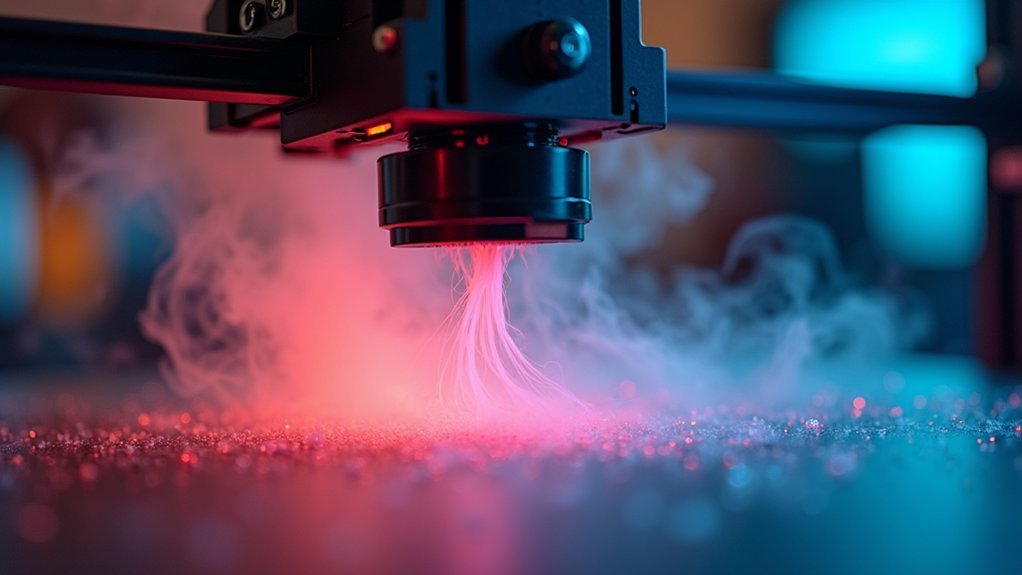
When you operate a 3D printer, it releases ultrafine particles (UFPs) – microscopic particles smaller than 100 nanometers that become airborne during the printing process.
These emissions occur when thermoplastic filaments like ABS and PLA are heated and extruded through the printer’s nozzle. During printing, UFP concentrations can reach levels between 10^4 to 10^6 particles per cubic centimeter, with peak emissions typically happening when you start your print job.
While PLA generally produces fewer particles than ABS, both materials generate these concerning emissions.
ABS filaments pose additional risks by releasing dangerous volatile organic compounds (VOCs) like styrene alongside the UFPs, creating a more toxic environment around your 3D printer.
The Heating Process Behind Particle Formation
As temperatures rise inside your 3D printer’s heating chamber, the thermal degradation of polymer filaments triggers the formation of ultrafine particles through a complex chemical process. When your printer heats materials to extrusion temperatures, volatile compounds break down from the polymer chains, creating harmful emissions of particles that range from 10^4 to 10^6 particles/cm³.
| Filament Types | Temperature Range | UFP Emission Rate |
|---|---|---|
| PLA | 180-220°C | Low |
| ABS | 220-260°C | 10^7-10^12 particles/min |
| Modified Polymers | 250-300°C | Very High |
The heating process becomes particularly dangerous with ABS filaments, which release styrene and other toxic compounds. Additives in your filament can worsen these emissions, making the thermal degradation process release ultrafine particles (UFPs) at rates comparable to laser printers.
Material Degradation During Filament Extrusion
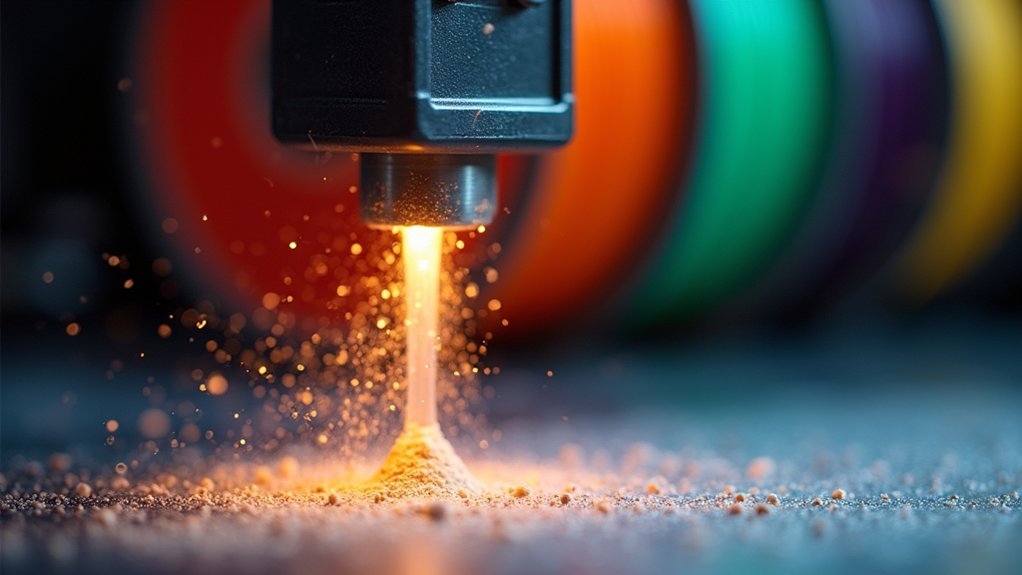
When you heat thermoplastic filaments like ABS and PLA in your 3D printer’s hot end, you’re triggering a complex thermal breakdown process that fractures the material’s molecular structure.
The intense temperatures don’t just melt the plastic—they disrupt chemical bonds within the polymer chains, causing the material to decompose and release volatile fragments into the air.
This degradation process becomes your primary source of ultrafine particles and toxic compounds that can pose serious health risks in your workspace.
Thermal Breakdown Process
During the filament extrusion process, your 3D printer subjects plastic materials to intense heat that triggers thermal breakdown—a chemical degradation process where polymer chains fracture and release harmful ultrafine particles (UFPs) and volatile organic compounds (VOCs) into your workspace air.
This thermal decomposition becomes particularly dangerous when you’re printing with acrylonitrile butadiene styrene (ABS), which releases carcinogenic styrene when heated beyond ideal temperatures.
The emission rates vary dramatically based on your material choices and printing conditions:
- ABS produces 10^7 to 10^12 particles per minute during extrusion
- Higher temperatures intensify breakdown and create more toxic byproducts
- PLA generates considerably fewer emissions than ABS
- Filament additives can release additional toxic particles
- Elevated extrusion temperatures increase both UFP and VOC emissions
Chemical Bond Disruption
While your 3D printer’s heating element transforms solid filament into molten plastic, it simultaneously triggers chemical bond disruption that fractures the molecular structure of your printing materials.
When you set temperatures above thermal stability limits, particularly with ABS filaments, you’re breaking apart polymer chains and creating dangerous byproducts like styrene.
This chemical bond disruption directly produces volatile organic compounds (VOCs) and ultrafine particles (UFPs) that contaminate your workspace air. You’ll notice higher emissions when using elevated temperature settings, as more molecular bonds break under extreme heat.
Filaments containing additives or fillers worsen this process, releasing additional toxic compounds.
The disrupted polymer fragments don’t just create harmful substances—they also increase UFP particle sizes, making them more dangerous when you breathe them.
Temperature Thresholds That Trigger Emissions
When you heat filaments beyond their melting points, you’re crossing critical temperature thresholds that dramatically increase ultrafine particle emissions from your 3D printer.
You’ll notice the most dangerous spikes occur when your bed temperatures exceed 100°C, triggering rapid UFP concentration increases that can compromise your indoor air quality.
These elevated temperatures don’t just melt your filament—they initiate thermal decomposition processes that release volatile organic compounds and other toxic particles into your workspace.
Filament Melting Point Impact
Temperature serves as the primary catalyst for ultrafine particle emissions in 3D printing, with different filament melting points creating distinct threshold effects that directly impact your exposure to toxic substances.
Your choice of printing material dramatically affects UFP production. Here’s what you need to know about emission rates:
- ABS filament melts at 220°C and produces considerably more ultrafine particles (UFPs) than other materials.
- PLA filament operates at 180°C, generating significantly fewer toxic emissions.
- ABS can emit up to 10 times more UFPs than PLA under identical printing conditions.
- Higher bed temperatures amplify particle emissions while improving print adhesion.
- Initial printing phases produce the highest emission peaks, requiring immediate attention.
Understanding these temperature-emission relationships helps you make informed decisions about filament selection and temperature management for safer 3D printing environments.
High Temperature Particle Release
As your 3D printer’s nozzle temperature climbs above 200°C, you’ll witness a dramatic surge in ultrafine particle emissions that transforms your workspace into a potential health hazard.
The correlation between high temperatures and particle release isn’t coincidental—it’s chemistry in action. When you’re printing with ABS filaments at temperatures exceeding 230°C, you’re triggering carcinogenic styrene releases alongside massive UFP emissions reaching up to 10^12 particles per minute.
Even PLA, considered safer than ABS, becomes problematic when you push temperatures above 190°C.
The initial printing phases prove most dangerous, as ultrafine particles spike rapidly during heat-up cycles. You’ll greatly reduce your exposure by maintaining temperatures below 200°C, where UFP emissions drop considerably and create a safer printing environment.
Thermal Decomposition Chemical Dangers
Beyond the sheer volume of particles released, specific temperature thresholds trigger dangerous chemical transformations that you can’t ignore.
When your printer’s extruder exceeds critical temperatures, thermal decomposition creates hazardous compounds that pose serious health risks.
Understanding these temperature dangers helps you make safer printing decisions:
• ABS filament produces carcinogenic styrene when heated above 240°C
- PLA filament releases toxic methyl methacrylate at elevated temperatures
- Higher extrusion temperatures greatly increase UFPs emission rates
- VOCs generation peaks during initial printing phases and stays elevated
- Thermal decomposition creates compounds far more dangerous than the original plastic
- Toxic VOCs: You’re breathing methyl methacrylate and other hazardous compounds during printing.
- Massive UFP concentrations: Your printer generates 10^4 to 10^6 ultrafine particles (UFPs) per cubic centimeter.
- Deceptive safety claims: Despite being plant-based, PLA still produces toxic particles that damage your respiratory system.
- Bacterial contamination: The porous surface of printed objects harbors harmful bacteria, especially problematic for food-contact items.
- Underestimated exposure: Without proper ventilation, you’re accumulating dangerous particle concentrations in your workspace.
- Size range: Most particles fall below 100nm, with many clustering between 10-50 nanometers
- Agglomeration potential: Smaller particles tend to clump together, creating larger, more harmful clusters
- Material dependency: ABS filaments produce substantially higher UFP concentrations than PLA materials
- Temperature correlation: Higher printing temperatures increase both particle count and size variability
- Peak emission timing: Maximum UFP release occurs during print initiation phases
- Well-ventilated areas reduce UFP concentrations by approximately 35%
- Higher air exchange rates directly correlate with lower particle levels
- Ventilation enclosures provide additional protection against emissions
- Peak concentrations occur at startup when ventilation isn’t adequate
- Standardized testing recommends air exchange rates of 4 times your printer’s volume
- Reduce UFP emission rates by approximately 35%
- Prevent rapid UFP dispersion during initial printing phases when concentrations spike
- Maintain effectiveness even with higher bed temperatures that typically increase emissions
- Require proper sealing since gaps considerably compromise containment performance
- Contain emissions at the source rather than allowing environmental spread
- Room size – Smaller spaces trap particles while larger rooms dilute emissions more effectively
- Air exchange rates – Higher ACH values reduce particle buildup in your workspace
- Ventilation quality – Poor airflow exacerbates toxic particle accumulation around your printer
- Sampling distance – Particles agglomerate as they travel, affecting concentration readings
- Filament used – ABS produces more emissions than PLA due to higher processing temperatures
You’ll notice emissions spike immediately when printing begins, then remain elevated for several minutes.
Operating at lower temperatures reduces these toxic releases, making temperature monitoring essential for protecting your health during 3D printing operations.
ABS Filament as a Major Source of UFPs
When you’re operating a 3D printer with ABS filament, you’re releasing one of the most significant sources of toxic ultrafine particles in desktop manufacturing. ABS produces emission rates reaching up to 10^12 ultrafine particles (UFPs) per minute, dramatically exceeding other filament types.
These printing emissions peak during startup, creating hazardous indoor air quality without proper ventilation.
You’ll also encounter dangerous volatile organic compounds (VOCs), particularly styrene, which carries serious health risks including respiratory problems and carcinogenic properties.
ABS consistently generates higher volumes of both UFPs and VOCs compared to alternative filaments, making it the most problematic choice for enclosed spaces.
If you’re printing in libraries or public areas, you’re putting patrons and staff at significant risk without adequate ventilation systems.
PLA Filament Emission Characteristics
While PLA filament enjoys a reputation as the safer alternative to ABS, you’re still exposing yourself to significant health risks that manufacturers often downplay.
PLA emissions create dangerous conditions that you shouldn’t ignore:
Don’t let PLA’s “eco-friendly” marketing fool you into thinking it’s harmless.
Volatile Organic Compounds Released During Printing
The toxic ultrafine particles from PLA printing represent just one piece of a larger contamination puzzle.
When you operate your 3D printer, it releases volatile organic compounds (VOCs) that pose significant health risks. The primary VOC emitted includes styrene, caprolactam, and lactide, classified as toxic air pollutants by the US EPA.
Emission rates vary dramatically based on your filament choice. ABS and PLA filaments produce different contamination levels, with ABS generating higher VOC concentrations.
You’ll encounter caprolactam emissions ranging from 2 to 180 μg/min and styrene from 10 to 110 μg/min.
Without proper ventilation, you’re exposing yourself to serious health effects including headaches, respiratory problems, and potential long-term complications from prolonged exposure to these toxic compounds.
Particle Size Distribution and Health Implications
When you operate a 3D printer, you’re exposed to ultrafine particles smaller than 100 nanometers that can penetrate deep into your lungs and enter your bloodstream.
These nanoparticles pose significant health risks because their tiny size allows them to bypass your body’s natural filtering mechanisms and reach crucial organs.
You’ll face the highest exposure during the initial printing phase when particle concentrations spike dramatically, making proper ventilation and monitoring essential for your safety.
Nanoparticle Size Characteristics
As 3D printers operate, they release ultrafine particles (UFPs) measuring less than 100 nanometers in diameter—a size that makes them particularly dangerous to your health.
These nanoparticles exhibit characteristics that greatly impact their behavior and toxicity levels.
The emission rates of UFPs vary dramatically based on several critical factors:
Understanding these nanoparticle characteristics helps you recognize the serious health implications of prolonged 3D printing exposure.
Health Risk Factors
Ultrafine particles from 3D printers pose considerable health threats because their microscopic size allows them to bypass your body’s natural defense mechanisms.
These UFPs penetrate deep into your lungs and enter your bloodstream, creating serious health risks including respiratory problems and cardiovascular diseases. Your exposure depends heavily on filament choice—ABS emissions produce dangerously high UFP concentrations reaching up to 10^6 particles/cm³, while PLA generates considerably lower levels.
Children face heightened vulnerability to these toxic particles. The smallest particles carry the greatest toxicity potential, and since most 3D printer emissions consist of UFPs under 100 nanometers, you’re exposed to the most harmful size range.
Peak emissions occur when printing begins, maximizing your initial exposure risk.
Ventilation Impact on Emission Concentrations
Proper ventilation dramatically reduces the concentration of toxic ultrafine particles your 3D printer releases into the air.
Without adequate airflow, UFPs accumulate quickly and remain elevated for 10-20 minutes after printing begins. Your indoor air quality depends on implementing effective ventilation strategies during 3D printing operations.
Here’s how ventilation impacts emission rates:
You’ll face long-term health risks from unfiltered UFP exposure, making proper ventilation essential for safe 3D printing environments.
Printer Age and Emission Level Correlations
While newer 3D printers incorporate advanced emission control technologies, older models release considerably higher levels of ultrafine particles and volatile organic compounds into your workspace.
Studies reveal that older printers generate markedly elevated UFP emissions compared to their modern counterparts, creating potential health risks in poorly ventilated areas. The correlation between printer age and emission levels means you’ll face higher exposure to harmful substances when operating outdated equipment.
Additionally, the filament used in conjunction with older machines compounds this problem, as these printers often lack quality control features that regulate material heating.
Libraries and institutions should prioritize upgrading aging 3D printers to reduce VOCs and protect users from toxic particle exposure.
Enclosure Effects on Particle Dispersion
Beyond upgrading to newer equipment, you can greatly reduce your exposure to harmful emissions by installing proper enclosures around your 3D printer.
These protective barriers effectively contain UFPs during the printing process, preventing rapid dispersion into your workspace environment.
Research demonstrates enclosures’ considerable impact on particle containment:
However, enclosures’ effectiveness depends heavily on proper installation.
Any gaps or openings can dramatically reduce their ability to contain harmful particles, potentially leaving you still exposed to dangerous UFPs.
Chemical Composition of Released Particles
Understanding what your 3D printer releases into the air requires examining the specific chemicals that different filaments produce during heating.
Different 3D printer filaments release distinct chemical emissions when heated, making material selection crucial for air quality management.
When you’re using ABS filaments, you’ll encounter markedly higher UFP concentrations and dangerous VOCs like styrene, a known carcinogen. ABS emission rates typically range from 10 to 110 μg/min, including toxic caprolactam releases.
If you’re printing with PLA, you’ll face lower overall emissions but still encounter hazardous methyl methacrylate. The heating process transforms these plastic materials into airborne particles that penetrate deep into your respiratory system.
Your printer’s age also matters—older models release considerably more UFPs and VOCs than newer units with improved emission control technologies.
Environmental Factors Affecting Emission Rates
When you’re operating your 3D printer, several environmental conditions greatly influence how many toxic particles escape into your breathing space. The emission rates of ultrafine particles (UFPs) vary considerably based on your setup and surroundings.
Key environmental factors that affect UFP concentrations include:
Your printer’s immediate environment determines whether you’ll breathe concentrated toxic particles or safely diluted air.
Frequently Asked Questions
Does 3D Printing Release Toxins?
Yes, you’ll be exposed to toxic ultrafine particles and volatile organic compounds when 3D printing. ABS releases carcinogenic styrene, while PLA emits hazardous methyl methacrylate, requiring proper ventilation for safety.
Is It Bad to Sleep in a Room With a 3D Printer?
You shouldn’t sleep in a room with a 3D printer because it emits harmful ultrafine particles and volatile compounds that can cause respiratory and cardiovascular problems, especially in poorly ventilated spaces.
Do 3D Printers Release VOC?
Yes, your 3D printer releases VOCs like styrene and caprolactam during operation. You’ll experience higher emissions with ABS filaments compared to PLA. These volatile compounds can cause headaches and health issues without proper ventilation.
Is 3D Printing Bad for Your Lungs?
3D printing can harm your lungs by releasing ultrafine particles and toxic compounds. You’ll face increased risks of respiratory issues, especially with poor ventilation. Use proper airflow to protect yourself.

Leave a Reply