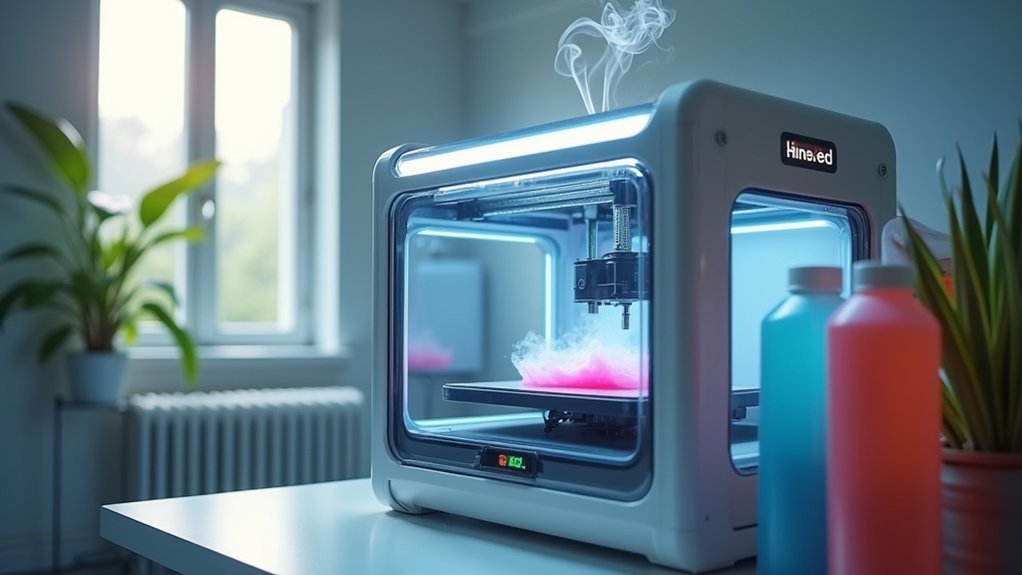
Resin printing releases volatile organic compounds and ultrafine particles that can cause immediate respiratory irritation and long-term health complications. You’re at risk of skin burns, allergic reactions, and exposure to possible carcinogens like styrene vapors without proper ventilation. These toxic fumes accumulate over time during extended printing sessions, making effective air filtration essential for your safety. Proper ventilation systems with activated carbon filters capture harmful emissions before they reach dangerous levels, protecting your respiratory health and workspace environment.
Understanding the Health Risks of Resin Fumes
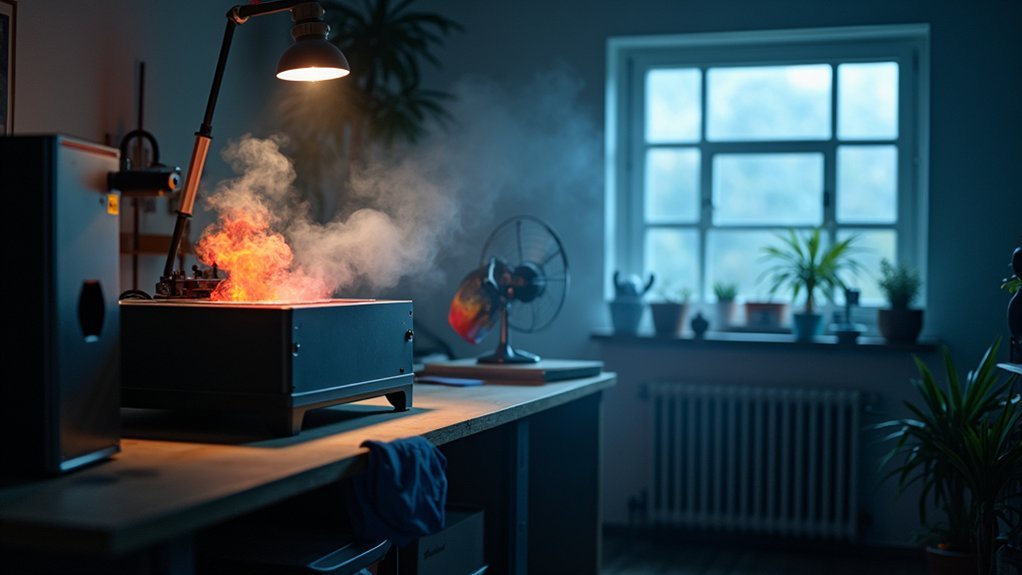
While you mightn’t always detect a strong odor during resin printing, your 3D printer is likely releasing volatile organic compounds (VOCs) and ultrafine particles that can seriously impact your health.
These resin fumes can cause immediate respiratory irritation and contribute to long-term health complications with repeated exposure. You’re also at risk for skin irritation, chemical burns, and allergic reactions when these emissions come into contact with your body.
Resin fumes pose immediate respiratory risks and long-term health complications, plus potential skin burns and allergic reactions from direct contact.
What makes this particularly concerning is that even low levels of resin fumes accumulate over time, creating significant health risks you mightn’t notice initially.
This invisible threat makes proper ventilation absolutely essential, especially during extended printing sessions when prolonged exposure amplifies these dangers for both you and anyone nearby.
Types of Harmful Emissions From Resin Printing
Resin printing releases several categories of harmful emissions that pose distinct health risks to anyone in the vicinity.
You’ll encounter volatile organic compounds (VOCs) that evaporate from liquid resins during printing and curing processes. These VOCs penetrate your respiratory system and can absorb through your skin, creating multiple exposure pathways.
Ultrafine particles (UFPs) represent another dangerous emission type. These microscopic particles easily bypass your body’s natural filtration systems, reaching deep into your lungs.
You’re also exposed to styrene vapors, a possible carcinogen that causes respiratory irritation and neurological symptoms.
During curing, additional irritants contaminate your indoor air quality.
Without proper ventilation and safety measures, these combined emissions create a toxic environment that threatens your immediate comfort and long-term health.
How Ventilation Systems Protect Your Respiratory Health
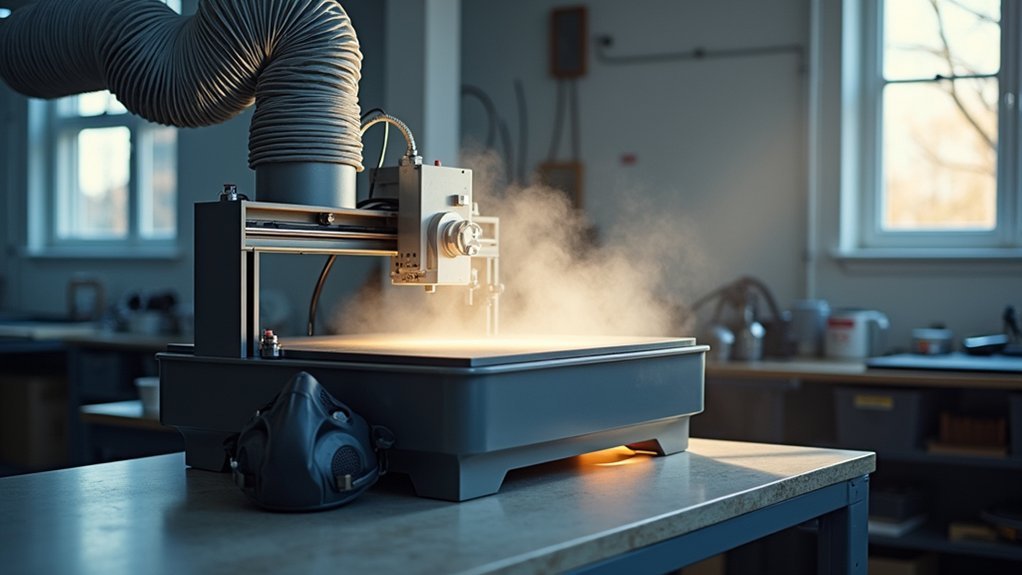
Proper ventilation systems protect your respiratory health by filtering out toxic fumes before they reach dangerous concentrations in your workspace.
You’ll want to monitor air quality continuously to guarantee your ventilation effectively removes harmful particles and maintains safe breathing conditions.
Additionally, you should consider using respiratory protection equipment as a backup safety measure, especially when working with particularly toxic resin formulations or in spaces with limited airflow.
Toxic Fume Filtration
When you operate a resin 3D printer, toxic fumes containing volatile organic compounds (VOCs) and ultrafine particles escape into your workspace, creating immediate health risks that range from headaches and respiratory irritation to more serious long-term complications.
Proper ventilation systems equipped with specialized filtration capture these dangerous emissions before they accumulate in your breathing space. Activated carbon filters work alongside exhaust fans to absorb harmful odors and particulates, greatly improving your air quality.
| Filter Type | Primary Function | Health Protection |
|---|---|---|
| Activated Carbon | Absorbs VOCs and odors | Prevents respiratory irritation |
| HEPA Filters | Captures ultrafine particles | Reduces particle inhalation |
| Combination Systems | Multi-stage filtration | thorough fume removal |
Regular air quality monitoring guarantees your filtration system effectively removes hazardous substances, maintaining a safer printing environment.
Air Quality Monitoring
Effective air quality monitoring transforms your resin printing workspace from a potentially hazardous environment into a controlled, safe zone where you can operate with confidence.
This proactive approach lets you detect dangerous pollutant levels before they compromise your health, enabling immediate corrective action when needed.
Air quality monitoring provides essential protection through:
- Real-time detection of volatile organic compounds (VOCs) and ultrafine particles
- Early warning systems that alert you to hazardous concentration levels
- Data tracking to identify patterns and enhance ventilation timing
- Compliance verification ensuring your safety measures meet health standards
You’ll gain peace of mind knowing exactly when pollutant levels spike, allowing you to adjust ventilation or pause printing sessions.
This systematic monitoring approach prevents cumulative exposure risks while maintaining ideal workspace conditions.
Respiratory Protection Equipment
Although ventilation systems form your primary defense against resin printing hazards, respiratory protection equipment serves as your critical backup safeguard when airborne contaminants persist.
You’ll need masks or respirators specifically designed to filter volatile organic compounds (VOCs) and ultrafine particles that ventilation alone mightn’t eliminate completely.
Choose respirators with activated carbon filters, as they’re most effective against chemical vapors from resin materials. N95 masks won’t protect you from VOCs, so invest in proper chemical-resistant equipment.
You should wear respiratory protection equipment every time you’re near your printer, especially during post-processing tasks like washing and curing.
This dual-layer approach—combining effective ventilation with quality respiratory gear—creates thorough protection that safeguards your long-term respiratory health during resin printing operations.
Setting Up Effective Air Filtration for Resin Workspaces
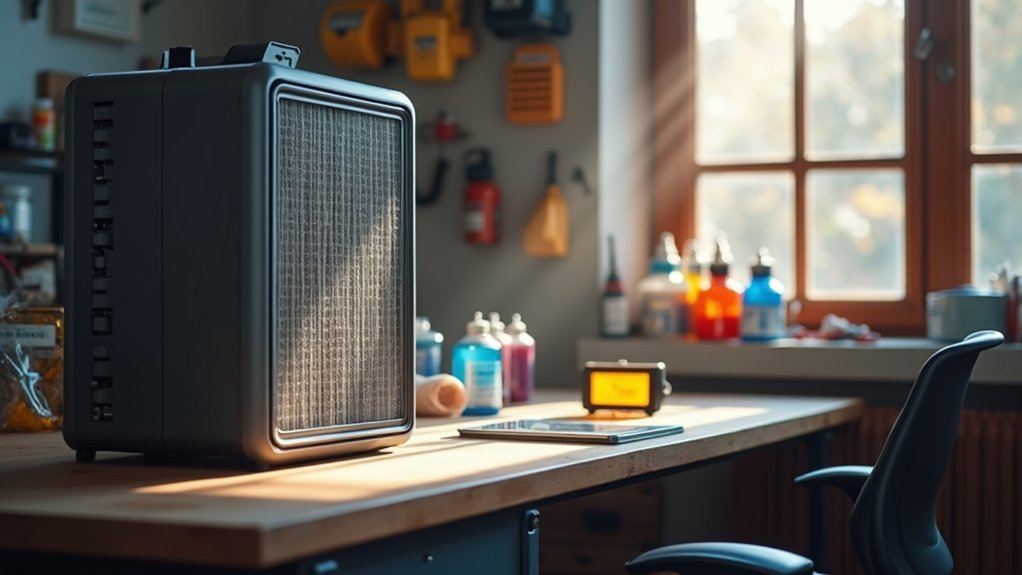
You’ll need to select high-quality carbon filters that effectively absorb VOCs and toxic fumes before they escape your workspace.
Your airflow system must create consistent circulation patterns that capture emissions at their source and move them through filtration components.
Installing the right combination of inline fans, exhaust vents, and air purifiers guarantees your filtration setup protects your health during extended printing sessions.
Carbon Filter Selection
When setting up air filtration for your resin workspace, choosing the right carbon filter becomes essential for capturing volatile organic compounds and eliminating the strong odors that resin printing produces.
Activated carbon filters remain the most effective solution for absorbing these harmful emissions.
To optimize your carbon filter selection:
- Match filter size to your ducting system – Guarantee compatibility with your ventilation setup to maintain proper airflow and filtration efficiency.
- Position filters before exhaust points – Place them strategically within your ventilation system to maximize capture effectiveness.
- Replace filters every 3-6 months – Saturated filters lose effectiveness and require regular replacement based on usage levels.
- Consider refillable options – These reduce waste and costs since you’ll replenish activated carbon media instead of discarding entire units.
Airflow System Design
Since proper airflow design forms the foundation of any effective resin workspace ventilation system, you’ll need to create a strategic layout that captures fumes at their source and directs them safely away from your breathing zone.
Your airflow system should incorporate HEPA filters to capture ultrafine particles and volatile organic compounds (VOCs) released during printing.
Install inline fans with adjustable speed settings to enhance circulation and guarantee harmful fumes are vented outside or filtered before recirculation.
Position your printer near windows or use ducting connected to external venting systems for immediate fume escape.
Install air quality monitors to track pollutant levels in real-time, allowing you to adjust ventilation as needed.
Regular maintenance, including carbon filter replacement and ductwork cleaning, guarantees peak performance.
Ventilation Equipment Installation
Installing the right ventilation equipment transforms your resin printing workspace from a potentially hazardous environment into a safe, breathable area.
You’ll need specific components to create an effective air purifier system that removes toxic fumes and maintains healthy air quality.
Follow these essential installation steps:
- Mount inline fans like the AC Infinity CLOUDLINE T4 for adjustable speed control and efficient airflow management.
- Install activated carbon filters to absorb odors and harmful chemical vapors from your workspace.
- Connect flexible aluminum ducting for easy adjustments and ideal positioning throughout your setup.
- Position equipment near windows or existing ventilation points to enhance direct fume dispersal outside.
Remember to regularly monitor and replace filter components to maintain peak ventilation equipment performance.
Choosing the Right Exhaust Fan for Your Printing Area
Although proper ventilation equipment forms the backbone of any safe resin printing setup, you’ll need to select an exhaust fan that can handle the unique challenges of dispersing chemical vapors effectively.
Consider models like the AC Infinity CLOUDLINE T4, which features adjustable speed control for ideal airflow management. You’ll want a minimum 200 CFM rating for larger spaces to guarantee adequate ventilation throughout your printing area.
Choose fans specifically designed for high humidity and chemical environments, as they’ll resist corrosion from resin vapors better than standard models.
Confirm your selected fan works with ducting systems like flexible aluminum ducting for easy installation.
Don’t overlook noise levels – brushless EC motors operate quietly while maintaining excellent performance for your workspace.
Installing Proper Ducting and Window Ventilation
You’ll need specific components to create an effective ducting system that channels harmful resin fumes safely outside your workspace.
The setup requires flexible aluminum ducting, secure metal fasteners, and a properly fitted window adapter to guarantee airtight connections throughout the exhaust path.
Installing these components correctly transforms your basic exhaust fan into a complete ventilation system that actively removes toxic vapors from your printing area.
Ducting Setup Components
When setting up proper ducting for your resin printer, flexible aluminum ducting serves as the backbone of your ventilation system, connecting your printer’s exhaust directly to the outside air.
This configuration helps reduce exposure to harmful fumes while maintaining effective airflow throughout your workspace.
Essential components for your ducting setup include:
- Duct expander and AC window adapter – These facilitate seamless venting through windows while maintaining proper seal integrity.
- Metal fasteners or 4-inch hose clamps – Secure all connections to create airtight seals and prevent dangerous leaks.
- Direct pathway positioning – Arrange ducting for the shortest, most efficient route to maximize fume removal effectiveness.
- Regular maintenance schedule – Inspect and clean ducting frequently to prevent blockages that compromise air quality.
Window Adapter Installation
Proper window adapter installation creates the critical bridge between your ducting system and the outside air, guaranteeing toxic resin fumes don’t circulate back into your workspace.
Start by measuring your window opening accurately, then select an AC window adapter that fits securely. Connect flexible aluminum ducting from your exhaust fan to the adapter using metal fasteners to prevent leaks that could compromise ventilation efficiency.
Seal any gaps around the adapter’s edges with weather stripping to create an airtight barrier. If you’re running multiple fans, incorporate a duct expander to enhance airflow throughout your printing space.
Regularly inspect all connections for wear or blockages that could reduce performance. A properly installed window adapter guarantees consistent fume removal, maintaining safe air quality while you print.
Using Grow Tents for Contained Resin Printing Environments
While traditional ventilation methods can struggle with resin printing fumes, grow tents offer a superior solution by creating a controlled environment that effectively contains harmful emissions.
The AC Infinity CLOUD LAB 422 Grow Tent provides sturdy construction and efficient air circulation management for your resin printing workspace.
Setting up your grow tent for ideal ventilation involves:
- Install inline fans and ducting to maintain continuous air exchange during lengthy print jobs.
- Leave the tent partially unzipped to enhance airflow while keeping fumes contained.
- Add carbon filters to absorb odors and improve overall air quality.
- Position exhaust ports strategically to direct toxic emissions away from your workspace.
This contained approach reduces fume concentration and creates a healthier environment for your projects.
Carbon Filters and Their Role in Air Purification
Carbon filters serve as your primary defense against the volatile organic compounds and toxic fumes that resin printers release during operation. These filters utilize activated carbon’s high surface area to capture harmful particles and odors, creating a safer printing environment. However, you shouldn’t rely solely on a carbon filter—proper ventilation remains essential since filters can’t eliminate all airborne contaminants.
| Filter Condition | Health Risk | Action Needed |
|---|---|---|
| New/Fresh | Low | Monitor usage |
| Partially Used | Moderate | Plan replacement |
| Saturated | High | Replace immediately |
| Overdue | Very High | Stop printing |
| Missing | Extreme | Install before use |
Regular replacement is vital as effectiveness diminishes when filters become saturated. Combining your carbon filter with proper ventilation maximizes protection against volatile organic compounds (VOCs).
Monitoring Air Quality During Printing Sessions
Beyond installing carbon filters and ventilation systems, you need real-time data to verify your safety measures are working effectively.
Air quality monitors detect harmful volatile organic compounds and ultrafine particles that resin printers release. You’ll want to establish baseline measurements before printing begins, then continuously track air quality throughout extended sessions.
Here’s your monitoring protocol:
- Check safety data sheets for your specific resin to understand expected emissions and safe thresholds.
- Monitor before, during, and after each printing session to track pollutant levels.
- Focus on prolonged sessions when exposure to resin fumes accumulates most dangerously.
- Adjust ventilation immediately when air quality indicators exceed safe limits.
This proactive approach guarantees your workspace remains safe for everyone present.
Temperature Control While Maintaining Airflow
Although effective ventilation protects you from harmful fumes, it can drop your workspace temperature below the ideal range needed for quality resin prints.
You’ll need to maintain temperatures between 70°F and 80°F while ensuring proper airflow continues removing toxic vapors.
Consider using heated vat chambers or fermentation belts to warm your resin directly without compromising ventilation effectiveness.
Personal space heaters work well for ambient temperature control, but you should monitor them carefully with thermostat controllers that automatically shut off at 86°F to prevent overheating.
Adjust your fan speeds based on current conditions—slower speeds during colder periods help retain heat while maintaining adequate air circulation.
Leave ventilation setups partially open to balance temperature control with fume dispersal, ensuring both print quality and your safety.
Ventilation Solutions for Windowless Spaces
When you’re working in a basement, interior room, or other windowless space, you’ll need to create an artificial pathway for toxic fumes to escape your workspace. Effective ventilation solutions require strategic planning and proper equipment installation.
Here are four essential components for windowless resin printing ventilation:
- Inline fan with flexible aluminum ducting – Creates powerful airflow to direct fumes outside through walls or ceilings.
- Activated carbon filter integration – Absorbs harmful particles and odors before air exits your space.
- Grow tent setup positioned sideways – Establishes controlled environment with enhanced fume dispersal when combined with inline fans.
- Y connectors and blast gates – Enable strategic airflow direction and multiple venting options.
Install air quality monitors to assess your ventilation system’s effectiveness and guarantee ideal safety levels.
Essential Personal Protective Equipment for Respiratory Safety
While proper ventilation forms your first line of defense against resin printing hazards, you’ll need additional respiratory protection to safeguard your lungs from toxic fumes that ventilation systems can’t completely eliminate.
A properly fitted respirator with organic vapor cartridges is essential for respiratory safety, as it filters out volatile organic compounds and other toxic substances that N95 masks can’t handle. N95 respirators only protect against particulates, making them insufficient for resin printing’s hazardous vapors.
Replace respirator filters regularly since saturated filters lose effectiveness and increase health risks.
Always combine respiratory protection with thorough protective gear including nitrile gloves and safety goggles.
Monitor air quality in your printing area to assess your respiratory protection’s effectiveness and determine if additional ventilation solutions are needed.
Maintaining and Upgrading Your Ventilation System
Your ventilation system’s effectiveness depends on consistent maintenance and strategic upgrades to handle resin printing’s unique challenges.
You’ll need to establish a routine for replacing filters, testing system performance, and evaluating when equipment upgrades become necessary.
These proactive steps guarantee your ventilation system continues protecting you from harmful fumes and particles as your printing needs evolve.
Regular Filter Replacement
Three critical factors determine your ventilation system’s ability to protect you from harmful resin fumes: filter quality, replacement timing, and maintenance consistency.
Regular filter replacement is your most powerful defense against compromised air quality that can reduce risks to your health.
Carbon filters lose effectiveness as they become saturated with captured particulates and fumes.
Here’s your essential maintenance schedule:
- Check filters every 3 months for visible contamination or decreased airflow
- Replace immediately when you notice increased odors in your workspace
- Mark calendar reminders to prevent overlooking replacement schedules
- Upgrade to multi-stage filtration for enhanced fume capture efficiency
Saturated filters create airflow restrictions and allow harmful substances to escape into your breathing space, compromising your safety.
System Performance Testing
Performance testing transforms guesswork into measurable safety data that protects your health during resin printing operations.
You’ll need an anemometer to measure airflow speed and volume, ensuring your ventilation system meets safety standards for removing volatile organic compounds (VOCs) from your workspace.
Check ducting connections regularly for leaks or blockages that compromise performance and allow toxic buildup.
Inspect carbon filter condition frequently—saturated filters drastically reduce fume removal effectiveness and must be replaced promptly.
Consider upgrading to high-performance inline fans or adding supplemental air purification systems when testing reveals inadequate performance.
These improvements enhance ventilation efficiency during extended printing sessions, providing better protection against harmful resin vapors that can accumulate in poorly ventilated spaces.
Equipment Upgrade Options
When standard ventilation systems fall short of safety requirements, strategic equipment upgrades can dramatically improve your workspace protection.
Enhancing your ventilation system with professional-grade components guarantees thorough safety practices that protect against harmful resin fumes and vapors.
Consider these essential upgrade options:
- AC Infinity CLOUDLINE T4 inline fan – Provides adjustable speed settings and superior airflow control for ideal fume extraction efficiency during printing operations.
- High-quality activated carbon filters – Effectively absorb odors and harmful particles before venting, creating a safer printing environment through enhanced filtration.
- Flexible aluminum ducting – Enables easy adjustments and improved airflow management, especially in confined or challenging workspace configurations.
- Explosion-proof industrial fans – Offer additional safety protection against flammable vapors from isopropyl alcohol and resin materials.
Creating Safe Resin Printing Protocols for Long-Term Health
Although resin printing offers remarkable detail and precision, you’ll need thorough safety protocols to protect your health during extended exposure to potentially harmful chemicals. Establishing complete ventilation alongside proper safety gear creates the foundation for long-term printing safety.
| Safety Component | Implementation | Benefit |
|---|---|---|
| Ventilation System | Install exhaust fans with carbon filters | Removes VOCs and particulates |
| Air Quality Monitoring | Use digital sensors for real-time tracking | Detects toxic buildup promptly |
| Personal Protective Equipment | Wear respirators and chemical-resistant gloves | Minimizes direct chemical exposure |
You’ll want to monitor air quality regularly while maintaining clean workspace protocols. Proper disposal methods for uncured resin prevent contamination buildup. Combining effective ventilation with complete safety gear ensures you can enjoy resin printing without compromising your respiratory health over time.
Frequently Asked Questions
How Important Is Ventilation for Resin Printing?
You’ll face serious health risks without proper ventilation during resin printing. Toxic fumes and VOCs require continuous air circulation and direct outside exhaust, not just carbon filters, for safe operation.
How Toxic Are Resin Printer Fumes?
Resin printer fumes contain VOCs and ultrafine particles that’ll irritate your skin and respiratory system. You’re risking allergies, sensitivities, and cumulative health effects from prolonged exposure to these toxic vapors.
Do You Need Ventilation to Work With Resin?
You absolutely need ventilation when working with resin. Without proper airflow, you’ll inhale toxic fumes that cause respiratory problems, headaches, and skin irritation. Use exhaust fans or air purifiers for safety.
Is It Safe to Resin Print Indoors?
You can safely resin print indoors if you’ve got proper ventilation. Install exhaust fans, use air purifiers, and guarantee continuous airflow. Don’t rely on odor alone—harmful fumes can be odorless.


Leave a Reply