

You’ll calculate resin 3D printer costs by adding material expenses ($30-$250 per liter), equipment depreciation (printer cost divided by lifespan hours), electricity consumption (100-300W multiplied by print time and local rates), and labor time for setup and post-processing. Don’t forget maintenance costs like FEP film replacements ($20-$50) and screen replacements ($200-$500 every 2-3 years). Factor in hidden expenses such as cleaning fluids, washing, and curing equipment to guarantee accurate budgeting that captures the complete financial picture.
Understanding Resin Material Costs and Consumption Rates
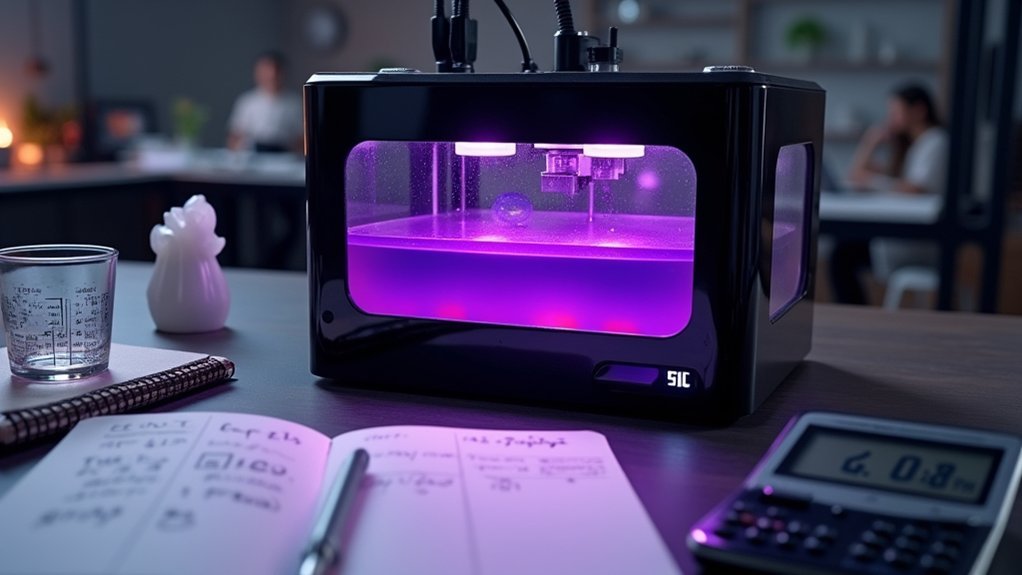
One of the most essential factors affecting your 3D printing budget is the cost of resin itself, which varies dramatically from $30 to $250 per liter depending on the material type and quality you choose.
Understanding consumption rates helps you calculate material cost accurately. Typically, one liter covers approximately 1,000 grams of print weight, though complex designs affect this ratio.
Your slicing software provides estimated weight in milliliters, which you’ll convert to grams using resin density for accurate cost calculations.
Remember that the printing process consumes additional material through support structures and waste.
For efficient use of resin, consider hollowing models or adjusting infill settings to considerably reduce consumption without compromising print quality.
Calculating Equipment Depreciation and Ownership Expenses
Beyond material costs, you’ll need to factor equipment depreciation into your per-print calculations to understand the true cost of ownership.
Calculate depreciation by dividing your printer’s initial purchase price by its estimated printer lifespan in hours. For example, a $2,500 printer with 1,500 operating hours equals $1.67 per hour depreciation.
Don’t overlook maintenance costs in your ownership expenses. Resin printers require screen replacements every 2-3 years, costing $200-$500.
Additional costs include periodic repairs, which you should estimate as a percentage of your initial purchase price.
Track your usage hours systematically and estimate maintenance intervals to develop a thorough cost analysis.
This approach guarantees you’re accounting for all ownership expenses, giving you accurate per-print costs for better business decisions.
Electricity Consumption and Power Costs
After accounting for depreciation and maintenance expenses, electricity costs represent another ongoing expense that impacts your printing budget. You’ll need to factor printer power consumption into your print cost calculator alongside material costs and labor costs to determine the final cost.
Most resin printers consume 100W to 300W during operation. Calculate your electricity costs by multiplying power consumption (in kW) by printing time (in hours) and your local electricity rate.
| Printer Power | 5-Hour Print | Electricity Cost |
|---|---|---|
| 100W | 0.5 kWh | $0.05-$0.15 |
| 200W | 1.0 kWh | $0.10-$0.30 |
| 300W | 1.5 kWh | $0.15-$0.45 |
Don’t forget idle power consumption during setup and post-processing, which adds to your total electricity costs.
Labor Time and Associated Wage Expenses
While electricity costs are relatively predictable, labor expenses often represent the largest variable cost in resin 3D printing projects.
You’ll need to account for setup time, which typically ranges from 0.1 to 0.2 hours per print job. If you encounter bed adhesion issues or require nozzle changes, expect an additional 15-30 minutes for recalibration.
Your labor cost calculations should include the entire workflow. Post-processing requires considerable time for washing and curing prints, often necessitating automated processes to minimize manual intervention.
Post-processing automation becomes essential when washing and curing steps consume significant portions of your project timeline.
You’ll also spend time monitoring during printing and making design adjustments.
For accurate expenses tracking, multiply your total operating time by your hourly wage rate. Remember that wage rates vary considerably based on your location and skill level, directly impacting your overall project costs.
Maintenance and Replacement Part Costs
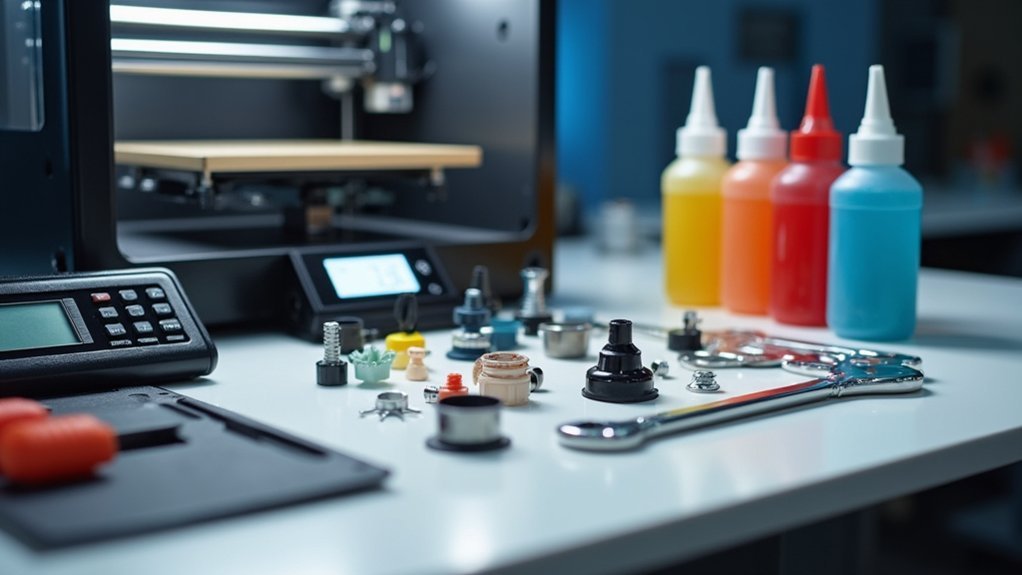
Labor costs represent just one component of your overall expenses, as ongoing maintenance and replacement parts add another significant layer to your 3D printing budget. You’ll need to factor in maintenance costs that directly impact your printer lifespan and operational efficiency.
| Component | Cost Range |
|---|---|
| Screen replacement (2-3 years) | $200-$500 |
| FEP film | $20-$50 |
| Cleaning supplies | Variable |
| Routine calibration | Time investment |
| Annual maintenance cost | 10-20% of purchase price |
Regular wear and tear affects replacement components like FEP film and screens. You should budget appropriately for cleaning supplies and calibration procedures. Proper maintenance extends your equipment’s 1500-hour average lifespan, making your annual maintenance cost investment worthwhile for long-term savings.
Post-Processing Materials and Equipment Expenses
You’ll need to factor in ongoing expenses for cleaning solutions and curing equipment when calculating your resin printing costs.
Isopropyl alcohol for washing prints typically runs $30 to $150 per gallon, while UV curing stations range from $50 to $500 depending on features and quality.
Don’t forget to include smaller items like support removal tools and safety gloves, which can add another $10 to $50 to your setup costs.
Cleaning Solution Costs
After your resin prints finish curing, you’ll need specialized cleaning solutions to remove uncured resin and achieve professional-quality results.
Cleaning solution costs for resin 3D printing typically range from $30 to $100 per liter, depending on the brand and type you choose. Isopropyl alcohol (IPA) offers a cost-effective alternative, priced between $20 and $50 per gallon.
You’ll want to contemplate ultrasonic cleaners for efficient post-processing, which cost $50 to $300 based on size and features. Larger, complex prints require more solution for thorough cleaning.
Don’t forget additional equipment expenses like gloves, brushes, and containers, which add $20 to $100 to your overall cleaning costs. Factor these recurring expenses into your total operational budget.
Curing Equipment Expenses
Once your prints are cleaned, curing equipment becomes essential for achieving ideal strength and durability in your finished models.
You’ll need UV light sources or curing chambers, with basic units starting at $50 and professional setups exceeding $1,000. These post-processing costs extend beyond initial equipment purchases.
You’ll spend additional expenses on disposable gloves and paper towels, adding $5-$15 per print job.
The curing process takes 30 minutes to several hours after cleaning prints, creating labor costs if you’re outsourcing work.
Don’t forget maintenance costs – replacing UV bulbs runs $20-$100 every few years depending on usage and equipment quality.
Factor in electricity consumption and workspace requirements when calculating your total curing equipment investment for accurate post-processing cost projections.
Setup Time and Slicer Configuration Costs
When calculating your resin 3D printing costs, you’ll need to account for the time spent setting up your printer and configuring slicer settings.
Your printer setup typically takes 0.1 to 0.2 hours, but complex jobs requiring bed leveling or nozzle changes can add another 15-30 minutes.
You’ll also spend 0.25 to 1 hour customizing slicer settings for ideal support placement and material efficiency, and this time should be factored into your labor rate calculations.
Printer Setup Duration
Three critical time investments shape your resin printer’s setup costs: initial machine preparation, slicer configuration, and calibration requirements.
Your printer setup duration typically ranges from 0.1 to 0.2 hours for basic preparation. However, nozzle changes can extend this by 15-30 minutes due to recalibration needs.
Slicer settings customization demands 0.25 to 1 hour, depending on your model’s complexity and required adjustments. Don’t underestimate this investment—efficient slicer configuration dramatically reduces printing costs by optimizing print time and material usage.
Remember that resin 3D printers require additional post-curing processes that impact your overall project timeline.
When calculating your total cost calculation, factor in these setup time variables alongside your standard printing costs for accurate project budgeting.
Slicer Customization Time
Your slicer customization represents the most variable component of setup costs, demanding anywhere from 0.25 to 1 hour depending on your print’s complexity and material requirements. Different printing materials require specific temperature and speed adjustments, while support placement can consume significant time during configuration.
| Customization Level | Time Required | Cost Impact |
|---|---|---|
| Basic filament settings | 15-20 minutes | Low |
| Support optimization | 30-45 minutes | Medium |
| Complex geometries | 45-60 minutes | High |
| Vase mode/hollowing | 20-30 minutes | Medium |
| Pre-optimized profiles | 0-5 minutes | Minimal |
Manual bed leveling adds another 15-30 minutes to your printer costs calculation. When using printing cost calculators, factor this slicer customization time into your material used calculations, as proper settings directly affect your printed object’s success rate and overall expenses.
Labor Rate Calculations
Since labor costs often represent the largest expense component outside materials, you’ll need precise calculations for setup time and slicer configuration to determine your project’s true cost.
Your hourly rate depends on local wages and skill level, typically ranging from $15-40 per hour for 3D printing operations.
Calculate setup time by adding printer preparation (0.1-0.2 hours for ready machines) plus any manual adjustments like bed leveling (15-30 minutes extra).
Include slicer configuration time, which varies from 0.25-1 hour based on complexity.
Don’t forget post-processing labor, as support removal and finishing can add several hours to printing jobs.
Multiply total labor hours by your hourly rate for accurate calculations.
This thorough approach guarantees cost estimation reflects true project expenses.
Hidden Operating Expenses and Additional Fees
While the initial purchase price of a resin 3D printer might seem straightforward, you’ll encounter numerous hidden operating expenses that can greatly inflate your total cost of ownership.
You’ll need to replace printer screens every 2-3 years at $200-$500 each, considerably impacting your budget. Electricity costs accumulate rapidly, especially with continuous operation in printer farms.
Post-processing costs for washing and curing add substantial labor expenses, even with automated systems requiring upfront investment.
Don’t overlook ongoing expenses for consumables like cleaning fluids and maintenance tools. Design adjustments may demand additional labor or software investments to guarantee printability.
These hidden costs often exceed initial calculations, making thorough planning essential for accurate cost assessment.
Frequently Asked Questions
How Do You Calculate Resin Prices?
You’ll calculate resin prices by determining your model’s volume in milliliters, then multiplying by the resin cost per liter. Don’t forget to add 10-20% extra for waste and supports.
How to Calculate 3D Printing Cost?
You’ll calculate 3D printing costs by adding material expenses, equipment depreciation, labor time, and electricity usage. Multiply resin volume by price per liter, then include setup, printing, and post-processing time costs.
How to Know How Much Resin to Use a 3D Printer?
Use slicing software to determine your 3D model’s volume in milliliters. Add 10-20% extra for supports and over-extrusion. Consider that typical resin density equals approximately 1,100 grams per liter.
How Do You Calculate Cost per Print?
Calculate your print’s cost by adding resin weight times cost per gram, printer depreciation per hour, electricity consumption, and labor time. Multiply each factor by duration, then sum all components for total expense.



Leave a Reply