When choosing between rectilinear and lines infill, you’ll need to balance your priorities. Select rectilinear if you’re printing functional parts that need structural strength, as its crisscross grid pattern provides superior load-bearing capacity and layer adhesion. Choose lines infill when you’re prioritizing speed and material efficiency for prototypes or decorative items, since it prints 15-25% faster and uses 10-20% less filament. Consider your project’s specific requirements to discover which pattern truly matches your goals.
Understanding Rectilinear Infill Pattern Properties
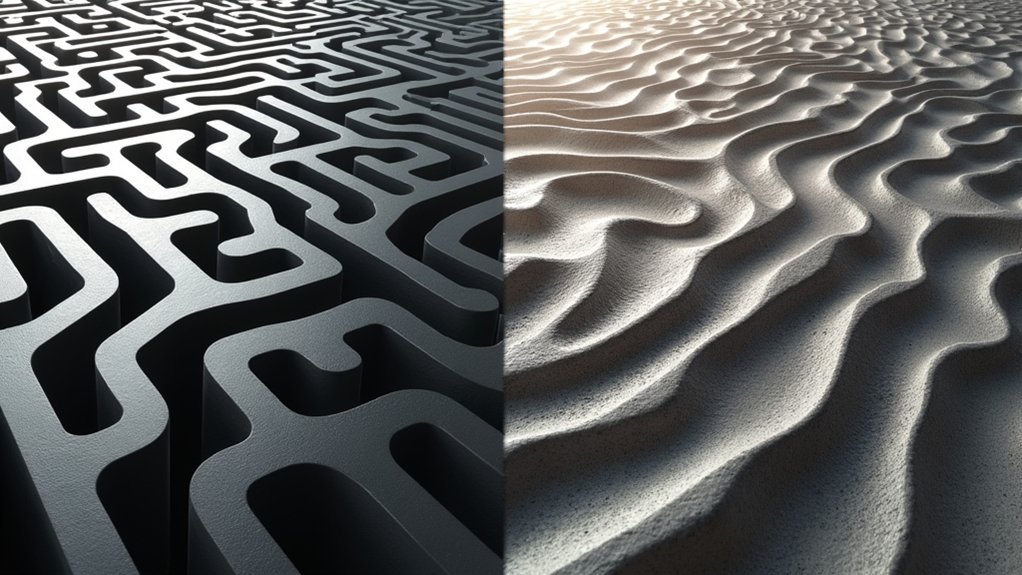
When you’re selecting an infill pattern for your 3D prints, rectilinear infill stands out as one of the most straightforward and widely-used options available.
This pattern features single diagonal lines that alternate direction between layers, creating enhanced layer adhesion while maintaining structural integrity. You’ll find it’s incredibly efficient for reducing filament consumption and improving print speeds compared to complex alternatives.
The mechanical properties of rectilinear infill work best for visual prints and prototypes where aesthetics matter more than strength.
Its non-continuous grid structure can create gaps at lower settings, so you’ll want to optimize infill density between 10-20% for the ideal balance of material efficiency and performance.
This simplicity makes it perfect when you don’t need maximum structural strength.
Lines Infill Pattern Characteristics and Benefits
Lines infill takes simplicity even further than rectilinear patterns by utilizing continuous straight lines that run in alternating directions across each layer. This lines infill pattern maximizes print speeds through minimal retractions and pauses, making it ideal when you need quick results.
The streamlined approach reduces material consumption compared to complex infill types, keeping your projects economical.
Key advantages of lines infill include:
- Speed optimization – Continuous paths eliminate unnecessary printer movements
- Cost efficiency – Lower material usage reduces filament expenses
- Customizable strength – Adjusting rotation angles optimizes performance for specific needs
However, you’ll sacrifice some structural integrity with this pattern. The unidirectional nature provides less shear resistance than grid or triangular patterns, making it best suited for decorative prints and low-stress applications rather than load-bearing components.
Structural Strength Comparison Between Patterns
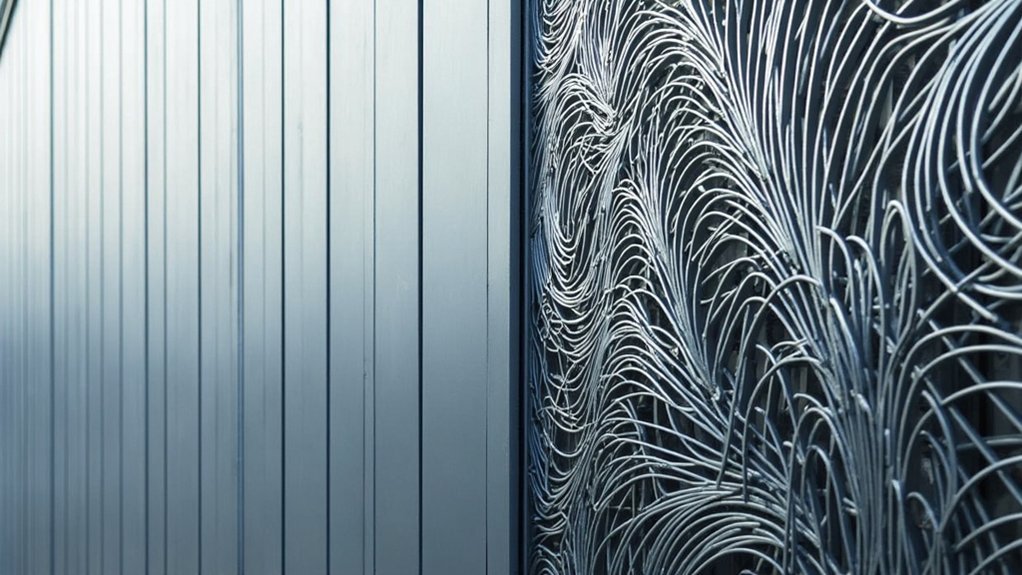
Although both patterns serve distinct purposes in 3D printing, rectilinear infill delivers considerably superior structural strength compared to lines infill.
When you’re evaluating load-bearing capacity, rectilinear infill creates a robust grid structure that alternates diagonal orientations between layers. This design provides better resistance to deformation under stress and enhanced mechanical support.
In contrast, Lines infill consists of continuous straight lines in one direction, offering minimal structural reinforcement.
While it’s faster to print, you’ll find it lacks the thorough support needed for functional parts.
If you’re printing components that require significant structural strength, rectilinear infill outperforms lines infill consistently.
Choose rectilinear for functional parts demanding durability, and reserve lines infill for aesthetic prototypes or non-critical applications.
Print Speed and Time Efficiency Analysis
When you’re comparing print speeds between rectilinear and lines infill, you’ll notice significant differences in how each pattern affects your overall printing time.
Lines infill typically prints faster because it maintains continuous extrusion in one direction, while rectilinear’s alternating diagonal patterns require more direction changes that can slow down the process.
Your printer’s retraction settings will also play an essential role, as lines infill minimizes these pauses compared to rectilinear’s more complex toolpath requirements.
Extrusion Continuity Differences
If you’re prioritizing speed over structural complexity, Lines infill delivers superior extrusion continuity that’ll considerably reduce your print times.
The Lines infill pattern maintains continuous extrusion with minimal retractions, allowing your printer to work more efficiently without frequent start-stop cycles. This streamlined approach translates to faster completion times and smoother printing operations.
In contrast, the Rectilinear pattern requires direction changes between layers, creating interruptions in extrusion flow that slow down your overall print speed.
- Continuous extrusion: Lines infill eliminates frequent retractions for uninterrupted material flow
- Reduced pause times: Single-direction printing minimizes layer shifts delays compared to alternating patterns
- Speed improvement: Lines infill can boost print speed by up to 30% over Rectilinear in non-structural applications
Layer Print Duration
While both infill patterns affect your overall print timeline, the actual layer duration differences reveal important trade-offs between speed enhancement and structural requirements. Lines infill delivers faster print speeds through continuous straight-line paths that minimize retractions and pauses. You’ll find this pattern ideal for prototypes where speed trumps strength. Rectilinear alternates direction between layers, creating stronger prints but requiring more complex toolpath calculations that increase layer duration.
| Factor | Lines Infill | Rectilinear |
|---|---|---|
| Print Speed | Fastest | Moderate |
| Toolpath Complexity | Simple | Complex |
| Suitable Density | 5-15% | 10-20% |
| Best Use Case | Prototypes | Functional Parts |
Your infill settings greatly impact print time, with rectilinear typically adding 15-25% more duration than lines infill at comparable densities.
Retraction Impact Comparison
Retraction frequency directly impacts your print timeline, with lines infill requiring considerably fewer retractions than rectilinear patterns.
Lines infill’s unidirectional approach minimizes interruptions during extrusion, allowing your printer to maintain consistent speeds throughout each layer. In contrast, rectilinear infill alternates directions between layers, forcing your extruder to retract more frequently as it navigates complex path changes.
Your retraction settings become essential when using rectilinear infill, as improper configurations can dramatically extend print time.
Lines infill eliminates many of these concerns through its simplified pathing strategy.
- Speed advantage: Lines infill can reduce print time by up to 20% for low-stress applications
- Fewer interruptions: Unidirectional patterns require minimal retractions during printing
- Simplified optimization: Less complex retraction settings needed with lines infill
Material Consumption and Cost Differences
When you’re evaluating infill options, material consumption becomes a critical factor that directly impacts your printing costs.
Lines infill typically uses 10-20% less filament than Rectilinear due to its simpler unidirectional pattern, while Rectilinear’s zig-zag structure requires more complex toolpaths and additional material.
You’ll need to balance these material costs against print time expenses and consider how infill density settings amplify these differences in your specific applications.
Filament Usage Comparison
Since material costs directly impact your 3D printing budget, understanding the filament consumption differences between Rectilinear and Lines infill becomes essential for project planning.
Lines infill consistently uses 10-20% less material than Rectilinear because it prints in a single direction per layer, eliminating the overlapping paths created by Rectilinear’s zig-zag pattern.
When you switch from Rectilinear to Lines infill on identical models, you’ll reduce your filament costs by approximately 5-15%, depending on your infill percentage and design complexity.
This material usage difference becomes more significant with higher infill densities.
- Cost savings: Lines infill reduces overall filament expenses by 10-20% compared to Rectilinear
- Efficiency: Single-direction printing eliminates wasteful overlapping paths and alternate orientations
- Budget impact: Switching patterns can decrease project costs by 5-15% on identical prints
Print Time Costs
Beyond material expenses, print time directly affects your operational costs through machine usage, energy consumption, and project scheduling.
Lines infill considerably reduces your print time compared to Rectilinear because it uses unidirectional patterns that minimize retractions and pauses. This efficiency translates to lower energy bills and faster project completion.
When you choose Rectilinear, you’ll face 10-20% longer print times due to its complex zig-zag movements. This extended duration increases material costs and ties up your printer longer, reducing overall productivity.
Lines infill lets you complete more projects daily, maximizing your equipment investment.
Consider that faster printing with Lines infill means quicker turnaround times for clients and reduced wear on your printer’s mechanical components, further lowering long-term operational expenses.
Density Impact Analysis
Although both infill patterns serve similar structural purposes, their density requirements create significant differences in material consumption and overall project costs.
When you’re conducting a density impact analysis, Lines infill consistently outperforms Rectilinear in material usage efficiency. The zig-zag nature of Rectilinear infill demands more filament to achieve the same infill density as Lines patterns.
At typical infill density ranges of 10-20%, you’ll experience substantial savings with Lines infill:
- Material reduction: Up to 30% less filament consumption compared to Rectilinear patterns
- Cost efficiency: Lower overall project expenses through reduced material waste
- Print time optimization: Faster completion due to simplified toolpath movements
You’ll find Lines infill particularly cost-effective for prototyping and aesthetic prints where material savings outweigh maximum structural strength requirements.
Best Applications for Rectilinear Infill
Three primary scenarios make rectilinear infill your best choice for 3D printing projects.
First, you’ll want this infill type for decorative items and non-load bearing parts where structural integrity isn’t critical. The alternating line pattern provides adequate support for top layers without compromising aesthetics.
Rectilinear infill works perfectly for decorative pieces where you need clean aesthetics without demanding high structural strength.
Second, when you’re creating prototypes or test models, rectilinear stands out as the best Cura infill option because its simple zig-zag pattern considerably reduces printing time compared to complex alternatives.
Third, you’ll benefit from choosing rectilinear when managing material costs is essential, as it consumes less filament while maintaining reasonable strength.
For enhanced durability without major time increases, you can combine rectilinear infill with multiple perimeters, creating prints that balance efficiency with performance.
Optimal Use Cases for Lines Infill Pattern
When you’re prioritizing print speed above all else, lines infill becomes your go-to pattern for rapid prototyping and quick test prints.
This unidirectional approach dramatically reduces print duration while maintaining adequate support for lightweight models.
You’ll find lines infill especially valuable for non-load-bearing parts where structural strength isn’t critical.
The pattern excels in decorative projects, artistic pieces, and visual prototypes where appearance matters more than mechanical properties.
- Speed-focused projects: Rapid prototyping, concept models, and iterative design testing
- Aesthetic applications: Decorative items, display pieces, and artistic creations requiring clean surfaces
- Material-efficient builds: Lightweight models using 10-20% density for ideal filament conservation
Density Settings Impact on Each Pattern
Density settings fundamentally alter how rectilinear and lines infill patterns behave in your prints. You’ll need higher density for Rectilinear infill (20-30%) to achieve adequate structural support, while Lines infill works effectively at lower densities (10-20%). When you increase Rectilinear infill density, you’ll greatly boost mechanical strength, making it perfect for functional parts. However, higher density in Lines infill won’t markedly improve strength but will consume more material and time.
| Aspect | Rectilinear Infill | Lines Infill |
|---|---|---|
| Ideal Density | 20-30% | 10-20% |
| Low Density Issues | Gaps between lines | Maintains continuity |
| Strength Impact | Pronounced vertical strength | Minimal strength gain |
| Print Speed | Slower due to alternating layers | Faster one-directional path |
| Best Application | Load-bearing parts | Aesthetic purposes |
Layer Adhesion and Print Quality Considerations
Beyond density considerations, layer adhesion plays a pivotal role in determining your print’s structural integrity and surface finish.
When you’re choosing between infill patterns, you’ll notice that Rectilinear’s alternating line direction greatly enhances inter-layer bonding compared to Lines’ unidirectional approach. This cross-directional support reduces delamination risks in high-stress applications.
While Lines infill delivers faster print speed through continuous paths, you’ll sacrifice layer adhesion quality. The unidirectional pattern lacks cross-support, potentially creating weaker surface quality under shear forces.
Rectilinear’s alternating orientation creates stronger structural integrity by improving bonding between layers.
- Rectilinear infill: Alternating directions enhance layer adhesion and prevent delamination
- Lines infill: Faster printing but weaker inter-layer bonding in stress applications
- Trade-off consideration: Balance print speed against required structural integrity for your specific application
Troubleshooting Common Issues With Both Patterns
You’ll encounter specific print quality problems when working with both rectilinear and lines infill patterns that can compromise your finished parts.
These issues often manifest as gaps between layers, weak adhesion points, or inconsistent extrusion that creates visible defects in your print.
Understanding these mechanical failure points helps you identify whether problems stem from your infill choice or other print settings that need adjustment.
Print Quality Problems
While both rectilinear and lines infill patterns offer distinct advantages, they’re also prone to specific quality issues that can compromise your prints.
Understanding these common problems helps you identify and resolve print quality issues before they ruin your projects.
Rectilinear infill can create gaps in top layers when line directions don’t align with walls, affecting surface finish.
Lines infill often produces visible layer lines due to unidirectional printing, resulting in poor bridging performance.
- Under-extrusion weakens both patterns – Improper flow rate or temperature settings create structural weak points
- Inconsistent extrusion patterns differ – Rectilinear shows uneven infill density while lines infill exhibits oozing and stringing
- Insufficient infill density causes failures – Low density percentages compromise structural integrity in functional parts
Mechanical Failure Points
When stress concentrates at infill intersection points, mechanical failures become inevitable if you haven’t optimized your print settings properly.
Both Rectilinear and lines infill create vulnerable spots where stress concentrations form, particularly when infill density drops too low. Lines infill’s unidirectional pattern weakens your part against bending and twisting forces, while Rectilinear’s alternating diagonal layers can fail under directional stress.
You’ll notice gaps developing when speed and temperature settings aren’t properly calibrated, reducing overall strength.
To improve mechanical performance, increase your infill density or switch to stronger patterns like Triangular or Gyroid. These alternatives distribute loads more effectively, eliminating the intersection-based failure points that plague both Rectilinear and lines infill under dynamic loading conditions.
Making the Final Decision for Your Project
Three key factors should guide your choice between Rectilinear and Lines infill for any 3D printing project.
First, evaluate your part’s structural requirements. If you need enhanced mechanical stability and superior layer adhesion, Rectilinear’s alternating diagonal orientations create a grid-like structure that outperforms Lines infill’s unidirectional pattern.
Second, consider your time constraints. Lines infill prints faster due to fewer pauses and continuous straight-line movements.
Third, assess your project’s purpose.
- Structural parts: Choose Rectilinear for better load distribution and part strength
- Aesthetic prototypes: Select Lines infill for speed and reduced filament consumption
- Low-stress applications: Either pattern works effectively at 10-20% density
Your decision ultimately depends on balancing strength requirements against printing efficiency for ideal project outcomes.
Frequently Asked Questions
Which Infill Pattern Should I Use?
You should choose Rectilinear infill if you’re printing parts needing moderate strength and structural support. Select Lines infill when you’re prioritizing speed for decorative prints or low-stress applications.
What Is Rectilinear Infill Good For?
You’ll find rectilinear infill perfect for decorative prints and prototypes where you don’t need high strength. It prints faster, uses less filament, and creates smoother surfaces while maintaining decent rigidity.
What Is the Best Infill Type in Bambu Lab?
You’ll find Rectilinear infill works best for most Bambu Lab prints since it balances speed with strength effectively. However, you should choose based on your specific project’s structural requirements and time constraints.
What Is the Best Infill for ABS?
You’ll want rectilinear infill at 20-30% density for ABS printing. It provides excellent layer adhesion and strength while helping counteract warping tendencies. This pattern balances durability with reasonable print times for functional parts.

Leave a Reply