
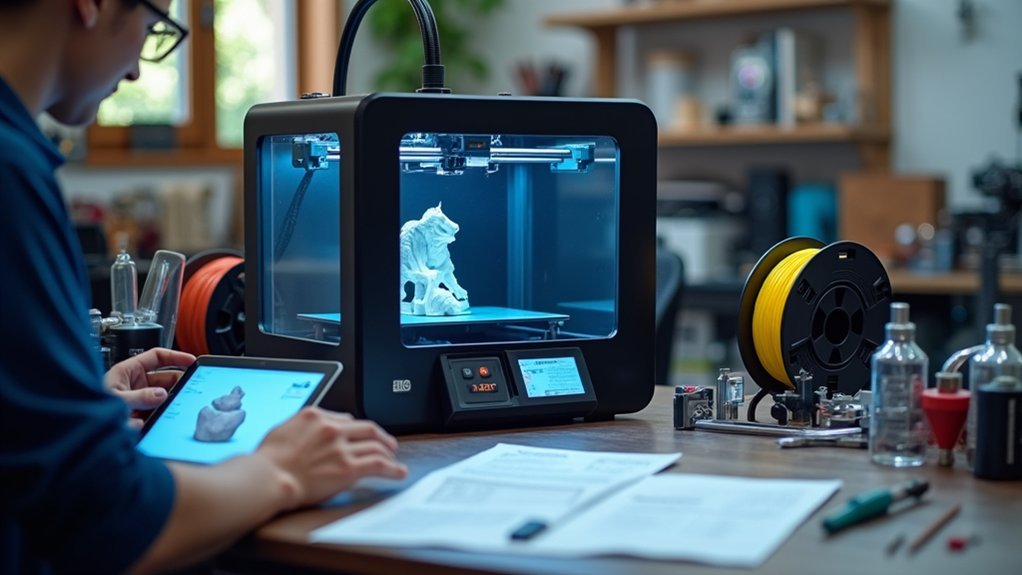
You’ll build effective 3D printing quality control workflows by establishing clear dimensional tolerances like ±10 μm accuracy standards, implementing advanced inspection technologies such as Keyence VL-500 scanners and optical profilometers, and integrating real-time layer analysis software that monitors over 10,000 images per build. Develop thorough material testing protocols using DSC, TGA, and tensile strength equipment while creating automated documentation systems that flag critical defects instantly. Foster cross-functional collaboration between production managers, quality engineers, and R&D teams to transform reactive troubleshooting into proactive quality management that’ll revolutionize your manufacturing precision.
Establish Pre-Production Quality Standards and Specifications

Before you begin any 3D printing project, you must establish clear quality standards and specifications that define exactly what constitutes acceptable output.
Your pre-production quality standards should include specific tolerances like dimensional accuracy of ±10 μm for parts requiring precise specifications. Define critical material properties such as tensile strength and surface roughness, especially for high-stress applications in automotive or aerospace industries.
Document these standards and communicate them to all stakeholders, making certain your design, production, and quality assurance teams understand expectations.
Implement robust systems for checking and repairing project data before production to minimize costly errors.
Regularly engage with customers to clarify their specifications, establishing clear understanding that builds trust and guarantees satisfaction with your final product.
Implement Advanced Inspection Technologies for Dimensional Accuracy
Once you’ve established your quality standards, you’ll need sophisticated inspection technologies to verify dimensional accuracy throughout your 3D printing workflow.
The Keyence VL-500 3D Scanner/CMM delivers exceptional precision of ±10 μm, enabling you to inspect large components in single continuous scans. For surface quality verification, implement the Keyence VR-6000 Optical Profilometer, which measures surface roughness to sub-micron levels with ±0.1μm repeatability.
Precision metrology tools like the VL-500 and VR-6000 enable sub-micron accuracy verification for critical 3D printed components.
Incorporate non-destructive testing methods like X-ray computed tomography to detect internal defects such as porosity without compromising part integrity.
Leverage advanced metrology tools including optical scanners and laser triangulation for rapid dimensional inspections, considerably reducing quality assurance timeframes.
Establish workflows with automated reporting features to standardize assessments, minimize human error, and maintain consistency across production runs.
Integrate Layer Analysis Software for Real-Time Defect Detection

You can transform your quality control process by implementing layer analysis software that monitors each layer as it’s printed, catching defects before they compromise your entire build.
This real-time approach lets you make immediate corrections rather than discovering problems after hours of printing time.
Real-Time Monitoring Benefits
Real-time monitoring transforms 3D printing quality control by providing instant visibility into build progress and defect formation as each layer forms.
You’ll maintain consistent quality standards by detecting defects within seconds, enabling immediate corrective actions before defective parts reach completion. This proactive approach prevents unnecessary manufacturing steps and reduces material waste considerably.
Layer analysis software automates the examination of over 10,000 images per build, eliminating reviewer-dependent variability that compromises quality consistency.
You’ll benefit from standardized outputs that minimize human error while accelerating root cause analysis for faster decision-making.
Instant report generation streamlines quality reporting across different printer OEMs, enhancing overall production efficiency.
Real-time monitoring fundamentally shifts quality control from reactive inspection to proactive defect prevention, improving your manufacturing timelines and reducing costs.
Automated Detection Workflows
While traditional quality control relies on post-production inspection, automated detection workflows integrate layer analysis software directly into your printing process to catch defects as they occur.
You’ll transform your manufacturing approach by implementing real-time monitoring that analyzes over 10,000 layer images per build in seconds rather than spending 45-60 minutes on manual processing.
Effective quality control through automated detection workflows delivers:
- Lightning-fast defect identification – Get instant alerts when problems emerge, preventing costly failures
- Dramatically reduced human error – Eliminate subjective assessments that compromise high-quality parts
- Early scrap detection – Avoid wasting materials and time on doomed builds
- Standardized quality reporting – Generate consistent documentation across different printer platforms
Your layer analysis system provides 360° build quality oversight, accelerating decision-making and optimizing root cause analysis for enhanced production efficiency.
Develop Material Characterization and Testing Protocols
Understanding your material properties becomes the foundation of successful 3D printing quality control, as inconsistent or poorly characterized materials can derail even the most carefully planned workflows.
You’ll need thorough material characterization using techniques like Differential Scanning Calorimetry (DSC) and Thermogravimetric Analysis (TGA) to analyze thermal properties and stability.
Rheometry evaluates viscosity, directly impacting flow behavior during printing. For mechanical properties assessment, conduct tensile strength testing using equipment like the Instron 5Kn to measure elongation at break and performance under stress.
Surface roughness measurements with tools like the Keyence VR-6000 Optical Profilometer assess texture quality for precise finishes.
Establishing standardized testing protocols guarantees consistency and reliability across projects, enabling better decision-making and quality assurance throughout your workflows.
Create Automated Quality Documentation and Reporting Systems

You’ll transform your quality control process by implementing automated report generation systems that cut documentation time from nearly an hour to seconds while eliminating human error.
These systems integrate seamlessly with real-time data streams from your 3D printers, creating standardized reports that maintain consistency across different equipment manufacturers.
You’re now positioned to make faster decisions about post-processing and quality control by having thorough build quality overviews available instantly.
Automated Report Generation Systems
As production demands intensify across manufacturing environments, automated report generation systems transform how you document and analyze 3D printing quality metrics.
These powerful tools slash your manual processing time from 45-60 minutes to mere seconds while maintaining thorough defect analysis capabilities.
Your automated report generation systems deliver standardized outputs across different OEMs, eliminating reviewer variability and ensuring compliance with industry standards.
By correlating in-situ sensor data with post-build results, you’ll detect issues earlier and accelerate root cause analysis.
- Watch critical defects get flagged instantly – no more waiting hours for quality assessments
- See your team’s collaboration flourish as Production Managers, Quality Engineers, and R&D unite through AI-enhanced reporting
- Feel confident presenting standardized reports that meet rigorous industry compliance requirements
- Experience the relief of early defect detection preventing costly production failures
Real-Time Documentation Integration
Real-time documentation integration revolutionizes your quality control workflow by seamlessly capturing and processing build data as each layer forms.
This automated quality documentation system tracks critical defects automatically within your manufacturing process, standardizing quality reports across different 3D printer OEMs while minimizing assessment variability.
You’ll benefit from thorough layer analysis that provides a 360° overview of build quality, enabling early scrap detection and avoiding unnecessary manufacturing steps.
The system correlates in-situ sensor data with post-build information, facilitating accurate root cause analysis for confident decision-making.
Real-time documentation enhances team collaboration by allowing members to flag observations and comments directly within quality reports, improving communication and decision-making capabilities throughout your production workflow.
Build Cross-Functional Team Collaboration for Continuous Process Improvement
When you establish a cross-functional team that brings together Production Managers, Quality Engineers, and R&D Engineers, you’re creating a powerhouse of diverse expertise that transforms how quality control decisions get made in your 3D printing operations.
Here’s how you’ll revolutionize your manufacturing processes:
- Accelerate problem-solving – AI-driven tools streamline communication, reducing time-to-market while maintaining quality parts standards.
- Catch defects early – Regular feedback sessions identify issues before they impact production runs.
- Share insights effectively – Standardized reporting processes must enable seamless knowledge transfer of critical defect data.
- Enhance transparency – Collaborative software integrates real-time quality metrics, driving accountability across all team members.
This integrated approach creates a culture of continuous improvement that proactively addresses quality challenges.
Frequently Asked Questions
What Is the Typical ROI Timeline for Implementing Quality Control Workflows?
You’ll typically see ROI within 6-18 months when implementing quality control workflows. Initial costs get offset by reduced waste, fewer reprints, and improved efficiency. Your timeline depends on production volume and complexity.
How Do Quality Control Costs Scale With Different Production Volumes?
Your quality control costs decrease per unit as production volumes increase. You’ll spread fixed inspection equipment costs across more parts, but you’ll need additional staff and automated systems for higher throughput requirements.
Which Quality Control Methods Work Best for Specific 3D Printing Materials?
You’ll need visual inspection for PLA’s surface defects, dimensional verification for ABS’s shrinkage issues, tensile testing for PETG’s layer adhesion, and thermal analysis for high-performance materials like PEEK or PEI.
What Staff Training Is Required to Operate Quality Control Equipment Effectively?
You’ll need training on equipment calibration, measurement techniques, data interpretation, and safety protocols. Staff should understand material properties, troubleshooting procedures, and documentation standards. Hands-on practice with specific instruments guarantees accurate quality assessments and consistent results.
How Do You Handle Quality Control for Multi-Material or Hybrid Prints?
You’ll need separate testing protocols for each material interface, monitor adhesion between layers, check thermal changes, and verify material compatibility. Test mechanical properties at junction points where different materials meet.

Leave a Reply