You’ll want to take into account Badger 3D Prime and Badger Stynlrez for exceptional coverage and durability on your printed models. For budget-friendly options, try Krylon Colormaxx or Duplicolor Filler Primer, though they may require multiple coats. Acrylic primers work well for PLA and ABS with quick 30-minute dry times, while epoxy primers offer superior filling for layer lines. Two-part systems provide unmatched adhesion but require technical skill. Proper surface preparation with 220-400 grit sandpaper guarantees ideal results across all primer types.
Why Prime Your 3D Printed Models
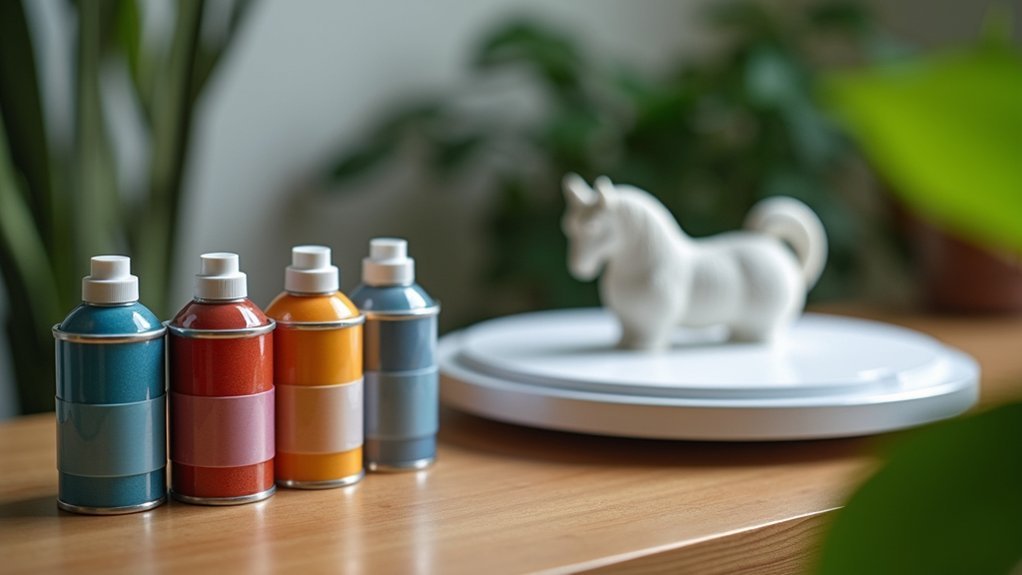
While you might be tempted to paint your freshly printed model straight off the build plate, priming serves as the essential foundation that transforms a raw 3D print into a professional-looking finished piece.
Primer fills those visible delamination lines and surface imperfections that make your model look unfinished. It creates better paint adhesion, ensuring your paint job won’t chip or peel with handling.
Primer smooths imperfections and creates superior paint adhesion, preventing chips and peeling for long-lasting, professional-quality finishes.
You’ll also discover hidden flaws once primer’s applied, giving you the chance to sand and correct problem areas before painting.
The right primer creates a hard, durable coating that resists stains and wear. While it’s not absolutely mandatory for every material, using primer guarantees you’ll achieve that smooth finish that separates amateur work from professional results.
Acrylic Primers for PLA and ABS Prints
When you’re working with PLA and ABS prints, acrylic primers offer the perfect balance of performance and convenience.
These water-based primers are environmentally friendly and safe to use on your printed models. You’ll appreciate their quick 30-minute dry time and easy application through spraying or brushing.
While acrylic primers create smooth surfaces by filling minor imperfections, they’ve weaker filling abilities for deeper defects. You’ll likely need multiple coats to cover significant layer lines effectively. However, they’re available in various colors and work across different materials.
Proper surface preparation remains essential—sand and clean your prints before applying primer. This guarantees ideal adhesion and enhances your model’s overall appearance, creating an excellent base for subsequent paint applications.
Spray Primers for Large and Complex Models
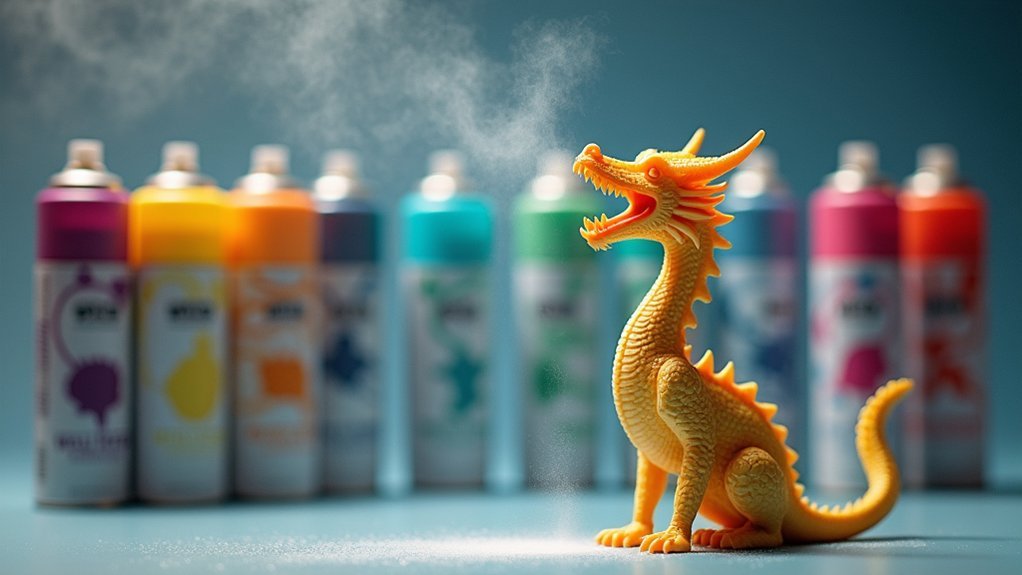
Spray primers excel when you’re tackling large or intricate 3D printed models that would be challenging to cover with brush application.
These aerosol-based products deliver uniform coverage quickly across complex surfaces and detailed geometries. You’ll want to maintain a 15–20 cm distance when spraying to prevent overspray while ensuring even distribution.
Maintain proper spray distance of 15-20 cm for even primer distribution across detailed 3D printed surfaces.
Krylon Colormaxx offers reliable performance for extensive projects, while Duplicolor Filler Primer’s filling properties effectively minimize visible layer lines.
You’ll achieve the best results by applying multiple thin coats rather than one heavy application, which preserves fine details and creates a smooth finish.
Always prioritize proper ventilation when using spray primers, as aerosol fumes can be harmful.
Work outdoors or use respiratory protection in enclosed spaces.
Epoxy Primers for Heavy-Duty Applications
If your 3D printed project demands maximum durability and superior surface preparation, epoxy primers deliver unmatched performance for heavy-duty applications.
You’ll appreciate their exceptional filling ability, which effectively covers layer lines and surface defects that plague 3D printed models. These primers create incredibly durable bonds that withstand harsh environments and heavy use, making them perfect for functional parts.
However, you’ll need technical skill to handle the two-part mixing process and extended drying time.
Once cured, epoxy primers resist polishing and sanding, so you must apply them carefully for ideal results.
Before choosing epoxy primers, verify they’re compatible with your specific printing material, as they don’t work with every substrate.
Enamel Primers for Outdoor and High-Wear Models
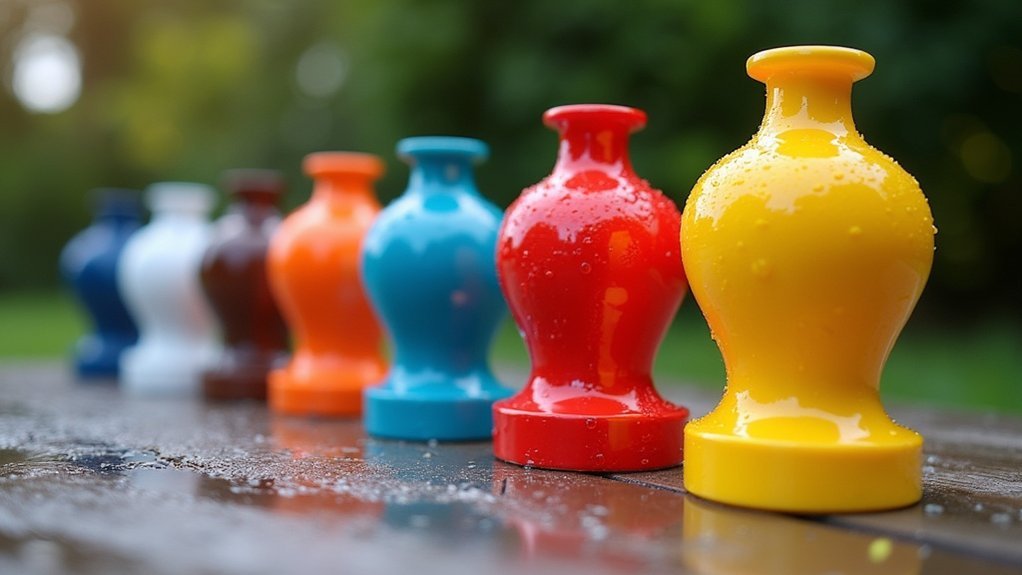
When you’re building 3D printed models that’ll face harsh outdoor conditions or heavy use, enamel primers offer superior protection through their solvent-based formula.
You’ll get a rock-hard coating that resists stains, weather damage, and wear far better than water-based alternatives. This durability makes enamel primers your best choice for garden displays, functional parts, or any model that needs to withstand real-world punishment.
Solvent-Based Coating Benefits
Because enamel primers contain solvents that evaporate during curing, they form an exceptionally hard and durable surface that outperforms water-based alternatives in demanding conditions.
When you choose solvent-based primers, you’re investing in exceptional durability that withstands physical stress and abrasion. The slow-drying formula allows better leveling, resulting in a smooth finish that enhances your model’s appearance.
Key advantages you’ll experience:
- Weather-resistant protection – Your outdoor models won’t fade or deteriorate under harsh conditions
- Superior adhesion – Creates an unbreakable bond that won’t chip or peel over time
- Professional-grade results – Achieves the same quality finish used in industrial applications
- Long-term investment – Eliminates the need for frequent touch-ups and refinishing
However, guarantee proper ventilation during application due to strong solvent odors.
High Durability Applications
While water-based primers work adequately for indoor display pieces, enamel primers become essential when your 3D printed models face the rigors of outdoor exposure or frequent handling.
These solvent-based solutions create a robust protective layer that withstands physical wear and environmental stress far better than their water-based counterparts.
You’ll find enamel primers particularly valuable for gaming terrain that endures constant manipulation during tabletop sessions.
The hard, stain-resistant coating prevents chipping and maintains your model’s appearance despite repeated use.
For outdoor displays, these primers excel at protecting against weather variations, UV exposure, and temperature fluctuations.
High-wear environments demand this level of protection to preserve your investment and maintain professional presentation standards over extended periods.
Automotive Filler Primers for Layer Line Coverage
You’ll find that automotive filler primers like Duplicolor Filler Primer Grey excel at eliminating those stubborn layer lines that standard primers can’t handle.
These heavy-duty primers pack serious filling power, making them your go-to choice when you’re dealing with rough prints that need significant surface smoothing.
Let’s examine how Duplicolor performs in real-world applications and explore the techniques that’ll give you professional-grade results.
Duplicolor Performance Analysis
Automotive filler primers bring serious muscle to the challenge of smoothing 3D printed layer lines, and Duplicolor’s offering stands as a prime example of this category’s potential. This Filler Primer delivers impressive coverage that transforms the surface of the model, tackling deeper imperfections that standard primers can’t handle.
You’ll need multiple coats for ideal results, but the filling power justifies the effort.
However, you must balance coverage with preservation. While it excels at smoothing, careful application prevents losing the detail of the model that makes your print special.
Key Performance Considerations:
- Exceptional filling power – conquers stubborn layer lines other primers abandon
- Multiple coats required – patience becomes your greatest ally
- Detail preservation challenges – intricate features demand surgical precision
- Ventilation mandatory – solvent fumes pose serious health risks
Application Best Practices
Since these high-performance primers pack serious filling power, you’ll achieve the best results by mastering their application technique rather than relying on their strength alone.
Start with proper surface preparation—sand your 3D printed model lightly and clean it thoroughly to guarantee ideal primer adhesion.
When these primers are available in aerosol form, maintain consistent distance and movement during spray painting to avoid pooling.
Apply multiple thin coats rather than one heavy coat of primer. This prevents detail loss while maximizing layer line coverage.
Allow several hours between applications for complete curing—rushing this step compromises adhesion and finish quality.
Work in well-ventilated areas and use steady, overlapping passes for even coverage across your model’s surface.
Airbrush Primers for Professional Results
When precision matters most, airbrush primers deliver the professional-grade results that serious modelers demand.
You’ll achieve smooth application with thin coats that preserve every intricate detail on your 3D printed models. Badger Stynlrez Black exemplifies excellence in even coverage, while their two-part 3D Prime system offers superior detail preservation despite requiring more technique.
Here’s why airbrush primers elevate your work:
Airbrush primers transform ordinary models into professional masterpieces through superior detail preservation and flawless finish quality.
- Preserve every detail – Thin layers won’t obscure fine features
- Build layers confidently – Quick-drying formulas allow multiple coats
- Achieve flawless finishes – Professional results that impress viewers
- Create lasting durability – Enhanced protection for display pieces
Remember to maintain proper ventilation and follow safety guidelines when applying these primers.
The fine particles and fumes require adequate airflow for safe operation.
Two-Part Primer Systems for 3D Prints
Although two-part primer systems require more preparation than their single-component counterparts, they’ll transform your 3D prints with unmatched adhesion and surface smoothing.
Products like Badger 3D Prime combine a base and hardener that, when mixed, create an incredibly strong adhesive layer. You’ll need to exercise patience during the mixing process and longer drying times, but the results justify the extra effort.
These specialized primers excel at filling layer lines and surface imperfections, delivering professional-grade results. Their superior adhesion works across various materials, from plastic to metal prints.
While they demand higher technical skill for proper application, two-part primer systems consistently produce a smooth appearance that’s perfect for detailed models requiring exhibition-quality finishes.
Surface Preparation and Application Techniques
Before you even think about opening that primer bottle, proper surface preparation will make or break your final results. Your 3D printed model’s surface needs meticulous attention before primers can work their magic.
Surface preparation isn’t optional—it’s the foundation that determines whether your 3D print transforms into a masterpiece or disaster.
Start by sanding with 220–400 grit sandpaper to eliminate those telltale layer lines. Next, wipe everything down with isopropyl alcohol—this removes dust and oils that’ll sabotage adhesion. Fill larger imperfections with epoxy resin or putty, then sand flush once dry.
Here’s your game-changing application strategy:
- Apply multiple thin coats instead of one thick layer
- Allow adequate drying time between each application
- Inspect thoroughly after the first coat
- Resand if necessary to achieve perfection
This methodical painting process guarantees your primers create the flawless foundation your masterpiece deserves.
Primer Performance Comparison and Testing Results
You’ll find that primer performance varies considerably across different products when tested on 3D printed models.
Coverage quality, durability during handling, and how well each primer preserves your model’s fine details become the key differentiators in real-world applications.
Testing results reveal clear winners and losers when you compare how these primers handle layer lines, maintain surface integrity, and protect intricate model features.
Coverage and Layer Hiding
When evaluating primers for 3D printed models, coverage consistency and layer line concealment emerge as the most critical performance factors that determine your final print’s professional appearance.
Coverage quality varies greatly between formulations. Badger 3D Prime delivers exceptional coverage with an A- rating, while Krylon Colormaxx struggles with C-rated performance, often revealing yellow undercoat in shadowed areas.
For layer hiding, Duplicolor Filler Primer excels despite sometimes obscuring fine details, while Badger Stynlrez and 3D Prime both achieve B- ratings with minimal visual differences.
Your primer choice directly impacts paint adhesion and finish quality:
- Frustration when layer lines show through expensive topcoats
- Pride in achieving smooth, professional-looking results
- Disappointment from visible undercoat bleeding through
- Satisfaction when details remain crisp yet well-covered
Durability Under Handling
Beyond achieving smooth coverage, your primer must withstand the inevitable handling that comes with painting, detailing, and displaying your models.
Badger 3D Prime demonstrated exceptional durability during testing, showing no noticeable damage from handling or rubbing, proving its reliability for Printed Objects requiring frequent manipulation.
Krylon Colormaxx earned a solid B rating with only minor scuffing after handling, indicating good resistance to typical wear.
Duplicolor Filler Primer showed mixed durability results, emphasizing that proper application techniques directly impact long-term performance.
Badger Stynlrez excelled in this category, maintaining solid coverage even after rough handling sessions.
For models you’ll handle extensively, prioritize primers with proven durability like Badger 3D Prime and Stynlrez over options requiring delicate treatment.
Detail Preservation Analysis
While durability guarantees your primer survives handling, detail preservation determines whether intricate features remain crisp and visible after application. Your primer choice directly impacts how well those carefully printed details survive the coating process.
Testing revealed significant differences in coverage and detail retention:
- Badger Stynlrez excels – earning an ‘A’ rating for maintaining fine details while delivering solid coverage with minimal layer line obscuring.
- Badger 3D Prime impresses – achieving ‘A’ detail retention despite requiring a two-step process.
- Duplicolor Filler Primer disappoints – receiving ‘B+’ for detail preservation but struggling with coverage, allowing yellow visibility in shadows.
- Krylon Colormaxx falls short – earning ‘B+’ for detail preservation but lacking uniform coverage compared to airbrush alternatives.
However, these differences may prove negligible for wargaming terrain viewed at typical tabletop distances.
Frequently Asked Questions
What Is the Best Primer for 3D Printed Models?
You’ll find acrylic primers work best for most 3D prints since they’re environmentally friendly and dry quickly. For airbrush application, choose Badger Stynlrez Black, or use Krylon Colormaxx spray for larger models.
Is Rustoleum Primer Good for 3D Prints?
Yes, you’ll find Rust-Oleum primer excellent for 3D prints. It’ll smooth imperfections, hide layer lines, adhere well to plastics, and dry quickly for professional results.
How Many Coats of Primer Do I Need for 3D Printing?
You’ll typically need two to three thin coats of primer on your 3D printed model. Apply each coat evenly, let it dry completely, then inspect for imperfections before deciding if you need additional layers.
Do You Need Primer for PLA 3D Prints?
You don’t strictly need primer for PLA prints since paint adheres directly, but you should use it anyway. Primer improves paint adhesion, fills layer lines, and creates a smoother, more professional finish.

Leave a Reply