
You’ll find five key differences between PLA and ABS that’ll guide your material choice. First, PLA comes from renewable plants while ABS derives from petroleum, making PLA more eco-friendly. Second, ABS handles heat better with 96°C deflection temperature versus PLA’s 55°C. Third, ABS offers superior flexibility and impact resistance despite PLA’s higher tensile strength. Fourth, PLA prints easier at lower temperatures without warping issues. Fifth, their applications differ—PLA suits decorative items while ABS excels in functional parts requiring durability and heat resistance. Understanding these distinctions will help you make informed decisions for your specific projects.
Material Origin and Environmental Impact Comparison
When you’re choosing between PLA and ABS for your 3D printing projects, understanding their fundamental material origins reveals stark differences in environmental impact.
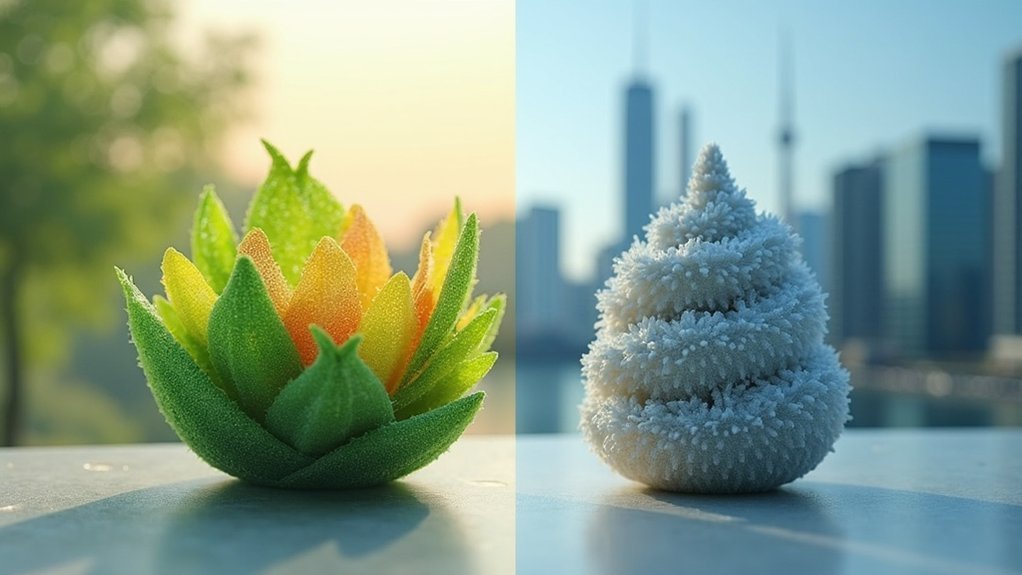
PLA comes from renewable plant-based sources like corn starch and sugarcane, making it a bioplastic with considerably lower carbon footprint. You’ll find that PLA manufacturing requires less energy and emits fewer toxins during production.
PLA’s plant-based origins from corn starch and sugarcane create a significantly more eco-friendly manufacturing process with reduced energy demands.
In contrast, ABS derives from petroleum-based resources, relying heavily on fossil fuels. Its production involves high energy consumption and substantial greenhouse gas emissions.
When you dispose of these materials, PLA biodegrades under industrial composting conditions without harmful byproducts, while ABS persists in the environment for years. ABS can take hundreds of years to decompose naturally in landfills.
This makes PLA the more sustainable choice if you’re prioritizing environmental responsibility in your 3D printing decisions.
Thermal Performance and Heat Resistance Analysis
Understanding thermal performance becomes essential as you select materials for applications where temperature exposure matters. ABS notably outperforms PLA in heat resistance, with a Heat Deflection Temperature of 96°C compared to PLA’s 55°C. This difference makes ABS suitable for automotive parts and outdoor tools, while PLA works better for indoor decorative items.
| Property | PLA | ABS |
|---|---|---|
| Heat Deflection Temperature | 55°C | 96°C |
| Glass Phase Change Temperature | ~60°C | 105°C |
| Coefficient of Thermal Expansion | 68µm/m-K | 90µm/m-K |
| Printing Temperature | 190-220°C | 220-250°C |
| Warpage Tendency | Low | High |
You’ll find PLA’s lower thermal expansion coefficient reduces warpage during printing, but ABS maintains structural integrity better under thermal stress for demanding applications. Professional users worldwide rely on comparison tools to systematically evaluate these thermal properties when selecting materials for specific temperature requirements.
Mechanical Strength and Flexibility Properties
While both materials offer distinct advantages in mechanical performance, PLA and ABS differ markedly in their strength and flexibility characteristics.
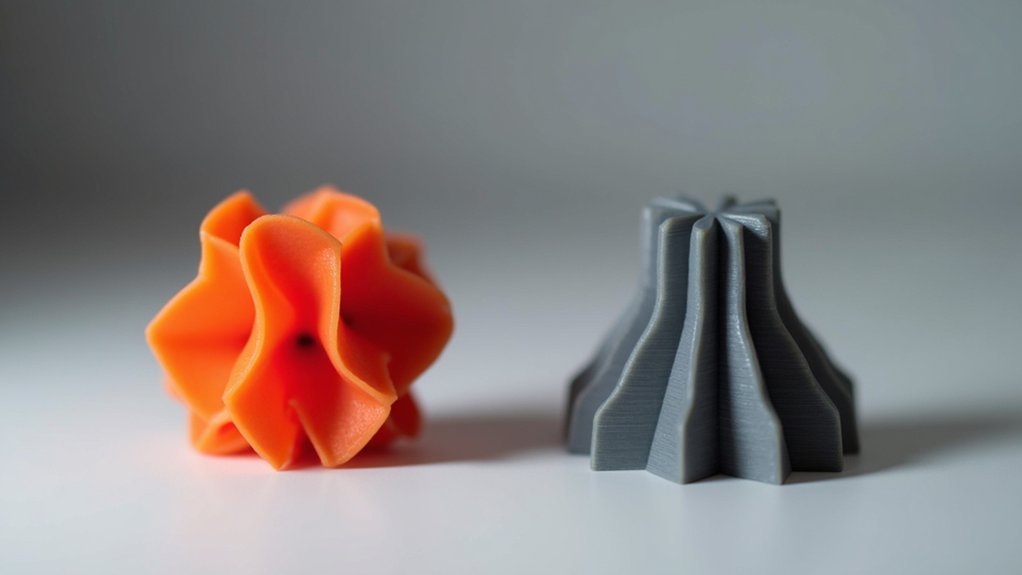
You’ll find PLA delivers superior tensile strength at 50-60 MPa compared to ABS’s 28-32 MPa, making it stronger in pure pulling forces. However, PLA’s brittleness becomes apparent under impact—its 96 J/m impact strength pales against ABS’s impressive 200-215 J/m rating.
When flexibility matters, ABS clearly wins. Its 11% elongation at break versus PLA’s mere 4% means ABS can stretch and absorb energy before failing. ABS demonstrates superior impact resistance with notched Izod impact strength of 101 J/m compared to PLA’s 27 J/m.
You’ll notice ABS’s lower elastic modulus (1,350 MPa) provides more flexibility than PLA’s rigid 3,800 MPa structure. For load-bearing or impact-prone applications, choose ABS’s superior toughness over PLA’s brittle rigidity.
Printing Characteristics and Processing Differences
Beyond their mechanical differences, PLA and ABS present dramatically different printing experiences that’ll directly impact your 3D printing success.
You’ll find PLA prints at lower temperatures (190-220°C) versus ABS’s 220-250°C range, making it more forgiving for beginners. While PLA works fine on unheated beds with open-frame printers, ABS demands heated beds (90-110°C) and enclosed chambers to prevent warping.
You’ll notice PLA produces smoother, shinier surfaces with better dimensional accuracy due to minimal thermal contraction. ABS requires post-processing like sanding or acetone smoothing for refined finishes.
Both materials achieve 0.5mm tolerances, but PLA’s reduced warping makes it superior for sharp edges and intricate details. ABS also emits fumes requiring ventilation, unlike user-friendly PLA. PLA’s plant-based composition typically doesn’t produce bad odors during printing, making it more pleasant for indoor workspace environments.
Application Suitability and Use Case Selection
When choosing between PLA and ABS for your project, you’ll need to match each material’s strengths to your specific application requirements.
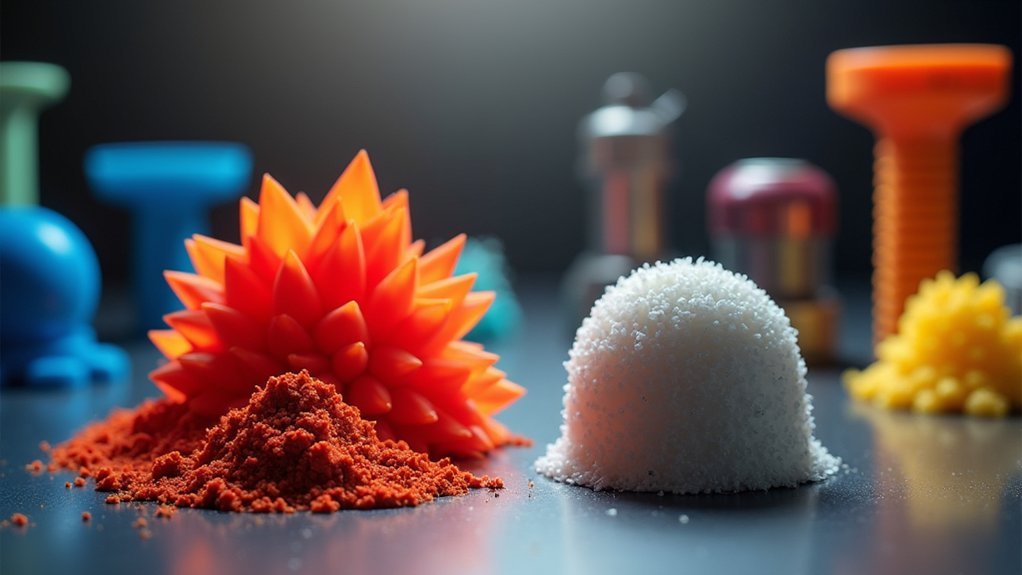
PLA excels in aesthetic applications like figurines and wall decorations due to its smooth, glossy finish and fine detail capabilities. You’ll find it perfect for prototyping, educational projects, and eco-friendly applications since it’s biodegradable and easy to print.
ABS suits functional applications requiring durability and heat resistance. You should choose ABS for automotive parts, electronics housings, and consumer products that’ll face mechanical stress. ABS’s higher ductility allows it to deform under stress without breaking, making it ideal for parts that need flexibility.
For outdoor applications, ABS’s superior impact resistance and flexibility make it your best option, while PLA’s brittleness limits its mechanical uses.
Frequently Asked Questions
Can PLA and ABS Filaments Be Mixed or Blended Together During Printing?
You can mix PLA and ABS filaments, but you’ll face adhesion issues, temperature conflicts, and potential nozzle clogs. Results aren’t predictable, and you’ll need specialized equipment for proper blending.
How Long Do PLA and ABS Printed Parts Typically Last Before Degrading?
PLA parts you’ll print can last decades under normal conditions but degrade in 50 days during industrial composting. ABS parts you create aren’t biodegradable and last hundreds of years naturally.
Are There Health Concerns When Printing With PLA Versus ABS Indoors?
You’ll face fewer health risks printing PLA indoors since it emits less harmful particles. ABS releases more VOCs and ultrafine particles, requiring proper ventilation to protect your respiratory health.
What Happens to Print Quality When Using Recycled PLA or ABS Filament?
You’ll notice recycled PLA maintains smooth finishes but loses some glossiness, while recycled ABS shows more visible layer lines. Both materials experience slight mechanical property degradation with each recycling cycle.
Can PLA and ABS Parts Be Safely Painted or Chemically Treated?
You can safely paint both PLA and ABS parts with proper preparation. Always test paint compatibility first, guarantee good ventilation, and choose plastic-specific paints to avoid chemical damage from solvents.
In Summary
You’ll find PLA’s your go-to for eco-friendly, easy printing with decent strength, while ABS offers superior heat resistance and flexibility for demanding applications. Your material choice depends on your project’s specific requirements – choose PLA for prototypes, decorative items, and beginner-friendly prints, but select ABS when you need durability, higher temperature resistance, or mechanical stress tolerance. Consider your printer’s capabilities, ventilation, and intended use before deciding.

Leave a Reply