
You’ll need metal powders with sphericity values of 0.91 or higher to meet ASTM F42 standards for additive manufacturing. Titanium alloys require the highest sphericity at ≥0.95, while stainless steel needs ≥0.92, and aluminum alloys require >0.90. These standards guarantee ideal powder flowability and packing density for consistent layer deposition. Higher sphericity improves part quality but increases production costs by 2-3 times due to specialized atomization processes. Understanding these requirements helps enhance your material selection and manufacturing success.
Understanding Sphericity in Metal Powder Production
Precision drives every aspect of metal powder production, and sphericity stands as one of the most critical parameters you’ll encounter.
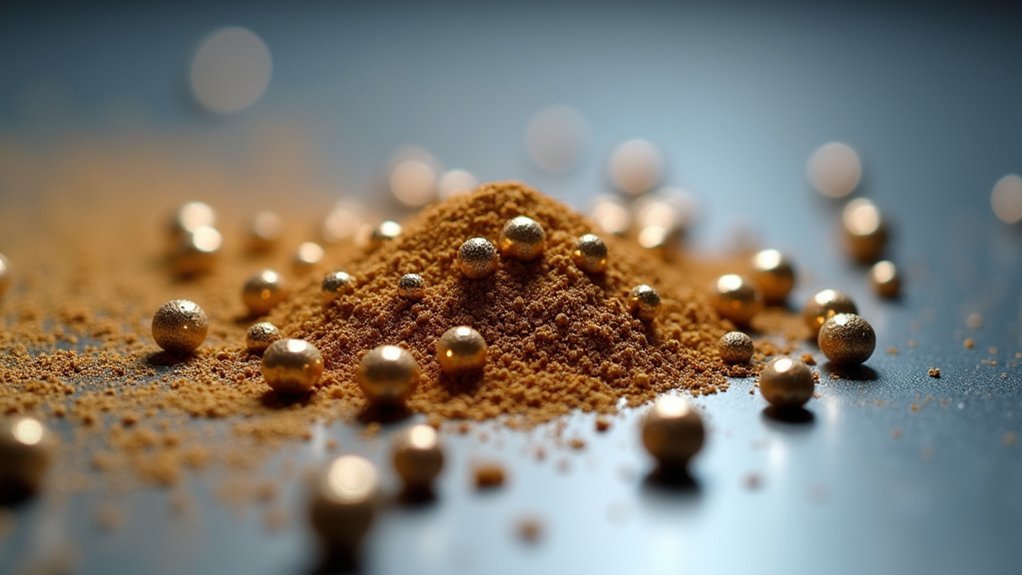
Sphericity measures how closely your particles resemble perfect spheres, calculated as the ratio between a sphere’s surface area (with identical volume) and the particle’s actual surface area. Values range from 0 to 1, with higher numbers indicating better spherical geometry.
Your production method directly influences sphericity outcomes. Gas atomization creates highly spherical particles through rapid cooling and solidification of molten metal droplets. This process consistently delivers the spherical shapes essential for peak performance.
When you achieve sphericity values of 0.91 or higher, your metal powders gain superior flowability and packing density.
These characteristics translate directly into smoother powder spreading during layer deposition, ultimately improving your printed parts’ quality and consistency.
Measurement Techniques for Powder Sphericity Assessment
You’ll need precise measurement techniques to accurately assess your metal powder’s sphericity for additive manufacturing applications.
Optical analysis methods provide the foundation for modern sphericity evaluation, using advanced imaging systems to capture detailed particle shape data.
Digital image processing then transforms these visual measurements into quantifiable sphericity values that determine whether your powders meet the critical 0.91 threshold for ideal printing performance.
Optical Analysis Methods
When you need precise measurements of powder sphericity for metal printing applications, optical analysis methods offer the most thorough and efficient assessment capabilities available.
These dynamic imaging systems capture particle shapes in real-time, providing detailed assessments that directly correlate particle shape with flowability and packing density performance.
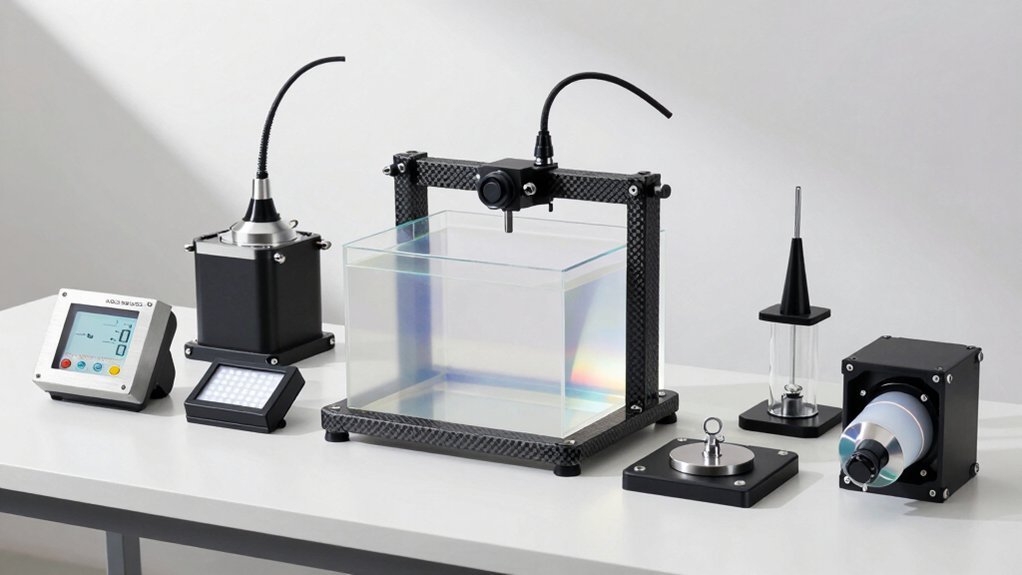
The PIC-1 dynamic imaging system exemplifies this technology, utilizing LED illumination and dual cameras to evaluate sphericity of powder by calculating the ratio between ideal and actual surface areas.
You’ll benefit from automated calculations processing over 20,000 particles per sample, yielding statistically significant morphology data.
Sphericity values range from 0 to 1, with particles ≥ 0.91 classified as ‘spherical.’
This classification guarantees ideal flowability in additive manufacturing, directly impacting your printed metal component quality and performance.
Digital Image Processing
Although traditional measurement methods provide basic particle data, digital image processing techniques revolutionize sphericity assessment by deploying advanced algorithms that analyze particle shapes with unprecedented precision.
You’ll find these systems compare actual surface area to theoretical perfect sphere measurements based on longest diameter calculations. Dynamic imaging platforms like PIC-1 capture thousands of particle images, computing essential metrics including circularity and aspect ratio for thorough sphericity evaluation.
You can process over 20,000 particles in single evaluations, generating statistically significant data for quality control. Metal powder sphericity values range from 0.73 to 0.96, with particles achieving 0.91 or higher classified as truly spherical.
This enhanced accuracy directly influences your powder selection and performance outcomes in additive manufacturing applications, ensuring ideal flowability standards.
Industry Standards for Metal Powder Sphericity Specifications
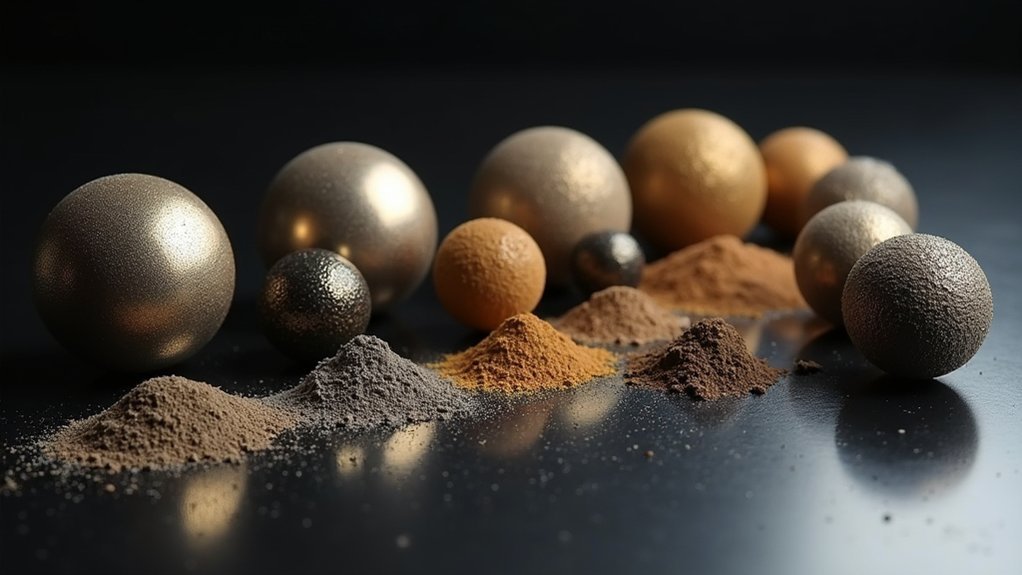
You’ll find that ASTM F42 establishes the foundational sphericity requirements of 0.91 or higher for most additive manufacturing applications, ensuring consistent powder flow and bed density.
ISO standards complement these specifications by providing additional measurement protocols and quality benchmarks that manufacturers must meet for certification.
Your specific equipment may require even stricter sphericity tolerances, as laser powder bed fusion systems often demand higher values than binder jetting or directed energy deposition processes.
ASTM Sphericity Requirements
The ASTM F42 committee has established rigorous sphericity standards that define metal powder quality in additive manufacturing applications. You’ll find that ASTM requires sphericity values of 0.91 or higher for peak performance in powder bed fusion technologies. This threshold guarantees superior flowability and reduces interparticle friction during processing.
| Atomization Method | Typical Sphericity | Quality Rating |
|---|---|---|
| Gas Atomization | 0.92-0.96 | Excellent |
| Water Atomization | 0.85-0.89 | Acceptable |
When you’re selecting powders for SLM operations, these ASTM specifications directly impact your print quality outcomes. Higher sphericity values improve packing density and consistent layer formation. You must implement rigorous quality control measures to meet these standards, as deviations below 0.91 greatly compromise flowability and increase defect formation in your printed components.
ISO Powder Standards
Multiple ISO standards govern metal powder sphericity specifications, with ISO 3272-1 establishing extensive requirements for additive manufacturing applications.
You’ll find that ISO 13320 mandates sphericity values exceeding 0.91 for ideal flowability, while ISO/ASTM 52900 demands over 98% sphericity specifically for laser powder bed fusion processes.
These powder characteristics directly impact your print quality and mechanical properties.
ISO 14879 provides measurement guidelines for particle morphology assessment, guaranteeing you can accurately evaluate sphericity metrics.
When you follow these ISO standards, you’ll achieve consistent processing parameters, reduced defects, and reliable part performance.
- ISO 3272-1 defines thorough additive manufacturing powder requirements
- ISO 13320 establishes minimum 0.91 sphericity threshold for flowability
- ISO/ASTM 52900 specifies 98% sphericity for L-PBF applications
- ISO 14879 standardizes morphology measurement techniques
- Compliance guarantees consistent mechanical properties and reduced processing defects
Equipment-Specific Specifications
Different additive manufacturing systems impose distinct sphericity requirements that’ll directly affect your powder selection and processing outcomes.
For Laser Powder Bed Fusion (L-PBF), you’ll need powders with sphericity ≥0.91 and particle size distribution between 15-45 μm to achieve ideal layer spreading and consistent melting. The spherical shape guarantees superior flowability during the recoating process.
Electron Beam Melting (EBM) systems require coarser powders ranging from 45-105 μm while maintaining high sphericity for effective sintering and part integrity.
Your choice of atomization method—gas or plasma—directly influences the spherical shape of particles, affecting both flowability and packing density.
ASTM F42 standards emphasize consistent sphericity across different AM processes to enhance efficiency and final part quality.
Impact of Sphericity on Powder Flowability Performance
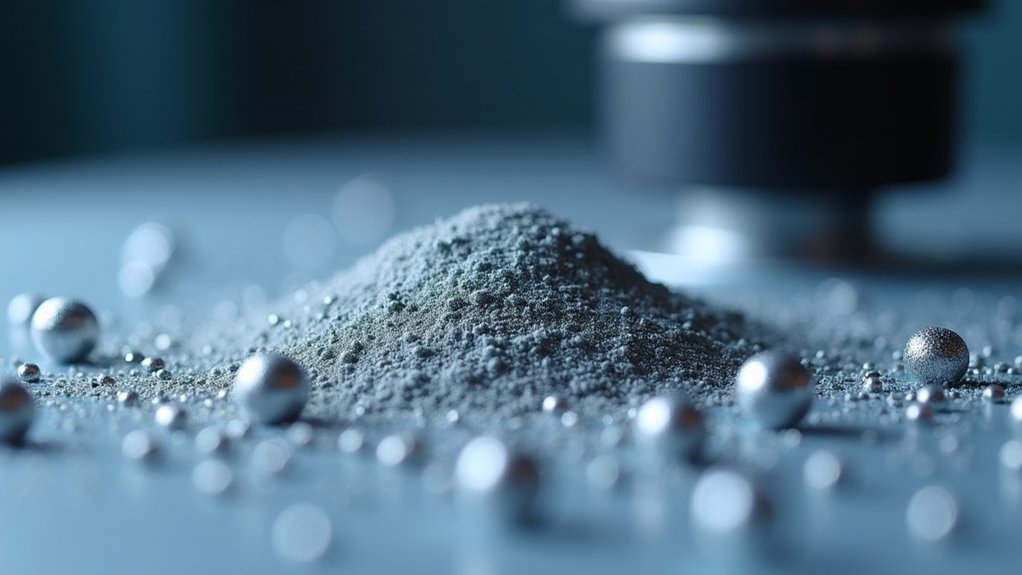
When sphericity values exceed 0.91 in metal printing powders, you’ll observe dramatically improved flowability that transforms the entire additive manufacturing process.
This enhanced flowability guarantees uniform powder spreading across build platforms, creating consistent layer formation that’s essential for high-quality prints.
Your powder particles will pack more densely when they’re highly spherical, reducing voids and maximizing material utilization in final components.
This improved packing density directly translates to stronger printed parts with superior structural integrity.
- Spherical powder particles roll more easily, reducing friction during spreading operations
- Enhanced flowability prevents powder bridging and guarantees smooth material distribution
- Better packing density minimizes porosity in sintered layers
- Consistent flow properties maintain uniform powder bed density throughout builds
- Reused spherical powders integrate seamlessly with fresh material
Sphericity Requirements for Laser Powder Bed Fusion Systems
Laser Powder Bed Fusion systems demand exceptionally high sphericity standards that go beyond general flowability requirements.
You’ll need metal powders with sphericity greater than 0.91 to guarantee peak performance during printing. This threshold directly impacts your powder’s flowability and uniform layer spreading capabilities.
When you’re working with particle size distributions between 15-45 μm, higher sphericity becomes even more critical.
It enhances melting characteristics and sintering efficiency while improving packing density and reducing interparticle friction. You’ll achieve better powder bed stability, leading to superior part quality.
For reliable L-PBF performance, you should target sphericity values exceeding 98%.
This guarantees consistent layer formation and prevents defects that compromise part integrity and mechanical properties.
Poorly spherical powders create inconsistent layers, undermining your entire printing process.
Electron Beam Melting Sphericity Specifications
You’ll need to meet stricter sphericity requirements for Electron Beam Melting than other additive manufacturing processes, with powders typically requiring 0.91 or higher sphericity values.
Your particle size distribution should fall within the 45–105 μm range to achieve ideal melting and sintering during the EBM process.
These specifications directly impact your powder’s flow characteristics and melting behavior, making sphericity control essential for preventing defects in your final components.
EBM Particle Size Requirements
Since Electron Beam Melting (EBM) operates at elevated temperatures with a focused electron beam, you’ll need metal powders with specific particle size distributions to achieve ideal melting efficiency. Your best particle size range should fall between 45 to 105μm. This controlled distribution directly impacts powder bed uniformity and prevents processing complications.
When selecting EBM powders, you must maintain sphericity values above 0.91. Gas atomization produces these spherical particles, enhancing flowability and packing density. Poor particle size control leads to agglomeration issues that compromise layer formation quality.
- Particle sizes below 45μm create excessive surface area, causing oxidation risks
- Oversized particles above 105μm reduce melting efficiency and surface finish
- Spherical morphology ensures consistent powder spreading across build platforms
- Controlled distributions prevent selective sintering defects during processing
- Ideal flowability reduces powder bridging in delivery systems
Sphericity Impact on Melting
When electron beams strike metal powder particles during EBM processing, spherical morphology becomes critical for achieving uniform energy absorption and consistent melting behavior. You’ll find that particles with sphericity values of 0.91 or higher deliver ideal flowability and thermal conductivity, ensuring efficient energy transfer during melting phases.
| Sphericity Range | Melting Uniformity | Thermal Behavior |
|---|---|---|
| 0.95+ | Excellent | Ideal conductivity |
| 0.91-0.94 | Good | Enhanced absorption |
| 0.85-0.90 | Fair | Moderate efficiency |
| 0.80-0.84 | Poor | Uneven heating |
| <0.80 | Very Poor | Incomplete melting |
Lower sphericity creates uneven layer formation and incomplete melting, compromising your part’s structural integrity. You’ll achieve better packing density with spherical particles, reducing porosity and enhancing mechanical properties essential for high-performance applications.
Powder Flow Characteristics
Ideal powder flow characteristics in EBM systems depend heavily on achieving sphericity values of 0.91 or higher within the preferred 45–105 µm particle size range.
You’ll find that maintaining these specifications directly impacts your print quality and consistency. Higher sphericity reduces inter-particle friction while improving packing density, resulting in smoother powder spreading across the build platform. This enhanced flowability guarantees uniform layer formation throughout your EBM process.
- Sphericity threshold: Maintain 0.91+ sphericity for superior powder movement and spreading uniformity
- Particle size optimization: Target 45–105 µm range to balance flowability with effective melting characteristics
- Friction reduction: Spherical particles minimize contact resistance during powder bed preparation
- Packing efficiency: Improved sphericity increases powder density and reduces voids between particles
- Layer consistency: Better flowability translates directly to more predictable and defect-free printed components
Direct Energy Deposition Powder Morphology Standards
As direct energy deposition (DED) processes build components layer by layer, the morphology of your metal powder becomes a critical factor that determines print quality and mechanical performance.
You’ll need powders with particle size distributions between 45 to 105 µm for effective melting and deposition. Your powder’s sphericity must exceed 0.91 to achieve ideal flowability and uniform layer formation. Irregularly shaped particles create inconsistent flow patterns and poor adhesion between layers, compromising your final component’s integrity.
The production method you choose directly impacts morphology quality. Gas atomization and plasma atomization techniques produce different sphericity levels, affecting your powder’s usability.
You must also maintain low oxygen and nitrogen impurity levels to preserve mechanical properties. Higher sphericity correlates with better packing density and more predictable deposition patterns during printing.
Atomization Methods and Their Effect on Particle Sphericity
Your powder’s sphericity depends heavily on which atomization method you select during production.
Gas atomization delivers the highest sphericity values (≥ 0.91) through rapid cooling and solidification from molten metal, creating uniform particles perfect for additive manufacturing.
Plasma atomization produces spherical particles but with variable sphericity due to inconsistent cooling rates during solidification.
Centrifugal atomization typically creates irregular shapes, reducing sphericity and compromising flowability for 3D printing applications.
- Gas atomization achieves superior sphericity through controlled rapid cooling processes
- Plasma atomization offers moderate sphericity with process-dependent variability
- Centrifugal methods produce irregular particles with poor flowability characteristics
- Higher sphericity directly improves powder packing density in printing systems
- Atomization selection critically determines final powder performance in manufacturing applications
Quality Control Protocols for Sphericity Verification
Effective sphericity measurement requires implementing robust quality control protocols that monitor particle characteristics throughout your production process.
Robust quality control protocols monitoring particle characteristics throughout production processes are essential for effective sphericity measurement implementation.
You’ll need dynamic imaging systems to accurately measure circularity and aspect ratio, guaranteeing particles meet the ≥ 0.91 sphericity threshold for additive manufacturing standards. These assessments directly impact flowability and packing density, which determine your final print quality.
ASTM standards provide specific measurement guidelines and acceptable ranges for consistent batch verification.
You should implement automated sphericity analysis to enhance quality control efficiency, enabling real-time adjustments to production parameters. Regular monitoring guarantees ideal powder characteristics across different applications.
Sphericity Tolerances Across Different Metal Alloy Types
Different metal alloys require specific sphericity tolerances to achieve excellent performance in additive manufacturing applications.
You’ll need to maintain precise sphericity standards for each material type to guarantee ideal flowability and consistent print quality. Metal powders with inadequate sphericity can compromise your manufacturing process through poor powder flow, uneven layer formation, and reduced packing density.
Understanding these tolerance requirements helps you select appropriate powders for your specific applications:
- Titanium alloys (Ti-6Al-4V): Maintain sphericity ≥0.95 for powder bed fusion excellence
- Stainless steel (316L): Achieve minimum 0.92 sphericity for enhanced packing density
- Inconel 718: Target 0.93-0.96 range for superior melting behavior during selective laser melting
- Aluminum alloys (AlSi10Mg): Guarantee sphericity >0.90 for effective layer formation
- General threshold: Values above 0.91 classify powders as acceptably spherical
Cost Implications of High Sphericity Powder Requirements
When you’re specifying high sphericity powders for your metal printing operations, you’ll face significant production cost factors that can dramatically impact your bottom line.
The specialized atomization processes required to achieve sphericity levels of 0.91 or higher command premium pricing that’s often 2-3 times higher than irregular powder alternatives.
You’ll need to carefully evaluate economic process tradeoffs between powder quality requirements and budget constraints, as overspecification can inflate costs without delivering proportional performance benefits.
Production Cost Factors
Although high sphericity metal powders deliver superior performance in additive manufacturing processes, they’ll greatly impact your production budget through specialized manufacturing requirements.
Advanced atomization techniques like gas and plasma methods drive up production costs compared to conventional powder manufacturing. Your material selection greatly affects pricing, with titanium alloys and Inconel commanding premium prices over standard stainless steels due to their complex processing needs.
Key production cost factors include:
- Specialized atomization equipment requiring substantial capital investment
- Rigorous quality control protocols demanding advanced testing equipment and expert oversight
- Custom powder specifications extending lead times and increasing manufacturing complexity
- Tight particle size tolerances often resulting in overspecification without performance benefits
- Enhanced processing requirements for maintaining consistent sphericity throughout production batches
Economic Process Tradeoffs
Manufacturing high sphericity metal powders creates a cascade of economic decisions that directly impact your bottom line and project timelines.
You’ll face higher material costs when using advanced atomization techniques like gas or plasma atomization instead of traditional methods. While sphericity values exceeding 0.91 improve flowability, you risk overspecification that inflates prices without meaningful technical benefits.
Customization requirements often extend lead times and increase costs, forcing you to balance performance needs against budget constraints.
Manufacturing processes become more complex as you pursue specialized high sphericity alloys, potentially requiring investment in additional equipment. Limited supplier availability compounds these challenges, creating dependency on expensive sources.
You must carefully evaluate whether enhanced powder characteristics justify the premium costs and extended procurement cycles.
Sphericity Degradation During Powder Recycling Processes
As you recycle metal powders through multiple processing cycles, mechanical wear and friction progressively degrade their spherical shape, creating increasingly irregular particles that compromise flowability.
When sphericity values drop below 0.91, you’ll encounter significant quality issues in your additive manufacturing process. Your recycled powders also experience particle size distribution shifts, with smaller particles becoming more prevalent and further reducing sphericity.
Your powder’s prior processing history directly impacts its reusability potential. Poor sphericity from previous prints prevents proper integration with new layers, ultimately affecting your final print quality.
Processing history determines powder viability – compromised sphericity from previous cycles creates layer integration failures that degrade final print quality.
- Monitor sphericity values continuously to maintain the 0.91 threshold
- Implement strict quality control protocols during recycling operations
- Track processing history to predict powder degradation patterns
- Assess particle size distribution changes after each recycling cycle
- Establish rejection criteria for powders with compromised sphericity
Comparative Analysis of Sphericity Standards by Equipment Type
Different additive manufacturing technologies impose varying sphericity requirements on your metal powders, with each equipment type demanding specific particle characteristics for optimal performance.
When you’re using laser powder bed fusion (L-PBF) systems, you’ll need powders with sphericity values of ≥0.91 to achieve ideal flowability and uniform layer deposition.
Your electron beam melting (EBM) equipment tolerates broader sphericity ranges while still benefiting from higher values for improved powder flow and packing density.
If you’re operating coaxial powder feeding printers, you’ll find less stringent sphericity requirements, though spherical particles still enhance overall performance.
Higher sphericity reduces interparticle friction, ensuring smoother operation.
Maintaining consistent sphericity across batches is essential for reliable part quality and mechanical properties.
Future Developments in Sphericity Measurement and Standards
While current sphericity measurement methods provide adequate baseline assessments, emerging technologies promise to revolutionize how you’ll evaluate and standardize metal powder characteristics in the coming years.
You’ll see 3D laser scanning replace traditional imaging, delivering unprecedented precision in particle shape analysis.
Standardized testing protocols through ISO and ASTM frameworks will guarantee consistent sphericity evaluation across powder manufacturing facilities.
Automation will eliminate human error while enabling real-time monitoring during production cycles.
Machine learning integration will help you predict how sphericity variations affect powder performance in additive manufacturing.
In-situ assessment tools will provide immediate feedback, allowing instant adjustments during manufacturing processes.
- Advanced 3D laser scanning for thorough particle shape analysis
- Automated real-time monitoring systems reducing measurement errors
- Standardized ISO/ASTM protocols guaranteeing industry-wide consistency
- Machine learning algorithms predicting powder behavior patterns
- In-situ assessment tools enabling immediate production adjustments
Frequently Asked Questions
What Are the Tolerances for Metal Printing?
You’ll need to maintain sphericity above 0.91 for ideal results. Your tolerances become critical in aerospace and medical applications, where deviations can compromise structural integrity and performance in high-precision manufacturing.
What Are the Different Grades of Metal Powder?
You’ll find metal powder grades categorized by composition like 316L stainless steel, Ti-6Al-4V, Inconel 718, AlSi10Mg, and CoCrMo, plus particle size ranges from 15-53 µm for laser systems.
What Is the Market for 3D Printing Metal Powder?
You’re looking at a rapidly expanding market worth $1.1 billion in 2021, projected to reach $3.8 billion by 2027. That’s a 23.6% annual growth rate driven by aerospace, automotive, and medical applications.
What Is the Standard Particle Size of a Powder?
You’ll find standard metal powder particles range from 15-53 μm for fine powders and 53-105 μm for coarse ones, with specific sizes depending on your additive manufacturing process requirements.

Leave a Reply