

You’ll find metal alloy powder costs range from $50 per kilogram for standard stainless steel to over $10,000 for precious metals like gold and platinum. High-performance alloys like nickel superalloys cost $300-$600 per kilogram, while specialty titanium powders exceed $1,000. Your total expenses include quality certification ($1,000-$5,000), testing ($300-$1,500 per batch), and transportation ($0.50-$2.00 per kg). However, bulk purchasing can reduce costs by 10-30%, and recycling delivers 20-50% savings. The complete picture reveals additional cost optimization strategies.
Understanding Base Metal Powder Costs Across Different Alloy Categories

When you’re exploring metal alloy powder pricing, you’ll find that costs vary dramatically across different categories, with standard metals forming the foundation of the market at $50 to $100 per kilogram.
These alloy categories determine your material costs considerably. Standard options like stainless steel and aluminum offer affordability for general applications, while high-performance metals advance into the $300 to $600 range for specialized uses in aerospace and medical fields.
Specialty metals represent the premium tier, where titanium alloys and precious metal powder can exceed $1,000 per kilogram.
You’ll notice that cost per kilogram increases greatly as performance requirements intensify. Understanding these categories helps you budget appropriately, whether you’re selecting basic functional materials or investing in cutting-edge specialty metals for demanding applications.
Standard Alloy Powders: Stainless Steel and Aluminum Price Analysis
As you examine standard alloy powders, you’ll discover that stainless steel and aluminum represent the most accessible entry points into metal powder applications.
Both standard alloy powders maintain competitive material prices ranging from $50 to $100 per kilogram, making them cost-effective choices for functional projects. Your cost analysis should consider that stainless steel pricing varies with alloy composition—higher-grade variants command premium rates at the upper price range.
Standard alloy powders remain cost-effective at $50-$100 per kilogram, though premium stainless steel compositions command higher pricing.
Aluminum powders offer similar pricing with added benefits of lightweight properties and corrosion resistance, making them ideal for automotive and aerospace applications.
You’ll find significant savings through bulk purchasing, as manufacturers and service providers often receive substantial discounts on larger orders, further improving the economic viability of these materials.
High-Performance Alloy Powders: Nickel and Cobalt Chrome Cost Factors
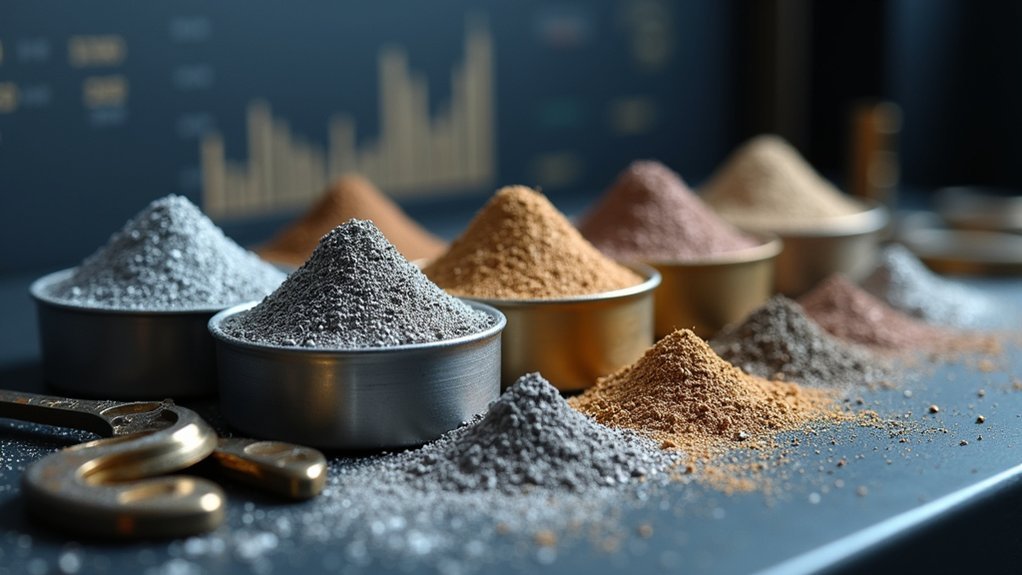
When you’re considering high-performance alloy powders, you’ll find that nickel superalloys typically cost between $300 to $600 per kilogram, making them a significant investment for aerospace and medical applications.
Cobalt chrome powders often exceed $500 per kilogram due to their exceptional wear resistance and biocompatibility properties that justify the premium pricing.
You’ll need to factor in how particle size, purity levels, and specific alloy compositions directly impact these costs, especially since finer powders command higher prices in the market.
Nickel Superalloy Pricing
Understanding the pricing structure of nickel superalloy and cobalt chrome powders proves essential for anyone working in aerospace, medical device manufacturing, or other high-performance applications.
Nickel superalloys typically command $300 to $600 cost per kilogram, reflecting their exceptional properties and manufacturing complexity.
Several factors directly influence your powder costs:
- Particle size specifications – Finer powders demand premium pricing due to advanced processing requirements
- Purity levels and chemical composition – Higher purity grades cost considerably more than standard variants
- Flowability characteristics – Enhanced flow properties increase manufacturing expenses
You’ll find batch purchasing offers substantial savings for large-scale projects.
The pricing reflects nickel superalloys’ unique combination of high-temperature strength and corrosion resistance, making them indispensable for specialized applications despite the investment required.
Cobalt Chrome Applications
Several industries rely on cobalt chrome alloys for their most demanding applications, where exceptional performance justifies the $300 to $600 per kilogram investment.
You’ll find these metal powders essential for aerospace components requiring superior strength-to-weight ratios and extreme temperature resistance. Medical device manufacturers choose cobalt chrome for dental implants and orthopedic hardware due to its biocompatibility and wear resistance.
When you’re evaluating manufacturing solutions, consider that the cost of metal represents just one factor in your total expenses.
Advanced processing techniques like Direct Energy Deposition and Selective Laser Melting require specialized equipment, increasing production costs. However, you’ll benefit from high buy-to-fly ratios that minimize waste, offsetting some material expenses and delivering valuable cost savings for intricate component production.
Premium Specialty Powders: Titanium and Precious Metal Pricing
You’ll encounter the highest costs in the powder metallurgy market when you’re sourcing titanium alloys and precious metal powders, which routinely exceed $1,000 per kilogram.
These premium materials command such pricing because they’re produced through advanced manufacturing techniques like gas atomization and require exceptional purity standards for aerospace and medical applications.
Your final costs will depend on specific factors including alloy composition, particle size distribution, and the stringent quality control measures that specialty-grade powders demand.
Titanium Alloy Powder Costs
When you’re sourcing titanium alloy powders for additive manufacturing, you’ll encounter some of the steepest material costs in the metal powder market. The material cost per kilogram typically exceeds $1,000 for high-performance titanium alloys used in aerospace and medical applications, though standard grades range from $300-$600.
Several factors drive these premium prices for metal powders:
- Particle characteristics – Finer powders with superior flowability command higher prices
- Purity levels – Medical and aerospace-grade specifications increase costs considerably
- Energy consumption – Intensive processing requirements elevate production expenses
While recycling capabilities can offset some expenses, you’ll still face substantial upfront investments.
Specialty titanium formulations often price even higher due to limited availability and specialized applications, making careful material planning essential for project profitability.
Precious Metal Premium Pricing
Precious metal powders command even steeper prices than titanium alloys, with gold and platinum formulations reaching $4,000 to $10,000 per kilogram depending on current market conditions.
You’ll find that precious metals consistently exceed the $1,000 per kilogram threshold due to their specialized applications in aerospace and medical industries. This premium pricing reflects the exceptional performance characteristics these materials deliver.
When you’re sourcing powder materials, you’ll notice that particle size and purity level greatly impact cost structures.
Finer precious metal powders typically carry higher price tags than standard grades. While bulk purchasing can provide some discounts, the premium pricing remains substantial compared to conventional titanium alloys.
You’ll need to factor these elevated costs into your manufacturing budget when selecting high-performance powder materials for critical applications.
Specialty Grade Price Factors
Several critical factors drive the elevated pricing of specialty grade metal powders beyond their base material costs.
When you’re sourcing high-performance materials like titanium alloys or precious metal powders, you’ll encounter complex pricing dynamics that reflect more than just raw material value.
The key factors influencing specialty grade pricing include:
- Production complexity – Advanced manufacturing processes requiring precise control over particle size, purity levels, and alloy composition greatly increase costs.
- Supply chain constraints – Limited suppliers and specialized distribution networks create bottlenecks that affect availability and pricing.
- Market demand fluctuations – Aerospace and medical sector requirements drive premium pricing for materials meeting stringent performance standards.
Understanding these factors helps you anticipate cost variations and make informed purchasing decisions for your high-performance applications.
Particle Size and Purity Impact on Metal Powder Costs
The particle size of metal alloy powders dramatically affects your purchasing costs, with finer powders typically carrying premium prices that can double or triple standard rates.
Finer metal alloy powders command premium pricing that can double or triple your standard procurement costs.
When you’re selecting metal powders between 10-25 μm, you’ll face considerably higher costs compared to coarser 45-150 μm grades due to complex production requirements. The enhanced flowability and precision capabilities of fine particles justify these premium pricing structures.
Purity levels create another major cost factor in your procurement decisions. Higher purity metal powders demand extensive processing to eliminate impurities, driving prices substantially upward.
You’ll find standard stainless steel powder costs $50-$100 per kilogram, while specialized high-purity alloys exceed $300 per kilogram. Additionally, you’ll encounter extra expenses for specialized handling and storage requirements that these premium materials demand.
Transportation and Storage Expenses for Metal Alloy Powders
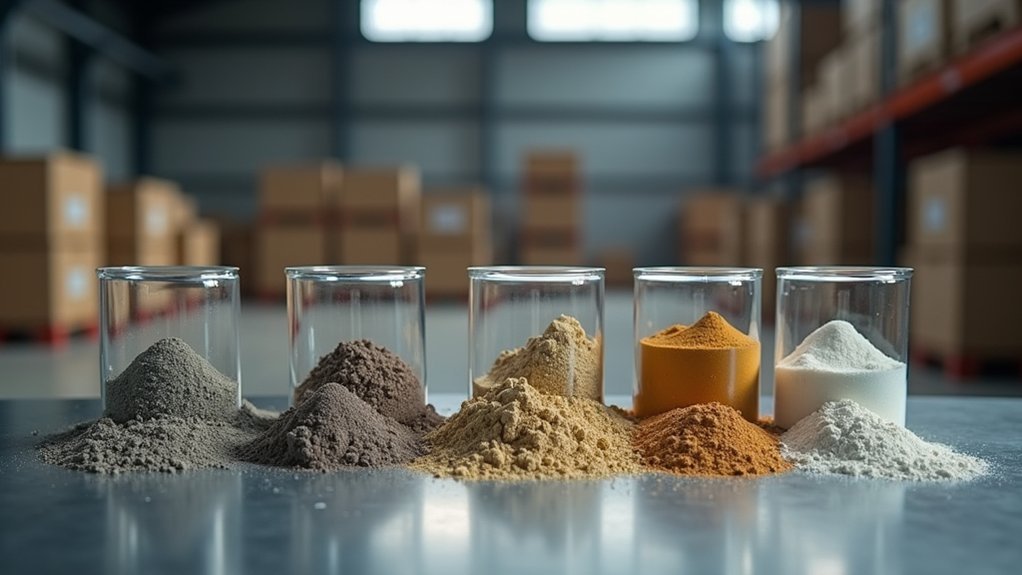
Beyond initial powder costs, you’ll face considerable transportation and storage expenses that greatly impact your total procurement budget for metal alloy powders.
Transportation costs typically range from $0.50 to $2.00 per kilogram for ground shipping within North America, varying by distance and weight. However, packaging requirements for metal powders add complexity since they need airtight containers to prevent oxidation, increasing shipping costs by 5-15%.
Storage expenses present additional challenges:
- Climate-controlled facilities cost 20-30% more than standard warehousing
- Safety compliance requires specialized handling and documentation
- Ideal conditions are essential to maintain powder quality
Smart inventory management can reduce these expenses considerably.
You’ll benefit from bulk purchasing strategies, as suppliers often offer discounts for larger orders that minimize shipment frequency and overall logistics costs.
Market Demand Fluctuations Affecting Powder Prices
You’ll notice that aerospace industry demand spikes can drive titanium and nickel-based superalloy prices from $300 to $600 per kilogram, creating significant cost pressures for your procurement budget.
When supply chain disruptions hit your suppliers, you’re likely to face sudden price hikes that can impact project timelines and profitability.
Raw material scarcity compounds these challenges, forcing you to navigate volatile pricing conditions that can shift dramatically based on geopolitical factors and seasonal trends.
Aerospace Industry Demand Spikes
As aerospace manufacturers ramp up production of aircraft and space vehicles, they’re driving unprecedented demand spikes for high-performance metal alloy powders that directly impact your material costs.
You’re now facing titanium and nickel superalloys pricing between $300-$600 per kilogram, with specialty grades exceeding $1000.
The aerospace industry’s 3-4% CAGR is intensifying competition for these critical materials:
- Extended lead times from suppliers struggling to meet surge demands
- Custom alloy development for advanced additive manufacturing applications commanding premium pricing
- Post-pandemic production acceleration creating supply chain bottlenecks
Your procurement strategy must account for these aerospace-driven market dynamics.
R&D investments in next-generation aircraft technologies are pushing demand for increasingly sophisticated metal powders, making cost planning more challenging as pricing volatility becomes the new normal.
Supply Chain Disruptions
Supply chain disruptions have transformed metal alloy powder pricing from predictable cycles into volatile swings that can devastate your budget planning overnight.
You’ve witnessed how geopolitical tensions and pandemics created unprecedented price increases of up to 30% in recent years, forcing manufacturers to scramble for alternative sourcing strategies.
When raw material availability becomes constrained through reduced mining outputs and transportation bottlenecks, you’ll face cascading effects throughout the supply chain.
These disruptions don’t just impact immediate costs—they reshape entire market trends and force you to reconsider long-term procurement strategies.
You can’t ignore how these supply chain vulnerabilities affect metal powders pricing structures, particularly when high-performance materials become scarce.
Understanding these disruption patterns helps you anticipate future volatility and develop more resilient purchasing approaches.
Raw Material Scarcity
Raw material scarcity drives metal alloy powder prices into territory that can cripple your production budgets, with market demand fluctuations creating perfect storms of cost escalation.
When high-performance metal powders like titanium become scarce, you’re looking at costs exceeding $1,000 per kilogram. Supply chain disruptions amplify these challenges, particularly when geopolitical factors affect mining operations.
You’ll face three critical pricing fluctuations:
- Market competition intensifies between traditional manufacturing and additive manufacturing sectors, driving up demand for limited metal powders
- Environmental regulations tighten mining practices, reducing supply while increasing production costs
- Global events disrupt availability as industries like aerospace surge post-crisis, creating unexpected demand spikes
These factors compound your procurement challenges, making strategic sourcing essential.
Supplier Reliability and Its Cost Implications
When you’re sourcing metal alloy powders, your supplier’s reliability directly impacts your bottom line in ways that extend far beyond the initial purchase price.
Reliable suppliers offer bulk discounts that reduce material costs by 10-30% compared to inconsistent sources. They guarantee your quality requirements are met, preventing costly waste and post-processing expenses that unreliable suppliers often cause through subpar powders.
Dependable suppliers deliver 10-30% cost reductions through bulk pricing while ensuring quality standards that eliminate waste and rework expenses.
You’ll avoid the 15-25% budget escalations from delays, expedited shipping, and lost production time when working with dependable partners.
Long-term relationships with trustworthy suppliers yield favorable pricing agreements, delivering overall cost savings of up to 20% on large orders. Their faster fulfillment eliminates expensive rush orders, improving your production efficiency while keeping costs controlled.
Bulk Purchase Discounts and Volume Pricing Strategies
Building on these supplier relationships opens the door to considerable savings through strategic bulk purchasing. When you order metal powders in larger quantities, you’ll access bulk purchase discounts ranging from 10% to 30%.
Suppliers employ tiered pricing structures where orders exceeding 100 kilograms greatly reduce per-kilogram costs.
Consider these volume pricing strategies:
- Negotiate long-term contracts for consistent pricing and guaranteed availability
- Target high-performance metals where bulk buying can slash costs from $600/kg to $300/kg
- Leverage rebate programs for regular, high-volume purchases
For high-performance metals like nickel superalloys and titanium alloys, bulk purchasing transforms project economics.
You’ll find suppliers increasingly willing to offer favorable terms when you commit to substantial volumes, making large-scale manufacturing projects financially viable.
Quality Certification and Testing Costs
While bulk purchasing delivers substantial savings, you’ll need to factor in quality certification and testing costs that greatly impact your total powder expenses. Quality certification involves thorough analysis of composition, particle size distribution, and impurity levels, costing $1,000 to $5,000 per certification. Testing costs for mechanical properties like tensile strength add another $300 to $1,500 per batch.
| Testing Type | Cost Range |
|---|---|
| Basic Certification | $1,000 – $5,000 |
| Mechanical Properties | $300 – $1,500 |
| Audit Fees | $500 – $3,000 |
| SEM Analysis | $1,000 – $3,000 |
| Ongoing Testing | $0.50 – $2.00/kg |
Regular compliance testing adds $0.50 to $2.00 per kilogram, while advanced SEM analysis for particle morphology costs $1,000 to $3,000 per analysis.
Regional Price Variations for Metal Alloy Powders
Although quality certification represents a notable expense, regional pricing variations can dramatically affect your overall procurement costs for metal alloy powders.
You’ll find substantial differences across global markets that directly impact your budget.
Here’s how regional demand influences pricing:
- U.S. markets average $3-12 per lb for stainless steel, while cobalt alloys reach $50-250 per lb
- European suppliers typically charge 10-20% more due to stricter regulations and quality standards
- Asian manufacturers offer competitive rates from $1.50-3.00 per lb, benefiting from lower manufacturing expenses
Your location relative to aerospace hubs and industrial centers affects pricing variations considerably.
Custom alloy prices command premiums everywhere, but you’ll still save considerably by sourcing strategically across regions while maintaining quality requirements.
Recycling and Reusability Cost Benefits
Beyond strategic sourcing across regions, you can achieve substantial cost reductions through recycling and reusing metal alloy powders from your manufacturing processes.
Recycling typically delivers 20% to 50% savings compared to purchasing new materials, with recovery rates reaching up to 90% of unused powder. This markedly reduces your material costs while maintaining consistent performance—recycled powders retain similar properties to virgin materials, ensuring quality in additive manufacturing applications.
You’ll find the initial investment in recycling systems quickly pays off, especially with high-performance metals exceeding $1,000 per kilogram.
Beyond financial benefits, implementing powder recycling supports your sustainability goals by minimizing environmental impact and reducing demand for raw material extraction.
Reused powders offer both economic and environmental advantages for modern manufacturing.
Total Cost of Ownership for Metal Powder Inventory Management
When calculating the true financial impact of metal powder operations, you must consider the total cost of ownership (TCO) that extends far beyond initial material purchases. Your initial material costs will range from $50 to over $1,000 per kilogram depending on alloy complexity, but that’s just the beginning of your financial commitment.
Smart TCO management requires addressing these critical areas:
- Storage and handling expenses – Poor management leads to contamination and degradation, increasing waste costs.
- Recycling strategies implementation – Achieving 90% recycling rates dramatically reduces long-term material expenditure.
- Inventory management systems – Tracking usage patterns and expiration dates optimizes material availability while minimizing holding costs.
You’ll also need regular market assessments since metal powders experience significant pricing fluctuations based on supply chain factors and demand variations.
Frequently Asked Questions
How Much Does Metal 3D Printing Powder Cost?
You’ll pay $50-$100 per kilogram for standard metals like stainless steel, but expect $300-$600 for high-performance alloys. Specialty metals including titanium often exceed $1,000 per kilogram for advanced applications.
What Is the Cost of Dmls Powder?
You’ll pay $50-100 per kilogram for standard DMLS metals like stainless steel, while high-performance alloys cost $300-600. Specialty metals such as titanium exceed $1,000 per kilogram due to their advanced properties.
What Are the Different Grades of Metal Powder?
You’ll find three main grades: standard metals like stainless steel ($50-100/kg), high-performance metals such as nickel superalloys ($300-600/kg), and specialty metals including titanium alloys (over $1,000/kg).
What Is Alloy Powder?
You’ll find alloy powder is finely ground metal mixtures created by atomizing molten alloys. It’s engineered for specific properties, offering controlled particle sizes and high purity for manufacturing complex parts in aerospace, medical, and automotive applications.




Leave a Reply