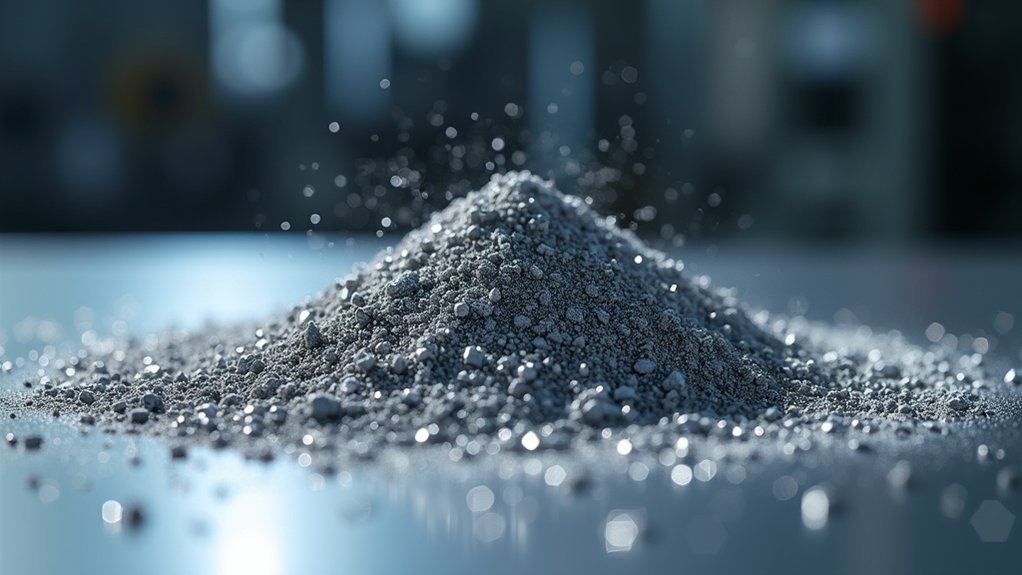
You’ll achieve ultimate tensile strengths of 2050±100 MPa with maraging steel powder through age-hardening at 490°C, making it ideal for aerospace applications requiring exceptional strength-to-weight ratios. The powder’s 15-53μm particle size guarantees optimal flow during direct metal laser sintering, while achieving 100% relative density eliminates porosity concerns. You can create complex geometries with integrated lattice structures that reduce material consumption while maintaining structural integrity. Understanding these enhancement parameters will release even greater performance possibilities.
Superior Mechanical Properties of Maraging Steel in Aerospace Applications
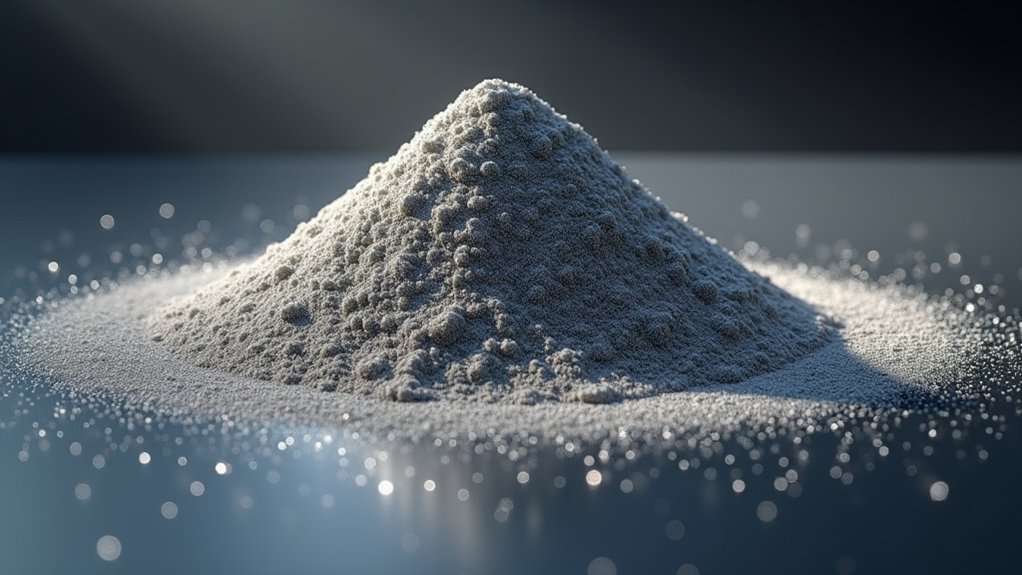
When you’re designing aerospace components that must withstand extreme mechanical stresses, maraging steel delivers the exceptional performance you need. This remarkable alloy achieves impressive ultimate tensile strength of 2050±100 MPa through its age-hardening process, making it ideal for critical aerospace applications.
Maraging steel’s exceptional 2050±100 MPa tensile strength through age-hardening makes it indispensable for critical aerospace applications requiring extreme stress resistance.
You’ll benefit from yield strengths reaching 1370-1424 MPa in the XY direction, providing essential structural integrity for demanding environments.
The excellent mechanical properties of maraging steel extend beyond raw strength. You’ll find exceptional toughness and high fatigue resistance that minimize mechanical failure risks in aerospace operations.
Heat treatment capabilities allow you to tailor hardness and strength to meet specific requirements. Additionally, maraging steel’s machinability after additive manufacturing enables you to produce complex geometries essential for modern aerospace component designs.
Heat Treatment Capabilities for Enhanced Performance Characteristics
Through precise thermal age-hardening processes, you’ll release maraging steel’s full potential by transforming its mechanical properties to meet demanding aerospace specifications. When you heat treat maraging steel powder components at 490°C, you’ll achieve remarkable property enhancements that make this metal ideal for metal 3D printing applications.
| Property | As-Built | Post Age-Hardening | Improvement |
|---|---|---|---|
| Tensile Strength | 1100±100 MPa | 2050±100 MPa | 86% increase |
| Hardness | <40 HRC | >50 HRC | Excellent hardness |
| Applications | Limited | Aerospace/Tooling | Expanded use |
You’ll find that this age-hardening process provides exceptional versatility in component design, allowing you to tailor properties for specific aerospace requirements. The steel maintains ductility while achieving superior strength, making it perfect for high-performance applications requiring both durability and precision manufacturing capabilities.
Direct Metal Laser Sintering Process Optimization for Aerospace Components
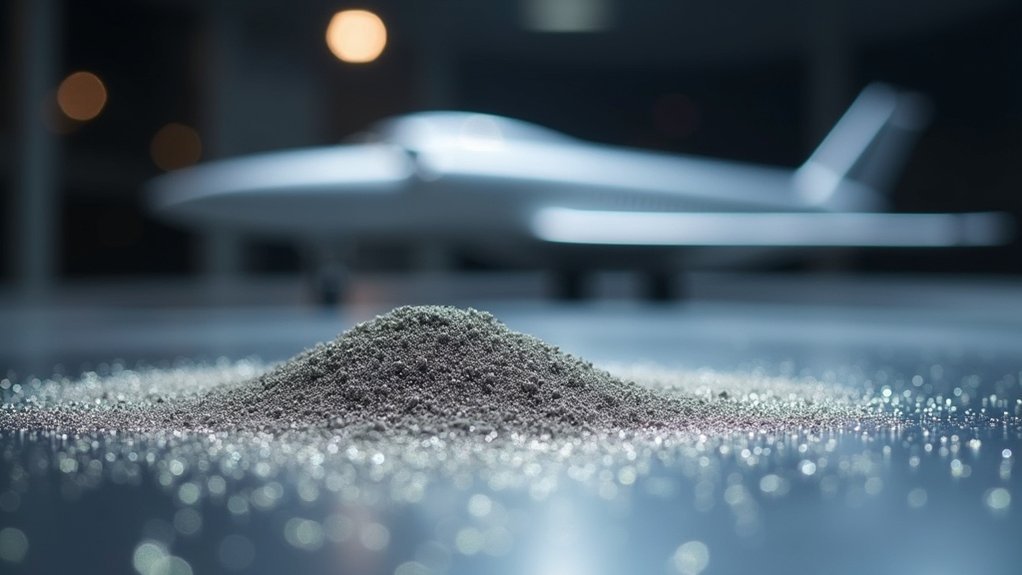
Optimize your Direct Metal Laser Sintering (DMLS) parameters to release maraging steel’s exceptional capabilities in aerospace component manufacturing.
You’ll achieve superior results by fine-tuning laser power, scanning speed, and layer thickness to guarantee 100% relative density in your components. This metal powder responds exceptionally well to controlled thermal processing, enabling complex geometries impossible through traditional methods while minimizing material waste.
Your DMLS process creates parts ready for the age-hardening process to obtain ultimate tensile strengths reaching 2050±100 MPa.
Post-processing at 490°C delivers excellent hardness and toughness combinations essential for demanding flight applications. You’ll benefit from exceptional dimensional stability throughout manufacturing, making maraging steel ideal for precision tooling applications.
The additive approach guarantees lightweight yet durable components that meet aerospace industry’s stringent safety and performance requirements.
Powder Specifications and Material Density Requirements
Precision defines the foundation of successful maraging steel 3D printing, starting with powder specifications that directly impact your component’s final performance.
You’ll need particles sized between 15μm to 53μm to achieve ideal flow characteristics during laser powder bed fusion. The gas atomization process using nitrogen creates spherical morphology, maximizing packing density for consistent results.
Material density requirements are critical for aerospace applications. You’re working with 8.9 g/cm³ density that enables 100% relative density in finished parts. This complete density eliminates porosity that could compromise structural integrity in flight-critical components.
Your maraging steel powder delivers excellent hardness after proper heat treatment, meeting stringent aerospace standards.
The spherical particles ensure repeatable processing parameters while maintaining the mechanical properties essential for demanding aerospace environments.
Cost-Effective Design Strategies for Complex Aerospace Geometries
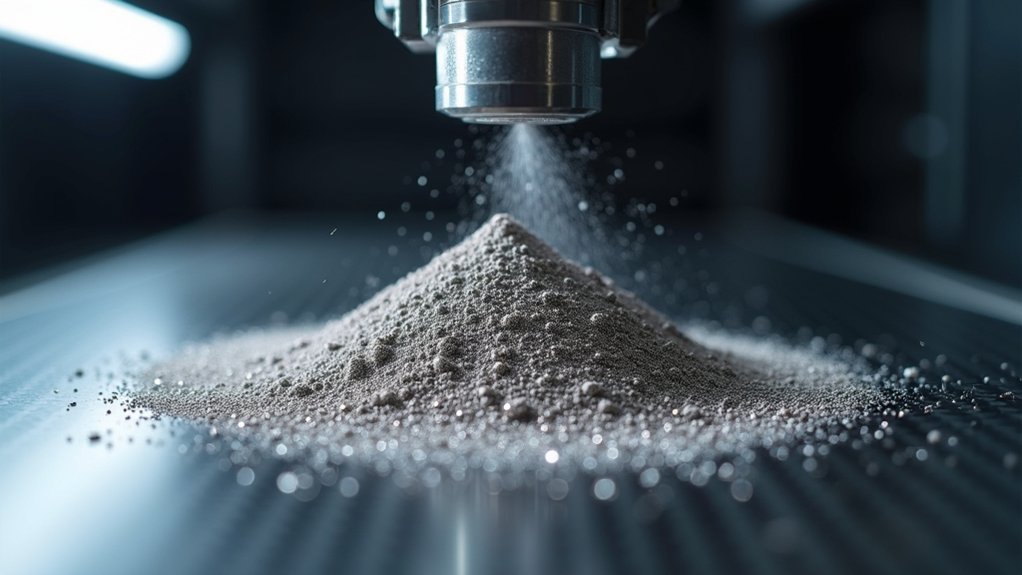
When designing complex aerospace geometries with maraging steel powder, you’ll reveal significant cost savings by leveraging additive manufacturing’s unique capabilities to create lightweight structures that traditional methods can’t achieve.
This specific alloy enables cost-efficient designs through integrated lattice structures and hollow sections that maintain strength while reducing material consumption. You can eliminate unnecessary features and combine multiple functions into single printed parts, cutting assembly time and production costs.
Strategic support structure placement prevents warping during the metal printing process, ensuring your intricate designs meet tight tolerances.
Don’t forget to include escape holes in enclosed areas—this simple addition facilitates unfused powder removal and streamlines post-processing. By optimizing these design elements, you’ll maximize the economic benefits of maraging steel powder in aerospace applications.
Frequently Asked Questions
What Are the Disadvantages of Maraging Steel?
You’ll face higher costs due to complex production, time-consuming heat treatment creating variability, limited wear resistance, potential brittleness causing cracking, and you’ll need specialized machining techniques increasing complexity.
What Is Maraging Steel Equivalent To?
You’ll find maraging steel equivalent to titanium alloys and tool steels in strength, while it’s comparable to aerospace-grade aluminum and nickel superalloys like Inconel in high-performance applications.
What Is Maraging Steel Used For?
You’ll find maraging steel used in aerospace rocket motor cases, tooling for injection molding, defense armor components, missile casings, and high-performance gears where you need exceptional strength and toughness.
Is 300M Maraging Steel?
You’re looking at a specific grade of maraging steel. 300M maraging steel, or 18Ni300, is indeed a high-performance variant that’s specially formulated for additive manufacturing applications.



Leave a Reply