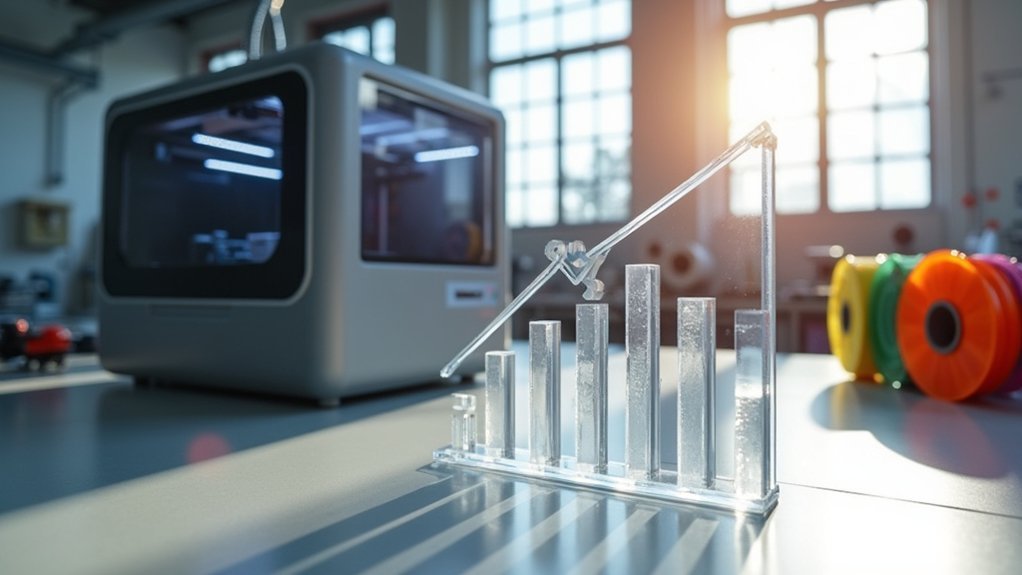
You’ll achieve remarkable cost savings with 3D printing manufacturing, including up to 87.6% ROI gains compared to traditional methods. Material waste drops dramatically—motorcycle brake levers cost $55.06 versus $2,869.46 for injection molding. You’ll eliminate expensive tooling and mold costs while reducing labor expenses through automation. Break-even typically occurs after producing just 96 parts with a $13,499 investment. On-demand production cuts inventory costs and enables cost-effective customization. Explore how these savings transform your production economics.
Understanding Return on Investment in 3D Printing Technology
Revolution in manufacturing economics has arrived with 3D printing technology, delivering remarkable returns on investment that can transform your production costs.
You’ll discover that additive manufacturing generates substantial cost savings, with documented cases showing ROI gains reaching 87.6% when comparing reduced manufacturing costs against initial equipment investments.
Your break-even point becomes achievable quickly—typically after producing just 96 parts with a $13,499 3D printer investment.
You’ll eliminate expensive tooling requirements while gaining the ability to create complex geometries and customized products.
The technology’s financial impact extends beyond equipment recovery, fundamentally changing how you approach production economics.
These return on investment metrics demonstrate that 3D printing isn’t just innovative—it’s financially transformative for your manufacturing operations.
Material Cost Reduction Through Additive Manufacturing
You’ll discover that additive manufacturing’s layer-by-layer approach eliminates the material waste inherent in traditional subtractive methods, where excess material is cut away and discarded.
This waste reduction translates directly into cost savings, as demonstrated by motorcycle brake lever production where 3D printing costs just $55.06 in materials compared to $2,869.46 for injection molding prototypes.
On-demand production further amplifies these savings by eliminating inventory costs and ensuring you only use materials when parts are actually needed.
Waste Elimination Benefits
Since traditional manufacturing methods like machining and molding remove material to create parts, they generate substantial waste that drives up your production costs.
3D printing flips this approach entirely by building objects layer by layer, using only the exact amount of material needed for each component.
This waste elimination approach delivers significant benefits to your bottom line. You’ll reduce costs by up to 75% in applications like sand casting, where production expenses can drop from 3,600 € to just 900 € per part.
The additive process minimizes material waste while eliminating expensive tooling requirements, making small-batch production economically viable.
You’ll also reduce material costs through on-demand manufacturing, which eliminates surplus inventory and overproduction expenses while enabling complex geometries with minimal material usage.
On-Demand Production Economics
Beyond eliminating waste, 3D printing transforms your manufacturing economics through on-demand production capabilities that drastically cut material costs.
You’ll eliminate the need for large inventories since parts are manufactured exactly when needed, reducing storage expenses and enabling just-in-time production models. This on-demand production approach means you’re not tying up capital in unused material sitting in warehouses.
The economic advantages become clear when comparing production costs. For instance, manufacturing a motorcycle brake lever through 3D printing costs $55.06 versus $195.95 for conventional CNC milling when producing under 100 units.
You’ll achieve substantial savings while maintaining quality. Additionally, the flexibility of additive manufacturing allows quick design iterations without expensive tooling changes, further reducing material waste and associated costs throughout your production cycle.
Elimination of Tooling and Mold Expenses
When you adopt 3D printing technology, you’ll immediately eliminate the substantial upfront costs associated with tooling and molds that traditional manufacturing demands. This elimination of tooling expenses translates to dramatic cost reductions, with savings reaching up to 75% compared to conventional methods.
| Manufacturing Method | Cost per Part | Tooling Required | Initial Investment |
|---|---|---|---|
| Traditional Manufacturing | €3,600 | Multiple molds | High |
| 3D Printing | €900 | None | Low |
| Small Batch Traditional | €3,600+ | Custom tooling | Very High |
| Small Batch 3D Printing | €900 | None | Low |
| Complex Geometry Traditional | €4,000+ | Multiple setups | Extremely High |
You’ll work with a single CAD dataset for production, removing expenses tied to creating and maintaining multiple molds. This makes individual parts and small batches economically viable without tooling overhead.
Labor Cost Savings in Production Processes
While traditional manufacturing requires extensive manual labor for setup, operation, and assembly, 3D printing automates the production process through layer-by-layer construction that runs with minimal human oversight.
You’ll dramatically cut labor costs by eliminating complex tooling preparation and lengthy changeover times between projects. Production time drops from weeks to days, reducing the total labor hours you need per project.
Slash labor costs by eliminating tooling setup and reducing production time from weeks to days per project.
The automation capabilities let you create complex geometries as single pieces, eliminating assembly labor that would otherwise be required for multi-component products.
You can also operate with leaner staffing models since on-demand production doesn’t require maintaining large workforces for extensive manufacturing runs, reducing your overhead costs while maintaining efficient output levels.
Reduced Waste and Material Efficiency Benefits
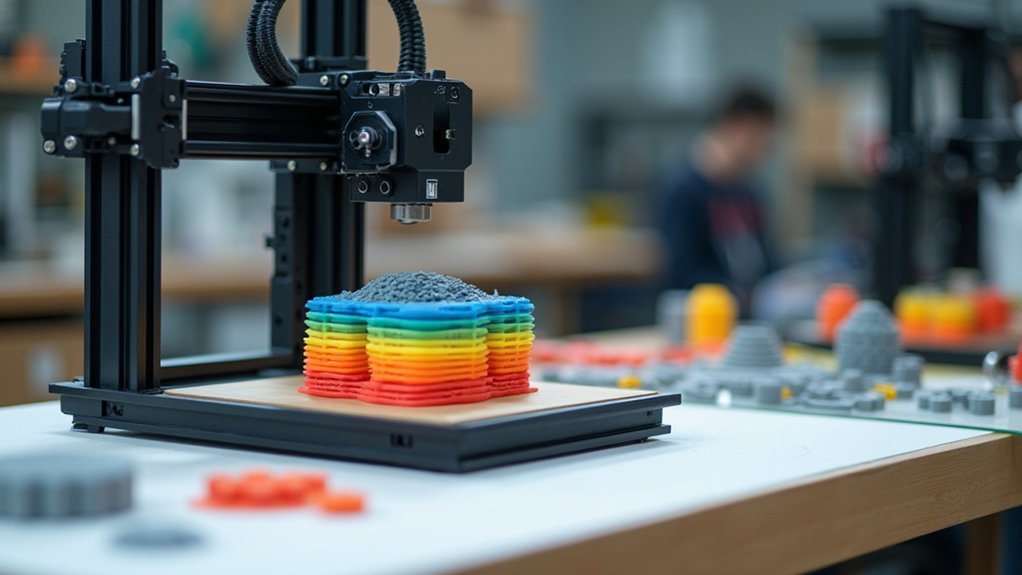
Unlike traditional subtractive manufacturing that cuts away excess material, 3D printing’s additive manufacturing process builds objects layer by layer using only the material needed for your final product.
This approach delivers exceptional material efficiency, reducing waste by up to 90% in certain applications compared to conventional methods.
You’ll eliminate expensive tooling and molds since 3D printing uses a single CAD dataset for production.
This streamlined approach minimizes both material and operational costs. In sand mold production, you can optimize designs to use less material while maintaining structural integrity.
Companies like GE Aviation demonstrate how reduced waste translates directly into cost reductions.
You’re not just saving money—you’re achieving significant environmental benefits through efficient material usage that maximizes every gram of raw material.
Time-to-Market Acceleration and Associated Savings
When you’re racing against competitors to launch new products, 3D printing transforms your development timeline from weeks into days.
You’ll create multiple design iterations rapidly, test prototypes quickly, and finalize products faster than traditional manufacturing allows.
This speed advantage doesn’t just get you to market first—it generates revenue while your competition’s still building their molds.
Rapid Prototyping Benefits
Since traditional prototyping methods can trap manufacturers in weeks-long development cycles, 3D printing emerges as a game-changing solution that compresses prototype production from extensive timeframes down to mere hours.
This rapid prototyping transformation delivers measurable benefits that directly impact your bottom line.
Consider how 3D printing’s rapid prototyping capabilities can revolutionize your operations:
- Speed advantages – You’ll reduce development time from weeks to hours, like ABB robotics cutting five-week cycles to one hour.
- Cost reduction – Production costs plummet dramatically, as Hartfiel Automation reduced prototype expenses from $125 to $4 per component.
- Enhanced iteration – You can create multiple prototypes daily, accelerating innovation cycles.
- Improved efficiency – On-demand production eliminates inventory storage needs, reducing warehousing costs.
Reduced Development Cycles
While accelerated prototyping delivers immediate benefits, 3D printing’s most significant financial impact comes through dramatically reduced development cycles that compress your entire time-to-market timeline.
You’ll cut mold and core production from weeks to just days, enabling rapid design iterations without traditional manufacturing constraints. This acceleration translates directly into reduced lead times and lower prototyping costs across your entire product development process.
Production with 3D printing allows simultaneous component manufacturing, further streamlining your workflow. You can respond swiftly to market demands while implementing design changes in real-time.
The result? You’ll launch products faster, capture market opportunities sooner, and generate revenue weeks or months earlier than competitors using conventional methods. These compressed development cycles create substantial cost savings through improved operational efficiency.
Market Entry Speed
Beyond development efficiency gains, 3D printing’s speed advantages create measurable financial returns through accelerated market entry that can’t be achieved with traditional manufacturing.
Your production process transforms from weeks-long waits to same-day delivery, fundamentally changing how you compete.
Consider these time-to-market breakthroughs:
- Mold production: You’ll reduce lead times from several weeks to just days.
- Prototype development: ABB robotics cut production from five weeks to one hour.
- Vehicle manufacturing: Local Motors produced an entire car in 44 hours.
- Design iterations: Instant implementation of changes accelerates your development cycle.
You’ll reduce time and cost simultaneously through on-demand manufacturing of custom parts.
This responsiveness lets you capture market opportunities faster than competitors using conventional methods, translating speed advantages into immediate revenue generation and competitive positioning.
Inventory Management and Storage Cost Reductions
As your business adopts 3D printing technology, you’ll discover that traditional inventory management becomes obsolete in many areas of production. On-demand production eliminates the need for extensive warehouse storage since you’re manufacturing components only when required.
You’ll greatly reduce storage costs by implementing just-in-time production models, cutting financial burdens associated with excess inventory. Boeing demonstrates this advantage by producing spare parts exclusively when needed, effectively eliminating surplus inventory expenses.
You’ll streamline your storage space and optimize resource usage, reducing overhead costs tied to inventory management. The flexibility of 3D printing enables rapid market responses, further decreasing large inventory requirements while enhancing operational efficiency.
Your business benefits from minimized warehousing expenses and improved cash flow management.
Prototyping Cost Advantages Over Traditional Methods
When you switch from traditional prototyping methods to 3D printing, you’ll dramatically cut costs while accelerating your development timeline.
You can iterate designs in hours rather than weeks, testing multiple variations in a single day without expensive tooling or molds.
This rapid iteration capability also reduces material waste since you’re only printing what you need for each specific design test.
Rapid Iteration Benefits
While traditional prototyping methods drain budgets and delay timelines, 3D printing transforms the economics of product development through unprecedented cost savings and speed advantages.
You’ll achieve rapid iteration capabilities that revolutionize your design testing process. Unlike conventional manufacturing methods that require weeks for single prototypes, 3D printing delivers multiple design versions within hours.
Here’s how rapid iteration benefits impact your prototyping costs:
- Multiple daily iterations – Create and test several design versions in one day versus waiting weeks.
- Instant design validation – Identify flaws immediately rather than after expensive tooling investment.
- Real-time optimization – Make adjustments on-the-fly without manufacturing delays.
- Accelerated market entry – Compress development cycles from months to days.
You’ll eliminate costly delays while maintaining design quality, enabling faster innovation cycles that keep you competitive in dynamic markets.
Material Waste Reduction
Traditional manufacturing methods squander raw materials through subtractive processes that carve away excess material, but 3D printing’s additive approach builds components layer by layer using only what’s necessary.
You’ll dramatically reduce material waste while slashing prototyping costs. Consider Hartfiel Automation’s success: they cut per-part costs from $125 to just $4 using 3D printing for manufacturing prototypes.
You’ll eliminate expensive tooling and molds that traditional production requires, streamlining your entire process. The technology lets you create complex geometries without generating excess waste, maximizing material efficiency.
This reduction in material waste doesn’t just lower your immediate prototyping costs—it contributes to sustainable manufacturing practices. You’re not only saving money but also reducing your environmental footprint through more efficient material usage.
Customization Without Additional Manufacturing Costs
Because 3D printing eliminates the need for new tooling or molds, you can create fully customized products without incurring the additional manufacturing costs that plague conventional production methods.
3D printing delivers true customization without the costly tooling and setup expenses that make traditional manufacturing prohibitively expensive.
You’ll use the same CAD data set for both unique and standard parts, removing expenses for additional setups.
Here’s how customization saves you money with 3D printing:
- No tooling changes – You can produce tailored components like Adidas’ customized midsoles without expensive retooling.
- Single print complexity – Design intricate geometries and personalized features in one process.
- Eliminated assembly costs – Complex parts print as unified components rather than multiple pieces.
- Industry flexibility – Aerospace and automotive sectors achieve substantial savings while meeting specific customer demands.
This manufacturing approach delivers cost-effective personalization previously impossible with traditional methods.
Supply Chain Optimization and Logistics Savings
When you implement 3D printing technology, you’ll transform your entire supply chain by shifting from traditional inventory-heavy models to lean, on-demand production systems.
You’ll dramatically reduce warehousing costs by producing parts only when needed, eliminating surplus stock storage requirements. Your shipping expenses and delivery times decrease considerably through local production capabilities that reduce lead time for critical components.
You can create custom geometries and specialized parts without relying on multiple suppliers, streamlining your entire logistics network.
Advanced Printing Solutions eliminate expensive tooling investments while enabling flexible manufacturing processes that adapt quickly to market demands.
Break-Even Analysis for 3D Printer Investments
Understanding the financial viability of your 3D printer investment requires a systematic break-even analysis that calculates exactly how many parts you’ll need to produce before recovering your initial costs.
Calculate your 3D printer’s break-even point by determining how many parts you must produce to recover initial investment costs.
Your break-even analysis should include these key calculations:
- Initial investment cost – Factor in your printer’s purchase price, such as $13,499 for industrial-grade equipment.
- Cost per part comparison – Compare traditional manufacturing costs ($2,869.46) versus 3D printing costs ($55.09 per part).
- Break-even quantity – Determine how many parts (like 96 units) you need to manufacture to recover costs.
- Accumulated savings tracking – Monitor your cost-effectiveness as savings compound with each printed part.
This investment analysis demonstrates remarkable potential. For example, producing nine parts can generate $25,329.33 in savings against just $495.81 in printing costs, proving exceptional ROI.
Frequently Asked Questions
Does 3D Printing Reduce the Cost of Making Things?
You’ll save considerably with 3D printing, reducing costs up to 75%. You won’t need expensive tooling or molds, you’ll waste less material, and you can produce individual parts economically without traditional manufacturing’s high expenses.
How Much Does a 3D Printer Cost for Manufacturing?
You’ll pay between €900 for entry-level manufacturing 3D printers and over €13,499 for advanced industrial machines. Your investment depends on the specific capabilities and features you need for your production requirements.
What Could Offset the Higher Manufacturing Cost of 3D Printing?
You’ll offset higher 3D printing costs through eliminated tooling expenses, reduced assembly needs, minimized material waste, and faster prototyping. These savings can cut production costs by 75%, dropping expenses from €3,600 to €900.
What Value Does 3D Printing Provide to the Manufacturing Process?
You’ll gain faster production times, eliminate expensive tooling costs, create complex geometries in single pieces, reduce post-processing work, and integrate seamlessly with conventional methods while cutting storage expenses.


Leave a Reply