
You can revolutionize construction with seven cutting-edge 3D printing methods: robotic arm extrusion systems for precise concrete deposition, gantry-based platforms offering fixed framework stability, contour crafting technology for intricate layer-by-layer building, powder bed fusion using sand and cement mixtures, wire arc additive manufacturing for strong metal components, paste extrusion printing with eco-friendly clay materials, and hybrid digital fabrication combining multiple technologies. These methods reduce construction time by 10x while cutting material costs up to 40%, transforming how you’ll approach modern building projects.
Robotic Arm Extrusion Systems for Concrete Deposition

Precision defines the core advantage of robotic arm extrusion systems in large-scale 3D concrete printing.
You’ll achieve unparalleled accuracy in concrete deposition through multi-axis movement capabilities that guarantee perfect layering and placement. These systems adapt to various specialized concrete mixtures, enhancing your project’s structural performance and sustainability.
You’ll complete construction projects in days rather than weeks thanks to high-speed printing capabilities. The robotic arm extrusion technology enables you to create complex geometries and intricate designs previously impossible with traditional methods.
Multi-axis movement assures structural integrity in your final product.
Integration of sensors and AI provides real-time monitoring during concrete deposition, guaranteeing consistent quality control.
You’ll minimize defects while maintaining exceptional output standards, dramatically reducing your overall construction time through advanced automated precision.
Gantry-Based Large Format 3D Printing Platforms
When you’re printing large-scale structures, gantry-based platforms give you the fixed framework and stability you need to move print heads precisely across massive build volumes.
You’ll find that these systems consist of rigid rails, carriages, and control mechanisms that work together to position extruders accurately while maintaining structural integrity throughout the printing process.
The real advantage you’ll notice is the dramatic speed improvement—these platforms can complete entire building sections in days rather than weeks, making them ideal when you’re facing tight construction deadlines.
Gantry System Components
- Linear actuators and rails – Control movement along X, Y, and Z axes with millimeter-level accuracy.
- Fixed frame structure – Provides unwavering stability for consistent print quality during extended operations.
- Print head assemblies – Accommodate various printing technologies and integrate seamlessly with different construction methods.
You’ll need to calibrate these components regularly to maintain peak performance.
The open architecture allows easy integration with extrusion systems and powder bonding technologies, making these platforms versatile for diverse construction applications.
Construction Speed Benefits
The sophisticated components that make gantry systems reliable also drive their remarkable speed advantages in construction projects. When you’re implementing gantry-based systems for large-scale 3D printing, you’ll reduce project timelines considerably compared to traditional construction methods. These platforms can complete entire structures in days or weeks rather than months.
| Speed Factor | Benefit |
|---|---|
| Continuous Deposition | Eliminates construction delays |
| Single-Piece Components | Reduces assembly time |
| Automated Precision | Minimizes labor requirements |
| 10x Faster Printing | Accelerates project completion |
| Consistent Quality | Prevents rework delays |
You’ll experience construction speed benefits through automated processes that maintain structural integrity while expediting the construction process. The technology’s ability to print large components without multiple connections streamlines workflows considerably.
Contour Crafting With Layer-By-Layer Material Building
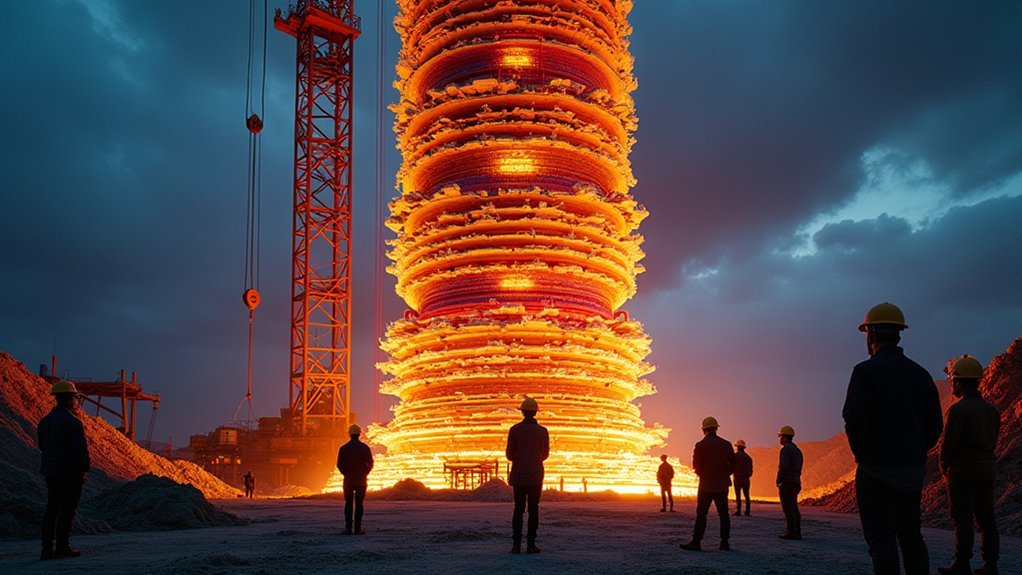
Although traditional construction methods have dominated the building industry for centuries, contour crafting revolutionizes how you can approach large-scale construction through its innovative layer-by-layer material building process.
This cutting-edge construction technology utilizes a gantry system that precisely extrudes materials like concrete and composites, enabling you to create complex structures with unprecedented accuracy.
The layer-by-layer approach offers remarkable advantages:
- Precision Control – You’ll achieve exact material placement for intricate architectural designs
- Waste Reduction – The process minimizes waste by using only necessary materials for each layer
- Design Flexibility – You can create customizable structures that meet specific architectural requirements
This automated construction technology transforms building timelines, allowing you to complete entire houses in days rather than months while maintaining structural integrity and design sophistication.
Powder Bed Fusion for Sand and Cement Mixtures
When precision meets innovation in large-scale construction, powder bed fusion (PBF) technology emerges as a game-changing method that’ll transform how you approach building with sand and cement mixtures.
This layer-by-layer process selectively applies binder to create durable building components with strength comparable to traditional concrete elements.
You’ll achieve remarkable material usage efficiency since only necessary binder amounts are applied, reducing waste by significant margins compared to conventional methods.
The construction industry benefits from PBF’s ability to produce complex structures with intricate geometries that standard techniques can’t accomplish.
You’ll experience faster production times with cost reductions up to 50% compared to traditional building practices, making PBF an innovative solution for architectural projects requiring both precision and efficiency.
Wire Arc Additive Manufacturing for Metal Construction Components

When you’re constructing large metal components through WAAM, you’re fundamentally using a controlled arc welding process that melts metal wire layer by layer.
This method doesn’t just create parts—it produces components with exceptional strength that can rival or exceed traditionally manufactured pieces.
You’ll find that the arc welding foundation of WAAM guarantees proper metallurgical bonding between layers, resulting in structural integrity that’s vital for construction applications.
Arc Welding Process
As traditional metal fabrication struggles with waste and time constraints, Wire Arc Additive Manufacturing (WAAM) emerges as a transformative solution that uses an electric arc to melt and deposit metal wire layer by layer.
This large-scale 3D printing process revolutionizes how you’ll approach metal construction by enabling complex structures with remarkable precision and minimal waste.
You’ll benefit from WAAM’s ability to construct aerospace and automotive components faster than conventional manufacturing methods.
The process delivers significant advantages:
- Material savings up to 30% by using metal wire directly instead of expensive metal blocks
- Advanced robotic integration guarantees consistent quality and reduces post-processing requirements
- Versatile applications from bridges to industrial components demonstrate the technology’s broad potential
WAAM’s precision and efficiency make it ideal for revolutionizing your metal construction projects.
Metal Component Strength
While conventional manufacturing often compromises between strength and weight, WAAM delivers exceptional structural integrity by creating dense, high-performance metal components with superior strength-to-weight ratios.
Wire Arc Additive Manufacturing revolutionizes large-scale 3D printing by building robust structures layer by layer, eliminating the material waste inherent in traditional manufacturing processes.
You’ll achieve superior mechanical properties through WAAM’s precise parameter control, allowing you to tailor microstructures for specific performance requirements.
The technology’s ability to create complex geometries without sacrificing structural integrity makes it ideal for aerospace and automotive applications where strength is critical.
With compatibility across aluminum, steel, and titanium, you can select materials that match your project’s exact specifications while maintaining exceptional durability and performance standards throughout the construction process.
Paste Extrusion Printing With Clay and Bio-Based Materials
One of today’s most promising large-scale 3D printing methods combines clay with bio-based materials through paste extrusion techniques. This approach delivers eco-friendly construction solutions while maintaining structural integrity comparable to conventional building materials.
You’ll benefit from paste extrusion printing’s robotic arm control system, which precisely deposits materials layer by layer through specialized nozzles. This process creates intricate architectural elements while achieving reduced material waste compared to traditional methods.
Key advantages include:
- Local sourcing capabilities – Clay materials can be sourced locally, minimizing transportation costs and environmental impact
- Design flexibility – You can customize structures for various architectural requirements and complex geometries
- Sustainable performance – This sustainable alternative offers strength and durability matching traditional concrete construction
Research confirms that bio-based materials integrated with clay deliver viable solutions for modern construction projects.
Hybrid Digital Fabrication Combining Multiple Printing Technologies
When construction challenges require diverse material properties and complex geometries, hybrid digital fabrication emerges as a revolutionary solution that combines multiple 3D printing technologies into unified systems.
You’ll leverage the strengths of different methods like FDM with SLS, enabling simultaneous use of various materials within single builds. This approach grants you unprecedented design freedom to create complex structures with tailored mechanical properties.
You’ll optimize resource utilization while considerably reducing material waste and production time. These printing technologies allow you to combine solid and porous materials, producing lightweight yet durable construction components.
Implementation delivers substantial cost benefits—you’ll achieve 30-40% reduction in material costs and 20-25% decrease in labor time compared to conventional building methods, making hybrid fabrication increasingly attractive for construction projects.
Frequently Asked Questions
What Is the Best Type of 3D Printing for Construction?
You’ll find extrusion-based methods work best for construction projects. They’re scalable, fast, and handle various materials effectively. Gantry systems offer precision for large buildings, while robotic arms provide flexibility for complex architectural designs.
What Is the Highest Quality 3D Printing Method?
You’ll find Stereolithography (SLA) delivers the highest quality 3D printing with exceptional precision and detail. It achieves layer resolutions as fine as 25 microns using laser-cured photosensitive resin technology.
What Is the Best 3D Printer for Big Projects?
You’ll want COBOD’s BOD2 for speed and precision in large builds, or ICON’s Vulcan for massive 2,000 square foot structures. Both deliver exceptional performance for big projects.
What Is the Best Type of Graphic for Large Scale Printing?
You’ll want vector-based graphics for large-scale printing since they’re infinitely scalable without quality loss. Use high-resolution files with CMYK color profiles, proper bleeds, and bold, high-contrast designs for ideal visibility.

Leave a Reply