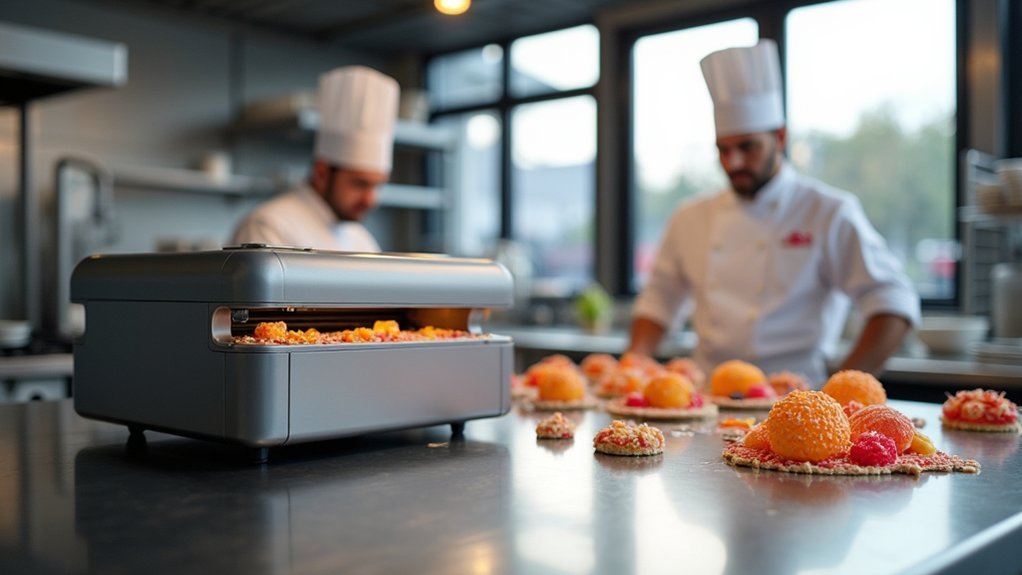
You’ll revolutionize your commercial kitchen with 3D food printing technology that cuts labor costs by up to 30% while producing complex dishes in just 10-12 minutes. This innovative equipment lets you create intricate, Instagram-worthy presentations that attract tech-savvy customers and differentiate your brand from competitors. You can accommodate special dietary restrictions seamlessly, reduce food waste through precise ingredient control, and minimize contamination risks with automated handling. The technology offers compelling ROI scenarios that’ll future-proof your restaurant business.
Understanding 3D Food Printing Technology in Commercial Settings
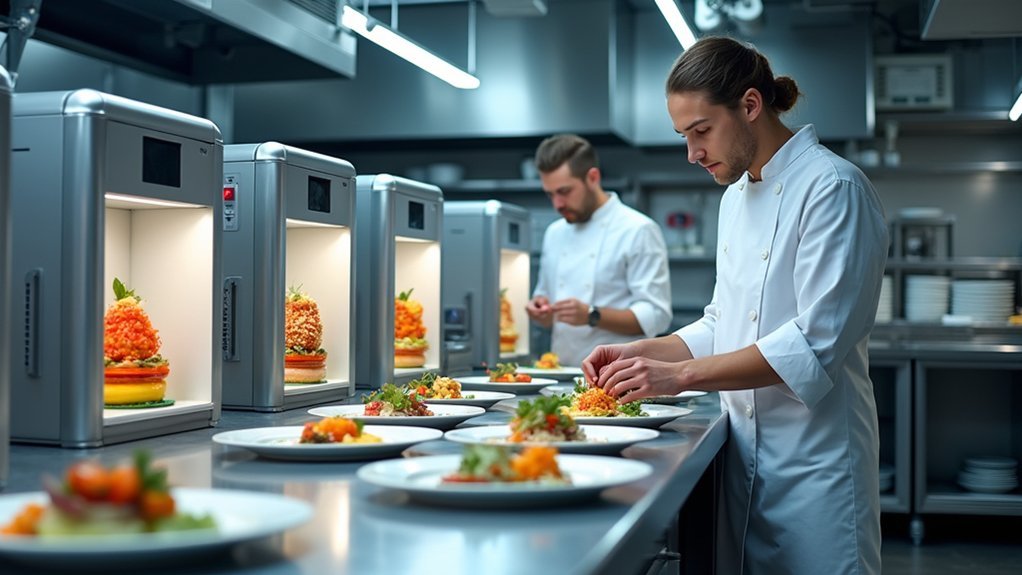
While traditional cooking methods have served commercial kitchens for decades, 3D food printing technology is revolutionizing how chefs create dishes by extruding edible materials through specialized nozzles to build intricate, layered designs from digital models.
3D food printing transforms culinary artistry by extruding edible materials through specialized nozzles to create impossible geometric designs from digital blueprints.
This innovative approach lets you work with puréed ingredients like fruits, vegetables, doughs, proteins, and sauces to achieve ideal viscosity for printing.
You’ll find that companies like Natural Machines and XYZprinting offer commercial-grade printers capable of producing complex shapes that would be impossible through conventional preparation methods.
Beyond creative possibilities, you can greatly reduce food waste by repurposing discarded ingredients into visually appealing dishes, while optimizing your labor resources and allowing your culinary team to focus on other essential kitchen tasks.
Enhanced Efficiency and Labor Optimization
As commercial kitchens face mounting pressure to increase output while managing labor costs, 3D food printing technology delivers unprecedented efficiency gains that transform your operational workflow.
You’ll achieve enhanced efficiency by producing complex dishes like cookies or meat pies in just 10-12 minutes, much faster than traditional methods. This technology optimizes your staffing by minimizing manual labor requirements, freeing your chefs to focus on intricate culinary tasks that truly require human expertise.
You’ll also reduce waste considerably by repurposing ingredients that would typically be discarded, transforming them into appealing, sellable dishes. This waste reduction directly improves your cost efficiency and bottom line.
Additionally, 3D printing guarantees consistent quality across every batch, eliminating variability from traditional cooking methods while boosting operational efficiency throughout your entire kitchen workflow.
Cost Reduction Through Precise Ingredient Control
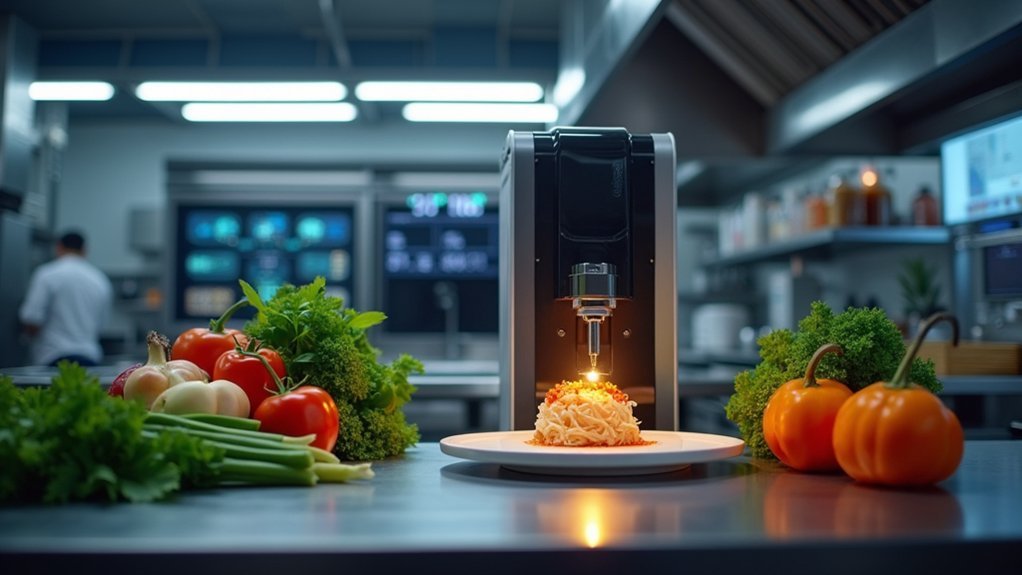
You’ll cut costs considerably by controlling exactly how much of each ingredient goes into every dish through 3D food printing technology.
This precise measurement eliminates the guesswork that leads to overuse of expensive ingredients and reduces waste from improperly portioned meals.
Your kitchen can achieve up to 30% savings in ingredient expenses while ensuring every plate contains the exact amount needed for ideal taste and presentation.
Minimize Food Waste
When commercial kitchens adopt 3D food printing technology, they’re releasing unprecedented control over ingredient usage that directly translates to remarkable waste reduction.
You’ll transform typically discarded items like vegetable peelings and overripe fruits into appealing dishes, maximizing every ingredient’s potential.
Food printing enables precise portion control, allowing you to create exact quantities that match customer orders rather than preparing excess food that goes unused.
You’ll optimize your inventory management by producing meals on-demand, eliminating the risk of overstocking perishable items.
The technology opens opportunities to incorporate unconventional ingredients like insects and algae that might otherwise be overlooked.
Studies show you can reduce food waste by up to 50%, creating more sustainable kitchen practices while considerably cutting operational costs through improved ingredient efficiency.
Optimize Portion Accuracy
Because 3D food printing operates through digital precision, you gain absolute control over ingredient measurements that eliminates the guesswork plaguing traditional cooking methods.
You’ll achieve consistent portion control across every dish, ensuring uniform serving sizes that enhance your cost management strategies. This technology lets you customize portions for specific dietary requirements without wasting excess ingredients.
Food printing enables you to reduce waste by up to 30% through exact quantity dispensing.
You’ll streamline inventory management since ingredients are used efficiently, minimizing spoilage risks. Digital designs guarantee portion accuracy that translates directly into better menu pricing strategies.
Your kitchen operations become more predictable and cost-effective when you can precisely measure and dispense ingredients for every order, maximizing profitability through elimination of overproduction.
Customization for Dietary Restrictions and Allergies
As dietary restrictions and food allergies become increasingly prevalent in commercial dining, 3D food printing emerges as a revolutionary solution that transforms how kitchens accommodate special dietary needs.
You’ll find that customization for dietary restrictions and allergies becomes seamless when you integrate food printers into your kitchen operations. These systems let you create allergen-free dishes tailored to individual customers while maintaining exceptional taste and presentation.
You can precisely control ingredient composition to meet strict nutritional requirements for conditions like diabetes or celiac disease.
Using pureed ingredients as “inks,” you’ll design visually appealing meals that accommodate various restrictions without compromising quality. This technology enables you to quickly adapt recipes, creating personalized dishes that boost customer satisfaction and loyalty while ensuring safe dining experiences for all patrons.
Waste Minimization and Sustainable Practices
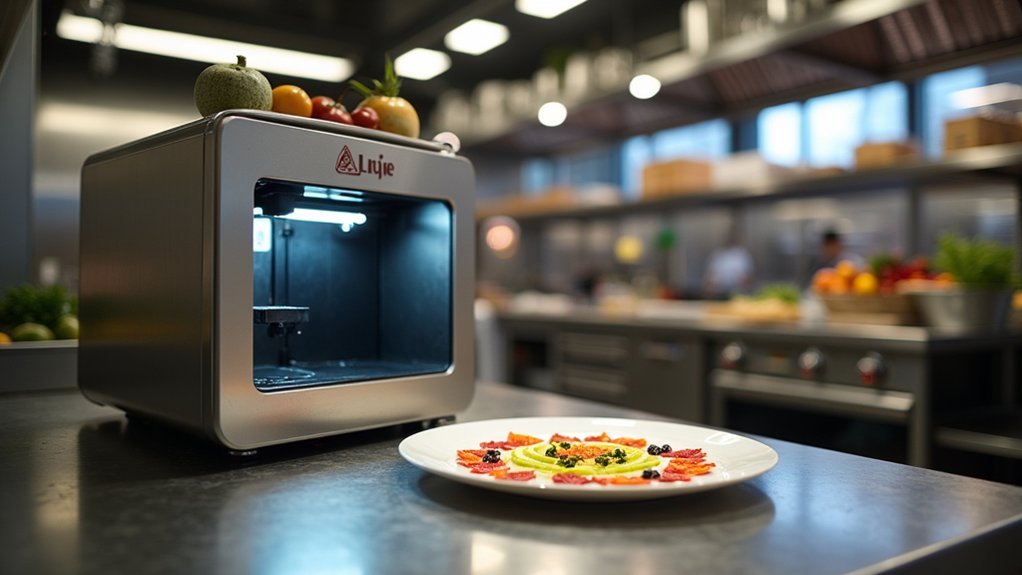
Beyond meeting individual dietary needs, 3D food printing revolutionizes sustainability practices in commercial kitchens by dramatically reducing waste streams.
You’ll transform discarded ingredients like vegetable peelings and stale bread into appealing dishes, maximizing every component’s potential. This technology allows precise portion control, preventing overproduction while optimizing ingredient utilization across your food production processes.
- Zero-waste transformation – Convert typically discarded ingredients into nutritious, visually appealing meals
- Precision portioning – Control exact serving sizes to eliminate overproduction and minimize leftovers
- Customized production – Create only what’s needed, reducing excess inventory and spoilage
- Future-ready sustainability – Meet growing demands of 9.6 billion people by 2050 through efficient resource management
You’re not just reducing waste; you’re pioneering sustainable food production that achieves near-zero waste while maintaining quality and profitability.
Consistent Quality and Standardized Production
While sustainability drives adoption, 3D food printing’s ability to deliver unwavering consistency sets it apart from traditional cooking methods in commercial kitchens.
You’ll achieve consistent quality across every batch through precise digital models that guarantee identical shapes and presentations. Your standardized production processes minimize variations in ingredient quantities and cooking methods, delivering uniform taste and texture that customers expect.
Digital precision eliminates batch-to-batch variations, ensuring every dish meets exact specifications for shape, ingredient ratios, and customer expectations.
You’ll reduce human error considerably by automating food design and production.
In your commercial kitchen, you can produce intricate designs and customized dishes at scale while maintaining the high standards essential for restaurant branding. This technology enhances operational efficiency by freeing your chefs from repetitive tasks, letting them focus on creativity while the printer maintains unwavering product quality standards.
Creative Design Capabilities and Visual Appeal
How can you transform culinary artistry beyond traditional limitations? 3D food printing opens up unprecedented creative design capabilities that’ll revolutionize your kitchen’s visual presentation capabilities.
Food printing offers extraordinary visual appeal through intricate decorations and customized shapes that were previously impossible to achieve consistently. You’ll create identical, precision-crafted items across multiple servings, ensuring every plate meets your high-end standards.
The technology lets you work with diverse ingredients—fruits, vegetables, and proteins—expanding your artistic expression range considerably. Transform pureed ingredients into stunning garnishes and sculptural elements that’ll impress customers and elevate their dining experience.
With the market projected to reach $525.6 million by 2023, you’re investing in technology that’s driving culinary innovation and encouraging chefs worldwide to explore new artistic possibilities.
- Create intricate cake decorations and customized pasta shapes with precision
- Produce identical food items ensuring consistent presentation across servings
- Work with diverse ingredients to expand creative culinary expressions
- Design visually appealing garnishes and sculptures from pureed ingredients
Food Safety Through Minimal Human Contact
Since food safety remains paramount in commercial kitchens, 3D food printing delivers unmatched protection through minimal human contact during preparation.
You’ll eliminate multiple contamination points that plague traditional cooking methods through precise digital modeling and automated ingredient handling.
The printing process utilizes clean, pre-packaged cartridges that dramatically reduce cross-contamination risks while maintaining sterile production environments.
You’re getting automated systems that monitor cooking conditions continuously, removing human error from critical safety protocols.
Your professional kitchens can customize allergen-free dishes with precise ingredient control, ensuring compliance with dietary restrictions without compromising safety standards.
This technology transforms how you approach food safety, creating controlled environments where contamination risks are minimized through systematic automation rather than manual intervention.
Market Differentiation and Competitive Advantage
As commercial kitchens increasingly compete for customer attention in a saturated market, 3D food printing emerges as a powerful differentiator that transforms ordinary dishes into visually stunning culinary masterpieces.
You’ll position your establishment as an innovative leader while streamlining operations and reducing labor costs. The food printing market’s projected growth to $525.6 million by 2023 offers early adopters significant advantages.
Your restaurant kitchens gain a competitive edge through:
- Intricate food designs that create Instagram-worthy presentations impossible with traditional cooking methods
- Customized meals tailored to specific dietary restrictions and health-conscious consumers
- Streamlined production processes that maintain quality while reducing preparation time
- Tech-savvy customer attraction that enhances your brand reputation and market positioning
Equipment Investment and Return on Investment
While these competitive advantages paint an exciting picture, the financial reality of implementing 3D food printing technology requires careful analysis of upfront costs and projected returns.
Commercial food printers represent a considerable investment, ranging from $2,499 to €6,000. However, you’ll find that labor savings and reduced waste create compelling return on investment scenarios.
| Investment Factor | Traditional Method | 3D Food Printing |
|---|---|---|
| Initial Equipment Cost | Low | $2,499-€6,000 |
| Labor Efficiency | Manual/Time-intensive | Automated/Fast |
| Food Waste | Higher | Substantially Reduced |
The food manufacturing sector’s 46.1% annual growth projection makes this technology increasingly attractive. You’ll position your kitchen as an industry leader while tapping into profitable niche markets through dietary customization. As equipment costs decrease and smart functionalities expand, your investment appeal will only strengthen.
Future-Proofing Your Restaurant Business
You’ll need to view 3D food printing as more than just trendy equipment—it’s a strategic investment that positions your restaurant for long-term success in an evolving market.
The technology’s projected 46.1% CAGR through 2023 signals strong consumer demand you can’t afford to ignore.
Your ability to adapt quickly to changing dining preferences and implement innovative solutions will determine whether you’re leading the market or struggling to catch up.
Technology Investment Returns
When restaurant owners evaluate 3D food printing technology, they’re looking at an investment that can deliver substantial returns through multiple revenue streams and cost reductions.
Your food printer investment pays dividends through dramatically reduced labor costs, with technology to print handling repetitive tasks that typically require 30-50% of kitchen staff time. You’ll improve efficiency while accessing a rapidly expanding market projected to reach $525.6 million by 2023.
Key investment returns include:
- Labor cost reduction – Automate repetitive food preparation tasks
- Zero waste operations – Transform leftover ingredients into profitable dishes
- Rapid menu innovation – Quick prototyping increases customer engagement and sales
- Premium customization revenue – Cater to niche dietary preferences commanding higher prices
This technology positions your establishment ahead of competitors while generating measurable profit improvements across multiple operational areas.
Market Adaptation Strategies
Beyond immediate financial returns, your restaurant needs strategies that position you for long-term market leadership as food printing technology evolves.
You’ll want to start by targeting niche markets where customization matters most. Nursing homes represent an ideal testing ground, as printers can create texture-modified meals for residents with swallowing difficulties while maintaining visual appeal.
Develop partnerships with local healthcare facilities and dietary consultants to establish your expertise in specialized food preparation. This positions you ahead of competitors when consumer demand for personalized nutrition increases.
Train your staff on 3D printing workflows now, ensuring seamless integration as technology advances.
Focus on building a reputation for innovation rather than waiting for widespread adoption. Early positioning in the $525.6 million market gives you competitive advantages that’ll be harder to achieve later.
Frequently Asked Questions
What Are the Benefits of Food Printing?
You’ll enhance food safety through minimal human contact, create allergen-free dishes, reduce waste efficiently, produce stunning visual designs, and lower labor costs while automating preparation processes in your kitchen operations.
Who Would Benefit From 3d-Printed Food?
You’ll find 3D-printed food benefits restaurants creating custom designs, nursing homes serving residents with swallowing difficulties, military feeding soldiers, NASA nourishing astronauts, and high-end kitchens streamlining production while reducing waste.
What Is the Purpose of 3D Printing Food?
You’ll use 3D food printing to enhance kitchen efficiency, create intricate customized designs, reduce waste by repurposing ingredients, guarantee consistent quality across batches, and meet evolving consumer demands for personalized dining experiences.
Why Is 3d-Printed Food Set to Go Mainstream?
You’ll see 3D-printed food go mainstream because it’s becoming cheaper, creates custom allergen-free meals efficiently, reduces waste, and major organizations like NASA are proving its practical value for specialized nutrition.

Leave a Reply