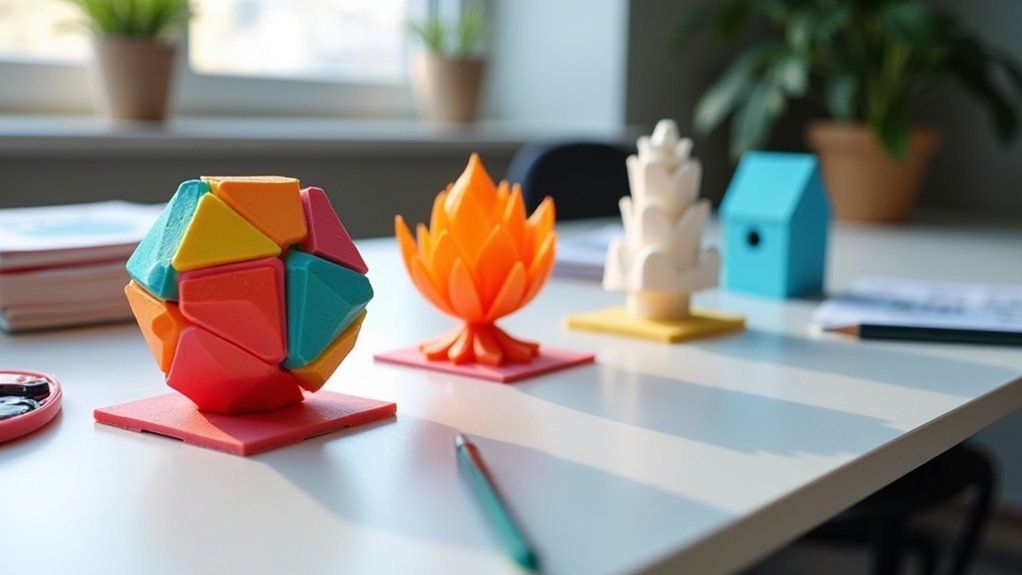
You’ll discover exciting 3D printing projects that transform learning into hands-on exploration. Create balloon-powered dragsters to demonstrate force and motion, design fraction blocks for visual math learning, and build mini catapults for physics experiments. Print anatomical models for no-mess biology dissection, topographical maps for geography lessons, and custom organizational tools like dinosaur tape dispensers. Develop assistive technology such as specialized pencil grips and communication boards. These projects enhance creativity while making complex concepts tangible and accessible for all students.
Educational Tools for Science and Math Learning
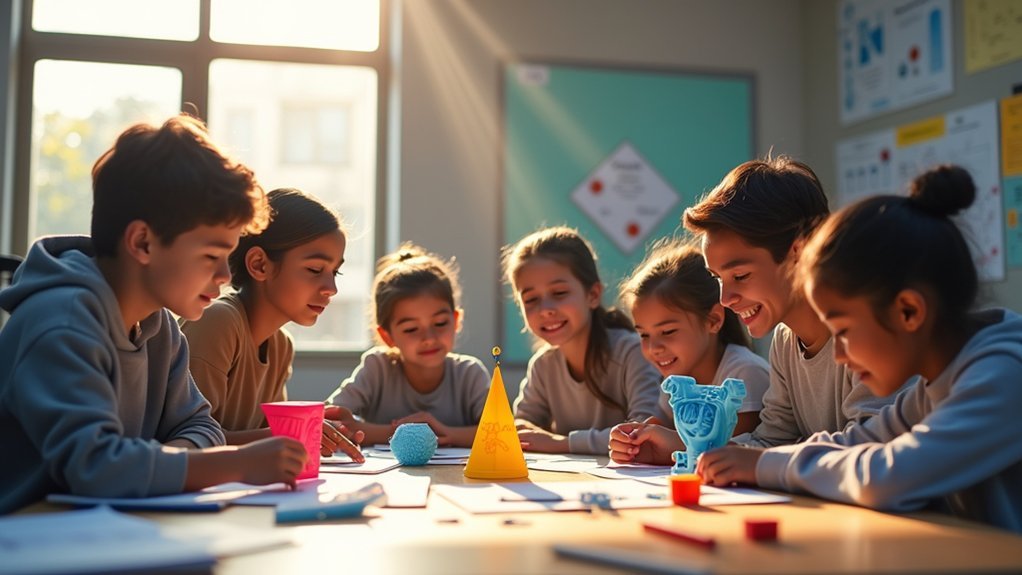
When you’re looking to make abstract concepts tangible, 3D printing transforms your classroom into an interactive learning laboratory.
Fraction blocks serve as perfect visual manipulatives that you can print to help students grasp mathematical concepts through tactile experiences. These hands-on tools make abstract fractions concrete and understandable.
You’ll keep students engaged with balloon-powered dragsters that demonstrate force and motion principles while encouraging design optimization for maximum distance.
Mini catapults combine physics experimentation with playful learning, letting students iterate their designs for better performance.
Spinning tops incorporate engineering principles while adding competitive elements as students aim for longer spin durations.
The no-mess frog dissection kit revolutionizes biology lessons, providing cleaner alternatives that maintain hands-on engagement without intimidation.
Creative and Fun Classroom Supplies
You can transform your classroom environment by creating functional novelty items that combine practicality with entertainment, like dinosaur tape dispensers and fidget cubes that help students stay focused.
These 3D-printed supplies don’t just organize your space—they make everyday classroom activities more engaging and enjoyable for your students.
You’ll also discover opportunities to design simple musical instruments that introduce students to sound science while providing hands-on creative expression.
Functional Novelty Items
Although traditional classroom supplies serve their basic purposes, 3D printing opens up exciting possibilities for creating functional items that spark joy and engagement in learning environments. These functional novelty items transform everyday objects into conversation starters that students to create with enthusiasm.
| Item | Primary Function | Educational Benefit |
|---|---|---|
| T-Rex Tape Dispenser | Organizes supplies | Engages 3D printing skills |
| Hexagon Coaster Set | Protects surfaces | Develops design abilities |
| Articulated Snowman | Seasonal decoration | Encourages creative thinking |
You can help your students develop practical design skills while producing items they’ll actually use. The T-Rex Tape Dispenser combines organization with creativity, while customizable coasters let students explore personal design preferences. These projects prove that functional doesn’t mean boring.
Musical Instruments Creation
The fusion of music and 3D printing technology creates extraordinary learning opportunities that resonate throughout the classroom. You can guide students through designing and creating customized musical instruments like ocarinas, transforming abstract musical concepts into tangible experiences.
The 12 Hole Ocarina serves as an excellent cost-effective example that maintains musical accuracy while encouraging creative expression.
When students craft their own instruments, they’ll develop collaboration and problem-solving skills as they experiment with different designs to achieve desired sounds.
You can integrate art, science, and technology by tailoring 3D printing projects to specific educational themes. Students will naturally explore sound physics and acoustics while building their instruments, making learning both engaging and educational through hands-on discovery.
Innovative Learning Tools in Biology
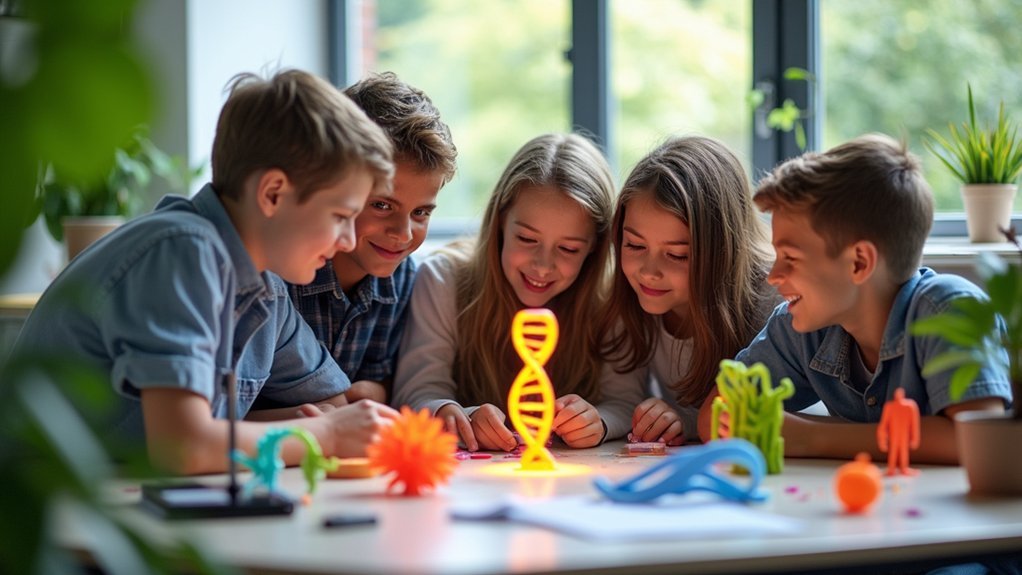
You can revolutionize your biology classroom with 3D-printed tools that make complex concepts tangible and engaging.
The No-Mess Frog Dissection kit eliminates the complications of traditional specimens while giving you hands-on anatomical experience.
Interactive 3D-printed human organs to scale let you explore biological structures in ways that textbooks simply can’t match.
No-Mess Frog Dissection
Biology classrooms are transforming thanks to innovative 3D printing technology that’s revolutionizing how students learn anatomy. The No-Mess Frog Dissection kit represents a breakthrough in educational tools, offering students of all ages a fun way to teach complex biological concepts without traditional dissection’s mess and ethical concerns.
You’ll find these realistic 3D-printed models perfectly mimic real frog anatomy, allowing hands-on exploration of internal organs and systems. This innovative approach encourages participation from squeamish students who’d typically avoid traditional dissections.
You can examine structures interactively, fostering deeper understanding of biological processes. The kit enhances your curriculum while facilitating important discussions about anatomy, biology ethics, and alternative teaching methods.
Through 3D printing, you’re creating engaging learning experiences that make complex scientific concepts accessible and memorable for every student.
3D Printed Human Organs
While traditional textbooks offer two-dimensional illustrations of human anatomy, 3D printed organs transform your biology classroom into an immersive learning laboratory. These tangible models allow students to take ownership of their learning by physically examining complex anatomical structures.
You’ll find that 3D printing creates hands-on experiences that make abstract biological concepts accessible and understandable.
When you incorporate these innovative tools into your curriculum, you’re encouraging critical thinking as students explore the intricacies of human anatomy. The tactile nature of 3D printed organs promotes deeper contemplation and reflection, bridging the gap between theoretical knowledge and practical application.
This interactive approach stimulates curiosity and enhances student engagement, fostering an innovative learning environment that supplements traditional teaching methods effectively.
Interactive Biology Models
Since traditional dissection methods can create barriers to learning through mess and student discomfort, interactive biology models revolutionize how you’ll teach complex biological concepts.
These 3D printing innovations transform abstract ideas into tangible experiences that engage students directly. The No-Mess Frog Dissection kit eliminates the unpleasant aspects of traditional methods while maintaining educational value.
Students can explore anatomical structures without dealing with preserved specimens. Human Organs to Scale provides realistic 3D-printed models that help you visualize organ functions and relationships within biological systems.
These tools encourage active participation and make biology more accessible to diverse learning styles.
- Enhanced visualization: 3D models help students understand spatial relationships between organs and systems
- Customizable learning: You can design and modify models to explore specific biological phenomena
- Increased engagement: Interactive elements foster creativity and critical thinking in biology education
Geography and Historical Education Projects
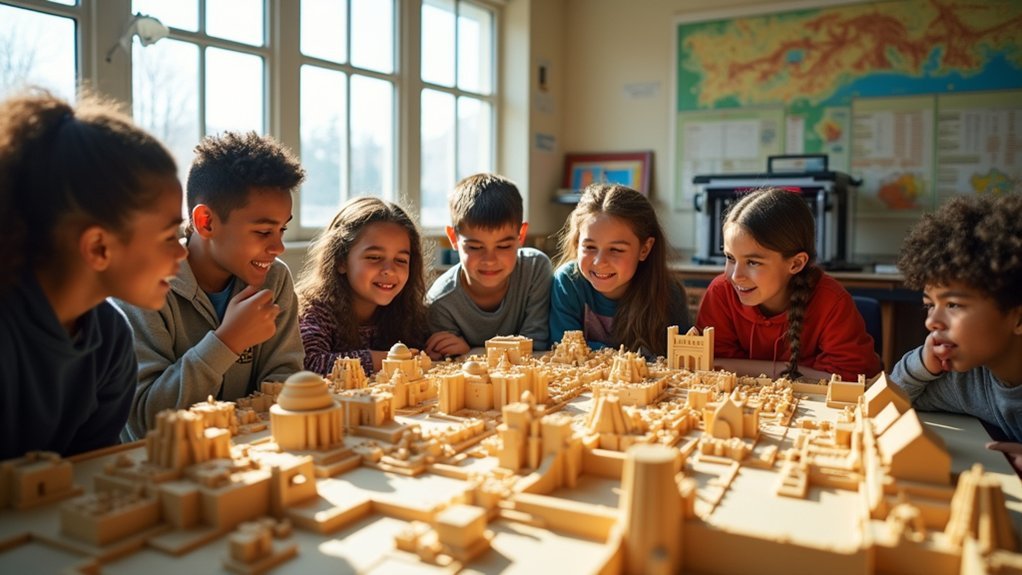
When you combine 3D printing with geography and history lessons, you’ll transform abstract concepts into tangible learning experiences that students can hold, examine, and explore. Students can create topographical maps of Mount Everest or design historical monuments to deepen their understanding of significant figures and events. These hands-on projects foster research skills while providing tangible connections to cultural heritage.
| Project Type | Educational Benefits |
|---|---|
| Topographical Maps | Enhanced physical geography understanding |
| Historical Monuments | Creative engagement with historical events |
| Ancient Artifacts | Cultural heritage exploration |
| Interactive Earth Puzzles | Geographical relationships learning |
| Environmental Models | Spatial awareness and change visualization |
Through 3D printing, you’ll help students develop spatial awareness and encourage interdisciplinary learning across geography and science subjects effectively.
Organizational and Practical Classroom Items
Beyond educational models and artistic creations, 3D printing offers practical solutions for everyday classroom organization and functionality. You can transform your learning environment by creating customizable key holders that help students manage their belongings while promoting personal responsibility.
Design personalized doorstops in various shapes to prevent slamming doors while adding unique engravings. Create whiteboard marker holders to organize dry-erase supplies and reduce clutter around boards, enhancing classroom efficiency.
Students can design custom drink coasters to personalize their beverage experience while exercising creativity. Chain link Gridfinity bins provide modular organizational solutions for school supplies and art tools, ensuring easy access to materials.
- Personal Responsibility Development: Organizational printing projects teach students accountability through managing their belongings
- Enhanced Learning Environment: Practical items reduce distractions and create more efficient classroom spaces
- Creative Problem-Solving Skills: Students learn to identify daily challenges and design functional solutions
Engineering and Design Challenge Projects
While organizational projects establish efficient classroom environments, engineering and design challenges push students to apply scientific principles through hands-on experimentation and problem-solving.
You’ll find that 3D printing opens up exciting opportunities for students to tackle real-world engineering problems. Balloon-powered dragsters let them explore force and motion principles while competing for peak performance.
Students can create spinning tops through iterative design processes, experimenting with size and weight distribution to maximize spin time. Mini catapults provide hands-on physics exploration while fostering creativity in projectile launching mechanisms.
The modular candy dispenser teaches engineering concepts through instant rewards that motivate younger learners. Interlocking earth puzzles enhance spatial awareness and geography skills, combining educational value with engaging engineering and design challenge experiences.
Art and Music Educational Applications
As students shift from engineering challenges to creative expression, 3D printing transforms how they’ll approach art and music education.
Art students can design unique sculptures and installations that materialize complex ideas for their portfolios. You’ll discover how designing custom musical instruments like ocarinas provides hands-on music education while encouraging creativity. The technology integrates seamlessly with traditional artistic methods, fostering innovation in your creative practices.
You can create interactive installations with 3D printed elements that enhance viewer participation and emotional responses. Additionally, producing personalized art supplies such as custom brushes or palette holders allows you to tailor tools to your specific needs.
- Custom instrument creation develops both technical skills and musical understanding through hands-on learning
- Interactive art installations bridge digital design with physical engagement, creating memorable experiences
- Personalized creative tools empower artistic individuality and enhance workflow efficiency
Assistive Technology and Accessibility Solutions
Moving from creative expression to practical problem-solving, 3D printing opens remarkable opportunities for developing assistive technology that transforms educational experiences for students with disabilities. You can create customized solutions that address individual needs while fostering hands-on learning and empathy among peers.
| Device Type | Application | Benefits |
|---|---|---|
| Pencil Grips | Writing Support | Enhanced comfort and control |
| Modified Utensils | Meal Independence | Improved grip for dining |
| Communication Boards | Non-verbal Expression | Personalized symbol layouts |
| Keyboard Adapters | Computer Access | Easier key navigation |
| Book Holders | Reading Assistance | Hands-free page viewing |
Through rapid prototyping, you’ll reduce traditional manufacturing costs and time constraints. Educational institutions can collaborate directly with students to design and print accessibility aids, creating innovative solutions that enhance classroom participation and everyday functionality while promoting inclusivity throughout learning environments.
Frequently Asked Questions
What Is an Example of 3D Printing in Education?
You’ll find students at J. H. Rose High School using 3D printing to create functional iPod speakers and toy drag racers, giving them hands-on design and engineering experience that connects classroom theory with real-world applications.
What Are Some Examples of Things That Can Be Made Using 3D Printing?
You can create jewelry like rings, functional items such as phone cases and cable organizers, educational models including anatomical parts, miniature figurines, replacement parts for broken objects, and decorative home accessories.
How to Create 3D Printing Projects?
You’ll start by choosing engaging projects that match your interests. Use beginner-friendly software like Tinkercad to design models. Practice design thinking through brainstorming and sketching. Guarantee proper printer calibration and collaborate with teammates effectively.
What Can I 3D Print for Beginners?
You can start with low-poly rings, custom bubble wands, mini octopus models, ball gear fidget toys, or pyramid lattices. These projects don’t require advanced skills and you’ll complete them quickly while learning fundamental printing techniques.

Leave a Reply