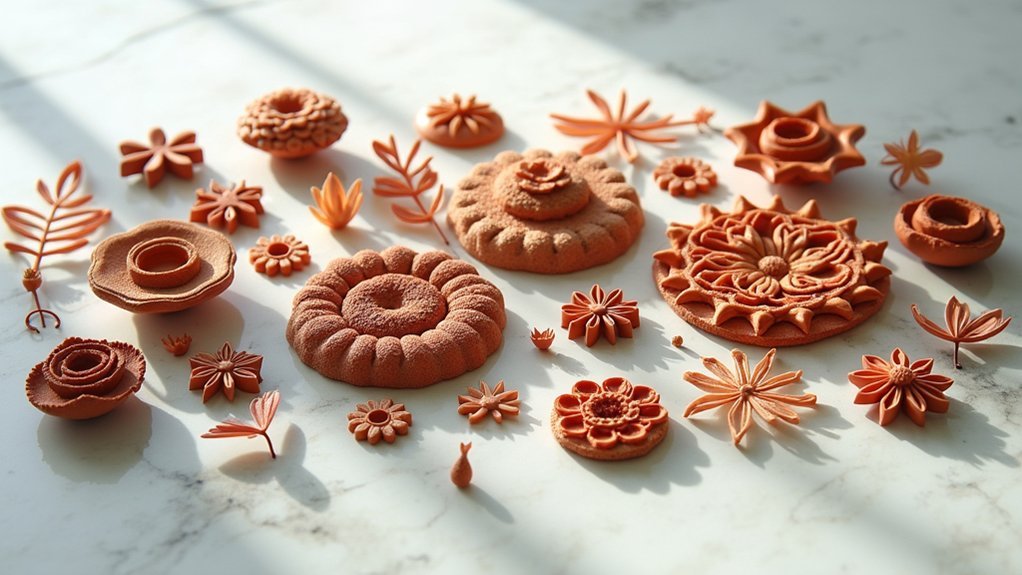
You can transform your culinary creations using clay-based inks for 3D printing that offer exceptional rheological properties and structural integrity. These FDA-approved materials like montmorillonite enhance viscosity, improve shape retention, and deliver bioactive compounds for functional foods. They’re biodegradable, exhibit shear-thinning behavior for smooth extrusion, and form reinforcing networks within food matrices. The technology enables intricate designs impossible with traditional methods while meeting clean-label demands. Discover how these innovations are revolutionizing commercial food manufacturing and creating new culinary possibilities.
Understanding Edible Clay Properties in Food Manufacturing
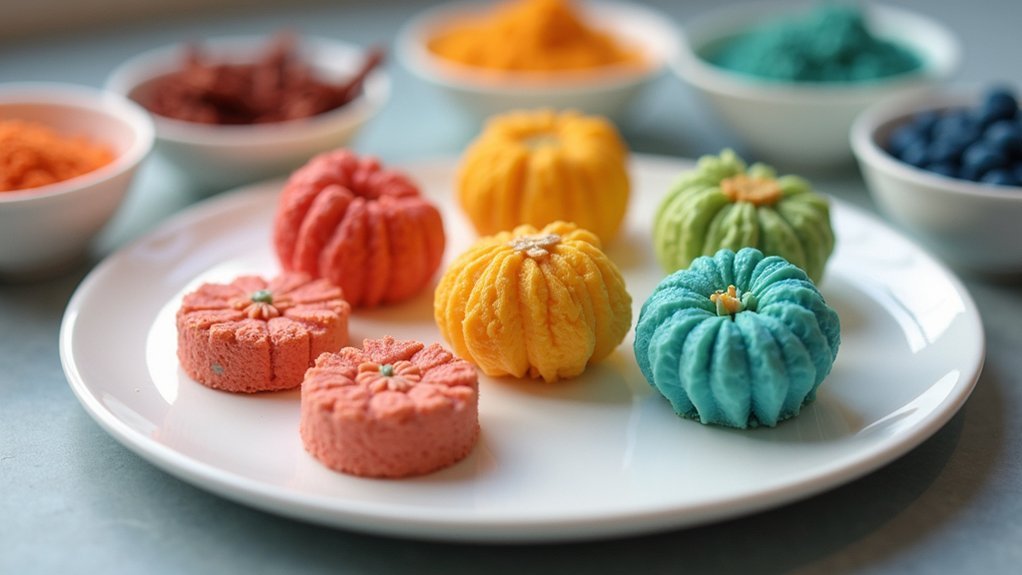
Breakthroughs in culinary 3D printing depend heavily on understanding how edible clays transform food manufacturing processes. When you’re working with montmorillonite and similar clays, you’ll discover their exceptional rheological properties enable superior printability by enhancing viscosity and structural integrity of food inks.
These materials don’t just improve flowability—they’ll help you achieve better shape retention in complex designs.
Edible clays deliver superior shape retention and enhanced flowability, revolutionizing complex 3D food design capabilities.
You’ll find that edible clays excel at retaining bioactive compounds, making them ideal for developing functional foods with enhanced nutrient delivery. Their biodegradable nature aligns perfectly with clean-label demands while addressing critical 3D printing challenges.
Modified clays can greatly improve texture and mouthfeel in your printed products, solving sensory quality issues that have historically limited 3D printing applications in professional kitchens.
Biocompatible Clay Selection for Culinary Applications
When selecting biocompatible clays for culinary 3D printing, you’ll need to prioritize FDA-approved materials like montmorillonite that meet strict food safety standards.
These biocompatible clays greatly enhance your food inks’ performance while maintaining safety for consumption.
Consider these key selection criteria:
- Regulatory approval – Choose clays with established FDA clearance for food applications
- Printability enhancement – Select clays that improve viscosity and shape retention during printing
- Mechanical properties – Opt for clays that strengthen structural integrity of printed foods
- Functional benefits – Pick clays that can carry bioactive compounds and probiotics
You’ll find that montmorillonite excels in all these areas, improving your food inks’ stability while enhancing the nutritional profile of printed foods.
It’s also environmentally sustainable, helping reduce food waste through byproduct utilization.
Rheological Characteristics of Clay-Enhanced Food Inks
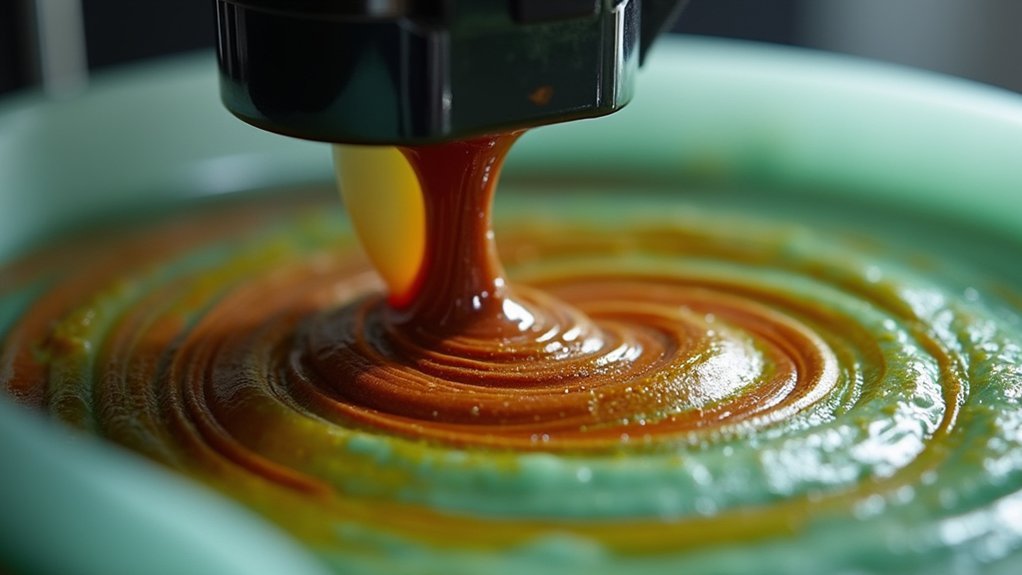
You’ll need to analyze flow properties when incorporating clay into your food inks, as these additives greatly alter how materials behave during extrusion.
Your clay-enhanced inks will exhibit distinct shear behavior characteristics, typically showing shear-thinning properties that facilitate smooth flow through narrow nozzles while maintaining structural integrity after deposition.
You can control viscosity modification effects by adjusting clay concentration, allowing you to optimize printability and achieve the desired consistency for your specific culinary application.
Flow Properties Analysis
As clay particles integrate into food ink formulations, they fundamentally alter the rheological landscape that determines your printing success. Understanding flow properties becomes essential when you’re working with clay-enhanced food inks that exhibit complex behaviors under different shear conditions.
Your thixotropic ink formulations demonstrate pressure-dependent flow characteristics that directly impact printability. When you analyze these systems, you’ll observe:
- Shear-thinning behavior – enabling smooth extrusion through nozzles
- Rapid viscosity recovery – maintaining structural integrity after deposition
- Elastic response enhancement – preventing deformation during layer stacking
- Concentration-dependent enhancement – allowing precise flow control adjustments
These flow properties create the foundation for successful clay-enhanced food ink performance.
You’ll find that proper analysis reveals ideal processing windows where your formulations achieve both excellent extrudability and superior shape retention throughout the printing process.
Shear Behavior Characterization
Beyond the fundamental flow properties lies the critical need to quantify how your clay-enhanced food inks respond to varying shear forces during actual printing conditions.
You’ll discover that montmorillonite clay dramatically alters viscosity profiles, creating shear-thinning behavior essential for successful extrusion. During 3D printing, your ink experiences high shear rates within the nozzle, causing temporary viscosity reduction that enables smooth flow.
Once deposited, shear forces drop rapidly, allowing viscosity recovery that prevents structural collapse.
You must conduct rheological testing across multiple shear rates to optimize clay concentrations. This characterization reveals the precise shear behavior needed for printability while maintaining structural integrity.
Understanding these viscosity-shear relationships lets you fine-tune clay-enhanced inks for specific printing applications without compromising food quality.
Viscosity Modification Effects
The specific viscosity changes that occur when incorporating clay into food inks represent the cornerstone of successful 3D printing performance.
When you add montmorillonite clay to your formulations, you’ll dramatically enhance the rheological properties of your food inks, creating ideal viscosity levels that guarantee consistent printability.
Clay integration produces four critical viscosity modifications:
- Increased baseline viscosity – enabling superior shape retention during layer deposition
- Enhanced thixotropic behavior – allowing smooth flow under shear stress while maintaining structure at rest
- Improved polymer network stability – reducing unwanted swelling and deformation
- Refined flow characteristics – balancing viscosity with printability for intricate designs
You’ll achieve the perfect viscosity-printability balance by carefully refining clay content, guaranteeing your 3D printed culinary creations maintain both structural integrity and design precision.
Formulation Techniques for Optimal Print Performance
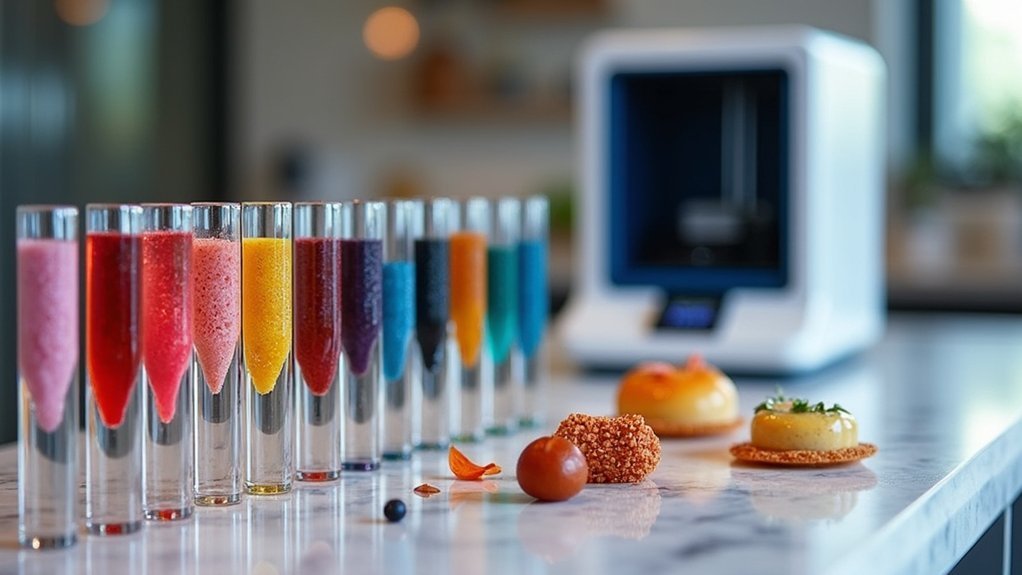
When developing clay-based inks for culinary 3D printing, you must carefully balance rheological properties to achieve ideal extrusion and structural integrity.
Start by incorporating thickeners like starches or hydrocolloids to enhance printability while preventing structural collapse. You’ll want to adjust moisture content strategically—higher water levels reduce viscosity, but you can use additives to maintain proper flow characteristics for smooth extrusion.
Natural clays such as montmorillonite strengthen your printed structures, enabling more complex designs without compromising stability.
Pay close attention to how clay interacts with other food ingredients, as these relationships directly impact your final product’s texture, flavor, and nutritional value.
Test different formulation ratios systematically to optimize both printing performance and the culinary experience of your finished creations.
Structural Integrity and Shape Retention Methods
You’ll achieve superior structural integrity in your 3D printed foods by understanding how clay particles form reinforcing networks within your ink matrix.
Your printed structures maintain their shape through specific clay reinforcement mechanisms that prevent deformation during and after deposition.
You can enhance shape retention by implementing targeted post-printing stabilization techniques that work synergistically with the clay’s natural binding properties.
Clay Reinforcement Mechanisms
As you incorporate natural clays like montmorillonite into your culinary inks, these materials create sophisticated reinforcement mechanisms that dramatically improve your printed food’s structural integrity.
The clay particles establish network structures that support your designs while enhancing viscosity and stability throughout the printing process.
Clay reinforcement works through several key mechanisms:
- Enhanced viscosity – Natural clays increase your food inks’ thickness, improving shape retention during extrusion.
- Network formation – Clay particles create structural frameworks that prevent deformation and collapse.
- Improved dispersion – Hydrophobically modified clays integrate better with hydrophilic food matrices.
- Thixotropic behavior – Clay inclusion promotes ideal flow properties during printing while maintaining structural fidelity.
These mechanisms boost dimensional stability and mechanical strength while optimizing rheological properties for successful culinary 3D printing applications.
Post-Printing Stabilization Techniques
Once your clay-based culinary structures emerge from the 3D printer, implementing targeted stabilization techniques becomes essential for maintaining their dimensional accuracy and preventing structural collapse.
Post-printing stabilization relies on multiple approaches to enhance your printed food’s integrity. You’ll want to apply chemical fixing agents that solidify extruded materials while preserving their intended form.
Dehydration and controlled heat application promote moisture evaporation, improving shape retention considerably. Incorporating thickeners like starches or hydrocolloids helps maintain ideal viscosity throughout the setting process.
Cold or ambient gelation methods allow your structures to set without compromising quality. Adding natural proteins or fibers enhances mechanical properties, ensuring your printed items withstand handling while maintaining both aesthetic appeal and functional characteristics.
Safety Standards and Food-Grade Clay Requirements
When developing clay-based inks for culinary 3D printing, you’ll need to ascertain your materials meet stringent safety standards established by regulatory bodies like the FDA.
Food-grade clay like montmorillonite must undergo rigorous testing to ascertain it’s safe for consumption.
Your clay selection must satisfy these critical requirements:
Your clay selection must satisfy these critical requirements for safe culinary 3D printing applications.
- Purity verification – Ascertain complete absence of harmful contaminants
- Non-toxic composition – Verify all components are safe for human consumption
- Processing stability – Confirm clay won’t degrade during food preparation
- Non-allergenic properties – Test for potential allergic reactions
You’ll also need to optimize rheological properties to achieve proper printability while maintaining safety compliance.
Research continues focusing on balancing functional requirements with safety standards, ascertaining your clay-based inks perform effectively without compromising consumer health.
Texture Enhancement Through Clay Nanocomposites
When you integrate clay particles into your culinary inks, you’re fundamentally altering the material properties that determine how your printed food will feel and taste.
The nanocomposite structure created by dispersing montmorillonite or similar clays throughout your base ingredients directly impacts the rheological behavior of your printing medium.
You’ll find that these modifications affect everything from the ink’s flow characteristics during extrusion to the final texture your consumers experience when biting into the finished product.
Clay Particle Integration
While traditional food inks often struggle with maintaining structural integrity during 3D printing, clay nanocomposites like montmorillonite offer a breakthrough solution for texture enhancement.
When you integrate clay particles into your food inks, you’re fundamentally transforming their textural properties and performance capabilities.
The integration process delivers four key advantages:
- Increased viscosity – Clay particles create perfect flow characteristics for precise extrusion
- Enhanced shape retention – Your printed structures maintain their form post-extrusion
- Improved mechanical stability – The nanocomposite structure strengthens during 3D printing
- Reduced moisture content – Clay integration leads to better texture and consumer appeal
You’ll find that montmorillonite’s biocompatibility makes it ideal for culinary applications, while its natural availability guarantees cost-effective production scaling for your innovative food printing projects.
Rheological Property Modification
Although clay integration transforms your food inks structurally, the real magic happens at the rheological level where montmorillonite nanocomposites fundamentally alter flow behavior and viscosity profiles. You’ll discover that clay nanocomposites enhance your food inks’ rheological properties by creating thixotropic behavior—materials that thin under shear stress but recover their structure when at rest. This characteristic improves printability while maintaining shape fidelity during extrusion.
| Property | Enhancement Effect |
|---|---|
| Viscosity Control | Increases base viscosity for better layer adhesion |
| Shear Response | Enables smooth extrusion through nozzles |
| Recovery Time | Rapid structure reformation prevents deformation |
| Flow Stability | Consistent material delivery throughout printing |
Your clay-enhanced inks demonstrate superior mechanical stability, reducing moisture-related deformation while promoting uniform ingredient dispersion for ideal printing performance.
Processing Parameters for Clay-Based Material Extrusion
Processing clay-based materials for culinary 3D printing requires precise control over multiple extrusion parameters to achieve successful results.
You’ll need to carefully adjust these processing parameters based on your clay composition’s specific rheological properties to guarantee ideal printability.
Critical parameters you must refine include:
- Nozzle diameter – Larger diameters accommodate thicker clay mixtures but reduce detail precision.
- Extrusion speed – Faster speeds risk structural deformation while slower speeds may cause material buildup.
- Layer height – Thinner layers improve surface quality but increase printing time considerably.
- Temperature control – Maintains consistent flow characteristics and prevents premature setting.
You’ll find that different clay formulations require unique parameter combinations.
Start with conservative settings and incrementally adjust based on your material’s behavior.
Monitor for clogging, shape distortion, and layer adhesion throughout the printing process.
Post-Processing Stability and Dimensional Control
Once your clay-based culinary prints complete the extrusion process, maintaining dimensional accuracy becomes your primary challenge. Post-processing stability depends heavily on controlling moisture content and incorporating stabilizing agents like hydrocolloids into your clay-based inks.
| Stabilization Method | Primary Function | Result |
|---|---|---|
| Hydrocolloid Addition | Increases viscosity | Enhanced structural integrity |
| Temperature Control | Manages texture | Improved shape retention |
| Moisture Optimization | Prevents swelling | Dimensional control |
You’ll need to monitor water levels carefully, as excessive moisture causes instability and dimensional loss. Natural clays like montmorillonite improve mechanical properties, while thickeners enhance your ink’s ability to maintain intended shapes. Strategic cooling or heating during post-processing helps lock in your design’s geometry under varying conditions.
Commercial Applications and Market Potential
The burgeoning 3D food printing industry presents unprecedented opportunities for clay-based ink technologies, with market projections reaching $1.1 billion by 2026.
You’ll find that commercial applications for clay-based inks are revolutionizing culinary manufacturing by enabling intricate designs previously impossible with traditional methods.
The market potential for these innovations centers on four key advantages:
- Enhanced structural integrity through montmorillonite clay formulations
- Improved flow properties allowing complex culinary architectures
- Nutritional benefits via bioactive compound incorporation
- Customization capabilities for chefs and food manufacturers
You can expect evolving regulatory frameworks to accelerate commercial adoption, particularly as health-conscious consumers demand functional foods.
Companies investing in clay-based inks aren’t just improving printability—they’re creating sustainable production tools that’ll reshape the entire culinary landscape through innovative customization possibilities.
Frequently Asked Questions
How Does Clay Affect the Taste and Flavor Profile of Printed Food?
You’ll notice clay adds an earthy, mineral taste that’s subtle but distinct. It doesn’t overpower other flavors but creates a unique texture and mild earthiness that some find pleasant while others consider unusual.
Can Clay-Based Inks Be Used With Existing Consumer 3D Food Printers?
You can’t directly use clay-based inks with most consumer food printers since they’re designed for chocolate, frosting, or dough. You’ll need specialized extruders and nozzles that handle clay’s unique viscosity and flow properties.
What Is the Shelf Life of Prepared Clay-Based Food Inks?
You’ll find prepared clay-based food inks last 3-7 days refrigerated, depending on ingredients used. Store them in airtight containers to prevent drying. Don’t freeze them since texture changes affect printability and performance.
Are There Any Dietary Restrictions or Allergies Associated With Edible Clays?
You’ll find edible clays generally safe, but they can contain aluminum which some people avoid. If you’re pregnant, have kidney issues, or take certain medications, you should consult your doctor first.
How Do Printing Speeds Compare Between Clay-Based and Traditional Food Inks?
You’ll find clay-based inks print slower than traditional food inks due to their thicker consistency and higher viscosity. They require reduced speeds to maintain structural integrity and prevent nozzle clogging during extrusion.

Leave a Reply