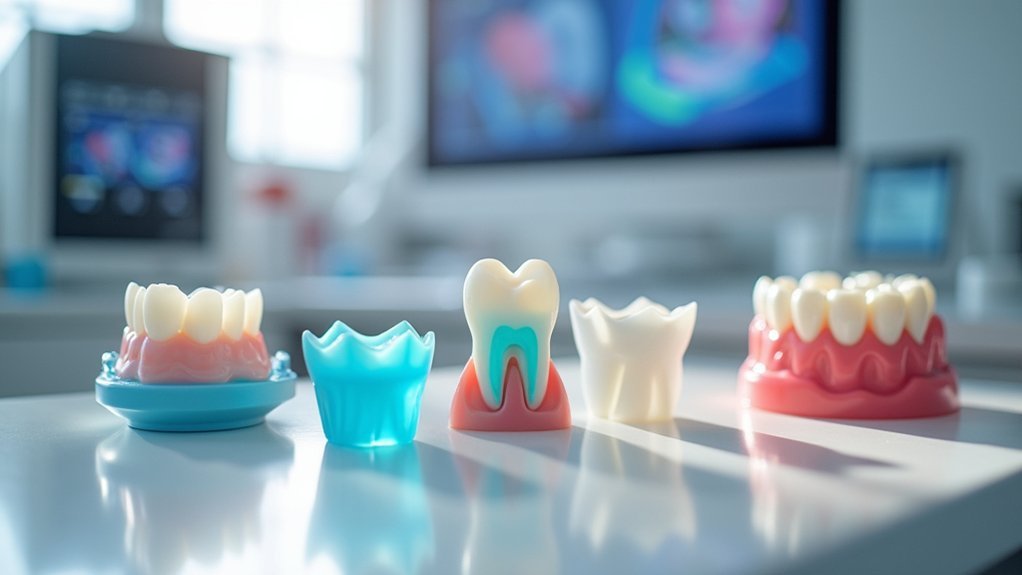
You can revolutionize your dental practice with SLA 3D printing across ten key applications: diagnostic models for case visualization and patient education, temporary crowns and bridges for same-day restorations, surgical guides for precise implant placement, clear aligners with superior accuracy, custom retainers from orthodontic models, biocompatible surgical templates for complex procedures, pre-treatment planning models, crown and bridge frameworks, and night guards that reduce production time from weeks to hours. These applications transform traditional workflows while enhancing patient outcomes and practice efficiency through streamlined digital processes.
Dental Models for Case Visualization and Patient Education
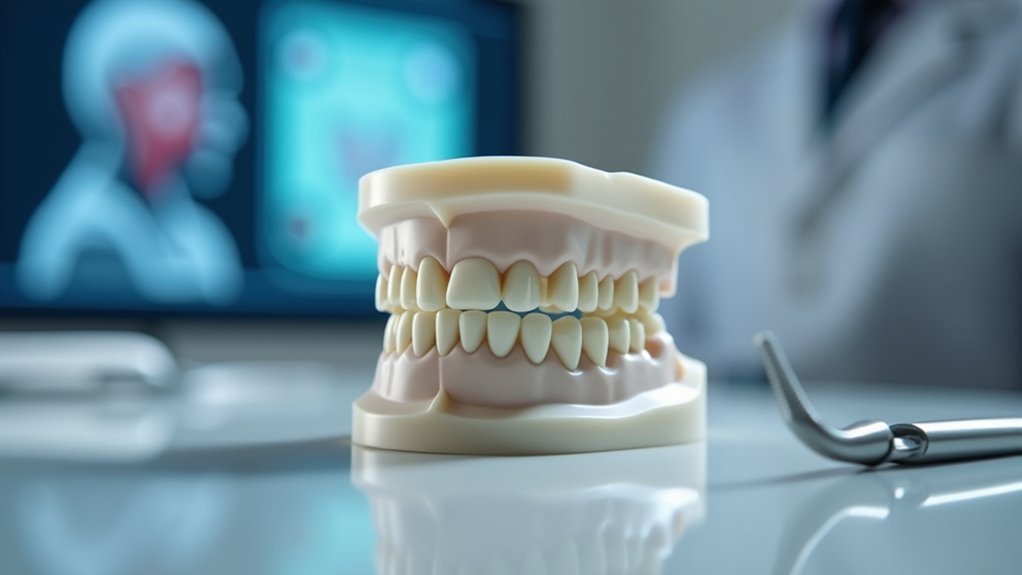
Precision becomes paramount when you’re visualizing complex dental anatomy for case planning and patient communication. SLA 3D printed dental models transform digital scans into accurate physical representations of patient-specific anatomical structures.
SLA 3D printing bridges the gap between digital dental scans and tangible, patient-specific anatomical models for enhanced precision.
You’ll find these models enable detailed examination of tooth morphology, jaw alignment, and spatial relationships essential for diagnosis while reducing ambiguity compared to 2D imaging alone.
For patient education, you can use these tangible visual aids to explain dental conditions, procedures, and expected outcomes effectively. They improve patient comprehension by transforming abstract digital data into concrete physical examples.
You’ll discover that patient-specific models help illustrate treatment necessity, benefits, and limitations clearly, empowering shared decision-making and increasing patient satisfaction and treatment acceptance. These models also serve as valuable resources for dental training, providing students with hands-on experience examining diverse anatomical variations and pathological conditions.
Temporary Crowns and Bridges for Trial Restorations
When you need immediate provisional restorations, SLA 3D printing delivers temporary crowns and bridges that combine rapid production with clinical-grade performance. You can create same-day restorations using biocompatible, tooth-colored resins with nano-ceramic fillers that provide strength for up to 12 months. The digital workflow transforms your intraoral scans into precise temporary restorations through photopolymerization technology.
| Traditional Method | SLA 3D Printing |
|---|---|
| Days to weeks turnaround | Same-day delivery |
| Multiple appointments | Single appointment |
| Limited shade matching | Multiple VITA shades |
You’ll achieve excellent marginal adaptation while maintaining cost-effectiveness through in-office production. These FDA-compliant materials offer superior mechanical properties and can accommodate single crowns to seven-unit bridges, expanding your clinical versatility greatly. The optimal printing orientation requires positioning the occlusal surface toward the build platform to ensure maximum accuracy and proper fit of the temporary restoration.
Surgical Guides for Precise Implant Placement
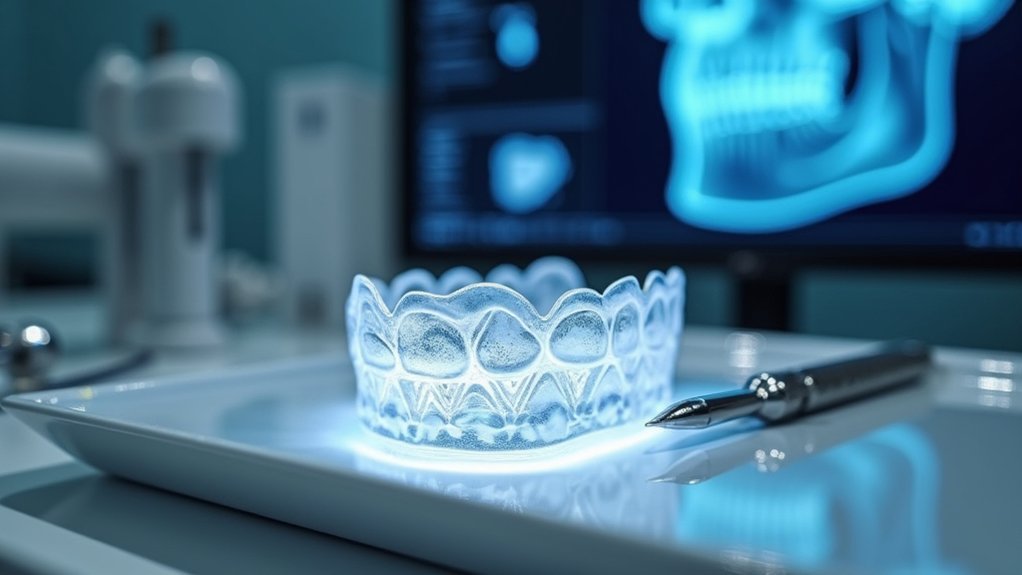
SLA 3D printing transforms implant surgery through customized surgical guides that deliver unmatched accuracy for drill positioning, angulation, and depth control.
You’ll capture patient anatomy using CBCT and intraoral scans, then design precise guides with dental CAD software like 3Shape Implant Studio. The digital workflow lets you print guides in-house using biocompatible photopolymer resins on reliable platforms like Formlabs Form 3B.
You’ll achieve superior clinical outcomes through minimally invasive procedures that reduce surgery time and postoperative discomfort. The guides prevent critical errors like nerve injury and sinus perforation while ensuring ideal implant positioning for prosthetic success. Restoratively-driven planning incorporates future crown designs to optimize implant positioning for ideal prosthetic outcomes.
Your patients benefit from smaller incisions, reduced infection risk, and faster healing since guided surgery often eliminates flap elevation requirements, making implant placement more predictable and successful.
Clear Aligners and Orthodontic Appliance Production
Modern orthodontic practices embrace 3D printing technology to revolutionize clear aligner production, moving beyond traditional thermoforming methods that require physical models and multiple manufacturing steps.
You’ll find that SLA printing delivers exceptional accuracy with 60-70 micron resolution, ensuring precise fit and enhanced patient comfort. The direct printing process eliminates manual grinding and polishing, greatly reducing production time—you can complete full batches in approximately one hour.
You’ll benefit from superior material properties when using dental LT resin, which provides greater mechanical strength than thermoformed alternatives.
Post-curing at 400-800°C for 15-20 minutes optimizes polymer cross-linking, resulting in aligners with 4.46-5.90 times higher compressive modulus.
Post-curing treatment dramatically enhances aligner strength, delivering up to 5.9 times greater compressive modulus through optimized polymer cross-linking.
This technology enables complete customization of thickness and geometry based on digital scans, delivering tailored orthodontic solutions. The market for 3D printed clear dental aligners is projected to grow at a CAGR of 8.4% through 2033, reflecting the increasing adoption of this advanced manufacturing approach in orthodontic practices worldwide.
Custom Retainers and Orthodontic Models
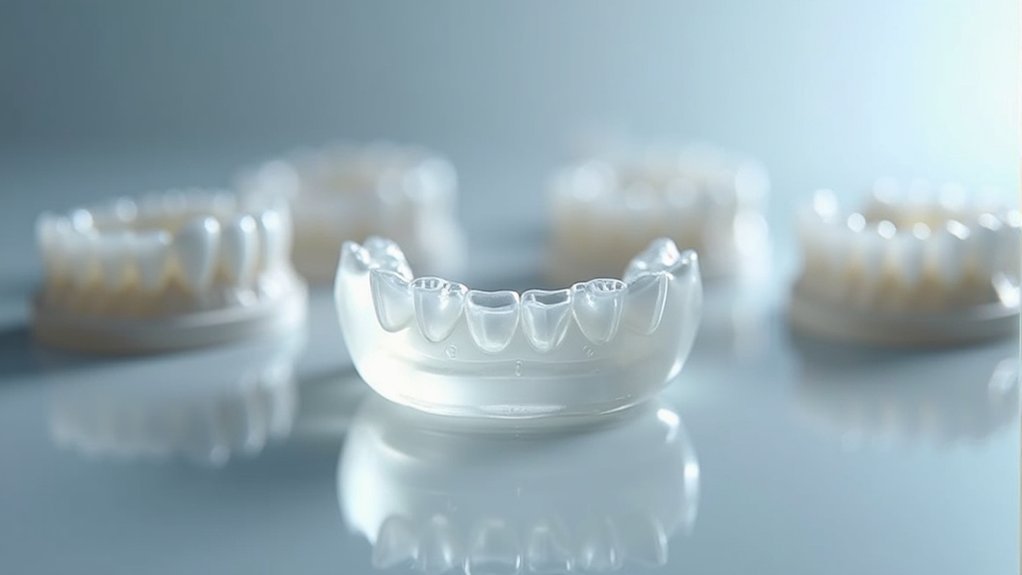
You’ll find that SLA 3D printing transforms orthodontic retainer production through precision model creation that achieves accuracy within 0.25 mm regardless of print orientation.
This technology enables you to manufacture custom appliances directly or use printed models as thermoforming bases, considerably reducing turnaround times to under one hour per batch.
The digital workflow eliminates traditional impression materials while providing enhanced mechanical strength and consistent reproducibility for your orthodontic practice. Compatible intraoral scanners including Primescan, iTero, Trios, and Omnicam streamline the initial impression capture process within 5-10 minutes.
Precision SLA Model Creation
Precision becomes paramount when creating orthodontic models and custom retainers, where even minute dimensional errors can compromise treatment outcomes. SLA printers consistently deliver trueness errors within clinically acceptable thresholds (<0.25 mm), outperforming DLP/LCD technologies greatly (p < 0.001).
Your workflow starts with digital scans converted through specialized CAD software into precise 3D models. The SLA printer then builds these layer-by-layer with micron-level accuracy using orthodontic-specific resins.
| Print Parameter | Impact on Precision | Clinical Consideration |
|---|---|---|
| Layer Height | Lower heights improve accuracy | Reduces stair-stepping effects |
| Printer Grade | Professional > Entry-level | Higher investment, better outcomes |
| Post-Processing | Maintains dimensional stability | Critical for retainer fitting |
Proper post-processing including cleaning and curing guarantees your models maintain the dimensional stability necessary for effective orthodontic applications. The material versatility of SLA technology enables specialized resin formulations optimized for biocompatible orthodontic applications.
Custom Appliance Manufacturing
While traditional retainer manufacturing requires multiple appointments and laboratory work, SLA 3D printing transforms your practice by enabling same-day custom appliance production.
You’ll achieve accuracy within 0.25 mm using specialized resins that match thermoformed plastics’ strength and flexibility. Your workflow begins with intraoral scanning, followed by CAD software preparation that simulates bracket removal. The SprintRay Pro printer creates retainers directly or produces precise models for thermoforming.
You’ll eliminate physical impressions while reducing patient wait times from days to under an hour. The high-resolution printing captures fine dental anatomy details, ensuring effective retention.
Digital fabrication minimizes material waste and reduces labor demands, lowering your production costs. Print angulation flexibility offers versatile build orientations without compromising precision, making custom appliance manufacturing efficient and sustainable. The biocompatible materials used in SLA printing ensure safe oral applications while maintaining the necessary durability for long-term orthodontic use.
Provisional Prosthetics for Treatment Evaluation
When designing complex restorative treatments, SLA 3D printing transforms how you’ll evaluate provisional prosthetics before committing to final fabrication.
You’ll create temporary crowns, bridges, and full-arch appliances with precise marginal fit using nano-ceramic filled biocompatible resins that withstand intraoral stresses for up to 12 months.
Your workflow starts with digital scans processed through CAD software, followed by layer-by-layer UV curing.
You’ll achieve same-day fabrication while reducing manual adjustments through consistent, repeatable quality.
These provisionals let you test occlusion, aesthetics, and function cost-effectively. The flexural strength of these 3D-printed provisional restorations ranges between 60 to 90 MPa, providing reliable mechanical performance comparable to traditional fabrication methods.
You can make rapid iterations using stored digital files, enabling chairside adjustments and quick remakes.
This approach enhances patient communication through accurate trial restorations while supporting extended treatment evaluation periods with durable, esthetic temporary solutions.
Biocompatible Surgical Templates for Complex Procedures
Beyond evaluating treatment outcomes with provisional prosthetics, SLA 3D printing enables you to fabricate biocompatible surgical templates that guide complex dental and maxillofacial procedures with unprecedented accuracy.
You’ll achieve precise drill positioning for implant placement in anatomically challenging sites while avoiding critical structures like nerves and sinuses. The high-resolution layer curing creates intricate geometries that match your patient’s unique anatomy perfectly.
Your surgical workflow becomes more predictable since these templates transfer virtual planning directly to the operative field. You’ll reduce procedural time, minimize intraoperative adjustments, and increase patient safety.
The biocompatible resins withstand sterilization while maintaining dimensional stability. Clear materials enhance visibility during surgery, letting you verify positioning accuracy. These surgical guides can be sterilized using steam autoclaves following CDC guidelines without compromising their structural integrity.
This technology transforms complex procedures like bone grafting, orthognathic surgery, and tumor resections into precise, minimally invasive interventions.
Diagnostic Models for Pre-Treatment Planning
You’ll transform your pre-treatment planning when SLA 3D printing delivers diagnostic models that capture every anatomical detail with exceptional precision.
These physical replicas let you visualize complex cases from multiple angles, ensuring you don’t miss critical structural relationships that could impact treatment outcomes. The quickest method to obtain accurate 3D data is through intraoral scanning, which seamlessly integrates with modern digital workflows.
Your workflow becomes remarkably efficient as digital impressions convert directly into tangible models, eliminating traditional laboratory delays and enabling same-day treatment discussions.
Enhanced Case Visualization
Diagnostic models serve as the foundation for effective pre-treatment planning, and SLA 3D printing has revolutionized how quickly and affordably you can produce these essential tools.
You’ll gain a tactile three-dimensional reference that helps you visualize anatomical complexities before treatment begins. These models enable you to better comprehend root morphology, arch relationships, and occlusal schemes that might be difficult to assess from digital scans alone.
You can use SLA diagnostic models to improve communication with lab technicians when designing customized prosthetics. They also enhance patient education by providing physical representations of planned interventions.
Additionally, you’ll find these models valuable for simulating procedures or trial positioning, which reduces unexpected complications during actual treatment delivery. Studies comparing standard dental 3D printers with non-dental alternatives have demonstrated the importance of selecting appropriate printing technology for achieving optimal model accuracy in clinical applications.
Accurate Anatomical Replication
While visualization benefits provide significant advantages for treatment planning, the accuracy of anatomical replication in SLA-printed diagnostic models determines their clinical reliability.
You’ll achieve extremely fine details through SLA’s single-point laser curing system, which replicates complex anatomy with minimal deviation from your digital scans. When you use dental-specific SLA printers like Formlabs with validated Model Resin, you’re producing models with clinically acceptable dimensional accuracy at $2-$3 per model.
The layer-by-layer photopolymerization process preserves intricate anatomical structures essential for pre-treatment analysis. You can print six diagnostic models in just eleven minutes using Fast Model Resin, enabling rapid case assessment without compromising precision.
Your material choice—whether stone-colored Model Resin for familiar tactile feedback or White Resin for enhanced surface visibility—directly impacts anatomical fidelity and diagnostic effectiveness.
Streamlined Diagnostic Workflows
Beyond achieving precise anatomical replication, modern SLA workflows transform how you integrate diagnostic modeling into daily practice.
PreForm’s Scan to Model feature converts your intraoral scan data directly into printable models without specialized CAD software, requiring just three steps: scanning, automated design, and post-processing. You’ll produce six diagnostic models in 11 minutes using Fast Model Resin or 34 minutes with Grey Resin, costing $2-3 per model.
This streamlined approach enables same-day chairside delivery, improving patient engagement while you maintain clinical throughput.
You can delegate printing tasks thanks to preset validated settings and minimal resin handling. Physical models enhance patient comprehension during treatment discussions and support interdisciplinary planning among specialists, helping you detect potential challenges early and coordinate surgical guides effectively.
Crown and Bridge Frameworks for Laboratory Work
Precision stands as the cornerstone of successful crown and bridge fabrication, and SLA 3D printing delivers exceptional accuracy that surpasses traditional laboratory methods.
You’ll achieve RMS deviations averaging 129±16μm compared to 177±25μm with traditional alginate impressions. Digital intraoral scanning captures detailed patient anatomy, enabling precise CAD designs through software like Exocad and 3Shape that integrate seamlessly with SLA printers.
You can utilize ceramic-filled hybrid resins like SprintRay Crown for durable definitive restorations or DENTCA’s FDA-cleared materials for temporary frameworks. These materials come in multiple tooth shades and support traditional polishing techniques.
Your workflow becomes streamlined through automation and digital file management, while removable dies enhance fit verification. SLA printing produces complex geometries impossible with milling, increasing your design freedom considerably. Single-visit chairside dentistry becomes achievable with rapid production capabilities that eliminate multiple patient appointments.
Night Guards and Occlusal Splints for Patient Comfort
Sleep disruption from teeth grinding and jaw clenching affects millions of patients, and SLA 3D printing transforms how you can deliver protective night guards and occlusal splints.
You’ll reduce production time from two weeks to just one hour while cutting costs from $80-150 per appliance to $3-4.
Digital impressions from intraoral scanners create precise 3D models, eliminating physical impressions and manual fabrication errors. The streamlined workflow includes a 5-minute scan, 5-minute design process, and quick setup without requiring in-field calibration.
You can choose between Dental LT Clear Resin for rigid, long-term splints or Dental LT Comfort Resin for flexible, comfortable night guards.
SmileGuard resin offers FDA-cleared materials specifically formulated for dental applications.
SLA printers produce up to eight splints in 54 minutes, enabling same-day delivery while maintaining high optical transparency and discoloration resistance for extended patient use.
Frequently Asked Questions
What Are the Typical Costs of SLA Dental Printers for Small Practices?
You’ll find desktop SLA dental printers typically cost several thousand dollars, with models like the Dentafab Sega around $9,000. You’ll also need to budget for ongoing resin and consumable costs.
How Long Does Post-Processing Take After Printing SLA Dental Restorations?
You’ll spend 30 minutes to 2 hours on post-processing, including 5-10 minutes washing, 5-20 minutes UV curing, and additional time for sanding, polishing, or coating depending on your restoration’s complexity.
What Safety Precautions Are Needed When Handling Uncured SLA Resins?
You’ll need chemical-resistant gloves, safety goggles, and respirators when handling uncured SLA resins. Guarantee proper ventilation, avoid skin contact, wash hands thoroughly afterward, and dispose of contaminated materials following hazardous waste regulations.
How Do SLA Printing Speeds Compare to Traditional Dental Laboratory Methods?
You’ll find SLA printing dramatically reduces production time from weeks to hours. While traditional dental lab methods take 1-3 weeks, you can complete SLA prints in 2-3 hours, enabling same-day delivery.
What Is the Expected Lifespan of SLA Printed Temporary Restorations?
You’ll find SLA printed temporary restorations typically last three to six months with proper care. They’re durable enough for interim use but won’t match permanent crowns’ longevity.

Leave a Reply