

You’ll want to focus on 1:24 scale Cat D9 Dozers and 1:48 scale Cat 651E Wheel-Tractor Scrapers for your architectural presentations. These high-quality die-cast models provide the precise engineering details and scale accuracy you need to effectively communicate construction processes to clients. They’re perfect for demonstrating equipment functionality, evaluating spatial relationships between machinery and site elements, and enhancing stakeholder communication during planning discussions. Continue exploring to discover professional integration techniques that’ll elevate your presentations.
Essential Construction Equipment Models for Architectural Projects
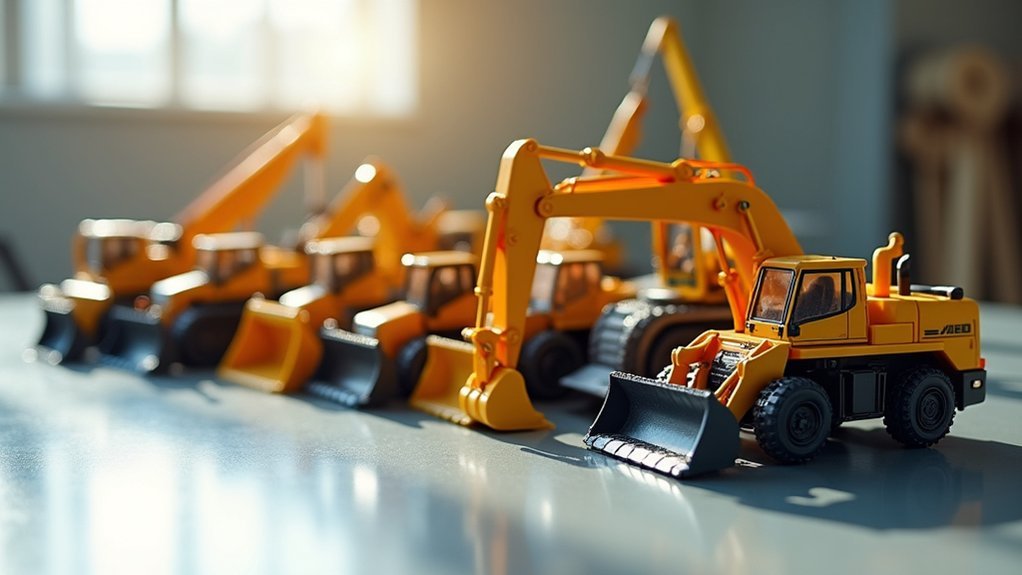
When you’re developing architectural presentations, incorporating scale construction equipment models transforms abstract project concepts into tangible, understandable visuals.
These detailed Scale Model replicas become essential components of your architectural models, allowing you to accurately represent heavy machinery that’ll be operating on your construction sites.
The 1:24 scale Cat D9 Dozer and 1:48 scale Cat 651E Wheel-Tractor Scraper offer the intricate detailing you need to enhance client presentations and demonstrate equipment functionality.
Scale Model Materials and Manufacturing Techniques
When you’re building construction equipment scale models, you’ll need to carefully evaluate materials based on durability, workability, and visual accuracy to match your architectural project’s requirements.
Your material choices should balance the precision demands of small-scale components with manufacturing constraints and budget considerations.
You’ll find that modern precision manufacturing methods, including laser cutting and injection molding, can dramatically improve your model’s accuracy while reducing production time.
Material Selection Criteria
Although many factors influence the success of your construction equipment scale model, material selection stands as the most critical decision you’ll make during the planning phase.
Your architectural model’s durability, aesthetic quality, and ability to accurately represent design intentions depend entirely on choosing appropriate materials.
Consider ABS plastic for detailed, intricate designs due to its injection molding versatility. Foam boards offer lightweight, easy-to-cut solutions perfect for clean architectural presentations.
Among common materials used, you’ll find plywood and cardboard provide cost-effective alternatives, while types of wood deliver natural authenticity for certain projects.
Don’t overlook transparent materials like Plexiglas, which enhance visual appeal through compelling light and shadow effects.
Match your material choice to the model’s intended use—prioritizing stability and durability for display pieces versus functional prototypes.
Precision Manufacturing Methods
Your material choices work hand-in-hand with precision manufacturing methods that transform raw components into accurate, detailed scale models. CNC machining and laser cutting techniques deliver exceptional accuracy when working with your selected materials, guaranteeing intricate details remain crisp and proportional.
3D printing technology revolutionizes complex geometries that traditional methods can’t achieve, allowing you to create architectural elements with unprecedented detail.
For high-volume production, injection molding provides consistency across multiple units while maintaining tight tolerances. Vacuum forming complements these processes by creating lightweight components without sacrificing structural integrity.
These precision manufacturing methods maximize your materials’ potential, whether you’re working with ABS plastic, brass, or aluminum. The combination guarantees your construction equipment models meet professional architectural presentation standards.
Top Construction Machinery Models for Site Planning
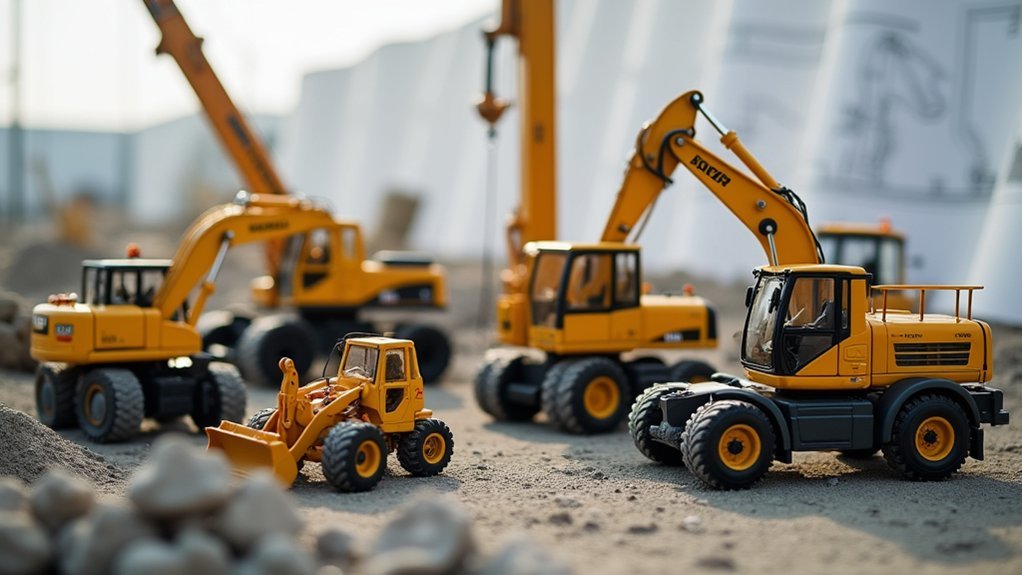
You’ll find that selecting the right earthmoving equipment models transforms your site planning approach from abstract concepts to concrete visualizations.
The scale accuracy of models like the Cat D9 Dozer and 651E Wheel-Tractor Scraper directly impacts how well you can assess spatial relationships and equipment positioning within your project boundaries.
Your terrain modification vehicle selection should prioritize models that represent the actual machinery you’re specifying, ensuring your planning accuracy matches real-world construction scenarios.
Essential Earthmoving Equipment Models
Two flagship models dominate the essential earthmoving equipment category for architectural site planning: the Cat D9 Dozer and Cat 651E Wheel-Tractor Scraper.
These scale models provide architects with precise representations of machinery that’ll shape your construction projects.
The Cat D9 Dozer’s 1:24 scale model ($949.85) demonstrates powerful dozing capabilities essential for site grading and preparation.
Meanwhile, the Cat 651E Wheel-Tractor Scraper’s 1:48 scale version ($379.95) showcases efficient material transport operations.
- Visualize equipment size relationships with actual site conditions
- Enhance design decisions through realistic machinery positioning
- Improve project feasibility assessments during planning phases
- Communicate complex earthmoving concepts effectively to clients
You’ll find these high-quality models invaluable for enriching presentations and helping stakeholders understand site preparation requirements.
Scale Accuracy for Planning
Scale accuracy determines the effectiveness of construction equipment models in architectural planning scenarios.
When you’re selecting models, you’ll find that 1:24 scale options like the Cat D9 Dozer offer realistic representations for detailed site analysis. The precise models at 1:48 scale, such as the Cat 651E Wheel-Tractor Scraper, enable accurate visualization of equipment placement and operational flow.
You’ll discover that proper scale accuracy helps assess the spatial relationship between machinery and site elements, ensuring your designs accommodate real-world constraints.
These detailed representations enhance stakeholder communication by providing tangible references during planning discussions. When you incorporate high-quality construction equipment models into your architectural model presentations, you’ll effectively illustrate operational aspects and facilitate better project decision-making through accurate scale representation.
Terrain Modification Vehicle Selection
Successful terrain modification begins with selecting the right equipment models that accurately represent the machinery you’ll need for earthmoving operations.
These architectural scale models serve as invaluable tools for visualizing complex site planning scenarios before construction begins.
When choosing terrain modification construction machinery for your projects, consider these essential models:
- Cat D9 Dozer (1:24 scale) – Delivers powerful earthmoving capabilities for major site preparation tasks
- Cat 651E Wheel-Tractor Scraper (1:48 scale) – Ideal for efficient grading and material handling operations
- Cat 657E Wheel-Tractor Scraper (1:48 scale) – Perfect for heavy-duty applications requiring enhanced productivity
- Classic Construction Models die-cast series – Provides high-quality representations for showcasing equipment functionality
These scale models bridge the gap between design concepts and execution realities, helping you understand how terrain modification impacts project timelines.
Educational Benefits of Construction Equipment Scale Models
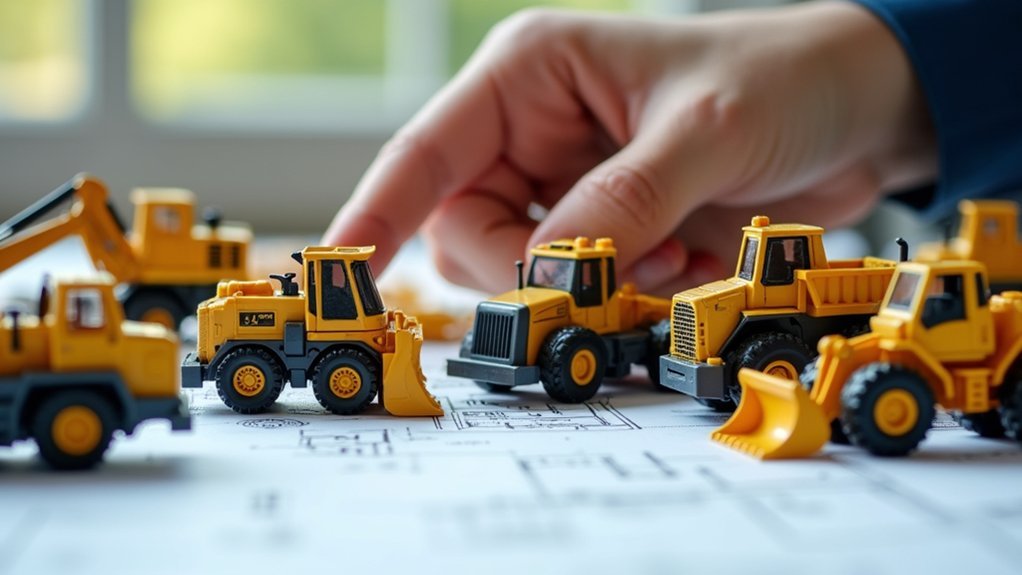
Understanding complex construction processes becomes considerably easier when you can hold a miniature excavator or crane in your hands. Scale models transform abstract concepts into tangible learning experiences, allowing you to grasp spatial relationships and equipment functionality that drawings alone can’t convey.
These detailed replicas help you visualize how machinery interacts with building sites, enhancing your understanding of construction sequencing and logistics. The high-quality material construction of die-cast models reveals intricate engineering details, giving you insights into mechanical systems and operations.
In educational settings, these architecture models encourage hands-on exploration of infrastructure development concepts. You’ll find yourself better equipped to communicate construction processes to clients and stakeholders, fostering collaboration through visual demonstration rather than technical explanations alone.
Professional-Grade Model Building Kits and Supplies
Professional architects and model builders require specialized kits that deliver precision and authenticity in their scale constructions.
Professional-grade model building kits offer extensive solutions for creating detailed architectural models that meet industry standards. Scale modeling demands the best materials and components to achieve realistic results.
You’ll find exceptional value in these essential supplies:
- Ultimate Build Kit (M570010) – Complete 1:12 scale system with extensive supplies for $275.00
- Utility Building Framing Kit (M380700) – Essential framework components at $70.30
- Garage Framing Kit (M380701) – Educational construction learning kit for $126.00
- Chrysler Building Microbeam Kit (M513016) – Iconic structure kit using innovative techniques for $26.90
These kits include miniature cinder blocks, framing materials, and specialized tools that enhance your architectural models’ quality and detail.
Integration of Construction Models in Architectural Presentations
When you integrate construction equipment scale models into your architectural presentations, you transform static design concepts into dynamic, engaging experiences that clients can truly understand.
These detailed models, like the 1:24 Cat D9 Dozer or 1:48 Cat 651E Wheel-Tractor Scraper, demonstrate operational capabilities and construction processes within your design framework. Models used alongside conceptual models create thorough presentations that showcase site logistics, construction timelines, and machinery impact on surrounding elements.
The tactile nature encourages interactive discussions, allowing clients to physically engage with your designs. High-quality die-cast construction equipment elevates presentation professionalism while demonstrating your commitment to detail.
You’ll effectively communicate how heavy machinery influences site functionality, helping stakeholders visualize construction methods and their relationship to the overall project design.
Frequently Asked Questions
What Scale Do Architects Use for Models?
You’ll typically use 1:100 scale for general building models, 1:50 for detailed features, and 1:200 to 1:500 for site planning. You’d choose 1:10 or 1:25 when you’re showcasing intricate details.
What Do Architects Use for Their Models?
You’ll use foam boards, cardboard, and plywood as your primary materials. You’ll need steel scales, architectural scalpels, and snap-off cutters for precision. You’ll bond components using rubber adhesives and integrate metals for structural integrity.
What Are Three Types of Models Used for Architectural Models?
You’ll use three main types of architectural models: volumetric tests made from paper for exploring spatial relationships, detailed models crafted from timber showcasing intricate elements, and prototyping models for testing structural functionalities.
What Is the Best Material for Architectural Models?
You’ll find foam boards work best for most architectural models since they’re lightweight, create clean joints, and cut easily. They provide the perfect balance of durability and workability for detailed construction.


Leave a Reply