
You’ll want to set your coasting distance between 0.2-1.0 mm to eliminate stringing and surface defects. For retraction distance, use 0.5-2.0 mm on direct drive printers and 2.0-6.0 mm for Bowden systems. Adjust coasting volume to 0.05-0.15 mm³ based on your filament type—PETG needs higher volumes than PLA. Set wipe distance between 0.5-1.5 mm and retraction speed at 25-45 mm/s. The specifics below will help you fine-tune these settings perfectly.
Understanding Coasting Distance Parameters and Their Impact on Print Quality
When you’re fine-tuning your 3D printer’s performance, coasting distance parameters serve as one of the most effective tools for eliminating common print defects like stringing and surface blemishes.
These coasting settings control when your printer stops extruding filament before completing a print segment, typically ranging from 0.2 to 1.0 mm depending on your specific setup.
Coasting settings determine the precise moment your printer ceases filament extrusion, typically within a 0.2-1.0mm range based on hardware specifications.
You’ll find that proper wipe distance adjustments greatly reduce oozing while improving overall surface quality.
However, you must strike the right balance—over-coasting creates visible gaps between layers, while under-coasting leads to unwanted stringing and blobs.
The ideal parameters vary based on your printer’s characteristics and filament type, making test prints essential for determining your ideal settings and achieving consistent, high-quality results.
Optimal Retraction Distance Settings for Different Printer Types
Direct drive and Bowden extruder systems require fundamentally different retraction distance settings to achieve ideal print quality. Your direct drive printer needs shorter retraction distances between 0.5-2.0mm because it’s more responsive to filament commands. Bowden setups demand longer distances of 2.0-6.0mm to compensate for the gap between extruder and hotend.
| Printer Type | Retraction Distance |
|---|---|
| Direct Drive | 0.5 – 2.0 mm |
| Bowden | 2.0 – 6.0 mm |
| TPU (Flexible) | 1.0 – 1.5 mm |
| Standard PLA/ABS | Follow printer type |
Set your retraction speed between 25-45 mm/s. Faster speeds reduce oozing but can cause jams in Bowden systems. For flexible filament type like TPU, use shorter distances to prevent compression issues and maintain reliable extrusion.
Balancing Coasting Volume With Filament Material Properties
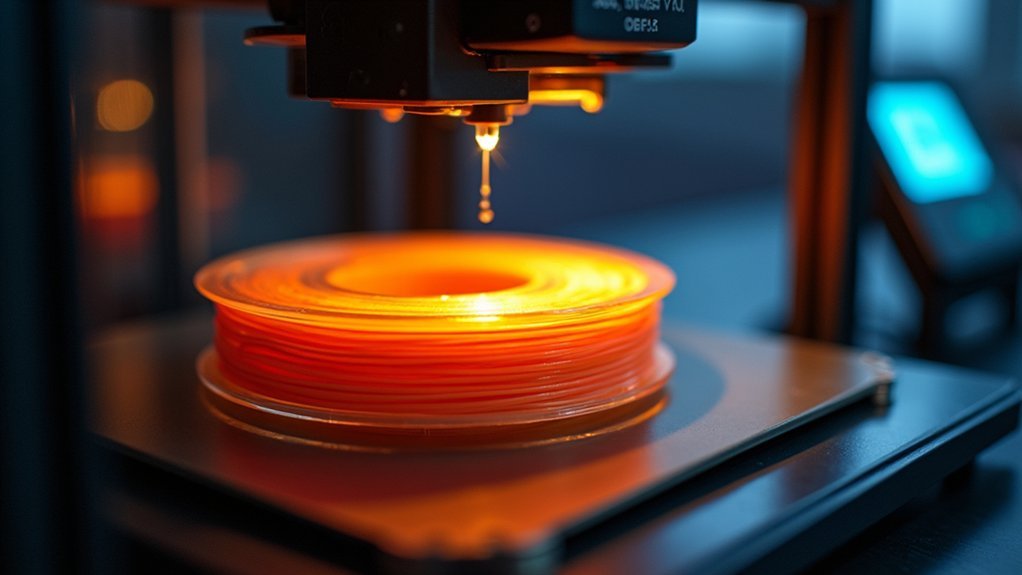
While retraction settings handle filament movement, coasting volume determines how much material flows as your extruder stops feeding filament before a travel move.
You’ll need to adjust this setting between 0.05 to 0.15 mm³ based on your specific material’s properties.
PETG requires higher coasting volumes since it oozes more than PLA, while PLA works well with lower settings.
Your printer type also matters—direct drive systems need less coasting volume compared to Bowden setups due to different filament compression characteristics.
Test coasting distances between 0.2 to 1.0 mm to find your sweet spot.
Each material behaves differently, so you’ll need regular testing to optimize filament flow.
Proper balancing prevents stringing while maintaining surface quality across various materials.
Fine-Tuning Wipe Distance for Seamless Layer Transitions
After your extruder retracts filament, the wipe distance setting controls how far your nozzle travels along the perimeter to clean off any remaining material. This movement smooths excess material and reduces visible artifacts for better print quality.
You’ll typically want to start within 0.5 to 1.5 mm, then fine tune based on your specific setup.
Your printer configuration affects ideal wipe distance:
- Direct drive printers – Use longer wipe distances for better material cleanup.
- Bowden setups – Require shorter distances due to filament compression dynamics.
- Layer settings coordination – Test wipe distance alongside coasting settings for best results.
Monitor your prints for bumps or blobs to determine necessary adjustments.
Excessive wiping can cause under-extrusion at new layer starts, so balance is key.
Testing and Calibrating Combined Coasting and Retraction Settings
Once you’ve configured your basic coasting and retraction parameters, you’ll need to systematically test how these settings work together to eliminate print defects.
Start by printing a baseline model without adjustments to identify where blobs or stringing occur. Begin with a coasting distance between 0.2 to 1.0 mm, monitoring closely to prevent layer gaps.
Print a test model first to pinpoint defect locations, then start with 0.2-1.0mm coasting distance while watching for gaps.
Set your initial retraction distance based on your printer type—direct drive systems need lower distances than Bowden setups.
Make incremental adjustments to both settings, testing small models each time to evaluate their combined impact.
This systematic approach helps you find the ideal balance between coasting distance and retraction distance for your specific printer and filament combination.
Frequently Asked Questions
What Is the Best Coasting Volume?
You’ll find the best coasting volume starts around 0.05 mm³, but it depends on your specific printer and filament. Test different volumes between 0.05-0.15 mm³ to optimize your print quality.
What Is the Coasting Distance for 3d Printing?
You’ll want to set your coasting distance between 0.2 and 1.0 mm for 3D printing. Start at 0.2 mm, then adjust based on your printer’s performance and filament behavior to eliminate stringing.
Should I Enable Coasting in 3D Print?
You should enable coasting if you’re experiencing oozing, stringing, or blobs at path endpoints. It’ll improve your print’s surface quality and reduce post-processing work, especially with certain filaments.
What Is the Coasting Value in Cura?
Coasting value in Cura represents the distance your printer stops extruding filament before completing a print segment. You’ll typically set this between 0.2mm to 1.0mm to reduce oozing and improve quality.

Leave a Reply