
Carbon fiber build plates outperform traditional glass alternatives through their exceptional thermal stability, superior strength-to-weight ratio, and advanced material properties. You’ll experience faster heat distribution, minimal thermal expansion, and outstanding dimensional stability that prevents warping. Their 600-700 KSI tensile strength resists impacts and eliminates crack formation, while excellent adhesion properties work across multiple filament types without adhesives. Though they cost more initially, their durability and extended lifespan make them cost-effective. Continue exploring to discover how these advantages transform your printing experience.
Understanding Carbon Fiber Build Plate Technology
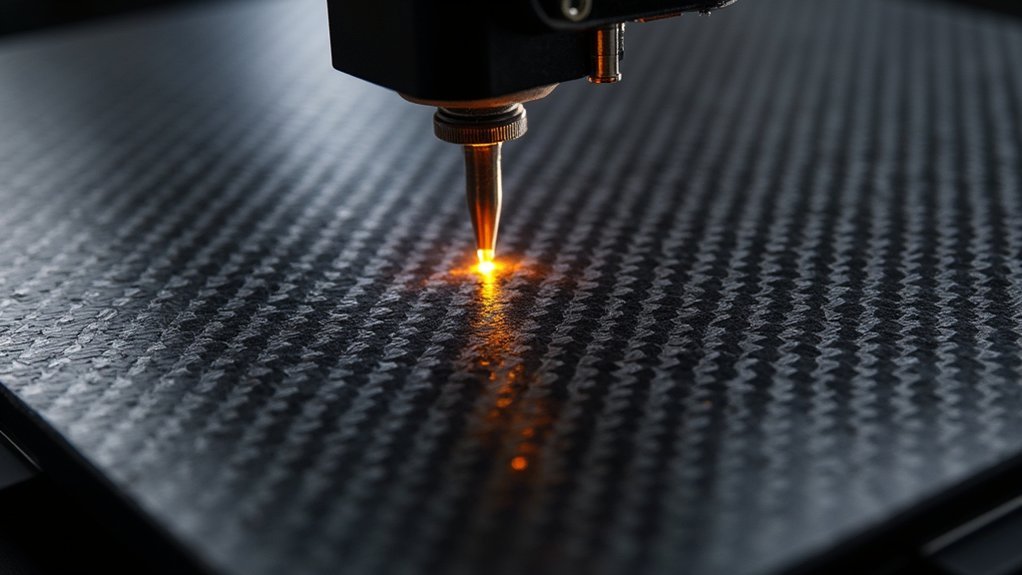
While traditional build plates often struggle with heat distribution and warping issues, carbon fiber build plates revolutionize 3D printing through their advanced material composition and engineering.
Your Carbon Fiber Plate features tightly interlocked carbon fiber strands that deliver exceptional stiffness and strength while maintaining a lightweight profile. This unique construction enhances your printer’s overall performance considerably.
The superior thermal conductivity allows your build plate to absorb and distribute heat rapidly, reaching desired temperatures quickly while maintaining consistent conditions.
You’ll benefit from excellent dimensional stability that resists warping under temperature fluctuations, ensuring precise prints every time.
The remarkable durability protects against impacts and surface damage, making your carbon fiber plate a long-lasting investment that outperforms traditional glass or acrylic alternatives prone to cracking.
Superior Thermal Stability and Heat Distribution
When temperatures fluctuate during printing cycles, carbon fiber build plates maintain their precise dimensions and shape, delivering the thermal stability that’s essential for consistent results. You’ll experience faster heating times due to carbon fiber’s excellent thermal conductivity, which rapidly absorbs and distributes heat across the entire surface.
| Property | Carbon Fiber | Traditional Materials | Benefit |
|---|---|---|---|
| Thermal Expansion | Ultra-low coefficient | Higher expansion rates | Dimensional stability |
| Heat Distribution | Uniform across surface | Uneven hot spots | Consistent temperatures |
| Cooling Rate | Rapid heat dissipation | Slower cooling | Reduced deformation risk |
| Temperature Stability | Maintains shape | Warping susceptible | Enhanced print quality |
You’ll notice improved print quality as the quick cooling properties minimize thermal-induced deformations while the low thermal expansion prevents surface instability during printing.
Enhanced Strength and Durability Compared to Glass
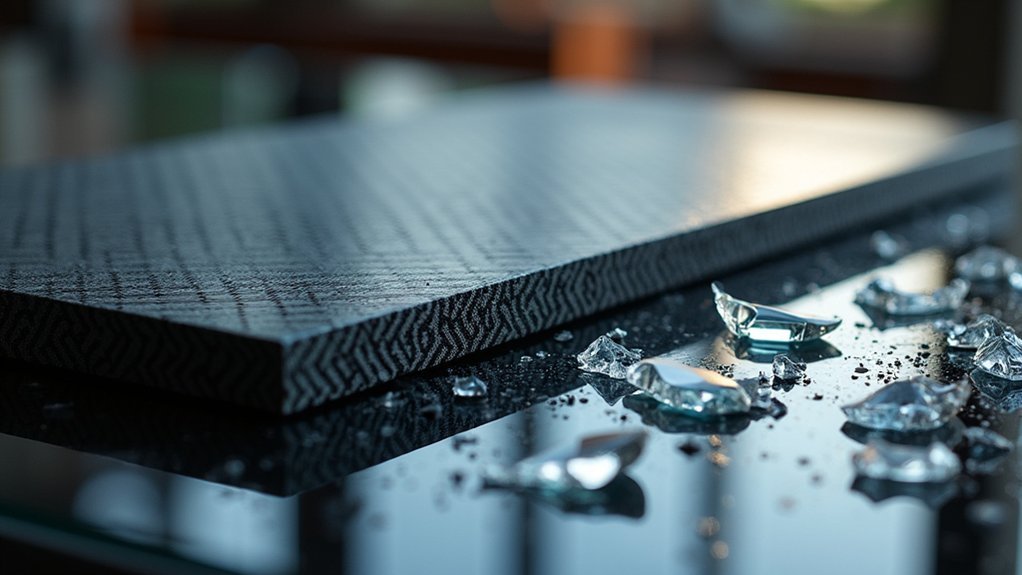
You’ll immediately notice carbon fiber’s superior impact resistance when compared to fragile glass build plates that crack from minor drops or mishandling.
Your carbon fiber plate maintains its structural integrity through countless print cycles, while glass alternatives deteriorate and develop stress fractures over time.
The advanced crack prevention technology in carbon fiber eliminates the worry of sudden plate failure that’s common with traditional glass surfaces.
Impact Resistance Superiority
Although glass build plates have dominated 3D printing for years, carbon fiber alternatives deliver remarkably superior impact resistance that transforms how you approach printer maintenance and operation. When you accidentally drop tools or experience printer head crashes, carbon fiber’s exceptional durability protects your investment while glass shatters or cracks.
| Property | Carbon Fiber | Glass |
|---|---|---|
| Impact Resistance | Exceptional | Poor |
| Tensile Strength | 600-700 KSI | 50-100 KSI |
| Thermal Stability | Superior | Moderate |
You’ll appreciate carbon fiber’s 600-700 KSI tensile strength, which remarkably outperforms glass alternatives. The material’s thermal stability prevents warping under temperature fluctuations, while its scratch-resistant surface maintains optimal printing conditions longer. This combination reduces replacement costs and downtime considerably.
Structural Integrity Longevity
While glass build plates require delicate handling and frequent replacements due to their brittle nature, carbon fiber alternatives deliver exceptional structural integrity that maintains peak performance across thousands of printing cycles.
You’ll experience unmatched durability as carbon fiber’s tensile strength of 600-700 KSI outperforms glass by considerable margins. This superior structural integrity means you won’t face the constant worry of cracks or shattering that plague glass surfaces.
Carbon fiber’s longevity stems from its ability to withstand accidental drops and impacts without compromising functionality. You’ll reduce replacement frequency notably, making it a cost-effective long-term investment.
The low thermal expansion properties guarantee your build plate remains dimensionally stable over time, preventing warping that could affect print quality and extending the plate’s effective lifespan.
Crack Prevention Technology
Carbon fiber’s molecular structure creates an inherently crack-resistant surface that eliminates the catastrophic failure points common in glass build plates. You’ll experience superior thermal stability that prevents the expansion and contraction cycles responsible for stress fractures in traditional materials.
| Feature | Carbon Fiber | Glass |
|---|---|---|
| Crack Resistance | Exceptional | Poor |
| Thermal Expansion | Minimal | High |
| Impact Tolerance | Superior | Brittle |
Your carbon fiber build plate won’t develop hairline cracks from thermal cycling or sudden temperature changes. Unlike glass surfaces that weaken over time, carbon fiber maintains its structural integrity throughout countless heating and cooling cycles. This crack prevention technology guarantees you won’t face unexpected build plate failures mid-print, protecting both your projects and printer investment.
Optimal Adhesion Properties Across Multiple Filament Types
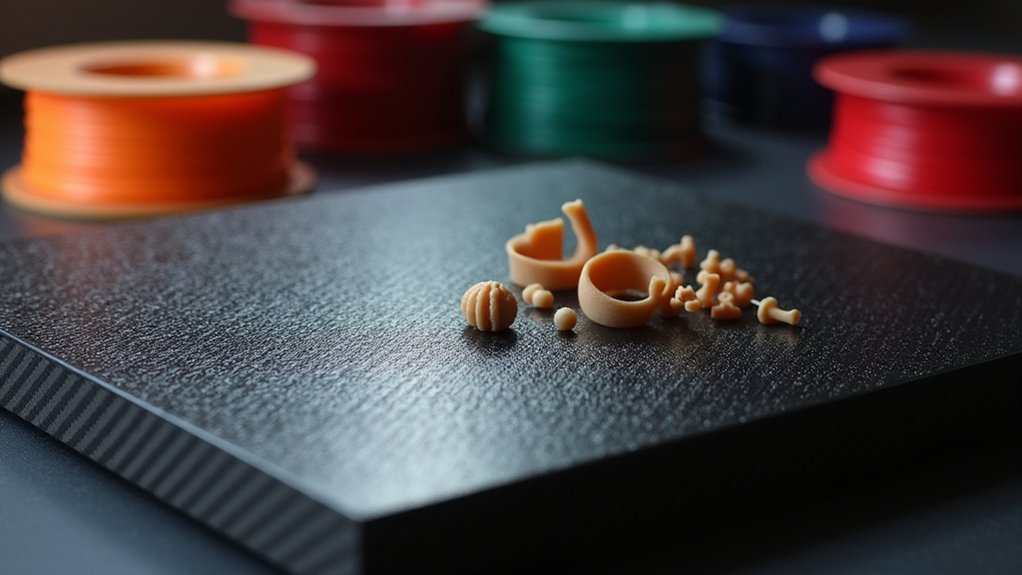
When you’re dealing with multiple filament types in your 3D printing workflow, you’ll find that carbon fiber build plates deliver exceptional adhesion performance that outshines traditional glass or aluminum surfaces.
Your carbon fiber build plate maintains ideal adhesion across PLA, ABS, PETG, nylon, and carbon fiber-infused materials without requiring additional adhesives. The superior thermal conductivity guarantees rapid heat distribution, creating consistent bonding conditions that enhance print quality from start to finish.
You’ll notice markedly reduced warping and print detachment thanks to the plate’s dimensional stability, which prevents expansion and contraction during temperature changes.
The consistently flat surface provides reliable adhesion even with challenging materials that typically cause failures on other surfaces. This versatility eliminates the need to switch build surfaces when changing filament types.
Lightweight Design for Improved Print Precision
Because lighter components translate directly to enhanced precision, you’ll experience greatly improved print quality with carbon fiber build plates that weigh considerably less than traditional glass or aluminum alternatives.
Carbon fiber build plates deliver exceptional print precision through their significantly reduced weight compared to conventional glass and aluminum surfaces.
This lightweight design transforms your printer’s performance through several key mechanisms:
- Reduced moving mass allows faster acceleration and deceleration without compromising stability
- Enhanced thermal stability guarantees your build plate reaches target temperatures quickly and maintains consistency
- Minimized vibrations during rapid movements prevent layer misalignment and surface imperfections
- Improved mechanical precision as lighter components reduce stress on your printer’s frame and motors
- Consistent flatness retention maintains ideal adhesion across the entire print surface
The combination of carbon fiber’s lightweight properties with its superior thermal characteristics creates an excellent printing environment where print precision reaches new levels of accuracy and reliability.
Long-Term Performance and Cost Effectiveness
While initial costs may seem higher, carbon fiber build plates deliver exceptional long-term value through their remarkable durability and resistance to impacts and surface damage.
You’ll experience cost effectiveness as these carbon fiber materials outlast traditional glass or acrylic alternatives, reducing replacement frequency and maintenance expenses.
The consistent flat surface maintains flawless prints over time, minimizing adjustments while superior thermal stability reaches printing temperatures faster, cutting energy costs.
Enhanced adhesion properties prevent print failures and costly reprints, ensuring reliable results.
Weight savings from carbon fiber construction reduce mechanical stress on your printer components, extending their lifespan.
With customization options for different printer models, you’re maximizing efficiency and performance.
This long-term performance translates into substantial savings, making carbon fiber build plates a smart investment for serious makers.
Frequently Asked Questions
What Are the Benefits of Carbon Fiber Plate?
You’ll experience exceptional durability and impact resistance, superior thermal conductivity for faster heating, lightweight stability for precise printing, excellent adhesion preventing warping, and consistent flat surfaces maintaining dimensional integrity.
What Makes Carbon Fiber so Special?
You’ll find carbon fiber’s unique because its tightly interlocked carbon chains create exceptional strength-to-weight ratios, dimensional stability across temperatures, corrosion resistance, and design versatility that outperforms traditional materials like steel and aluminum.
What Gives Carbon Fiber Its Strength?
You’ll find carbon fiber’s strength comes from tightly interlocked carbon atom chains forming microscopic crystalline structures. This arrangement creates exceptional tensile strength of 600-700 KSI, making it stronger than steel or aluminum.
What Makes Carbon Fiber Stronger Than Steel?
You’ll find carbon fiber’s superior strength comes from its crystalline structure and lower density. It’s 6-10 times stronger than steel while weighing 80% less, giving it exceptional specific strength for demanding applications.

Leave a Reply