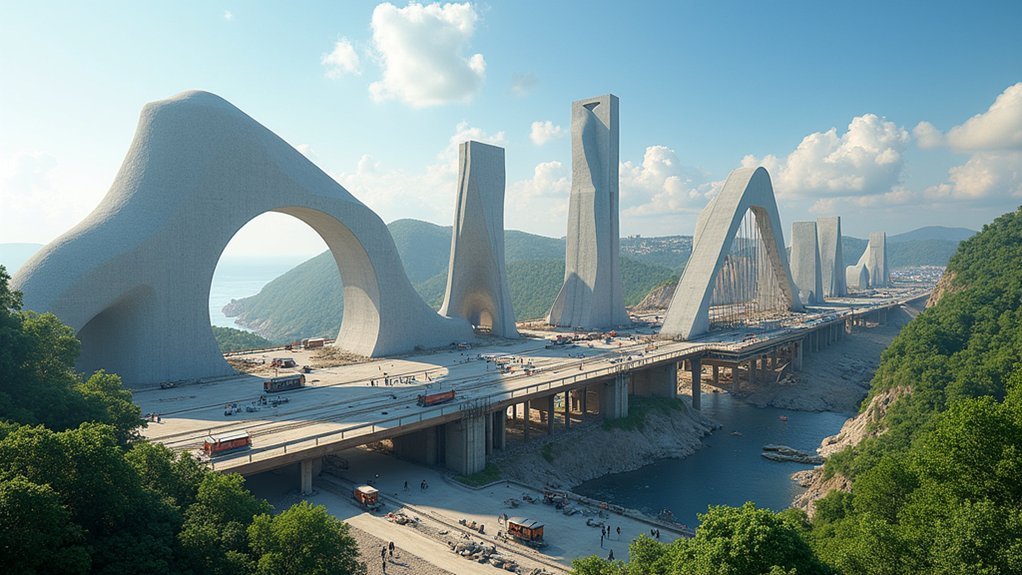
You’ll discover five game-changing 3D printing methods revolutionizing bridge construction: Contour Crafting creates precise concrete components through automated layer deposition, while Metal 3D Printing with robotic welding systems builds complex geometries like the MX3D Bridge in just six months. Powder Bed Fusion produces lightweight yet strong steel elements, Large-Scale Stereolithography enables intricate designs with photopolymer resins, and Hybrid 3D Printing integrates reinforcement materials directly into the process. These technologies can slash construction time by 75% while achieving previously impossible structural designs that’ll transform how you think about modern infrastructure development.
Contour Crafting Technology for Concrete Bridge Components
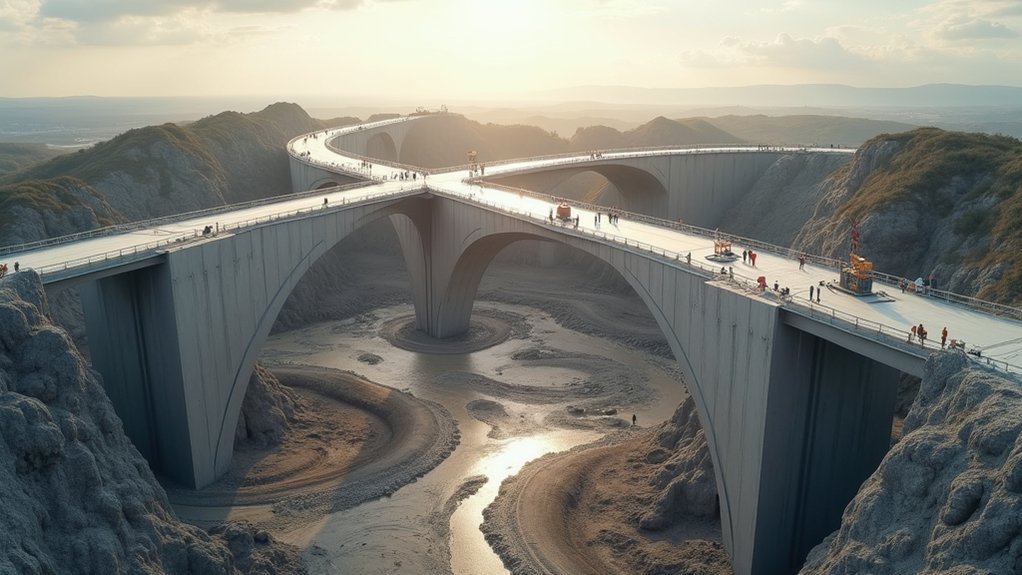
When you’re looking to revolutionize bridge construction, contour crafting technology stands out as a game-changing approach that builds concrete components through precise, computer-controlled layer deposition.
This emerging technology transforms traditional construction processes by enabling complex geometries that weren’t previously achievable. You’ll benefit from greatly reduced material waste since the system applies concrete only where needed, directly supporting sustainability goals in bridge construction.
Contour crafting enables unprecedented geometric complexity while eliminating material waste through precise concrete placement exactly where structural needs demand.
The automation capabilities streamline your project timeline while maintaining exceptional structural performance. You can integrate intricate architectural features seamlessly, creating components that are both functional and visually appealing.
This construction technology dramatically cuts labor requirements and accelerates completion schedules. By implementing contour crafting, you’ll achieve cost-effective solutions that optimize resource utilization while delivering superior results in modern bridge development projects.
Metal 3D Printing With Robotic Welding Systems
Revolutionary metal 3D printing with robotic welding systems transforms bridge construction by depositing molten metal with unprecedented precision, creating complex geometries that traditional methods can’t achieve.
You’ll witness enhanced structural integrity as robotic welding systems apply material exactly where needed, dramatically reducing material waste compared to conventional approaches.
The MX3D Bridge in Amsterdam exemplifies this technology’s potential, where robotic arms printed stainless steel infrastructure in just six months.
You’ll benefit from three key advantages:
- Real-time monitoring capabilities through advanced sensors embedded within printed structures
- Significantly reduced construction timeframes compared to traditional construction methods
- Precise material application that optimizes resource usage and minimizes waste
This revolutionary approach enables you to construct intricate designs while maintaining superior structural performance and monitoring capabilities throughout the infrastructure’s lifespan.
Powder Bed Fusion for Structural Steel Elements
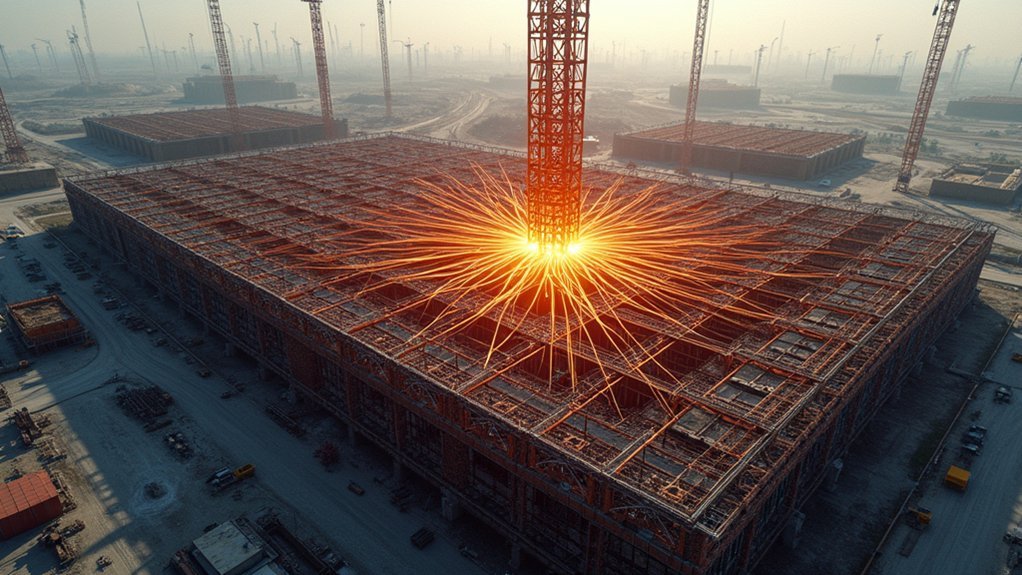
Powder Bed Fusion (PBF) revolutionizes structural steel fabrication by precisely melting metal powder with high-energy lasers, layer by layer, to create intricate bridge components that traditional manufacturing can’t produce.
You’ll discover this 3D printing method transforms how you approach construction techniques for modern bridges.
With PBF, you can fabricate lightweight components that maintain exceptional strength, reducing your bridge’s overall weight without compromising structural integrity.
PBF enables engineers to achieve optimal strength-to-weight ratios, creating robust bridge components that dramatically reduce structural load while preserving essential performance characteristics.
This technology eliminates excessive material waste by using only necessary powder amounts, supporting sustainable construction practices throughout your construction projects.
You’ll appreciate PBF’s ability to create unique, aesthetically complex structural steel elements that enhance your bridge’s architectural value.
The rapid prototyping capabilities accelerate production timelines, cutting labor costs and streamlining construction schedules for more efficient project delivery.
Large-Scale Stereolithography for Complex Geometries
Large-scale Stereolithography (SLA) takes precision manufacturing to new heights by employing powerful lasers to cure liquid photopolymer resins into solid, complex geometries that traditional construction methods simply can’t replicate.
You’ll find this 3D printing technology revolutionizing how the construction industry approaches bridge components, enabling rapid prototyping and dramatically reducing construction time.
SLA’s capabilities transform structural applications through:
- High-resolution detailing – Creates intricate designs with smooth surface finishes essential for modern bridge aesthetics
- Advanced construction materials – Utilizes engineered photopolymers offering enhanced strength and durability for demanding environments
- Complex organic shapes – Produces geometries impossible with conventional techniques, as demonstrated by Amsterdam’s MX3D Bridge
This technology’s precision and efficiency make it invaluable for creating sophisticated bridge elements that push architectural boundaries.
Hybrid 3D Printing With Integrated Reinforcement Materials
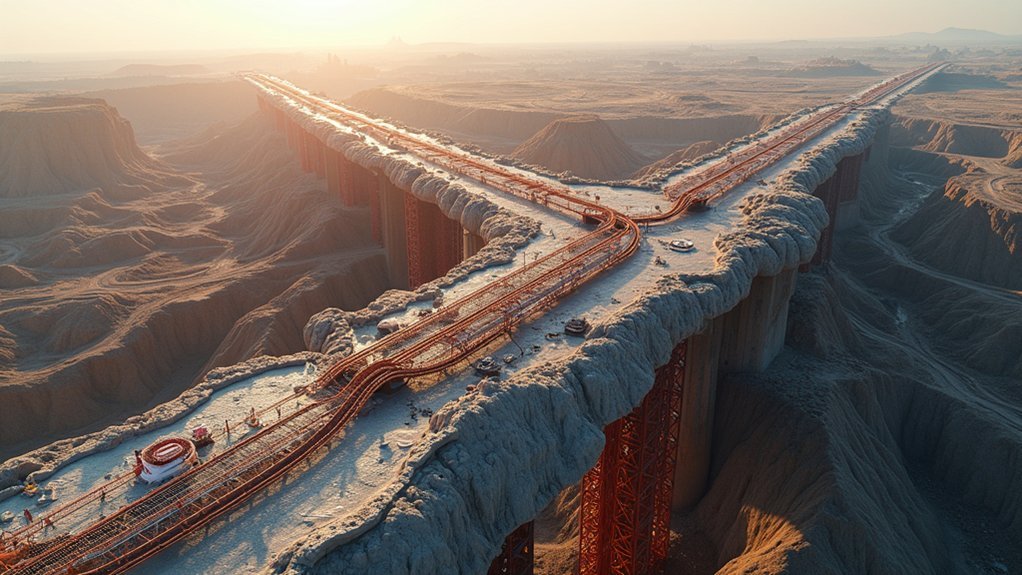
Multiple breakthrough techniques now combine traditional reinforcement materials like steel and glass fibers directly into the 3D printing process, creating bridge structures that exceed conventional strength requirements while maintaining design flexibility.
Hybrid 3D printing allows you to precisely place reinforcement materials within printed layers, optimizing material usage while reducing overall structural weight. You’ll achieve enhanced structural integrity and superior load-bearing capacity through this integrated approach.
This method considerably reduces construction time by eliminating separate reinforcement installations after printing. You can create complex geometries while maintaining strict safety standards and performance requirements.
The environmental impact decreases substantially as you minimize material waste and incorporate recycled materials into the reinforcement system, making hybrid 3D printing an increasingly sustainable solution for modern bridge construction projects.
Frequently Asked Questions
How Is 3D Printing Revolutionary?
You’ll find 3D printing transforms manufacturing by creating complex geometries impossible with traditional methods, reducing material waste through precise deposition, accelerating production speeds, and enabling real-time monitoring integration.
In What Industry Is 3D Printing Used to Create a Model of Bridge?
You’ll find 3D printing used to create bridge models in the construction industry, where it’s revolutionizing design processes through rapid prototyping, testing structural concepts, and enabling complex geometries previously impossible with traditional methods.
What Is the Best Type of 3D Printing for Construction?
You’ll find Contour Crafting’s the best 3D printing method for construction since it rapidly deposits concrete layers, dramatically cuts labor costs, and builds entire structures faster than traditional methods allow.
Would It Be Possible to 3D Print an Entire Bridge?
You can absolutely 3D print an entire bridge. Several have been successfully constructed worldwide, including Amsterdam’s steel MX3D Bridge and Shanghai’s 26.3-meter concrete span, proving this technology’s viability.



Leave a Reply