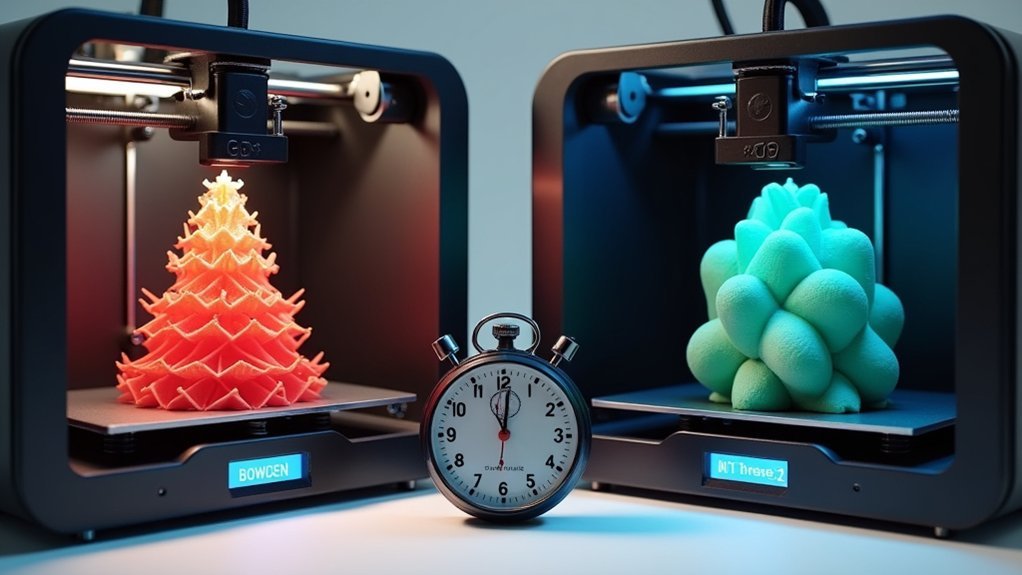
Bowden extruders considerably outperform Direct Drive systems in raw print speed, achieving 200-300mm/s compared to Direct Drive’s 50-100mm/s limitation. Your Bowden setup’s lighter weight (228g vs 444g) enables faster acceleration up to 7000mm/s² and higher resonance frequencies at 106Hz, reducing vibrations during rapid movements. However, you’ll face quality trade-offs with Bowden at maximum speeds, while Direct Drive maintains superior precision at moderate velocities. Understanding these performance characteristics will help you optimize your printer’s capabilities.
Understanding Extruder Weight Impact on Print Acceleration
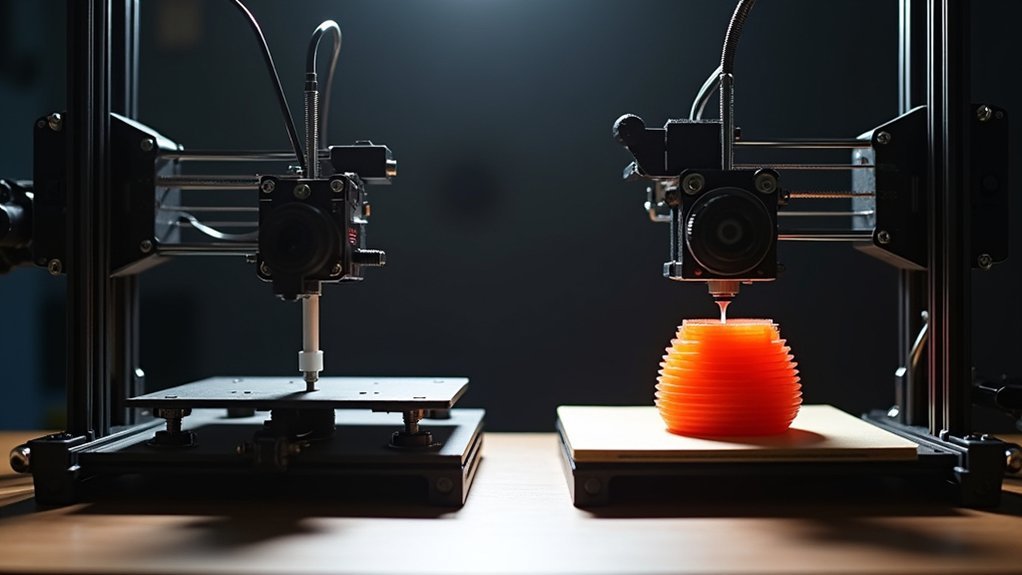
When you’re choosing between Bowden and Direct Drive extruders, the weight difference dramatically impacts your printer’s acceleration capabilities.
Your Bowden setup weighs just 228 grams compared to Direct Drive’s hefty 444 grams, nearly doubling the print head mass. This extruder weight difference directly affects how quickly your printer can change direction and speed up movements.
The lighter Bowden configuration achieves a resonance frequency of 106 Hz, while Direct Drive systems reach only 42 Hz.
You’ll experience faster acceleration with Bowden setups because there’s less mass to move around. The increased inertia from Direct Drive’s heavier print head creates slower acceleration and deceleration times, extending your overall print duration.
This weight advantage allows Bowden systems to maintain higher speeds while reducing vibrations that could compromise print quality.
Resonance Frequency Differences Between Bowden and Direct Drive Systems
Beyond the weight differences, resonance frequency variations create another essential performance gap between Bowden and Direct Drive systems.
Resonance frequency differences between extruder types significantly impact printing performance, with Bowden systems achieving substantially higher frequencies than Direct Drive configurations.
You’ll find that Bowden setups achieve approximately 106 Hz resonance frequency, while Direct Drive systems reach only 42 Hz. This higher frequency translates directly into superior print speed capabilities for Bowden configurations.
The resonance frequency differences affect your printer’s acceleration limits and overall performance:
- Acceleration capabilities: Bowden systems support higher accelerations beyond the typical 4400 mm/s² limit of Direct Drive setups
- Ringing reduction: Higher resonance frequency produces less visible ringing artifacts during rapid movements
- Input shaper tuning: Bowden requires MZV@99.6Hz settings versus Direct Drive’s 3HUMP_EI@77.8Hz configuration
These frequency characteristics enable Bowden systems to handle faster movements with better stability and print quality.
Maximum Achievable Print Speeds for Each Extruder Type
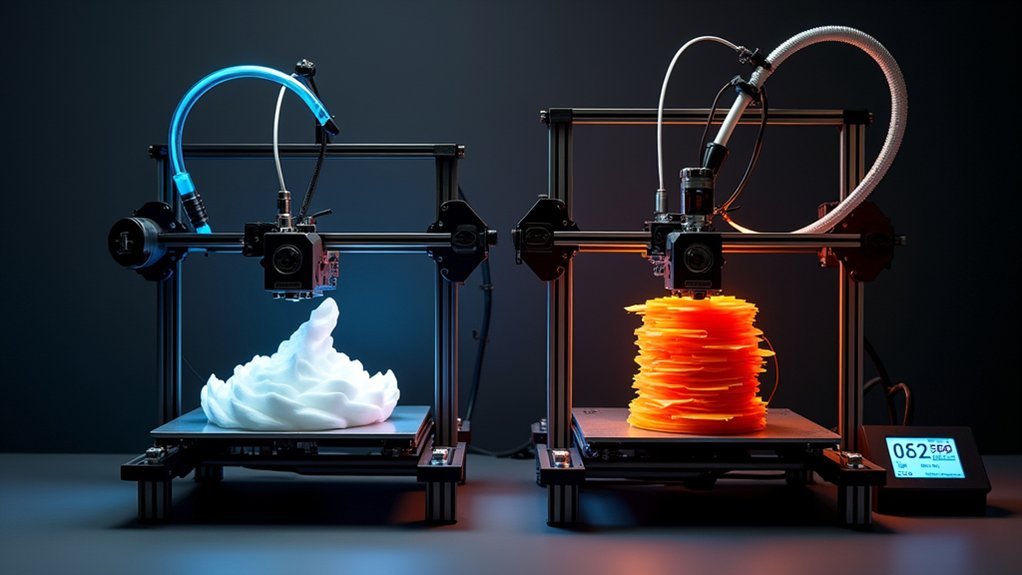
Two distinct speed categories emerge when comparing maximum achievable print speeds between extruder types.
Your Bowden extruder can reach impressive speeds of 200-300 mm/s, thanks to its lightweight design that minimizes inertia during rapid movements.
In contrast, your Direct Drive system typically maxes out around 50-100 mm/s because the motor’s added weight on the print head limits acceleration capabilities.
The speed difference stems from mass distribution.
Bowden setups achieve higher acceleration rates up to 4400 mm/s², while Direct Drive systems experience reduced acceleration due to increased moving mass.
However, don’t assume speed equals quality – both configurations can produce similar print results.
Bowden’s advantage lies in reduced vibrations at higher speeds, making it ideal when you need faster throughput without sacrificing precision.
Volumetric Flow Rate Limitations and Speed Bottlenecks
Although maximum speed capabilities tell part of the story, your extruder’s volumetric flow rate determines how fast you can actually print with consistent quality.
Bowden extruders face significant challenges as volumetric feed rates increase. The longer PTFE tube creates additional friction, leading to pressure buildup that compromises extrusion consistency.
You’ll notice quality degradation from filament compression and bending within the extended pathway. Meanwhile, direct drive systems maintain superior extrusion force under pressure, delivering reliable performance even at higher volumetric feed rates.
Consider these critical speed bottlenecks:
- Bowden systems require 2-3mm retraction distances, creating speed limitations during frequent retractions
- Increased friction in longer pathways reduces maximum achievable volumetric feed rate
- Direct drive setups handle pressure buildup more effectively, maintaining consistent print speed throughout demanding prints
Movement Dynamics and Inertia Effects on Print Quality
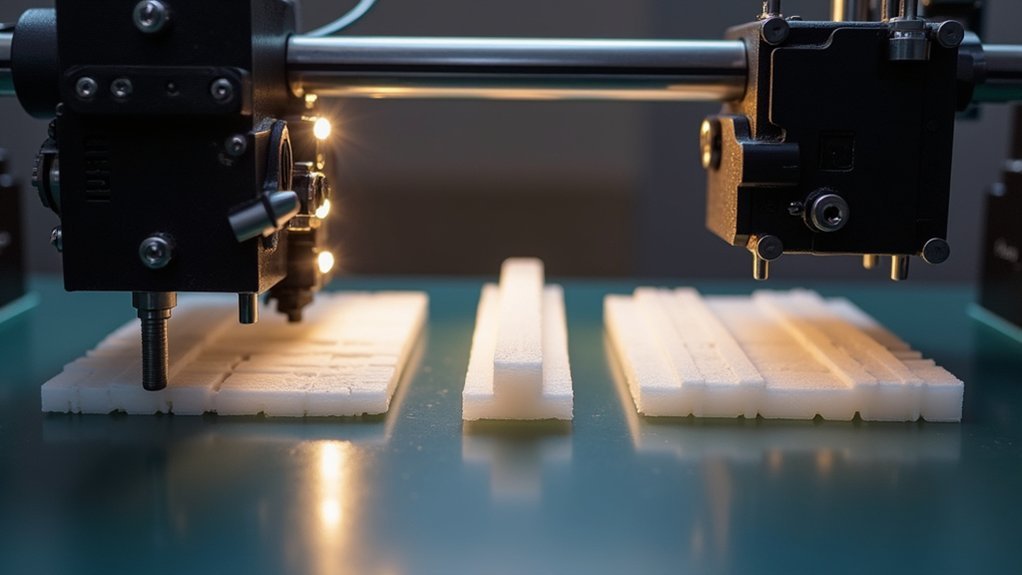
When you’re pushing print speeds to their limits, the weight difference between Bowden and Direct Drive setups creates drastically different movement dynamics that directly impact your print quality.
Your Bowden’s lighter 228-gram printhead accelerates much faster than Direct Drive’s 444-gram mass, but this advantage comes with trade-offs in precision control during complex geometries.
You’ll need to balance the reduced inertia benefits against potential vibration issues, especially when input shaping can’t fully compensate for the dynamic forces at play.
Mass Impact on Acceleration
Since mass directly influences how quickly your 3D printer can accelerate and decelerate during movements, the weight difference between Bowden and Direct Drive systems creates a significant performance gap.
Your Bowden setup’s 228-gram printhead allows for much higher acceleration compared to Direct Drive’s hefty 444 grams. This lighter weight on the printhead means your motors don’t have to work as hard to change direction quickly, resulting in faster print speeds and smoother movements.
The reduced inertia effects translate directly into better performance:
- Bowden systems achieve resonance frequencies around 106 Hz versus Direct Drive’s 42 Hz
- Less stress on your stepper motors during rapid acceleration changes
- Reduced ringing artifacts that improve overall print quality at high speeds
Vibration Control During Movement
While your printer’s acceleration capabilities matter greatly, vibration control determines whether those speed gains translate into quality prints.
Direct Drive vs Bowden systems show stark differences in their vibration characteristics during movement. Your Bowden extruder’s lighter 228-gram printhead creates higher resonance frequencies around 106 Hz, markedly reducing unwanted vibrations compared to Direct Drive’s heavier 444-gram setup operating at lower 42 Hz frequencies.
This mass difference directly impacts your print quality during rapid direction changes. Bowden’s reduced inertia minimizes ringing artifacts since the lightweight printhead changes direction with less momentum buildup.
While Direct Drive systems require complex input shaping tuning to manage vibrations, Bowden setups achieve cleaner vibration control naturally. You’ll notice this advantage most during high-speed printing, where Bowden’s superior vibration control delivers consistently better results.
Speed Vs Precision Trade-Offs
Although Bowden extruders excel at achieving impressive speeds up to 200-300 mm/s thanks to their lightweight printheads, you’ll face inevitable trade-offs between raw speed and precision that fundamentally shape your printing strategy.
Direct Drive systems operate at maximum accelerations of 4400 mm/s² but sacrifice speed for control. Their heavier components create more inertia, yet you’ll achieve superior precision with shorter retraction distances and immediate material response.
Bowden setups leverage their 106 Hz resonance frequency for reduced vibrations and faster acceleration, but friction in longer PTFE tubes compromises volumetric feed rates during intricate prints.
- Speed Priority: Choose Bowden for rapid prototyping and simple geometries requiring minimal detail
- Precision Focus: Select Direct Drive for complex models demanding tight tolerances and fine features
- Balanced Approach: Consider print complexity before optimizing speed settings
Acceleration Settings Optimization for Bowden Configurations
When optimizing acceleration settings for Bowden configurations, you’ll discover that the lighter printhead weight creates a significant advantage for achieving faster print speeds. Your Bowden setup can handle accelerations up to 4400 mm/s² without significant vibrations, thanks to reduced inertia from the remote extruder placement.
| Setting | Standard Value | Optimized Value |
|---|---|---|
| Max Acceleration | 3000 mm/s² | 4400 mm/s² |
| Resonance Frequency | 90 Hz | 106 Hz |
| Input Shaping | ZV@80Hz | MZV@99.6Hz |
| Retraction Distance | 1mm | 2-3mm |
You’ll need to calibrate Pressure Advance carefully since higher volumetric feed rates can create pressure issues. Input shaping techniques like MZV@99.6Hz will further reduce ringing while maintaining your acceleration settings’ effectiveness.
Direct Drive Speed Constraints Due to Added Mass
When you mount a direct drive extruder on your printhead, you’re adding significant mass that directly impacts your printer’s acceleration capabilities.
The 444-gram weight creates higher inertia, forcing you to reduce maximum acceleration to around 4400 mm/s² compared to lighter Bowden setups.
This added mass doesn’t just slow your acceleration—it also introduces movement limitations that can cause vibrations and require longer settling times after rapid directional changes.
Mass Impact on Acceleration
Since direct drive extruders mount the motor and gear assembly directly on the print head, you’re adding approximately 444 grams of mass that must accelerate and decelerate with every movement.
This substantial weight creates considerable inertia challenges that directly impact your printing performance. Direct Drive setups typically max out at 4400 mm/s² acceleration, considerably lower than what you’ll achieve with lighter configurations.
The physics are straightforward: more mass requires more force to change direction or speed. This translates to:
- Slower acceleration and deceleration cycles during direction changes
- Increased stress on stepper motors when pushing heavier loads
- Reduced overall print speeds compared to lighter alternatives
In contrast, the Bowden system’s lightweight design eliminates this mass penalty, allowing notably higher accelerations and faster printing speeds.
Weight-Induced Movement Limitations
The weight penalty becomes even more pronounced when you consider resonance frequencies and movement dynamics. Your direct drive’s heavier printhead creates weight-induced movement limitations that directly impact print speed. The 444-gram mass generates lower resonance frequencies, reducing your printer’s agility during rapid movements.
| Parameter | Direct Drive | Bowden |
|---|---|---|
| Printhead Weight | 444g | ~150g |
| Max Acceleration | 4400 mm/s² | ~7000 mm/s² |
| Resonance Frequency | 42 Hz | 106 Hz |
| Movement Agility | Limited | High |
You’ll notice slower print speeds during intricate designs, as the added mass introduces vibrations that compromise quality. The lower 42 Hz resonance frequency compared to Bowden’s 106 Hz means your direct drive system can’t achieve the same high-speed printing capabilities, particularly when executing detailed geometric patterns.
Vibration Control and Print Head Stability at High Speeds
Although both extruder types can achieve impressive print speeds, their vibration control characteristics differ greatly due to weight disparities in their moving components.
Your Bowden setup’s lighter 228-gram print head generates a resonance frequency of ~106 Hz, markedly outperforming the Direct Drive’s ~42 Hz frequency. This higher frequency translates to superior vibration control and enhanced print head stability during rapid movements.
The reduced inertia in Bowden systems allows you to reach 200-300 mm/s speeds with minimal ringing artifacts.
While both configurations can utilize input shaping techniques—MZV@99.6Hz for Bowden and 3HUMP_EI@77.8Hz for Direct Drive—the Bowden’s inherent weight advantage provides better stability control.
- Bowden extruders achieve 2.5x higher resonance frequencies than Direct Drive systems
- Input shaping optimization differs between setups for maximum vibration reduction
- Weight reduction directly correlates with improved high-speed print head stability
Layer Height Considerations for Speed-Optimized Printing
When you’re optimizing for speed, your layer height choice becomes a critical balancing act between print time and quality output.
You’ll find that Bowden setups typically excel at faster speeds with taller layers around 0.2mm or higher, while Direct Drive systems maintain superior quality at finer layer heights despite slower movement speeds.
Your extruder type directly influences which layer height strategy will give you the best speed-to-quality ratio for your specific printing needs.
Optimal Layer Heights
Since layer height directly impacts both print speed and quality, you’ll need to strike the right balance between efficiency and detail when enhancing your 3D printing workflow.
For speed-focused printing, you’ll want to use layer heights between 0.2mm and 0.3mm, which provides excellent speed without sacrificing essential layer adhesion.
Your extruder type greatly influences ideal layer height selection:
- Bowden extruders perform best with higher layer heights (0.25mm-0.3mm) to compensate for increased friction in the longer filament path
- Direct Drive setup allows smaller layer heights (0.1mm-0.2mm) thanks to precise retraction settings and superior extrusion control
- Material considerations matter—some filaments achieve better results with specific layer thicknesses regardless of your extruder type
Always consider your printer’s capabilities when selecting layer heights for ideal speed-to-quality ratios.
Speed Vs Quality
The relationship between speed and quality becomes more complex when you factor in how each extruder type handles different layer heights at high velocities. Bowden extruders excel at high print speed but sacrifice print quality due to longer filament paths creating friction and control issues. Direct Drive systems maintain superior print quality through precise filament control, though they’re limited by heavier print heads that reduce maximum speeds.
| Layer Height | Bowden Speed | Direct Drive Speed |
|---|---|---|
| 0.1mm | 150mm/s | 80mm/s |
| 0.2mm | 250mm/s | 120mm/s |
| 0.3mm | 300mm/s | 150mm/s |
You’ll need to choose your priorities: Bowden for maximum speed with acceptable quality, or Direct Drive for premium print quality at moderate speeds.
Extruder Type Impact
Beyond speed versus quality trade-offs, your choice of extruder fundamentally changes how layer height affects your printing capabilities.
Bowden extruders excel with thicker layers since they reduce retraction complexities while maintaining their lightweight advantage for faster movements. You’ll achieve higher acceleration rates up to 200-300 mm/s, making them ideal for speed-optimized printing with less intricate models.
Direct Drive Extruders maintain consistent extrusion force across various layer heights without sacrificing quality. Their quick retraction capabilities support intricate designs at higher speeds, though the added weight limits acceleration compared to Bowden setups.
Key layer height considerations:
- Thicker layers favor Bowden systems for reduced retraction issues
- Variable layer heights work better with Direct Drive’s consistent force
- Speed optimization requires balancing layer height with extruder capabilities
Extruder Motor Performance Requirements at Different Speeds
When you’re pushing your 3D printer to higher speeds, the motor performance requirements between Bowden and Direct Drive systems diverge markedly.
Your extruder motor in a Direct Drive setup doesn’t need massive torque since the filament path is shorter, allowing precise control at various printing speeds. You’ll achieve faster retraction speeds with minimal 1mm distances, reducing stringing effectively.
Direct Drive’s shorter filament path enables precise motor control with lower torque requirements and faster retraction speeds.
Conversely, Bowden systems demand more powerful motors with higher torque capabilities. You’re fighting increased friction through that longer PTFE tube, especially at elevated speeds.
Your motor must overcome pressure buildup that causes inconsistent extrusion. You’ll also need longer 2-3mm retraction distances at slower speeds, straining motor performance during rapid accelerations and potentially compromising print quality when speed becomes critical.
Filament Feeding Efficiency During Rapid Print Movements
As printing speeds climb beyond conventional rates, your filament feeding efficiency becomes the critical bottleneck that determines success or failure.
Direct Drive extruders excel in this arena through their short filament path, delivering quicker response times and markedly reducing jam risks during rapid movements. You’ll notice the difference immediately when your printer handles sudden direction changes and accelerations.
Bowden systems struggle with longer retraction requirements, typically needing 2-3mm compared to Direct Drive’s minimal needs. The extended PTFE tube creates friction that hinders filament flow at higher volumetric rates, causing pressure inconsistencies that compromise your print quality.
- Direct Drive maintains consistent extrusion force during rapid accelerations
- Bowden setups suffer from filament compression and bending issues
- Flexible materials perform dramatically better with Direct Drive systems
Print Quality Trade-offs When Maximizing Speed
While Bowden extruders promise impressive speeds of 200-300 mm/s thanks to their lightweight printheads, you’ll face a harsh reality: sacrificing precision for speed often isn’t worth the trade-off.
When you push Bowden systems to maximum velocities, the longer filament path creates friction and pressure issues that degrade print quality considerably. You’ll notice visible artifacts like ringing and stringing in detailed sections where precision matters most.
Direct Drive extruders can’t match those raw speeds due to added weight, but they’ll deliver consistently superior results.
Their precise retraction control eliminates many defects that plague high-speed Bowden printing. When working with intricate models or flexible filaments, Direct Drive’s controlled extrusion force maintains quality even under pressure, making slower speeds worthwhile.
Real-World Speed Testing Results and Performance Benchmarks
Real-world testing reveals that Bowden extruders consistently outperform Direct Drive systems in raw speed metrics, achieving maximum acceleration rates of 4,400 mm/s² compared to Direct Drive’s considerably lower accelerations.
Your Bowden extruder can maintain speeds of 200-300 mm/s while handling high-frequency movements better, thanks to its 106 Hz resonance frequency versus Direct Drive’s 42 Hz.
Performance benchmarks show clear advantages for Bowden setups:
- Speed capabilities: Bowden systems achieve higher maximum speeds with less visible ringing artifacts
- Acceleration performance: Superior acceleration rates translate to faster overall print times on complex geometries
- Movement precision: Higher resonance frequency enables cleaner motion control at speed
However, you’ll notice Direct Drive maintains consistent extrusion force at higher volumetric rates where Bowden extruders begin experiencing pressure-related limitations.
Speed Optimization Strategies for Each Extruder Configuration
Since each extruder configuration presents distinct mechanical characteristics, you’ll need tailored optimization strategies to maximize their speed potential.
For Bowden setups, you can push print speeds to 200-300 mm/s by leveraging the lighter printhead’s reduced inertia. However, you’ll need longer retraction distance settings of 2-3 mm to combat stringing issues. Implement MZV@99.6Hz input shaping to minimize vibrations at these higher speeds.
Direct Drive systems require different approaches. While you can’t achieve the same peak print speeds due to added printhead weight, you’ll maintain superior quality with shorter retraction distances.
Use 3HUMP_EI@77.8Hz input shaping to optimize acceleration and deceleration performance. Focus on consistent extrusion rather than maximum speed for best results with intricate designs.
Frequently Asked Questions
Is Direct Drive Faster Than Bowden?
You’ll find direct drive isn’t faster than Bowden extruders. Bowden systems achieve higher speeds due to lighter print heads, while you’re limited by direct drive’s heavier weight affecting acceleration and movement.
Does Direct Drive Print Faster?
You’ll generally find direct drive doesn’t print faster than Bowden systems. The heavier print head creates more inertia, reducing acceleration and limiting your maximum speeds to around 150-200 mm/s typically.
What Are the Disadvantages of Direct Drive?
You’ll face slower print speeds due to heavier print heads, complicated maintenance access, increased wear on belts and bearings, complex calibration requirements, and reduced maximum speeds from added weight.
Is Direct Drive Better for 3D Printing?
You’ll find direct drive better for precision printing and flexible filaments since you get superior control and responsiveness. However, you’ll sacrifice speed due to increased weight on your print head.

Leave a Reply