
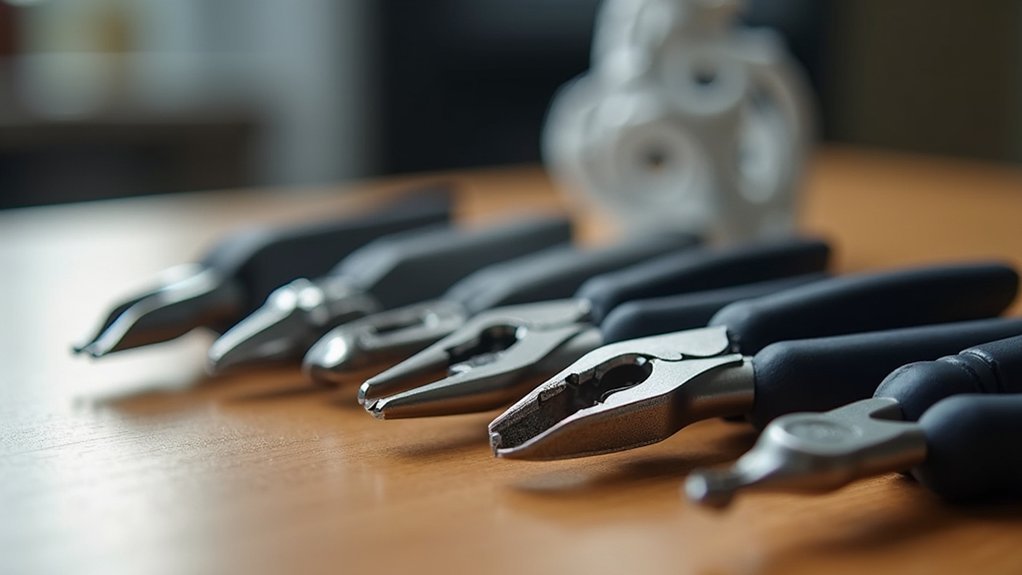
You’ll need four essential categories of tools for professional support removal: precision picks for cleaning narrow crevices and detailed areas, cutting implements like fine clippers for efficient bulk material removal, scraping tools for stubborn remnants, and heat-based solutions such as propane torches for eliminating persistent fine strings. A complete toolkit can be assembled for under $100, prioritizing welding pliers, deburr tools, and quality scrapers. Master these tools to transform your post-processing workflow entirely.
Essential Hand Tools for Precise Support Removal
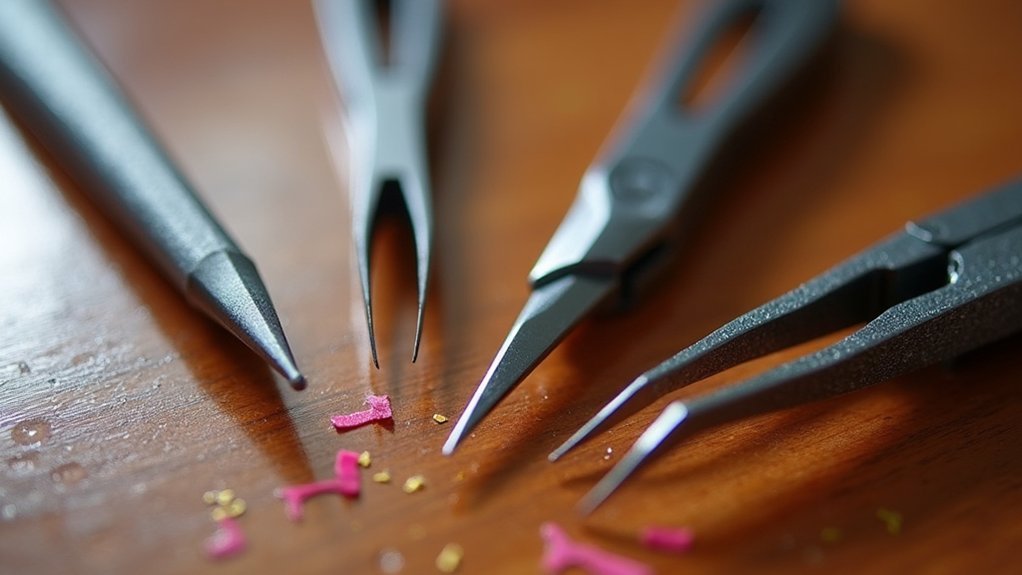
Three essential categories of hand tools form the foundation of effective 3D print support removal: precision picks, cutting implements, and scraping tools.
You’ll find that precision picks excel at cleaning narrow crevices and detailed areas where larger tools can’t reach. Cutting implements like fine clippers help you remove bulk support material efficiently, while scraping tools handle stubborn remnants and weak supports that need peeling away.
I highly recommend investing in a thorough kit like the 3D Printing Clean-Up Utility Tool Kit, which includes a 3-piece precision set with double-ended tools featuring six different blades, scrapers, and picks.
The high-quality stainless steel ends paired with polished wooden handles guarantee durability, though prolonged use may cause some discomfort due to smaller handle sizes.
Specialized Scrapers and Picks for Tight Spaces
When you’re dealing with intricate 3D prints, specialized scrapers and picks become indispensable for maneuvering through the tight spaces that standard tools simply can’t handle.
These precision-edged tools excel at support removal by accessing narrow crevices and intricate details that would otherwise remain untouched.
Picks come in various shapes and sizes, making them perfect for reaching confined areas during support removal. The 3D Printing Clean-Up Utility Tool Kit offers double-ended tools with six different blades specifically designed for removing support material and finishing models in tight spaces.
High-quality stainless steel construction guarantees durability and consistent performance across multiple cleaning sessions.
Ergonomically designed handles provide enhanced grip and control, reducing slippage risk during extended use while maintaining precision throughout your support removal process.
Cutting Tools for Trimming Excess Material
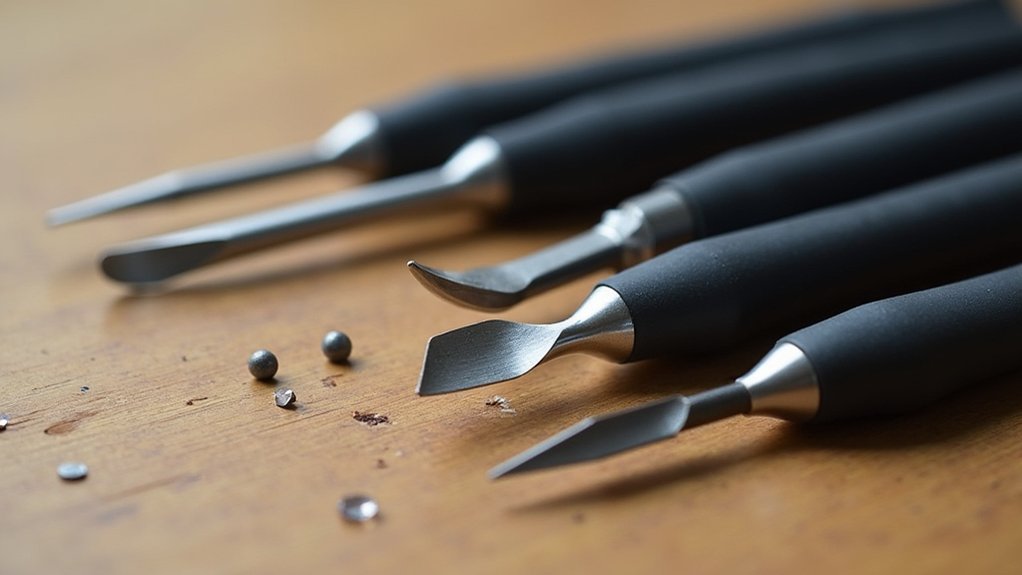
After your specialized picks and scrapers have accessed the tightest spaces, cutting tools become your primary allies for efficiently trimming away larger support sections and excess material.
Fine clippers stand out as indispensable instruments for precision work, allowing you to navigate small support areas without damaging your model’s delicate features. You’ll know how useful welding pliers are when you need to peel off weak supports quickly and efficiently across larger sections.
For finishing touches, a deburr tool proves invaluable for smoothing rough edges and removing brims, ensuring your prints achieve that professional appearance.
When dealing with fine strings and surface imperfections, a propane torch can melt away these unwanted remnants, giving your models a seamless final finish.
Heat-Based Methods for Eliminating Fine Strings
While cutting tools handle the bulk of support removal, heat-based methods offer an elegant solution for eliminating those persistent fine strings and hairs that cling to your finished prints. A propane torch effectively vaporizes these delicate remnants without damaging your model’s integrity.
You’ll need to maintain proper distance to prevent overheating the plastic while ensuring only unwanted material gets affected. This technique proves particularly valuable when dealing with stringing issues caused by improper retraction settings.
You can apply heat selectively for precise cleaning, targeting specific areas where fine strings remain stubborn. The process is still quite efficient, considerably reducing your post-processing time compared to manual removal methods.
Heat-based cleaning enhances your overall workflow efficiency, delivering professional-quality results with minimal effort required.
Building Your Complete Tool Kit on a Budget
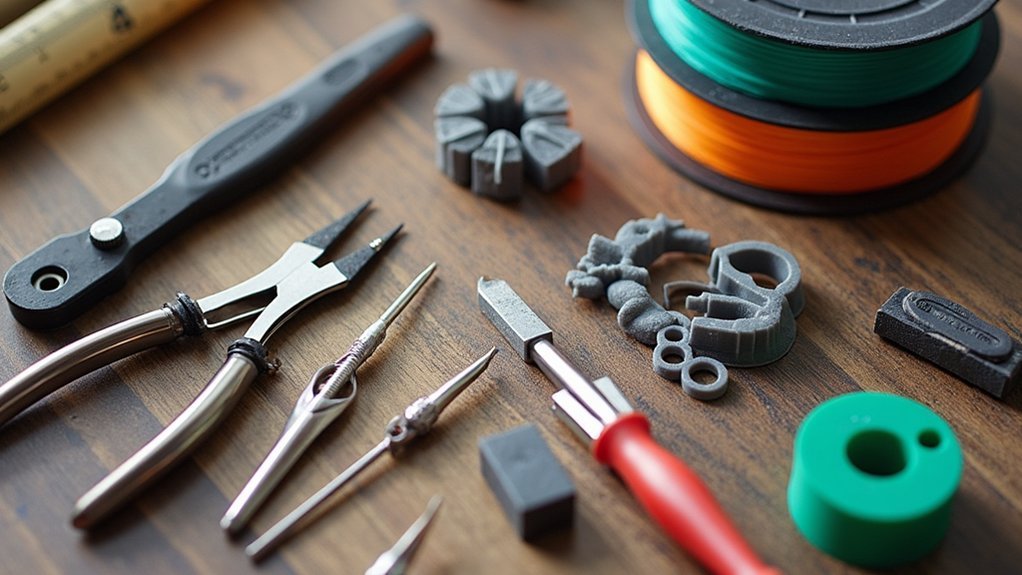
Building a thorough support removal toolkit doesn’t require breaking the bank, as you can assemble everything you need for under $100.
You’ll want to prioritize essential tools that deliver maximum value: welding pliers for effortless support removal, fine clippers for precise trimming, and a deburr tool for smoothing rough edges.
Online platforms like Amazon make acquiring these tools straightforward with quick delivery options.
Don’t skip investing in a quality scraper for precision cleaning—it’ll make a whole lot of difference in your workflow efficiency and final print quality.
Organize your workspace to keep tools easily accessible.
This simple step streamlines your cleaning process and greatly boosts productivity, ensuring you spend less time hunting for tools and more time perfecting your prints.
Frequently Asked Questions
What Is the Best Tool for Removing Supports From 3D Prints?
You’ll want welding pliers for larger support sections since they’re excellent for peeling and removal. For smaller areas, use fine clippers. A deburr tool smooths edges while scrapers access tight spots effectively.
What Is the Easiest Support Pattern to Remove 3D Printing?
Tree support structures offer you the easiest removal since they’ve minimal contact points with your model. You’ll also find grid patterns simple to detach due to their open design allowing better access.
What Cura Supports Are Easiest to Remove?
You’ll find Grid and Lines supports easiest to remove in Cura due to minimal contact areas. Breakaway supports snap off effortlessly, while Conical supports offer good accessibility. Lower density settings around 10-15% help too.
How Do You Remove Support Material From 3D Printing?
You’ll start with welding pliers to peel off large support sections, then use scrapers for stubborn base remnants. Fine clippers trim detailed areas, while deburr tools smooth edges and torches melt remaining strings.

Leave a Reply