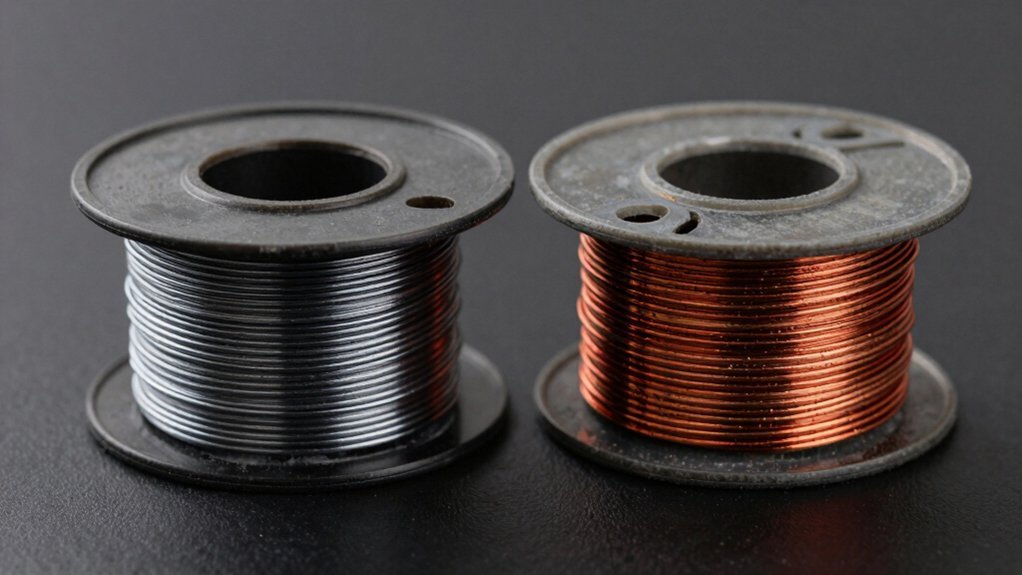
You’re probably wondering which metal‑fill filament can give you that heavy, realistic look without breaking your printer. In 2026 the top contenders are Gizmo Dorks Metal Bronze Fill and Protopasta Metal‑Filled PLA, each offering a distinct finish and density profile. Both demand careful temperature tuning, bed adhesion tricks, and post‑processing, but the payoff in realism is worth the effort. The real question is which one aligns best with your printer’s capabilities and the finish you’re after.
| Gizmo Dorks Metal Bronze Fill Filament for 3D Printers 1.75mm 200g |  | Best Overall | Base Material: PLA‑bronze composite | Metal Content: Bronze powder (unspecified %) | Diameter: 1.75 mm (±0.03 mm) | CHECK ON AMAZON | Read Our Analysis |
| Protopasta Metal-Filled PLA Filament (2kg) |  | Heavy‑Duty Choice | Base Material: PLA‑stainless steel composite | Metal Content: 60 % stainless steel by weight | Diameter: 1.75 mm | CHECK ON AMAZON | Read Our Analysis |
More Details on Our Top Picks
Gizmo Dorks Metal Bronze Fill Filament for 3D Printers 1.75mm 200g
Looking for a filament that delivers a true bronze sheen without the hassle of post‑processing? Gizmo Dorks Metal Bronze Fill Filament blends bronze powder with a PLA base, so you print like regular PLA while getting a laser‑sintered metallic finish. It’s 1.75 mm with a ±0.03 mm tolerance, weighs 200 g, and ships vacuum‑sealed with desiccant. Print at 190‑225 °C; a 60 °C heated bed isn’t required but helps adhesion on glass, blue painter’s tape, or kapton. The spool fits most desktop printers, from Monoprice Maker Select to LulzBot. Expect minimal warping, a solid bronze look, and a sculpture‑like texture straight out of the printer.
- Base Material:PLA‑bronze composite
- Metal Content:Bronze powder (unspecified %)
- Diameter:1.75 mm (±0.03 mm)
- Spool Weight:200 g
- Recommended Print Temp:190–225 °C
- Compatibility:Broad (e.g., Monoprice Maker Select, LulzBot, FlashForge)
- Additional Feature:Vacuum‑sealed with desiccant
- Additional Feature:Laser‑sintered appearance
- Additional Feature:Black‑bronze color scheme
Protopasta Metal-Filled PLA Filament (2kg)
If you need a filament that combines the ease of PLA with a genuine metallic heft, Protopasta’s 2 kg metal‑filled PLA is the go‑to choice. It blends 60 % stainless‑steel powder into a 1.75 mm PLA base, giving it roughly double the density of standard PLA. You’ll find it works smoothly on Prusa, Bambu, Creality, and Ender printers, producing high‑quality prints with minimal clogs or bubbles. After printing, you can polish or apply patina for a true metal finish, perfect for cars, tools, miniatures, or accessories. Made in the USA, the recyclable spool reflects Protopasta’s long‑standing commitment to quality, sustainability, and community.
- Base Material:PLA‑stainless steel composite
- Metal Content:60 % stainless steel by weight
- Diameter:1.75 mm
- Spool Weight:2 kg
- Recommended Print Temp:Not specified (PLA range)
- Compatibility:Broad (e.g., Prusa, Bambu, Creality, Ender)
- Additional Feature:60% stainless‑steel content
- Additional Feature:Polishable for patina finish
- Additional Feature:Recyclable spools, USA‑made
Factors to Consider When Choosing Metal-Fill Filaments for Heavy, Realistic Looking Prints
When you pick a metal‑fill filament, check its material composition and density to gauge weight and realism. Make sure your printer can hit the required temperature range and that the bed adhesion strategy matches the filament’s needs. Finally, consider post‑processing finish options and whether the spool’s dimensions fit your printer’s tolerance.
Material Composition & Density
What makes a metal‑fill filament feel truly heavy and realistic? You’ll notice the PLA base mixed with metallic powder, which spikes the density far beyond ordinary PLA. Some blends reach twice the density, giving each layer a solid, weighty feel that mimics real metal. The amount of metal loading and the particle size dictate both heft and surface finish—larger particles often produce a brushed look, while finer powders can be polished to a shine. Keep in mind that higher metal content changes extrusion dynamics; you may need to adjust flow and monitor nozzle wear. By evaluating these composition and density factors, you ensure your prints not only look metallic but also carry that satisfying, substantial mass.
Print Temperature Range
Ever wondered why metal‑fill filaments demand hotter hot‑ends than regular PLA? You’ll need 190‑225 °C to melt the resin and suspended bronze or stainless‑steel particles. Each formulation has its own sweet spot, so check the manufacturer’s range before you start. Printing below that window causes under‑extrusion and voids, ruining the metallic sheen you’re after. Too high, and you’ll degrade the surface finish, making the part look dull. Begin with a test print, then adjust in small increments—maybe 5 °C at a time—until flow feels smooth and layers bond well. Remember, a heated bed around 60 °C helps reduce warping for heavy prints, but many metal‑fills work fine without it if you fine‑tune the hot‑end temperature.
Bed Adhesion Strategies
A solid first layer is the foundation of any metal‑fill print, so getting the bed to stick right is essential. Set your heated bed to around 60 °C; most metal‑fill filaments cling best at this temperature, though a well‑prepped non‑heated surface can work too. Choose a surface that bonds well—blue painter’s tape, glass with a thin glue‑stick layer, or kapton tape each give reliable grip for metallic PLA blends. Keep the bed perfectly level and ensure consistent extrusion, because metal pellets can cause slight flow variations that jeopardize adhesion. For larger, heavy parts, add a brim or raft to combat warping and improve stability. Finally, lower the part cooling fan to let layers fuse solidly, reducing the chance of delamination.
Post‑Processing Finish Options
How much you’ll love the final look depends on the post‑processing route you pick, because metal‑fill filaments demand specific finishing steps to reveal their realistic shine. First, sand with coarse grit to remove layer lines, then progress to finer grits until the surface feels smooth. Follow with a polishing compound and a soft cloth for a mirror‑like finish, especially on PLA‑metal blends. If you want an aged look, apply a chemical patina or heat‑oxide treatment to introduce color variations and depth. Seal the result with a clear varnish or resin to protect against wear and boost luster without hiding detail. Finally, check for porosity; a primer or sealant can fill gaps before painting or additional coating.
Spool Compatibility & Tolerance
Why does spool compatibility matter when you’re printing heavy, realistic metal‑fill parts? Because the hub diameter, usually 1.5 inches for 1.75 mm filament, must match your feeder; a mismatch causes jams or uneven feeding. Check the filament’s diameter tolerance—typically ±0.03 mm—since tighter tolerances keep extrusion steady and avoid constant recalibration when you switch brands. Consider spool weight and size; heavier spools can strain the feeder tension and affect wrap quality, potentially leading to wobble on tall prints. Look for vacuum‑sealed packs with desiccant to keep moisture out, which otherwise makes the spool stick or swell. Finally, note the printer family compatibility (Prusa, Creality, Ender, etc.) to ensure core and flange fit for smooth, reliable feeding.
Frequently Asked Questions
How Do Metal-Fill Filaments Affect Printer Nozzle Wear?
Metal‑fill filaments are abrasive, so they’ll erode your nozzle faster. Use hardened steel or ruby tips, keep temperatures low, and clean regularly to minimize wear and maintain print quality.
Can Metal-Fill Filaments Be Used on All 3D Printer Brands?
You can use metal‑fill filaments on most 3D printers, but you’ll need a hardened nozzle, proper temperature settings, and a printer that handles abrasive materials without clogging or excessive wear.
What Post‑Processing Steps Improve Surface Smoothness?
You’ll sand the print with progressively finer grits, then apply a metal‑filled epoxy or spray coating, and finally polish with a polishing compound to achieve a smooth, realistic surface.
Are Metal‑Filled Filaments Safe for Food‑Contact Prints?
You shouldn’t use metal‑filled filaments for food‑contact parts; the metal particles can leach, and the polymer matrix often isn’t food‑grade, so it’s unsafe even after post‑processing.
How Does Filament Humidity Impact Print Quality?
You’ll see warping, layer splitting, and surface roughness when filament absorbs moisture; it bubbles and sizzles in the nozzle, causing inconsistent extrusion and weaker bonds, so always dry your filament before printing.

Leave a Reply