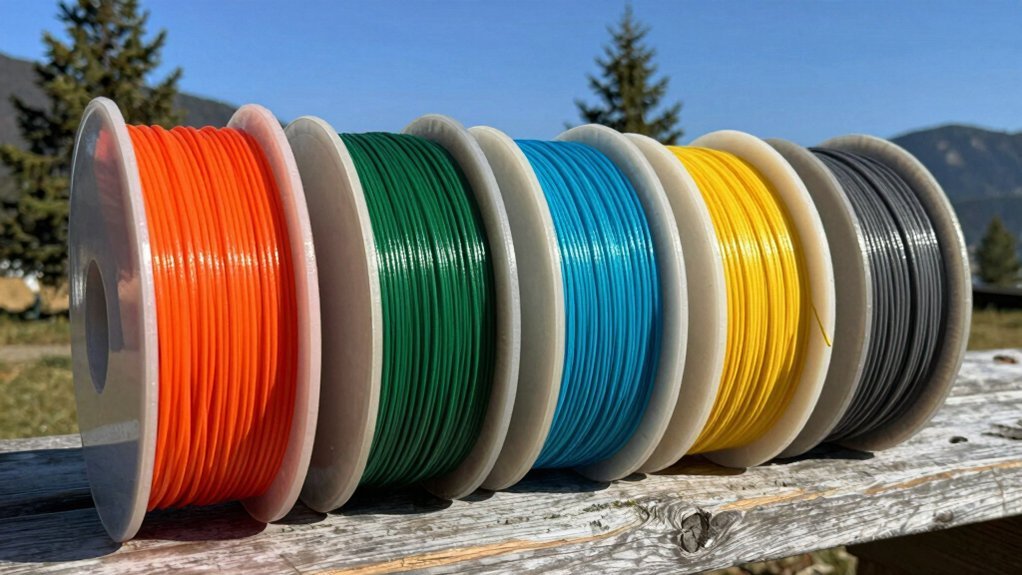
You’re probably looking for a filament that won’t fade, crack, or warp when the sun beats down on it, and the market in 2026 offers a handful of solid ASA options that promise exactly that. From iSANMATE’s UV‑resistant black line to ELEGOO’s moisture‑safe white spool, each product tackles the same core challenges in slightly different ways. The trade‑offs in price, reinforcement, and packaging could tip the balance for your specific project—let’s see which one aligns best with your needs.
| iSANMATE 1.75mm Black UV-Resistant 3D Filament (1kg) | 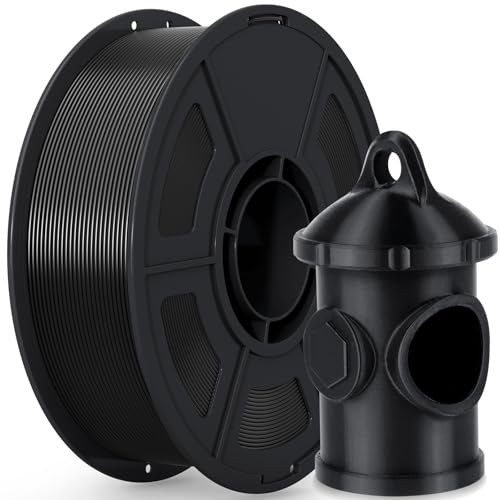 | Best Overall | Diameter: 1.75 mm | Weight per Spool: 1 kg | Color: Black | CHECK ON AMAZON | Read Our Analysis |
| Polymaker ASA 3D Filament 1kg Black Heat‑Weather Resistant |  | Value Pick | Diameter: 1.75 mm | Weight per Spool: 1 kg | Color: Black | CHECK ON AMAZON | Read Our Analysis |
| OVERTURE ASA 1.75mm 1kg Filament – Premium Anti‑UV Black |  | UV Champion | Diameter: 1.75 mm | Weight per Spool: 1 kg | Color: Black | CHECK ON AMAZON | Read Our Analysis |
| Siraya Tech Fibreheart ASA-GF 3D Filament (1kg Black) | 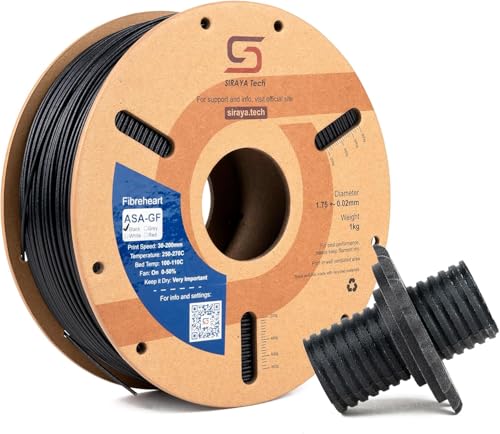 | Reinforced Pro | Diameter: 1.75 mm | Weight per Spool: 1 kg (listed as 1.2 kg package) | Color: Black | CHECK ON AMAZON | Read Our Analysis |
| ELEGOO 1.75mm White Filament 4KG UV‑Resistant for FDM Printers |  | Bulk Power | Diameter: 1.75 mm | Weight per Spool: 4 kg | Color: White | CHECK ON AMAZON | Read Our Analysis |
More Details on Our Top Picks
iSANMATE 1.75mm Black UV-Resistant 3D Filament (1kg)
If you need a filament that won’t fade or crack under relentless sun, iSANMATE’s 1.75 mm black ASA is the go‑to choice for outdoor projects. You’ll get a 1 kg spool with ±0.02 mm dimensional accuracy, sealed in a vacuum‑packaged, desiccant‑lined bag that blocks moisture and dust. The ASA polymer offers excellent UV and weather resistance, maintaining color and strength even after prolonged exposure. Print at 240‑270 °C, 30‑100 mm/s, with a heated bed of 80‑100 °C, and use a closed enclosure plus a glue‑coated bed for reliable adhesion. It fits most consumer and industrial printers, including Bambu Lab AMS/AMSLite, and comes with a three‑month warranty.
- Diameter:1.75 mm
- Weight per Spool:1 kg
- Color:Black
- UV/Weather Resistance:Excellent UV & weather resistant
- Recommended Nozzle Temperature:240–270 °C
- Packaging Type:Vacuum‑sealed with desiccant
- Additional Feature:Vacuum‑sealed with desiccant
- Additional Feature:Tested for Bambu Lab AMS
- Additional Feature:3‑month warranty
Polymaker ASA 3D Filament 1kg Black Heat‑Weather Resistant
Looking for a filament that can endure sun‑baked, windy, and rainy conditions without cracking? Polymaker ASA 1 kg black filament delivers exactly that. Its UV‑resistant, weather‑proof formulation resists environmental stress cracking, while tolerating up to 100 °C (212 °F). You’ll notice high toughness and impact resistance, ideal for RC planes, car accessories, or any outdoor functional part. Print at 250 °C nozzle and 90 °C bed, 50 mm/s speed; an enclosed printer helps avoid warping on large builds. The recycled 3.0 cardboard spool arrives with lifetime technical support and a risk‑free warranty, backed by Amazon’s 30‑day return guarantee.
- Diameter:1.75 mm
- Weight per Spool:1 kg
- Color:Black
- UV/Weather Resistance:UV‑resistant, weather‑resistant
- Recommended Nozzle Temperature:250 °C
- Packaging Type:Upgraded cardboard spool & box, recycled
- Additional Feature:Recycled cardboard spool
- Additional Feature:Lifetime technical support
- Additional Feature:Amazon 30‑day return
OVERTURE ASA 1.75mm 1kg Filament – Premium Anti‑UV Black
Who needs a filament that won’t fade or warp under relentless sun and rain? OVERTURE ASA 1.75 mm 1 kg gives you premium anti‑UV black that stays true outdoors. Its patented, clog‑free, bubble‑free formula dries for 24 hours, then vacuum‑seals in resealable foil, preserving dimensional accuracy of ±0.02 mm. You’ll appreciate the advanced CCD diameter control and self‑adaptive extrusion, which keep tolerances tight across consumer and industrial printers. The material resists UV, heat, and weather, so functional parts hold up in harsh climates. With a one‑year shelf life and dedicated support, you can print confidently and store safely.
- Diameter:1.75 mm
- Weight per Spool:1 kg
- Color:Black
- UV/Weather Resistance:Excellent UV protection, weather resistant
- Recommended Nozzle Temperature:Not specified (standard ASA range)
- Packaging Type:Vacuum‑sealed resealable foil
- Additional Feature:Clog‑free, bubble‑free formula
- Additional Feature:24‑hour pre‑drying
- Additional Feature:1‑year shelf life
Siraya Tech Fibreheart ASA-GF 3D Filament (1kg Black)
Outdoor engineers and hobbyists needing a durable, high‑temperature filament will find the Siraya Tech Fibreheart ASA‑GF 3D Filament (1 kg, Black) especially compelling. Its 10 % glass‑fiber reinforcement lifts strength, stiffness, and impact resistance beyond standard ASA, while the UV‑enhanced matrix keeps color and mechanical properties stable under relentless sun and rain. You’ll print at 250‑270 °C with a 100‑110 °C bed, using an enclosure at 60‑80 °C to curb warping. The material tolerates up to 106 °C glass transition and 92‑97 °C heat‑deflection, making it ideal for outdoor brackets, enclosures, and high‑temp industrial parts. Dry for 4‑6 hours at 70‑80 °C after storage to maintain performance.
- Diameter:1.75 mm
- Weight per Spool:1 kg (listed as 1.2 kg package)
- Color:Black
- UV/Weather Resistance:Superior UV & weather resistance
- Recommended Nozzle Temperature:250–270 °C
- Packaging Type:Standard packaging (no special mention)
- Additional Feature:10% glass‑fiber reinforced
- Additional Feature:106 °C glass transition
- Additional Feature:High‑impact strength
ELEGOO 1.75mm White Filament 4KG UV‑Resistant for FDM Printers
If you need a filament that won’t fade or warp under sun and rain, the ELEGOO 1.75 mm White ASA 4 kg spool is a top pick for outdoor and weather‑proof projects. Its UV‑resistant ASA maintains color and strength even after prolonged exposure, while a 99 °C heat deflection temperature lets it survive hot, humid environments. You’ll appreciate the high impact resistance for drone frames or automotive parts, and the stable extrusion reduces warping on enclosed printers. The vacuum‑sealed, desiccant‑packed spool arrives dry, ensuring consistent interlayer adhesion and smooth feeding. With a 4 kg capacity, you get long‑run printing without frequent reloading.
- Diameter:1.75 mm
- Weight per Spool:4 kg
- Color:White
- UV/Weather Resistance:Excellent UV & weather resistance
- Recommended Nozzle Temperature:Not specified (standard ASA range)
- Packaging Type:Vacuum‑sealed with desiccant
- Additional Feature:4 kg bulk spool
- Additional Feature:Pre‑dried before packing
- Additional Feature:Strong interlayer adhesion
Factors to Consider When Choosing ASA Filaments for Outdoor and Weatherproof Applications
When picking an ASA filament for outdoor use, you should first check its UV resistance and how well it protects against sunlight‑induced degradation. Next, evaluate its weather resistance, mechanical strength, and toughness to ensure it can endure rain, temperature swings, and impact. Finally, confirm the filament’s printing temperature compatibility and that its packaging offers moisture protection to keep it ready for the job.
UV Resistance Weather Resistance
What makes an ASA filament truly suitable for outdoor use is its UV and weather resistance. You’ll want a material that keeps color and strength after months of sunlight, so look for UV‑stabilized formulations that contain additives to prevent yellowing and stress cracking. High‑quality brands usually publish a UV rating or long‑term outdoor performance data; check those numbers before buying. Weather resistance matters just as much—your filament should repel rain, resist humidity, and tolerate temperature swings without swelling or warping. Dimensional stability is key, especially for parts that must stay tight‑fitting over time. Remember that UV and weather protection can differ between manufacturers, so compare specifications and read user reviews to confirm real‑world durability.
UV Protection Capability
Why does UV protection matter when you pick an ASA filament for outdoor use? Sunlight can fade colors, yellow surfaces, and cause micro‑cracks that weaken parts. Look for filaments that list UV‑stabilizing additives or co‑polymers; these chemicals absorb or block harmful wavelengths, keeping dimensions stable and preventing embrittlement. Check the manufacturer’s outdoor‑functional test data—automotive or equipment benchmarks usually involve months of continuous exposure. A higher UV rating often correlates with longer retention of strength, so the part stays robust after years of sun. Finally, verify that the claim isn’t just “weather‑resistant” but specifically mentions UV protection, because that distinction ensures the filament can survive harsh, sun‑intensive environments without rapid degradation.
Mechanical Strength & Toughness
UV protection keeps the polymer from yellowing, but the real test of an outdoor ASA filament is how well it holds up under mechanical stress. You should look for grades that add impact‑resistant additives or glass‑fiber reinforcement; a 10 % fiber content can boost stiffness and load‑bearing capacity while keeping the part lightweight. Check the heat‑deflection temperature (HDT) – values around 90–100 °C mean the filament won’t soften during hot summer days, preserving dimensional stability. Warping resistance matters too; a filament that stays flat in a heated enclosure will retain its strength on large panels. Finally, choose a high‑weather ASA that maintains impact strength and color after prolonged UV exposure, ensuring your outdoor prints stay tough and reliable.
Printing Temperature Compatibility
How do you guarantee your outdoor‑grade ASA prints stay dimensionally stable and free of defects? Start by setting the nozzle between 240 °C and 270 °C, adjusting within that window for each filament brand. Keep the heated bed at 80 °C–110 °C to curb warping and boost layer adhesion. Print slower, around 30–50 mm/s, to let each layer settle and to improve surface finish. Use an enclosed or partially enclosed printer to maintain a consistent temperature environment, which further reduces warping. Before printing, dry the filament for at least 24 hours or store it in a vacuum‑sealed bag to eliminate moisture that causes bubbles and weakens the part. These temperature and environment controls ensure reliable, weather‑proof ASA prints.
Packaging Moisture Protection
Moisture protection is a make‑or‑break factor when selecting ASA filament for outdoor, weather‑proof prints. You’ll find that reputable brands vacuum‑seal spools with desiccants, keeping the material dry until you’re ready to print. A dry filament prevents bubbling, poor layer adhesion, and warping, all of which degrade dimensional accuracy and long‑term durability. Some manufacturers ship pre‑dried spools, while others expect you to dry the filament after purchase—typically 70–80 °C for several hours. Look for resealable foil bags that include a fresh desiccant; they let you open, use, and close the package without re‑exposing the filament to humidity. This simple packaging choice preserves the consistent material properties essential for outdoor performance and extends shelf life.
Frequently Asked Questions
What Is the Optimal Print Temperature for ASA on a 0.4 Mm Nozzle?
You should set the nozzle to about 250‑260 °C and the bed to 90‑100 °C, adjusting within that range if you notice stringing or poor layer adhesion, and keep the enclosure warm.
How Does ASA Compare to PETG for UV Resistance Over 5 Years?
You’ll find ASA holds UV resistance much better than PETG over five years; it degrades slower, retains color, and resists brittleness, while PETG fades and becomes fragile under prolonged sunlight exposure.
Can ASA Be Printed Without an Enclosure and Still Avoid Warping?
You can print ASA without an enclosure, but keep the ambient temperature stable, use a heated bed around 100 °C, and minimize drafts; otherwise warping may still occur.
What Post‑Process Methods Improve Asa’s Water‑Proofing?
You improve ASA’s water‑proofing by applying a clear epoxy coat, using a UV‑cured resin, sanding then sealing with a polyurethane spray, and finally baking a thin layer of silicone sealant for extra barrier protection.
Is ASA Safe for Food‑Contact Applications After Printing?
Yes, you can use ASA for food‑contact if you print with a food‑grade filament, ensure the printer’s nozzle and build plate are clean, and apply a certified food‑safe coating or sealant after printing.

Leave a Reply