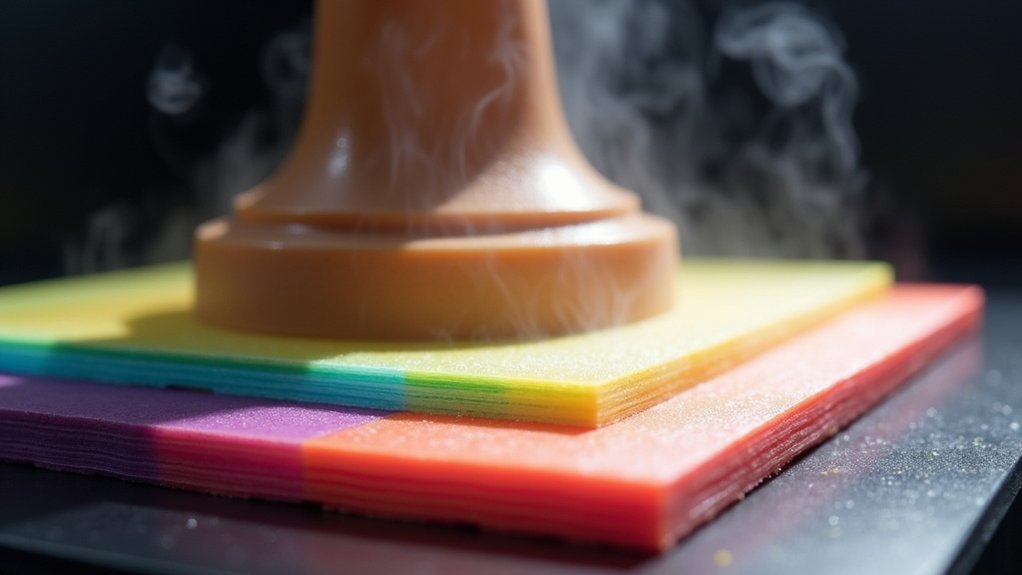
Your 3D printer’s bed temperature directly controls how well your print layers bond together by keeping the filament pliable during the critical first layer adhesion phase. For PLA, you’ll want to set your heated bed between 50-70°C, with 60°C as an ideal starting point. Proper bed temperature prevents warping, eliminates cool spots that cause adhesion failures, and guarantees uniform heat distribution across your build surface. Understanding these thermal dynamics will help you troubleshoot common bonding issues and achieve professional-quality prints.
Understanding the Science Behind Bed Temperature and Layer Bonding
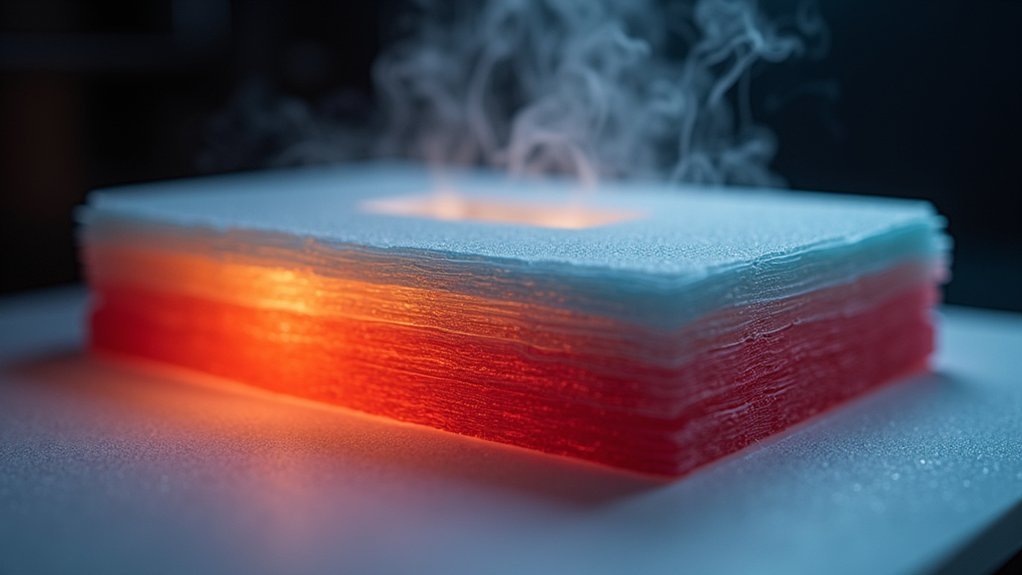
When you’re setting up your 3D printer, bed temperature plays an essential role in determining whether your first layer will stick properly or fail completely.
The science behind layer bonding involves thermal dynamics that keep your filament soft enough to create strong adhesion between the print surface and subsequent layers. For PLA, ideal settings typically range from 50-70°C, maintaining the perfect balance for proper bonding without deformation.
Proper thermal dynamics ensure filament remains pliable for optimal adhesion while preventing deformation during the critical bonding process.
When you don’t achieve correct printing temperatures, you’ll experience poor adhesion that leads to warping, peeling edges, or complete print failure.
The bed temperature directly affects your filament’s pliability upon contact, ensuring each layer fuses effectively. This thermal control maintains structural integrity throughout the printing process, preventing rapid cooling that weakens layer bonds and compromises your final print quality.
How Heated Print Beds Create Optimal Adhesion Conditions
When you maintain your print bed at the proper temperature, you create a controlled surface that dramatically improves how your first layer bonds to the build platform.
Your heated bed distributes warmth evenly across the entire printing area, preventing cool spots that could cause adhesion failures or warping.
You’ll find that this temperature-controlled environment keeps your filament at the ideal consistency for strong layer-to-bed bonding throughout the printing process.
Temperature-Controlled Surface Benefits
Although basic 3D printer beds can work for simple projects, heated beds transform your printing experience by creating a controlled thermal environment that dramatically improves first layer adhesion.
When you maintain consistent temperature across the bed surface, you’ll eliminate common adhesion issues that plague cold bed printing. The heated bed prevents your filament from cooling too rapidly, which reduces warping and creates a strong foundation for subsequent layers.
- Optimal temperature ranges: Set PLA between 50°C-70°C and ABS between 80°C-110°C for best results
- Prevents thermal shock: Gradual cooling eliminates sudden temperature changes that cause layer separation
- Reduces “elephant’s foot”: Proper bed temperature prevents excessive heat that deforms bottom layers
- Maintains filament flexibility: Heat keeps material pliable for better surface bonding
- Enhanced print quality: Consistent temperature creates smoother layer shifts throughout printing
Heat Distribution Effects
The moment your heated bed reaches its target temperature, thermal energy begins spreading across the entire print surface, creating microscopic zones of consistent heat that work together to maintain ideal adhesion conditions. This even heat distribution prevents localized cooling that compromises first-layer adhesion and creates weak points in your printed object.
When you maintain proper temperature control, you’re eliminating the thermal variations that cause warping. Each filament type requires specific bed temperature ranges to achieve maximum layer bonding – your print bed’s uniform heat distribution guarantees these conditions remain stable throughout the printing process.
| Filament Type | Bed Temperature | Heat Distribution Benefit |
|---|---|---|
| PLA | 50-70°C | Prevents edge lifting |
| ABS | 80-100°C | Reduces thermal contraction |
| PETG | 70-85°C | Eliminates corner warping |
| TPU | 40-60°C | Maintains flexibility adhesion |
| ASA | 90-110°C | Prevents large-part distortion |
Temperature Effects on First Layer Foundation Strength
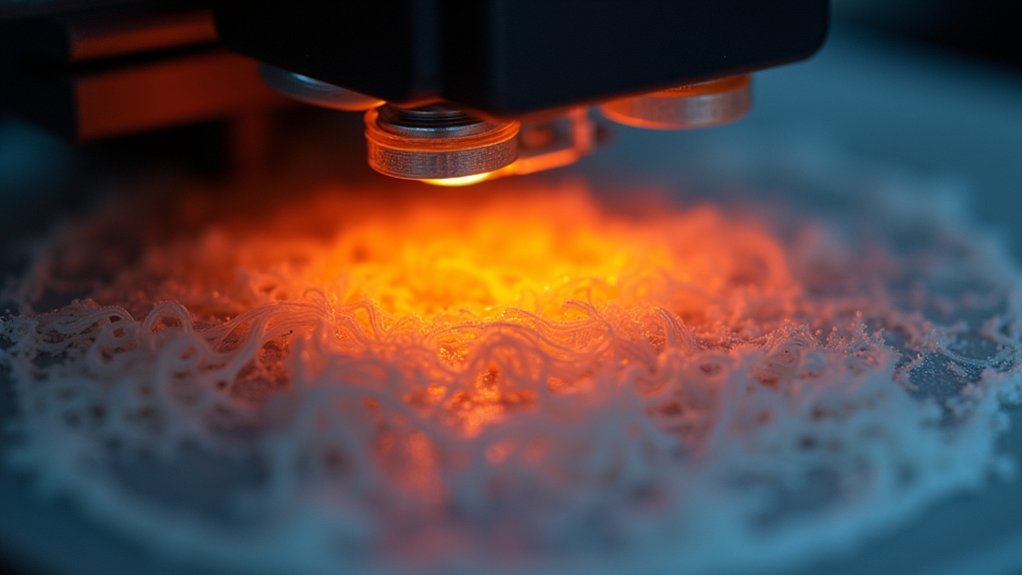
Since proper first layer adhesion forms the cornerstone of successful 3D printing, you’ll find that bed temperature plays a critical role in establishing foundation strength that determines your entire print’s success.
Ideal settings for PLA typically range between 50°C to 70°C, with 60°C serving as your preferred starting point. Temperature fluctuations below 50°C cause poor adhesion, leading to warping and layer separation, while exceeding 70°C softens filament excessively.
- Maintain consistent bed temperature across your entire print surface to prevent uneven adhesion
- Use incremental adjustments of 5°C when fine-tuning temperature for better foundation strength
- Clean your print surface thoroughly before heating to maximize first layer adhesion
- Monitor for “elephant’s foot” formation, indicating excessive bed temperature
- Combine proper temperature with surface preparation for ideal structural integrity
Optimal Bed Temperature Settings for Different Filament Materials
Five distinct filament materials require dramatically different bed temperature settings to achieve ideal print quality and adhesion.
You’ll need a bed temperature range of 50-70°C for PLA (Polylactic) materials, with 60°C ensuring your first layers stick properly.
ABS requires a higher temperature setting between 80-110°C to maintain good layer adhesion and prevent warping or layer separation.
PETG performs best at 50-80°C, where separation and ensuring print stability become manageable.
Nylon works within 50-70°C, though moisture control remains critical for quality results.
TPU typically requires a lower bed temperature of 30-60°C to avoid excessive adhesion while maintaining proper bonding.
When your temperature is too low, you’ll experience poor adhesion and failed prints across all materials.
Common Layer Bonding Problems Caused by Incorrect Bed Temperature
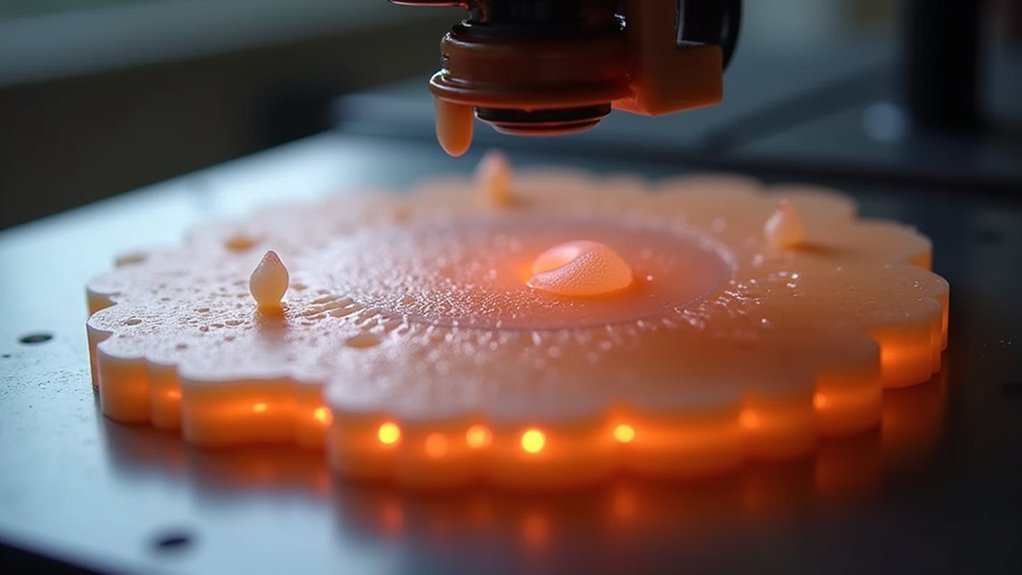
When bed temperature settings drift from ideal ranges, layer bonding problems emerge that can destroy your print’s structural integrity and visual quality.
Poor adhesion becomes your biggest enemy, causing warping and compromised layer bonding throughout your project.
Temperature inconsistencies turn into your worst nightmare, creating adhesion failures that compromise every layer of your print’s foundation.
- First layer failures – Low bed temperature prevents proper adhesion, causing PLA prints to peel and warp when temperatures drop below 50°C
- Elephant’s foot effect – Excessive heat creates wider, distorted bottom layers that compromise dimensional accuracy
- Layer separation issues – Insufficient heating weakens bonds between layers, creating visible gaps and structural weaknesses
- ABS warping problems – Inadequate temperature control below 80°C exacerbates warping, leading to complete print failures
- Temperature fluctuations – Minor variations cause uneven surfaces and unpredictable layer separation throughout the printing process
Calibrating Your Heated Bed for Maximum Layer Adhesion
Understanding these layer bonding challenges points to one clear solution: proper bed calibration. You’ll need to set your heated bed within the ideal temperature range of 50-70°C for PLA to prevent warping and achieve maximum first layer adhesion. Monitor your bed temperature closely during calibrating, as temperatures too low cause poor bonding while excessive heat deforms your first layer.
| Calibration Step | Temperature Action |
|---|---|
| Initial Setup | Set bed to 60°C for PLA |
| Temperature Tower | Test 5°C increments |
| Surface Prep | Clean at target temp |
| Fine-tuning | Adjust based on adhesion |
Regular bed leveling guarantees consistent first layer contact across the surface. You can enhance print quality by cleaning the surface and applying adhesives when necessary, supporting effective layer bonding throughout the printing process.
Advanced Temperature Control Techniques for Professional Results
You can achieve professional-grade results by implementing multi-zone heating systems that provide independent temperature control across different bed sections.
Real-time temperature monitoring with thermocouples or infrared sensors lets you track thermal variations and make instant adjustments during prints.
Gradient temperature profiles allow you to customize heating patterns that match your specific material requirements and print geometries.
Multi-Zone Heating Systems
Although traditional single-zone heating beds work well for basic prints, multi-zone heating systems represent a significant leap forward in temperature control precision.
These advanced setups use multiple heating elements that you can independently adjust across different bed sections. You’ll achieve ideal adhesion for various print geometries while preventing warping in specific areas.
Multi-zone heating lets you customize bed temperature according to each material’s thermal properties. You can set higher temperatures for ABS while maintaining lower zones for PLA simultaneously. This maintains consistent ambient temperature around your printed object, improving layer bonding and minimizing thermal shock.
- Independent heating zones prevent warping in large prints
- Simultaneous printing of different materials without temperature adjustments
- Enhanced layer bonding through consistent ambient temperature control
- Reduced print failures and improved print quality
- Increased production efficiency and reduced downtime
Real-Time Temperature Monitoring
When precision matters most in professional 3D printing, real-time temperature monitoring becomes your most valuable tool for achieving consistent results.
You’ll achieve optimal print quality by implementing thermocouples or thermistors that provide precise bed temperature readings within recommended ranges—50-70°C for PLA and 80-110°C for ABS.
Temperature sensors monitoring ambient conditions help you maintain stable environments essential for layer bonding.
PID controllers dynamically adjust heater output, ensuring consistent temperatures throughout your print cycle.
Advanced slicing software can incorporate live temperature data to automatically modify print parameters in real-time.
This feedback loop prevents warping and strengthens adhesion between layers, dramatically improving your success rates and reducing failed prints.
Gradient Temperature Profiles
Gradient temperature profiles represent the cutting edge of thermal management in professional 3D printing, allowing you to dynamically adjust bed temperatures throughout the printing process for superior results.
This advanced technique optimizes layer adhesion by gradually modifying temperatures based on print height, preventing warping while maintaining structural integrity.
Advanced slicing software enables precise temperature gradient control, letting you customize thermal settings for specific filament properties.
- Enhanced adhesive bonding through strategic temperature changes between layers
- Reduced warping by implementing gradual cooling cycles for materials like ABS
- Improved structural integrity via optimized thermal conditions at different print heights
- Material-specific optimization allowing consistent temperature profiles tailored to filament characteristics
- Professional-grade results with minimized defects like elephant’s foot through controlled thermal management
Troubleshooting Layer Separation Issues Through Temperature Adjustments
One of the most frustrating problems you’ll encounter in 3D printing is layer separation, where visible gaps and structural weaknesses appear between printed layers. Poor adhesion typically stems from inadequate bed temperature, causing warping and compromised print quality. When adjusting temperature for PLA, start with 50-70°C and make incremental changes.
| Issue | Temperature Adjustment | Expected Result |
|---|---|---|
| Layer separation | Increase by 5°C | Better adhesion |
| Warping edges | Increase by 5°C | Reduced lifting |
| Elephant’s foot | Decrease by 5-10°C | Less deformation |
| Uneven heating | Calibrate bed level | Consistent bonding |
| First-layer adhesion | Monitor and adjust | Improved foundation |
You’ll need to regularly monitor calibrating temperature settings while ensuring proper surface preparation. Uneven heating creates inconsistent adhesion patterns, so maintaining steady temperatures across your print bed prevents cracks and separation throughout your entire project.
Frequently Asked Questions
How Does Bed Temperature Affect Adhesion?
You’ll achieve better adhesion with proper bed temperature since it keeps your filament warm enough to bond while preventing overheating that causes deformation and elephant’s foot effects.
What Temperature Is Good for PLA Layer Adhesion?
You’ll want to set your PLA bed temperature between 50°C and 70°C for ideal layer adhesion. Start with 60°C as it’s the sweet spot that prevents warping while ensuring strong bonding.
Why Are My 3d Printed Layers Not Sticking Together?
Your layers aren’t sticking because you’re likely using too low bed temperature. Increase it by 5°C increments until you reach 60-70°C for PLA to improve bonding between layers.
Does a Hotter Bed Make PLA Stick Better?
Yes, you’ll get better PLA adhesion with a hotter bed around 60°C. It softens the filament so it conforms and bonds better, but don’t exceed 70°C or you’ll create elephant’s foot deformation.

Leave a Reply