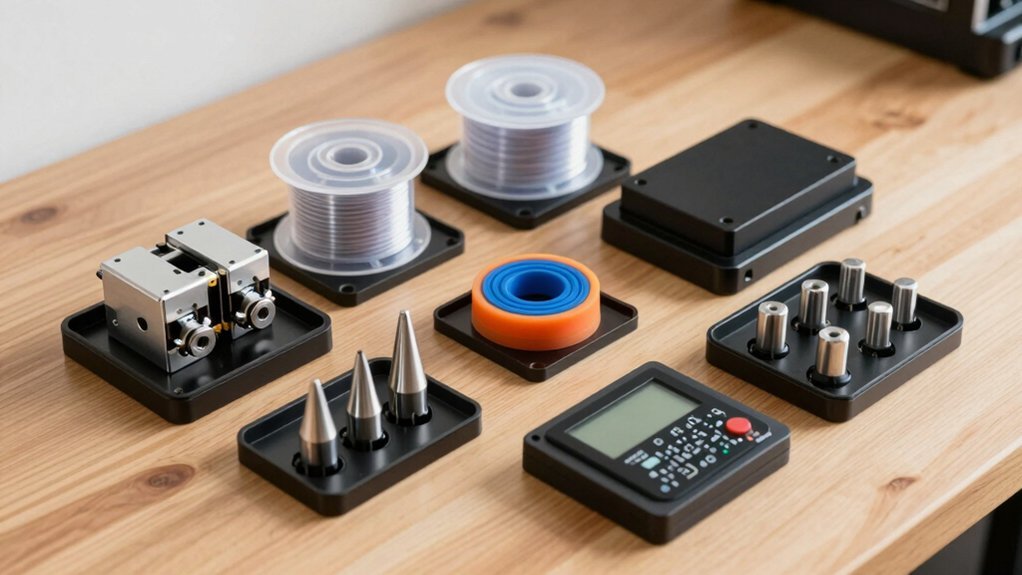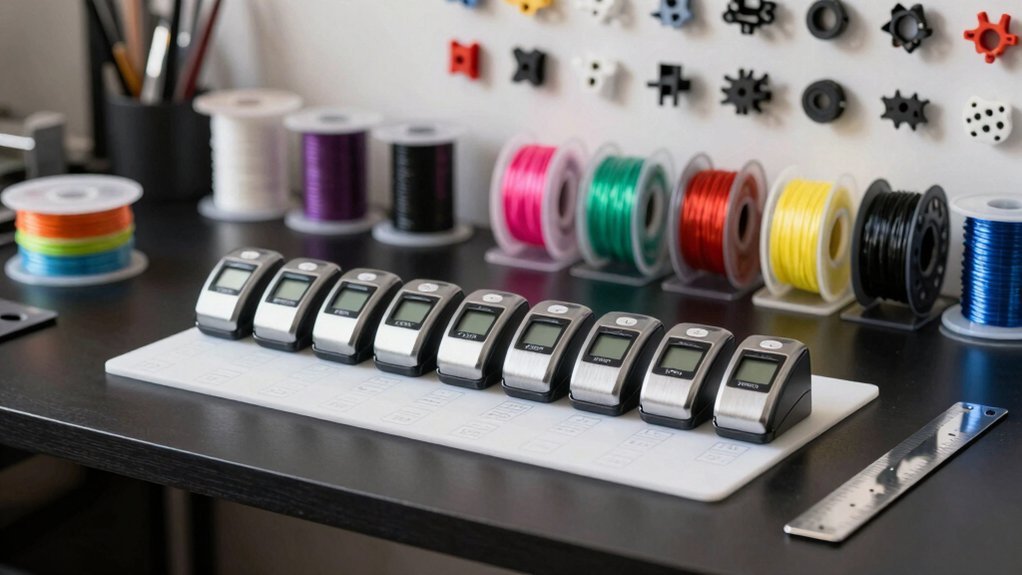

You’ll need all-metal hotends with copper blocks and titanium heatbreaks to reach 300°C+ temperatures for nylon and polycarbonate printing. Upgrade to PT100 sensors for ±0.1°C precision control, volcano-style heater blocks for 50% higher flow rates, and ruby-tipped nozzles for exceptional durability. Direct drive extruders improve filament control, while enclosed chamber heating systems maintain 60-70°C ambient temperatures. These seven upgrades transform your printer into a high-temperature powerhouse capable of handling engineering-grade thermoplastics with professional results.
All-Metal Hotend Construction for Enhanced Temperature Tolerance
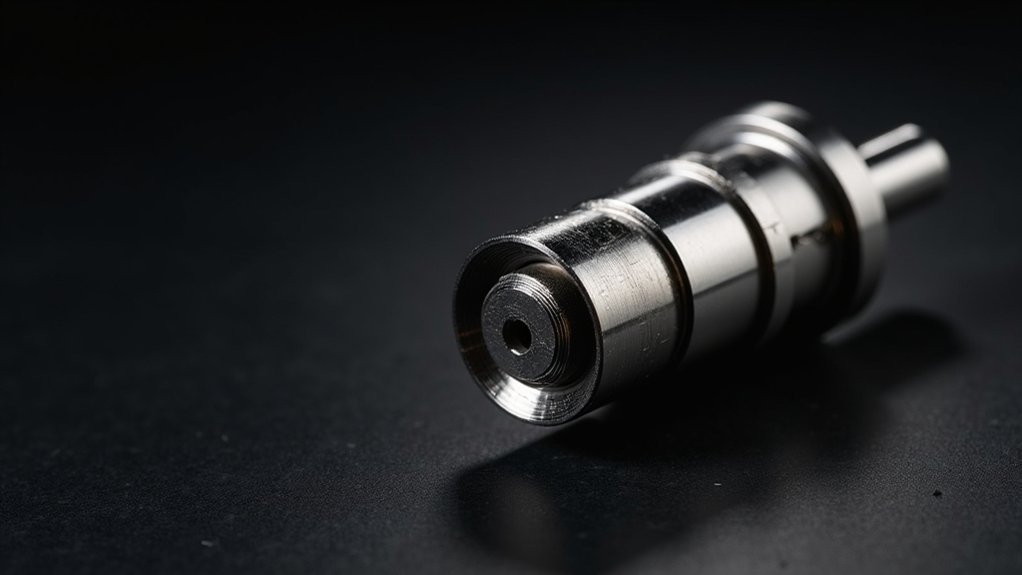
When you’re pushing the boundaries of 3D printing with advanced materials, all-metal hotends become essential upgrades that’ll transform your printer’s capabilities.
These robust hot end components withstand temperatures up to 300°C or higher, enabling you to print demanding filaments like nylon, polycarbonate, and PEKK with confidence.
Related guide: Best Extruder Upgrades That Eliminate 3D Printing Jams Once and For All
All-metal hotends handle extreme temperatures beyond 300°C, unlocking high-performance materials like nylon and polycarbonate for professional applications.
The all-metal construction eliminates PTFE liners that degrade under high temperature conditions, ensuring consistent performance without material breakdown.
You’ll benefit from enhanced thermal conductivity that distributes heat evenly, improving filament flow while reducing clogs during challenging prints.
Upgraded heat breaks in these hotends prevent heat creep, maintaining reliable extrusion without unwanted filament softening.
Related guide: Best Most Reliable Bearing Upgrades for Better Performance
This versatility opens doors to engineering-grade thermoplastics, dramatically expanding your project possibilities beyond standard materials.
Precision Temperature Control Systems With PT100 Sensors
All-metal hotends reach their full potential when paired with precision temperature control systems featuring PT100 sensors.
You’ll gain exceptional accuracy measuring temperatures up to 500°C with ±0.1°C tolerance, making them perfect for high-temperature materials like polycarbonate and PEKK. These sensors integrate seamlessly with various hotend systems, providing the consistent readings you need for ideal material performance.
You’ll want to pair your PT100 sensor with a PID control system for precise temperature regulation.
This combination greatly reduces material degradation risk while improving layer adhesion – vital for complex geometries in high-performance prints. The enhanced temperature stability you’ll achieve transforms challenging materials into reliable printing options, expanding your manufacturing capabilities beyond standard thermoplastics.
Copper Block and Titanium Heatbreak Combinations
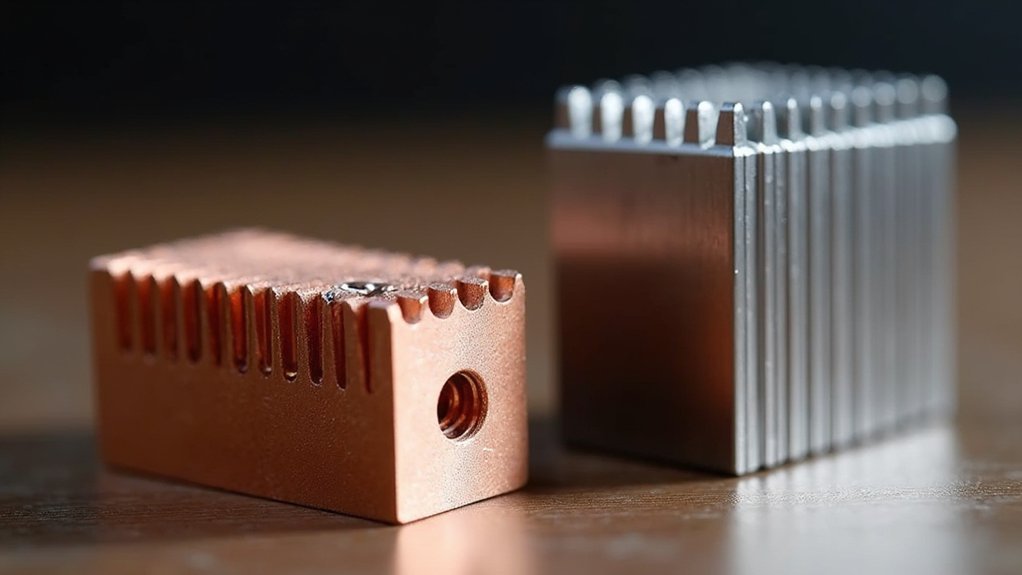
Since thermal management determines your print quality at extreme temperatures, copper block and titanium heatbreak combinations deliver the ideal balance of heat retention and thermal isolation you need.
The copper block’s superior heat retention maintains consistent high temperatures essential for engineering-grade thermoplastics, while the titanium heatbreak’s low thermal conductivity prevents heat creep from compromising your hotend performance.
This combination excels when you’re printing challenging materials like nylon and polycarbonate, where precise temperature control prevents degradation and guarantees quality layer adhesion.
You’ll experience markedly reduced clogging issues and enhanced filament flow rates, making your high-temperature printing more reliable.
The enhanced thermal conductivity and stability allow efficient heat transfer during demanding printing processes, transforming your printer’s capability with advanced materials.
Volcano Style Heater Blocks for Increased Flow Rates
When you’re pushing high-temperature materials through your hotend at speed, you’ll quickly discover that standard heater blocks become the bottleneck in your printing process.
Volcano style heater blocks solve this problem by accommodating larger diameter nozzles and providing greatly enhanced material flow rates that keep pace with faster printing speeds.
You’ll also benefit from superior temperature control thanks to the larger heating area, which maintains consistent heat distribution even when extruding high volumes of demanding materials like nylon or polycarbonate.
Enhanced Material Flow
Although standard hotends work well for many applications, Volcano style heater blocks revolutionize material flow by featuring an extended melt zone that accommodates larger diameter nozzles and dramatically increases extrusion rates.
You’ll experience up to 50% higher flow rates compared to standard hotends, enabling smoother extrusion that minimizes clog risks and improves print quality.
The extended melt zone guarantees uniform heating, which is vital when you’re working with high-temperature materials like nylon and polycarbonate.
You can also print with layer heights up to 1.2 mm, accelerating your printing process while maintaining detail for lower-resolution projects.
However, you’ll need compatible nozzles and careful calibration to maximize these enhanced material flow benefits.
Temperature Control Benefits
Beyond increased flow rates, Volcano style heater blocks deliver superior temperature control that transforms your high-temperature printing capabilities.
The larger heating element surface area guarantees rapid heat transfer, dramatically reducing the time you’ll wait to reach ideal printing temperatures for demanding materials like nylon and polycarbonate.
This enhanced thermal performance provides three critical advantages:
- Consistent heat distribution – eliminates hot spots that cause material degradation
- Faster temperature recovery – maintains stability during rapid extrusion changes
- Precise thermal regulation – prevents temperature fluctuations that compromise print quality
You’ll maintain material integrity throughout complex geometries and large-scale production runs.
The superior temperature control minimizes thermal stress on advanced filaments, guaranteeing they retain their mechanical properties while enabling the high-speed printing that modern manufacturing demands.
Ruby-Tipped Nozzles for Advanced Material Compatibility
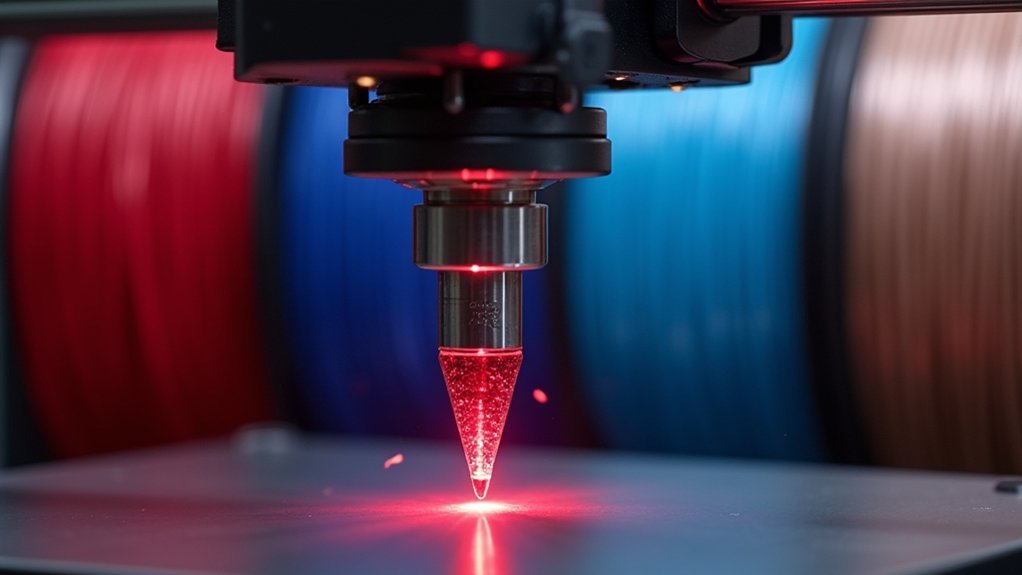
As you push into advanced materials like carbon fiber-reinforced filaments and high-performance nylons, standard brass nozzles simply can’t keep up with the demands of abrasive printing and extreme temperatures.
Ruby-tipped nozzles, like the Olsen Ruby nozzle, solve this problem with exceptional durability and wear resistance that dramatically extends their lifespan when printing abrasive materials.
These premium nozzles handle extreme temperatures exceeding 300°C while maintaining superior thermal conductivity for improved heat distribution.
You’ll notice better extrusion consistency and enhanced print quality at high temperatures. The ruby tip’s resistance to wear also reduces clogging risks, ensuring reliable performance with specialty filaments requiring precise temperature control.
For serious high-temperature printing applications, ruby-tipped nozzles deliver the performance and longevity you need.
Direct Drive Extruder Integration With High-Temp Hotends
When you’re upgrading to high-temperature printing, pairing a direct drive extruder with your high-temp hotend creates a powerful combination that dramatically improves filament control and print quality.
You’ll experience better retraction response, reduced skipping with flexible materials, and enhanced precision when working with engineering-grade thermoplastics like nylon and polycarbonate.
However, you’ll need to carefully consider mounting compatibility and potential firmware adjustments to guarantee your direct drive system works seamlessly with your chosen high-temp hotend.
Direct Drive Benefits
Three key advantages make direct drive extruders an excellent match for high-temperature hotends.
You’ll experience greatly improved print reliability and material compatibility when you combine these systems.
The benefits you’ll gain include:
- Enhanced Material Control – You’ll achieve precise extrusion with engineering-grade thermoplastics like nylon and polycarbonate, as the direct drive system provides consistent filament feed and better flow control.
- Reduced Heat Creep Issues – You’ll maintain ideal filament temperatures by minimizing the distance between extruder and hotend, preventing premature melting and jams.
- Higher Speed Capability – You’ll print faster without quality loss, as the shortened filament path enables quicker response to extrusion commands during complex geometries.
This combination expands your printing versatility noticeably.
Installation Compatibility Considerations
Before mounting your high-temperature hotend to a direct drive extruder, you’ll need to confirm several critical compatibility factors that determine installation success.
First, verify your hotend’s maximum temperature rating exceeds 260°C for materials like nylon or polycarbonate. Check if you’ll need specific mounting brackets or adapters, as many hotends don’t directly fit all direct drive systems.
Examine the heat break’s design to guarantee it prevents heat creep at elevated temperatures, which commonly causes clogs in direct drive setups.
Verify the filament path maintains smooth alignment throughout the assembly, as misalignment creates friction issues with viscous high-temp materials.
After installation, you’ll need to recalibrate your extruder steps/mm settings since high-temperature hotends often have different internal geometries affecting extrusion accuracy.
Enclosed Chamber Heating Systems for Material-Specific Requirements
Although hotend upgrades enable high-temperature printing, you’ll need an enclosed chamber heating system to access the full potential of engineering-grade thermoplastics. Your chamber must reach 60°C to 70°C for materials like polycarbonate and PEKK, preventing warping and ensuring proper layer adhesion.
Three key components will optimize your heated enclosure:
- Dedicated heaters – Lasko heaters effectively raise chamber temperatures for consistent thermal management.
- PID temperature controllers – Maintain precise temperatures while reducing print failures and missed steps.
- Proper ventilation systems – Circulate air to prevent overheating and material degradation.
You’ll find that controlled chamber heating eliminates cooling-related contraction issues that plague high-temperature materials.
This system transforms your printer’s capability, allowing you to successfully print engineering-grade thermoplastics with professional-quality results.
Frequently Asked Questions
What Is the Max Temperature for Creality Hotend?
Your stock Creality hotend typically reaches a maximum temperature of around 240°C, which works well for PLA and ABS filaments but won’t handle higher-temperature materials like nylon or polycarbonate effectively.
What Is the Highest Temperature for 3D Printing?
You’ll typically reach around 300°C for standard high-temperature printing with nylon and polycarbonate. However, specialized filaments like PEEK and PEKK can require temperatures exceeding 350°C for best results.
What Is the Max Temperature for Ender 5 Hotend?
Your stock Ender 5 hotend reaches maximum temperatures around 240°C, suitable for PLA and ABS. You’ll need an all-metal hotend upgrade to achieve 300°C for high-temperature filaments like nylon.
What Is the Max Temperature for the MK8 Hotend?
You’ll find the MK8 hotend’s max temperature ranges from 240°C to 260°C, depending on your specific model. This lets you print PLA, ABS, and PETG but limits high-temperature materials.