You need three critical ventilation requirements for safe resin printing: maintain 6-10 air changes per hour (ACH) with 10 ACH being ideal for hazardous fume removal, install a negative pressure enclosure system that creates 2-5 Pascals pressure differential to prevent fume escape, and integrate organic vapor respirators with local exhaust ventilation at 100 feet per minute capture velocity. Standard office ventilation won’t protect you from dangerous VOCs, and you’ll discover how these systems work together for maximum protection.
Minimum Air Exchange Rates and Volume Requirements
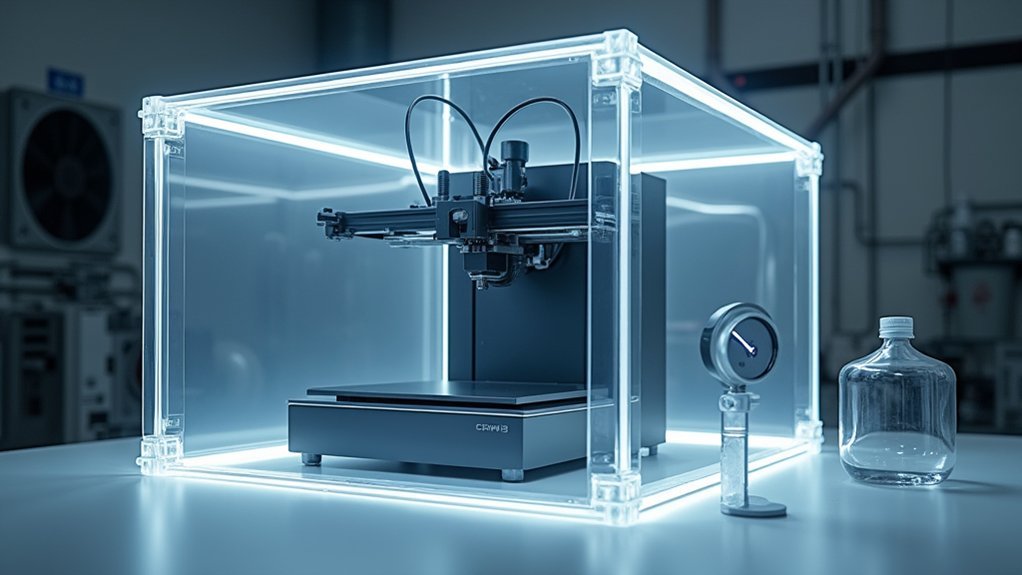
Proper ventilation for resin 3D printing requires a minimum of 6 to 10 air changes per hour (ACH) to safely dilute volatile organic compounds and airborne contaminants.
You’ll need at least 10 ACH for effective removal of hazardous fumes, while occupational guidelines suggest 6 ACH as the absolute minimum for designated printing spaces.
Standard office ventilation rates of 2-4 ACH won’t protect you from resin exposure.
Your ventilation volume must match your room size and printer emissions.
Larger or multiple printers demand proportionally greater airflow volumes measured in cubic feet per minute (CFM).
In smaller enclosed areas, you’ll need higher volume exchanges to overcome concentration risks.
Calculate your requirements based on room volume, emission rates, and air change frequency while maintaining consistent operation during printing.
Negative pressure enclosures are particularly effective for directing contaminated air away from the operator and ensuring complete fume extraction from the printing area.
Negative Pressure Enclosure Systems With External Exhaust
While achieving adequate air exchange rates provides baseline protection, negative pressure enclosure systems offer superior containment by creating a controlled airflow environment that actively prevents resin fumes from escaping into your workspace.
You’ll need to install an exhaust fan with higher capacity than any inlet airflow to maintain 2-5 Pascals pressure differential. This creates inward airflow through gaps instead of outward fume leaks.
| Component | Specification | Purpose |
|---|---|---|
| Exhaust Fan | Continuous-rated, corrosion-resistant | Pulls contaminated air out |
| Ductwork | Smooth, short runs to exterior | Routes fumes outside |
| Seals | Resin-vapor resistant materials | Prevents fugitive emissions |
Your enclosure must be nearly airtight with dedicated external venting through window adapters or vent ports. Position air inlets on the panel opposite to filtration system to optimize airflow distribution throughout the chamber. Regular inspection of seals and fan operation guarantees system integrity and consistent negative pressure maintenance.
Personal Protective Equipment Integration With Ventilation Setup
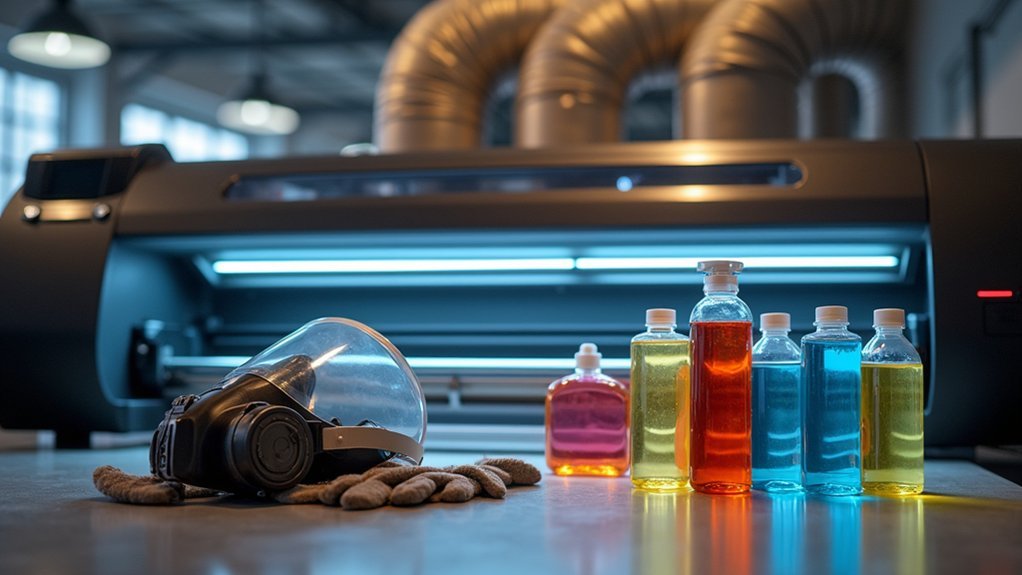
Even the most effective negative pressure system can’t eliminate every resin vapor from your immediate workspace, making personal protective equipment your critical second line of defense.
You’ll need respirators with organic vapor filters during resin pouring, print cleaning, and printer opening. Standard face masks won’t protect against VOCs. Pair respiratory protection with nitrile gloves and safety goggles to prevent dermal and eye contact with resin vapors.
Your PPE creates layered protection when combined with local exhaust ventilation operating at 100 feet per minute capture velocity.
PPE and local exhaust ventilation at 100 FPM capture velocity work together to create comprehensive protection against resin vapors.
Wear lab coats or disposable overalls to prevent contamination, especially in areas where ventilation may release vapor into room air. Regular fit testing and maintenance guarantee your respirator’s effectiveness, while proper PPE training maximizes protection alongside your ventilation systems. Remember that PPE does not replace the need for adequate ventilation systems, as proper airflow remains the primary defense against harmful emissions.
Frequently Asked Questions
Can I Use My Resin Printer in a Basement Without Windows?
You can’t safely use resin printers in windowless basements without proper ventilation. You’ll need mechanical exhaust fans, ducting to outside vents, and enclosed printing chambers to prevent dangerous fume accumulation.
How Often Should I Replace Ventilation System Filters for Optimal Performance?
You should replace HEPA filters every 6-12 months for moderate use, but more frequently with daily resin printing. Watch for lingering odors, reduced airflow, or visible filter discoloration as replacement indicators.
What Are the Signs That My Current Ventilation Setup Is Inadequate?
You’ll notice persistent chemical odors, respiratory irritation, headaches, or visible haze around your printer. Sticky residue on nearby surfaces, increased room temperature, and complaints about air quality also indicate inadequate ventilation.
Is It Safe to Print Overnight With Ventilation Systems Running Unattended?
You shouldn’t print overnight unattended, even with ventilation running. Ventilation systems can fail, printers may malfunction creating fire hazards, and fumes can accumulate if exhaust stops working without supervision.
Do Different Resin Types Require Different Ventilation Strength or Configurations?
You’ll need stronger ventilation for polyester resins due to high styrene emissions, while epoxy resins require moderate airflow. Configure local exhaust systems for point-source control rather than general dilution ventilation.