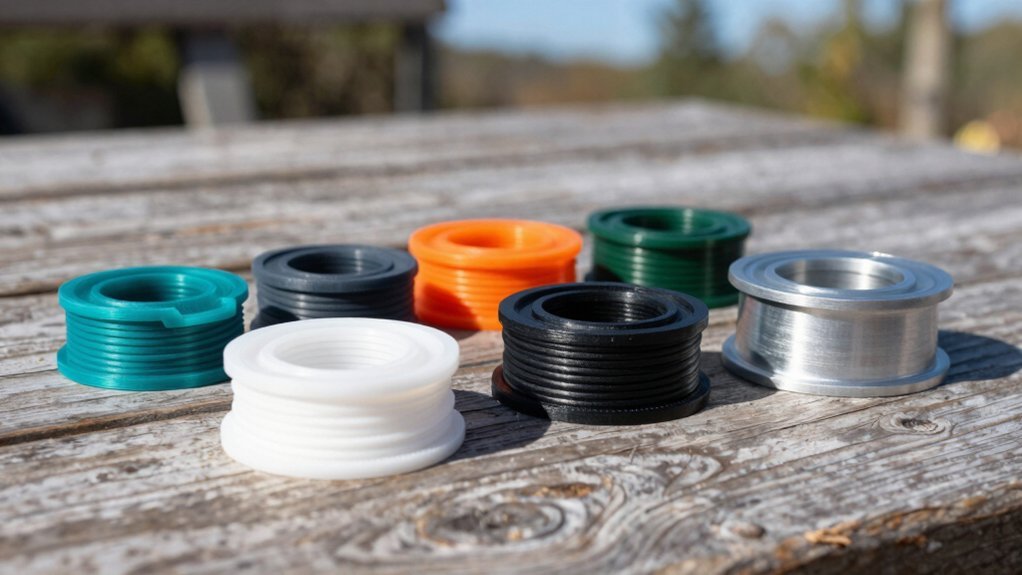
You’re looking for a filament that won’t crumble under sun, rain, or temperature swings, and the 2026 market offers seven solid ASA options that hit those marks. Each brand brings its own twist—vacuum‑sealed packs, carbon‑fiber reinforcement, or ultra‑tight tolerances—so you can match performance to your printer’s capabilities and your project’s exposure. The real question is which of these specs will make the biggest difference for your outdoor prints.




More Details on Our Top Picks
FLASHFORGE ASA 1.75mm Black 3D Filament 1kg
Looking for a filament that won’t fade or warp under relentless sun? FLASHFORGE ASA 1.75 mm Black gives you UV‑stable, shrink‑resistant material that holds shape up to ~93 °C. The spool arrives vacuum‑sealed, dried for 24 hours, and inspected with CCD diameter control, so 99 % of the filament stays within ±0.02 mm tolerance. You’ll notice clog‑free, bubble‑free extrusion, perfect for outdoor functional parts like RC planes or car accessories. Its chemical resistance tackles oils and solvents, while the durable composition endures harsh weather. One kilogram provides ample material for long‑term projects without compromising precision.
- Material Type:ASA
- Diameter:1.75 mm
- Weight per Spool:1 kg
- UV/Weather Resistance:High UV & weather resistance
- Dimensional Accuracy:±0.02 mm (99 % within tolerance)
- Packaging Moisture Protection:Dried 24 h, vacuum‑sealed
- Additional Feature:24‑hour pre‑dried
- Additional Feature:Advanced CCD diameter control
- Additional Feature:99% tolerance consistency
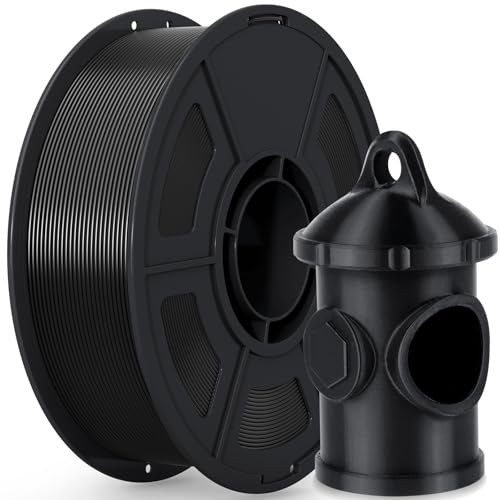
iSANMATE 1.75mm Black 3D Filament UV & Weather Resistant 1kg
If you need a reliable ASA filament that can endure harsh sunlight and weather for outdoor prints, the iSANMATE 1.75 mm Black 1 kg spool delivers exactly that. It offers ±0.02 mm dimensional accuracy, a 1 kg vacuum‑sealed coil, and a black hue that resists UV‑induced fading. Print at 240‑270 °C with a 80‑100 °C bed, using 30‑100 mm/s speeds, and apply a thin glue layer for adhesion. The material stays stable in enclosures and tolerates high‑temp continuous runs. It works with most consumer and industrial printers, including Bambu Lab AMS/AMSLite, and comes with a three‑month warranty.
- Material Type:ASA
- Diameter:1.75 mm
- Weight per Spool:1 kg
- UV/Weather Resistance:UV & weather resistant
- Dimensional Accuracy:±0.02 mm
- Packaging Moisture Protection:Vacuum‑sealed with desiccant
- Additional Feature:Recommended enclosure printing
- Additional Feature:Glue bed adhesion tip
- Additional Feature:Tested for Bambu Lab AMS
OVERTURE ASA Filament 1.75mm 1kg Black (Anti-UV)
For anyone needing a reliable, UV‑resistant filament for outdoor functional parts, the OVERTURE ASA 1.75 mm 1 kg black spool delivers exactly that. Its patented formula keeps the material clog‑free and bubble‑free, and the 24‑hour drying cycle before vacuum‑sealing ensures consistent extrusion. Dimensional accuracy stays within ±0.02 mm thanks to CCD diameter measurement and self‑adaptive control, so you’ll see tight tolerances on every print. The filament resists UV, heat, and weather, making it perfect for garden fixtures, automotive brackets, or signage. OVERTURE also offers broad printer compatibility, a one‑year unopened shelf life, and responsive support for a smooth printing experience.
- Material Type:ASA
- Diameter:1.75 mm
- Weight per Spool:1 kg
- UV/Weather Resistance:Excellent UV protection, weather resistant
- Dimensional Accuracy:±0.02 mm
- Packaging Moisture Protection:Vacuum‑sealed, resealable foil
- Additional Feature:1‑year unopened shelf life
- Additional Feature:Patented clog‑free formula
- Additional Feature:Dedicated printing support
Polymaker ASA-CF08 Carbon Fiber Filament 1.75mm 0.5kg
Polymaker’s ASA‑CF08 filament is the go‑to choice for anyone needing a UV‑resistant, high‑rigidity material that can endure harsh outdoor conditions without warping. You’ll appreciate its 8 % carbon‑fiber reinforcement, delivering 69 MPa XY bending strength and 43 MPa tensile strength while holding a 103 °C HDT. The matte finish hides layer lines, and the vacuum‑sealed spool stays moisture‑free and tangle‑free. You can print up to 350 mm/s with strong bed adhesion, no heated chamber required, but you’ll need a hardened steel or ruby nozzle because the filament is abrasive and brittle. Ideal for prototypes, outdoor housings, and marine or automotive parts, it’s available in six vibrant colors and suits both pros and hobbyists.
- Material Type:ASA (Carbon‑Fiber reinforced)
- Diameter:1.75 mm
- Weight per Spool:0.5 kg
- UV/Weather Resistance:UV & weather resistant (enhanced by carbon fiber)
- Dimensional Accuracy:±0.02 mm (CCD measurement)
- Packaging Moisture Protection:Vacuum‑sealed, moisture‑free
- Additional Feature:8% carbon fiber reinforcement
- Additional Feature:Hardened steel nozzle required
- Additional Feature:Matte surface hides layer lines
Creator ASA Filament 1.75mm 1KG (Natural) Outdoor‑Resistant 3D Printing Filament
The Creator ASA Filament 1.75 mm 1 kg (Natural) is perfect for anyone who needs reliable, weather‑proof 3D prints—especially outdoor fixtures, signage, and functional parts that must endure UV exposure, rain, and temperature swings. Its UV‑ and water‑resistant chemistry lets you print parts that survive harsh sunlight and moisture without yellowing. Heat‑resistance keeps mechanical strength intact at elevated temperatures, so brackets and housings stay tough. You’ll appreciate the neat, fully mechanical winding and manual checks that cut tangles and clogs. Dried, vacuum‑sealed with desiccant, the filament stays dry. Advanced CCD measurement guarantees 1.75 mm diameter with ±0.02 mm tolerance, delivering smooth extrusion and precise, repeatable prints.
- Material Type:ASA
- Diameter:1.75 mm
- Weight per Spool:1 kg
- UV/Weather Resistance:UV, weather, water resistant
- Dimensional Accuracy:±0.02 mm (99 % probability)
- Packaging Moisture Protection:Dried, vacuum‑sealed with desiccant
- Additional Feature:Full mechanical winding
- Additional Feature:Strict manual quality checks
- Additional Feature:Neat, tangle‑free spool
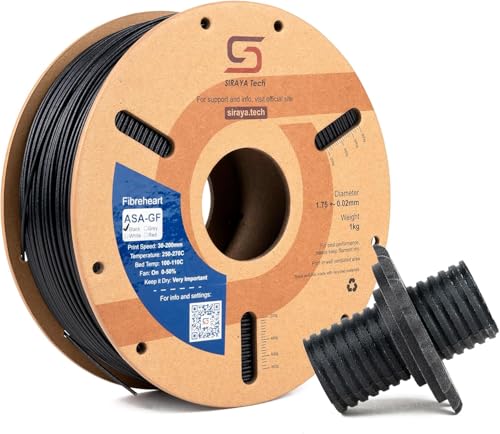
Siraya Tech Fibreheart ASA-GF 3D Filament (1kg Black)
If you need a filament that can endure harsh sunlight and high temperatures while maintaining strength, Siraya Tech’s Fibreheart ASA‑GF 3D Filament (1 kg, Black) is a top pick. Its 10 % chopped glass‑fiber reinforcement raises tensile strength and impact resistance beyond standard ASA, while the UV‑stable polymer keeps color and mechanical properties intact outdoors. The material tolerates a 106 °C glass transition and a 92‑97 °C heat‑deflection range, minimizing warping and preserving dimensional accuracy. Print with a 250‑270 °C nozzle, 100‑110 °C bed, and 60‑80 °C enclosure; use 1‑5 mm retraction at 1800‑3600 mm/min. Dry at 70‑80 °C for 4‑6 hours after storage.
- Material Type:ASA‑GF (Glass‑Fiber reinforced)
- Diameter:1.75 mm
- Weight per Spool:1 kg (listed) / 1.2 kg (package)
- UV/Weather Resistance:Superior UV & weather resistance
- Dimensional Accuracy:±0.02 mm (implied by CCD)
- Packaging Moisture Protection:Dried, vacuum‑sealed, moisture‑protected
- Additional Feature:10% glass fiber reinforcement
- Additional Feature:106 °C glass transition temperature
- Additional Feature:Reduced warping, high stability
Inslogic 1.75mm UV Weather‑Resistant 3D Filament (4 Spools)
Looking for a filament that can survive relentless sun and rain while delivering precise, low‑warping prints? Inslogic’s 1.75 mm ASA comes in four 1 kg spools—black, red, blue, green—each vacuum‑sealed and pre‑dried for moisture protection. You’ll print at 250‑280 °C with stable bed adhesion, minimal shrinkage, and fine detail on large parts. Its tensile strength hits 52.4 MPa and impact resistance 18.33 KJ/m², making it ideal for outdoor housings, tooling, and high‑stress components. The material resists UV, rain, and heat, ensuring long‑term durability. Technical support is readily available if you run into issues.
- Material Type:ASA
- Diameter:1.75 mm
- Weight per Spool:1 kg (×4 spools)
- UV/Weather Resistance:UV & weather resistant
- Dimensional Accuracy:±0.02 mm (high precision)
- Packaging Moisture Protection:Dried, 100 % vacuum‑sealed bags (pre‑dried)
- Additional Feature:Four‑color pack set
- Additional Feature:Tensile strength 52.4 MPa
- Additional Feature:18.33 KJ/m² impact resistance
Factors to Consider When Choosing ASA Filaments for UV-Resistant Outdoor 3D Prints
When you pick an ASA filament, check its UV resistance rating first to guarantee it won’t yellow under sunlight. Next, look at dimensional accuracy tolerance and temperature stability limits so your prints stay true in varying climates. Finally, consider moisture‑proof packaging and follow print‑bed adhesion tips to avoid warping and layer separation.
UV Resistance Rating
Wondering how to gauge a filament’s UV resistance? Look for explicit UV‑weather ratings on the product page. A solid rating means the manufacturer has tested color retention and yellowing after prolonged sun exposure, so the print stays vibrant. Check whether the filament’s formulation resists photo‑oxidative aging; this protects both aesthetics and mechanical strength when UV rays break down polymer chains. Brands that list long‑term outdoor performance claims—like “no noticeable fading after 6 months” or “maintains tensile strength under sunlight”—are usually more trustworthy. Prioritize filaments that highlight weather resistance, because they often combine UV blockers with moisture and temperature protection, ensuring your outdoor prints endure harsh environments.
Dimensional Accuracy Tolerance
If you want your outdoor ASA prints to fit together perfectly and stay dimensionally stable, pay close attention to the filament’s diameter tolerance. A ±0.02 mm tolerance at 1.75 mm ensures consistent extrusion and tight part dimensions, which is essential for assemblies exposed to UV and weather. Look for brands that guarantee 99 % of their filament falls within that range; they usually employ CCD diameter measurement and adaptive control during production. Tighter tolerances reduce warping and dimensional drift, especially on large components that experience temperature swings. Choosing a filament with proven dimensional accuracy lets you trust that joints will remain snug and mechanical performance won’t degrade over time. This precision translates directly into reliable, long‑lasting outdoor prints.
Temperature Stability Limits
Dimensional accuracy only gets you so far; the real test for outdoor ASA prints is how they hold up under heat. You’ll want a filament whose heat deflection temperature (HDT) sits around 90‑105 °C, because that range keeps mechanical strength intact on scorching days. Most standard ASA grades stay stable up to 90‑100 °C, while premium blends push the limit to 93 °C or higher, reducing warping and dimensional drift under direct sun. If you opt for carbon‑fiber reinforced ASA, expect higher thermal stiffness, but remember it requires hotter nozzle settings (250‑270 °C) and may wear tooling faster. Long‑term exposure still tests color and shape, so prioritize a filament that balances UV protection with robust temperature resilience for reliable outdoor performance.
Moisture Protection Packaging
How can you keep your ASA filament dry until it hits the hot end? Look for vacuum‑sealed packaging that includes a desiccant packet; this combination blocks moisture ingress and extends shelf life. Check the spool’s specifications for a moisture‑free, tangle‑free design—these features help the filament feed smoothly and lower the risk of bubbling or warping. If the brand lists a shelf‑life note, trust it as an indicator that the material will stay stable over time. Before you start printing, dry the filament for about 24 hours in a low‑humidity environment to eliminate any absorbed water. By choosing a filament that arrives in a moisture‑barrier bag and drying it properly, you’ll reduce defects and keep your outdoor prints reliable.
Print Bed Adhesion Tips
Keeping your ASA filament dry is only half the battle; the next step is securing solid bed adhesion so outdoor prints stay flat and warp‑free. Set your heated bed between 80–110 °C; this temperature range gives ASA enough tack while preventing premature softening. Before each print, spread a thin layer of glue stick or a resin‑friendly adhesive on a PEI or coated‑glass surface—these materials hold the first layer firmly and resist the UV‑induced expansion of outdoor parts. Keep the printer enclosed and maintain a stable chamber temperature to eliminate drafts that could lift the print. Finally, always dry and vacuum‑seal the spool; moisture creates bubbles that break the bond between filament and bed, ruining long, outdoor‑exposed prints.
Mechanical Strength Requirements
Why should you prioritize mechanical strength when selecting an ASA filament for outdoor, UV‑exposed prints? Because tensile and impact loads, temperature swings, and UV radiation can quickly degrade weak parts. Look for fiber‑reinforced blends—10 % glass or carbon fibers boost tensile strength and impact resistance, keeping components rigid under stress. Choose formulations with a high heat deflection temperature (HDT 90–103 °C) so they retain stiffness on hot days. Dry the filament thoroughly (vacuum‑sealed, 24 h) to avoid moisture‑induced brittleness that compromises strength. Print in an enclosed, temperature‑controlled chamber and equip a hardened‑steel nozzle to handle abrasive fibers. These steps ensure your outdoor prints stay tough, stable, and UV‑resistant over time.
Compatibility With Printers
Which printer will give you the most reliable UV‑resistant ASA prints? You need a machine that reaches 240–270 °C nozzle and 80–110 °C bed temperatures. Most consumer and industrial Cartesian or core‑XY printers meet those specs, but an enclosed build chamber is essential to keep airflow low and temperature stable, preventing warping on outdoor parts. Verify that your printer’s firmware supports the higher extrusion temperatures and that the heated bed can sustain 80–110 °C for solid adhesion. Some ASA brands list specific compatibility—AMS/AMSLite, Bambu Lab, etc.—so double‑check the manufacturer’s notes for your model. Finally, store filament in vacuum‑sealed bags with desiccants and dry it before use; moisture causes bubbles and ruins extrusion on any printer configuration.
Frequently Asked Questions
How Does ASA Filament Affect Printer Nozzle Wear Over Time?
You’ll notice ASA’s higher extrusion temperature and abrasive filler can wear your nozzle faster, especially brass ones. Switching to hardened steel or ruby nozzles and cleaning regularly will extend nozzle life.
Can ASA Filaments Be Recycled After Outdoor Use?
Yes, you can recycle ASA filaments after outdoor use; just clean them, shred them into granules, and feed them into a filament extruder, ensuring no contaminants or UV‑degraded sections remain.
What Is the Optimal Cooling Fan Setting for ASA Prints?
You should set the cooling fan to 30‑40 % for ASA prints, using a gentle airflow that solidifies layers without causing warpage; adjust within that range to balance surface finish and dimensional stability.
Do ASA Filaments Require a Heated Enclosure for Consistent Quality?
You don’t need a heated enclosure for ASA, but keeping the ambient temperature stable—around 30‑40 °C—helps prevent warping and layer delamination, especially on large prints or in cool rooms.
How Does ASA Compare to PETG for UV Resistance?
You’ll find ASA outperforms PETG in UV resistance; its polymer structure absorbs less sunlight, so it retains color and strength longer, while PETG degrades, yellows, and becomes brittle faster under prolonged exposure.