
Carbon filters protect you from dangerous 3D printer emissions by using activated carbon’s porous structure to capture harmful volatile organic compounds like styrene and acetaldehyde before they reach your lungs. When you’re printing with materials like ABS, these filters become essential since they release more toxic VOCs than PLA filaments. You’ll need to replace them every six months for ABS printing or after 500+ hours with PLA. Proper placement near your printer’s exhaust maximizes their effectiveness in keeping your workspace safe from respiratory irritants and other health hazards that could otherwise cause headaches and eye discomfort.
Understanding 3D Printer Emissions and Health Risks
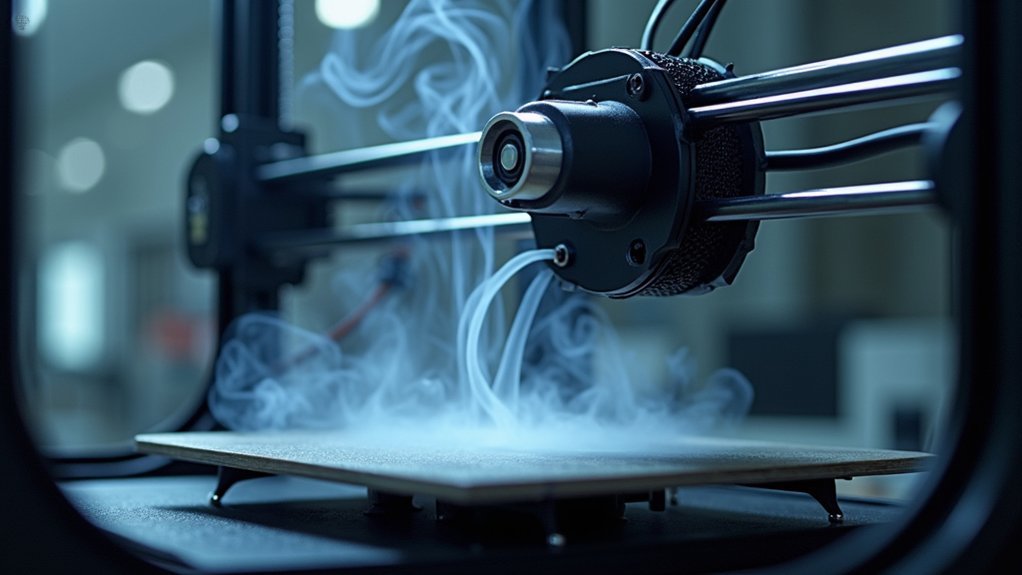
When you fire up your 3D printer, it doesn’t just melt plastic—it releases a cocktail of volatile organic compounds and ultrafine particles into your workspace.
These 3D printer emissions include harmful chemicals like styrene, ethylbenzene, and acetaldehyde that can cause respiratory irritation, headaches, and eye discomfort.
Related guide: Best Resin Funnel and Filter Sets for Clean Resin Transfers
The health risks vary depending on your filament choice. ABS produces markedly more dangerous VOCs than PLA, though even PLA isn’t completely harmless.
NIOSH specifically warns that these fumes pose serious health threats, especially in poorly ventilated areas where emissions accumulate.
While long-term effects remain uncertain, you shouldn’t wait to find out.
That’s where activated carbon filters become essential—they’re your first line of defense against these invisible but potentially dangerous airborne contaminants.
What Makes Carbon Filters Essential for 3D Printing Safety
Carbon filters work by leveraging the unique properties of activated carbon to trap the very chemicals that make 3D printing dangerous. When you’re printing, especially with materials like ABS, your workspace fills with VOCs that pose serious health risks.
Activated Carbon Air filtration systems address this problem through their porous structure, which creates an enormous surface area for capturing these toxic molecules before they reach your lungs.
What makes these filters essential is their ability to complement HEPA filters in thorough air filtration systems. While HEPA handles particles, carbon tackles gaseous pollutants.
You’ll need different replacement schedules depending on your filament—PLA filters last 500+ hours, while ABS requires six-month replacements. This proactive approach protects your health and creates safer printing environments.
How Activated Carbon Adsorption Captures Harmful VOCs
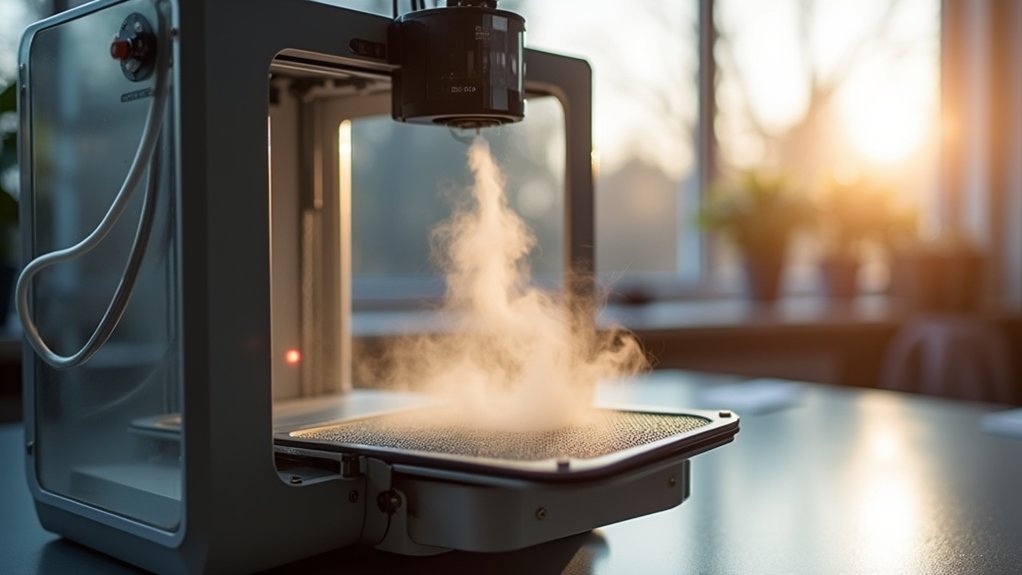
Adsorption—the process where molecules stick to a surface—transforms activated carbon into a powerful weapon against 3D printing’s toxic emissions.
Your activated carbon filter’s porous structure creates an enormous surface area that traps harmful VOCs like styrene and formaldehyde released from ABS and PLA filaments.
When you position your fume extractor close to your printer, the activated carbon works by attracting and holding chemical molecules within its microscopic pores.
This process considerably reduces dangerous compounds floating in your workspace air, dramatically improving air quality in confined spaces.
You’ll maximize capture efficiency by maintaining proper airflow and regularly replacing filters.
The closer your carbon filter sits to emission sources, the more effectively it’ll grab those harmful VOCs before they spread throughout your printing environment.
Types of Carbon Filtration Systems for 3D Printers
Your choice of carbon filtration system determines how effectively you’ll capture harmful emissions from your 3D printer. You can select from standalone activated carbon filters specifically designed for 3D printers, which easily integrate into printer enclosures for improved air quality.
These systems excel at removing volatile organic compounds (VOCs) and odors from materials like ABS and PLA.
For thorough protection, you’ll find hybrid systems that combine activated carbon with HEPA filters, capturing both harmful fumes and particulate matter simultaneously.
Many commercial printer enclosures come with built-in activated carbon filters, providing immediate emission management in confined spaces.
Each system type offers different advantages, so you’ll need to evaluate your specific printing materials, workspace requirements, and budget when making your selection.
Comparing Carbon Filters With HEPA and Other Filtration Methods
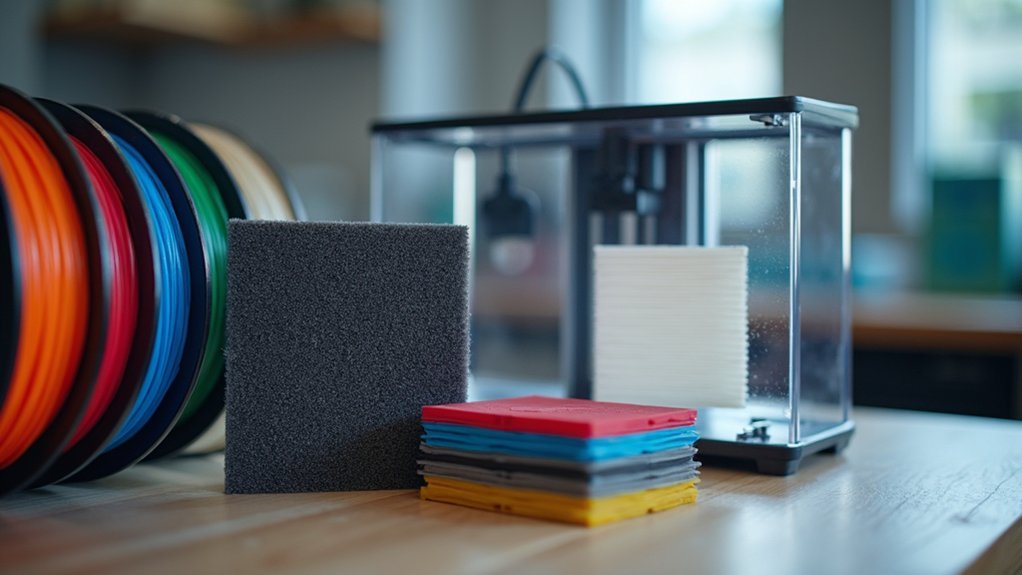
While HEPA filters excel at trapping microscopic particles down to 0.3 microns, they can’t capture the volatile organic compounds and chemical fumes that make 3D printing potentially hazardous.
That’s where carbon filters become essential for your printing environment. Carbon filters specialize in adsorbing VOCs and odors through their porous activated carbon structure, particularly effective against ABS emissions.
Carbon filters use activated carbon’s porous structure to adsorb volatile organic compounds and odors from ABS printing emissions.
However, you shouldn’t choose one over the other. The most effective approach combines both filtration methods since each addresses different pollutants.
HEPA filters handle dust, allergens, and particulates, while carbon filters tackle gaseous emissions and unpleasant smells.
This dual-filter system guarantees thorough air purification, protecting you from both visible particles and invisible chemical vapors that standard HEPA filters simply can’t remove.
Selecting the Right Carbon Filter for Your 3D Printer Setup
When choosing a carbon filter for your 3D printer, you’ll need to match the filter’s capabilities to your specific printing materials and setup requirements.
Carbon filters effectively remove harmful VOCs from the air and eliminate fumes produced during printing.
Here’s what you should prioritize when selecting your filter:
- Material compatibility – Choose filters specifically designed for your filament types, as ABS generates more VOCs than PLA.
- Adsorption capacity – Look for activated carbon filters with high capacity ratings to guarantee they’ll trap harmful chemicals effectively.
- System integration – Verify the filter fits your printer’s ventilation system, whether built-in or external.
Consider combining carbon filters with HEPA filters for complete protection.
Replace PLA filters after 500+ hours of use, while ABS filters need replacement every six months due to higher emissions.
Proper Installation and Positioning of Carbon Filter Systems
After selecting the appropriate carbon filter, proper installation becomes crucial for achieving peak protection against harmful emissions.
You’ll want to position your carbon filters as close to the fume source as possible to maximize VOC capture effectiveness. Confirm you’ve securely mounted the filter within an enclosure or fume extractor system to prevent unfiltered air from leaking back into your workspace.
Always check the airflow direction indicated on your filter unit during proper installation. Incorrect orientation will greatly hinder filtration performance.
You’ll need to maintain sufficient airflow around your filter system to prevent clogging and guarantee ideal fume adsorption. This might require installing additional fans if necessary.
Follow your manufacturer’s guidelines for installation and maintenance to make certain your carbon filter system operates effectively throughout its intended lifespan.
Maintenance Schedule and Replacement Guidelines for Carbon Filters
Proper installation sets the foundation, but maintaining your carbon filter system determines its long-term effectiveness in protecting your workspace from harmful emissions.
Establishing replacement guidelines based on your printing habits guarantees consistent VOCs removal and peak air quality.
Your maintenance schedule should follow these key intervals:
- ABS and high-emission materials: Replace carbon filters every six months due to increased VOC exposure.
- PLA and low-emission filaments: Filters typically last 500+ hours or up to one year.
- Regular inspections: Check monthly for visible dirt, saturation signs, or reduced airflow.
Document each replacement date and track your printer’s operational hours.
This documentation helps you anticipate future maintenance needs and guarantees timely filter changes.
Regular monitoring prevents filter saturation and maintains your filtration system’s protective capabilities.
Effectiveness of Carbon Filters With Different Filament Materials
While all 3D printing materials benefit from carbon filtration, your filter’s effectiveness varies greatly depending on which filament you’re using.
Carbon filters excel at capturing VOCs, but different materials produce vastly different emission levels. When you’re printing with PLA filament, you’ll find carbon filters highly effective since PLA produces minimal VOCs, allowing filters to maintain peak performance for extended periods.
However, ABS presents a greater challenge due to its considerably higher VOC emissions, including harmful compounds like styrene and formaldehyde. Your carbon filter will work harder when processing ABS fumes, requiring more frequent replacement to maintain effectiveness.
For resin printing, carbon filters become absolutely essential, capturing dangerous irritants and allergens that could otherwise cause serious respiratory issues.
Combining Carbon Filtration With Proper Ventilation Strategies
You’ll maximize your 3D printing safety by strategically combining carbon filters with both passive and active ventilation systems.
Your filter placement directly impacts how effectively toxic fumes get captured before they spread throughout your workspace.
You’ll need to coordinate maintenance schedules between your filters and ventilation components to guarantee consistent protection against harmful VOCs.
Passive Vs Active Systems
When it comes to maintaining safe air quality during 3D printing, you’ll need to choose between passive and active ventilation systems—or better yet, combine both approaches with carbon filtration for peak effectiveness.
Passive systems depend on natural airflow to dilute fumes, while active systems use fans to forcefully expel emissions.
Here’s how they work with carbon filters:
- Passive systems provide basic protection by allowing natural air circulation to disperse VOCs gradually throughout your workspace.
- Active systems rapidly remove contaminants using powered fans, delivering faster air turnover and more effective emission control.
- Carbon filters excel at adsorbing VOCs from both systems, greatly reducing harmful particle concentrations.
You’ll achieve ideal results by integrating both strategies with carbon filtration.
Remember that regular maintenance and monitoring of your chosen system guarantees continued effectiveness in protecting your health.
Filter Placement Optimization
Strategic placement of your carbon filters can dramatically improve their effectiveness and work hand-in-hand with your ventilation setup to create ideal air quality.
Position your filters as close to the printer’s exhaust port as possible to capture VOCs and ultrafine particles right at the source. This filter placement optimization prevents harmful emissions from dispersing throughout your workspace.
Combine your carbon filters with active ventilation systems like exhaust fans to maintain continuous fresh airflow.
If you’re using an enclosed printer, verify it has both filtration components and ventilation openings that create balanced airflow patterns.
Monitor your setup with VOC sensors to fine-tune placement and ventilation adjustments.
The combination of passive and active strategies with strategically positioned carbon filters greatly reduces harmful particle concentrations.
Maintenance Schedule Coordination
Since carbon filters and ventilation systems work together as an integrated safety network, you’ll need to coordinate their maintenance schedules to sustain peak performance.
Your integrated approach should follow these essential steps:
- Monthly inspections – Check carbon filters alongside HEPA filters and ventilation components, examining for dust buildup and evaluating air quality through monitors.
- Replacement timing – Replace carbon filters every 6 months for ABS materials, while PLA filters can last up to a year or 500+ hours of use.
- System-wide maintenance – Coordinate filter changes with fan and duct cleaning to guarantee efficient airflow for effective fume extraction.
Air quality monitors help you determine when both carbon and HEPA filters need attention, preventing safety compromises and maintaining ideal performance across your entire filtration system.
Measuring Air Quality Improvement With Carbon Filter Implementation
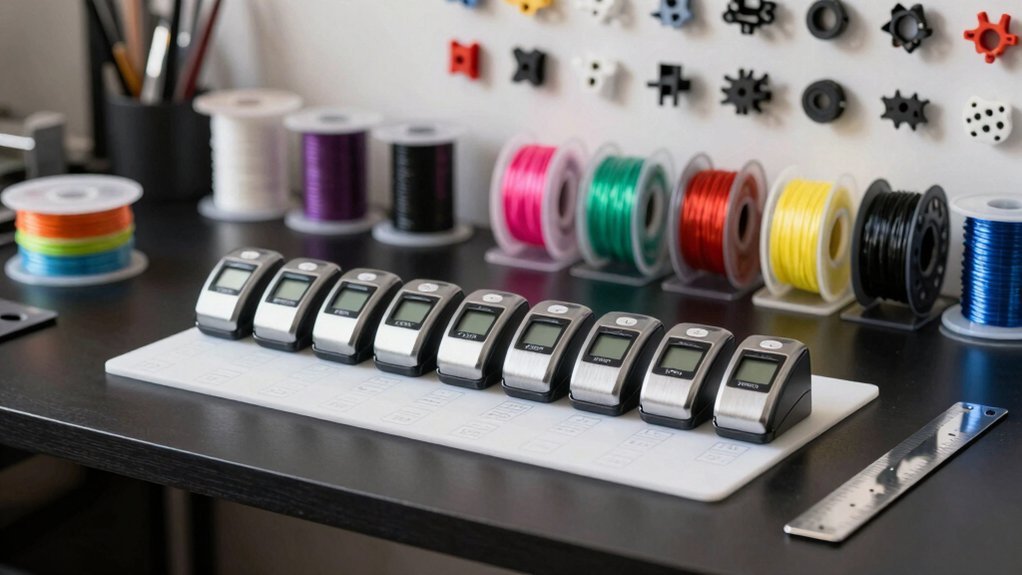
How can you determine if carbon filters are actually improving your 3D printing workspace’s air quality? Air quality monitors provide the most reliable method for tracking VOC levels before and after installing carbon filters in your printing process.
These devices deliver quantifiable data showing real improvements in air safety, with studies demonstrating up to 90% reduction in airborne contaminants when activated carbon filters are properly implemented.
You’ll want to establish baseline measurements before filter installation, then monitor continuously during printing operations. The data will clearly show how effectively your carbon filters capture harmful substances like styrene and formaldehyde.
For thorough results, consider combining carbon filtration with HEPA systems to address both VOCs and fine particulate matter, creating measurable improvements across all air quality parameters.
Frequently Asked Questions
Is a Carbon Filter Enough for 3D Printing?
You shouldn’t rely on carbon filters alone for 3D printing safety. They’ll capture VOCs and odors but won’t remove fine particles. You’ll need HEPA filters too for thorough protection against all harmful emissions.
Are Carbon Filters Safe?
You’ll find carbon filters are safe when you maintain them properly. They don’t release harmful substances while filtering VOCs and fumes. You should replace them regularly to guarantee they’re working effectively and safely.
Is 3D Printing Carbon Fiber Safe?
You’ll face respiratory risks when 3D printing carbon fiber without proper precautions. You must use enclosed setups with activated carbon filters, wear protective masks, and maintain ventilation systems to safely print with these materials.
What Are the Benefits of Carbon Filter?
You’ll breathe cleaner air as carbon filters trap harmful VOCs and odors from your workspace. They’re especially effective in enclosed areas, improving safety and comfort while you work with various materials and chemicals.