
To maximize your 3D printing ROI, start by targeting high-value parts that are expensive to produce traditionally or need frequent design revisions. Calculate your true ownership costs including materials ($20-$500/kg), labor ($20-$50/hour), and annual maintenance (15-20% of investment). Leverage time-to-market benefits by compressing development cycles from months to weeks. Choose the right technology—FDM for prototyping, SLS for precision. Plan for scalability by analyzing departmental needs and future growth. These strategic approaches will reveal substantial profit potential.
Identify High-Value Parts and Applications for Maximum Cost Savings
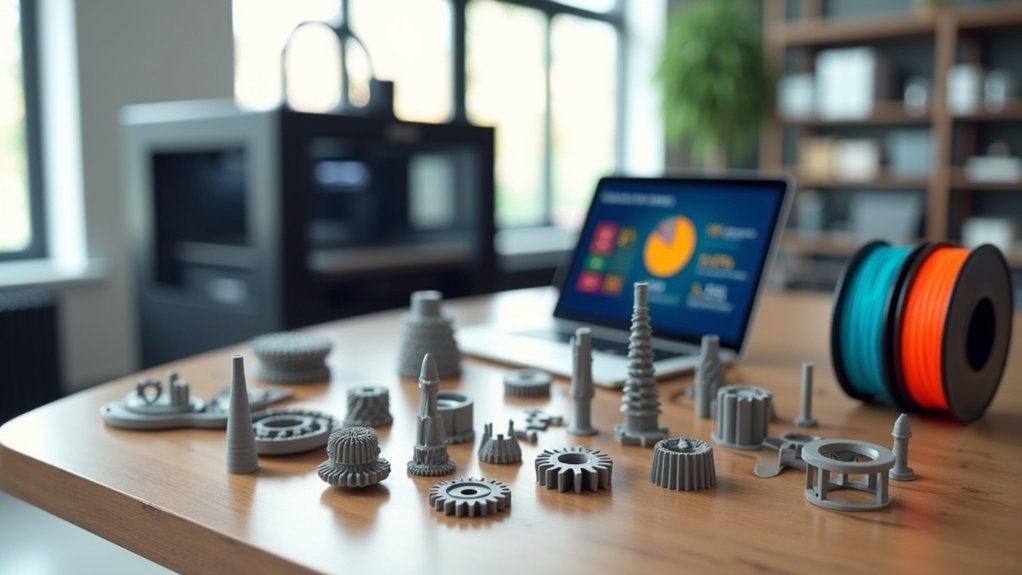
When evaluating your current manufacturing processes, you’ll find the greatest 3D printing ROI by targeting parts that are expensive or challenging to produce through traditional methods.
Focus on components requiring frequent design revisions or custom elements, where additive manufacturing eliminates costly tooling changes and accelerates iterations.
Analyze your legacy part files to compare current production costs and lead times against 3D printing alternatives.
High-value parts sourced overseas often present significant cost-saving opportunities when brought in-house.
Consider components used in critical projects where reduced lead times translate to improved efficiency.
Calculate True Cost of Ownership Including Materials, Labor, and Equipment
Beyond the initial sticker price of your 3D printer, calculating true cost of ownership requires a thorough analysis of all expenses that’ll impact your bottom line.
Variable costs like materials range from $20 to $500 per kilogram depending on filament type. Labor expenses for setup, monitoring, and operations typically cost $20-$50 hourly based on technician expertise.
Equipment maintenance adds 15-20% of your initial investment annually. Post-processing dramatically affects production cost, adding 30-50% per part for cleaning, finishing, and inspection.
Don’t overlook overhead expenses including utilities, facility space, and depreciation, which contribute an additional 10-30% to total ownership costs.
Understanding these detailed expenses guarantees accurate ROI calculations.
Analyze Time-to-Market Benefits and Lead Time Reductions
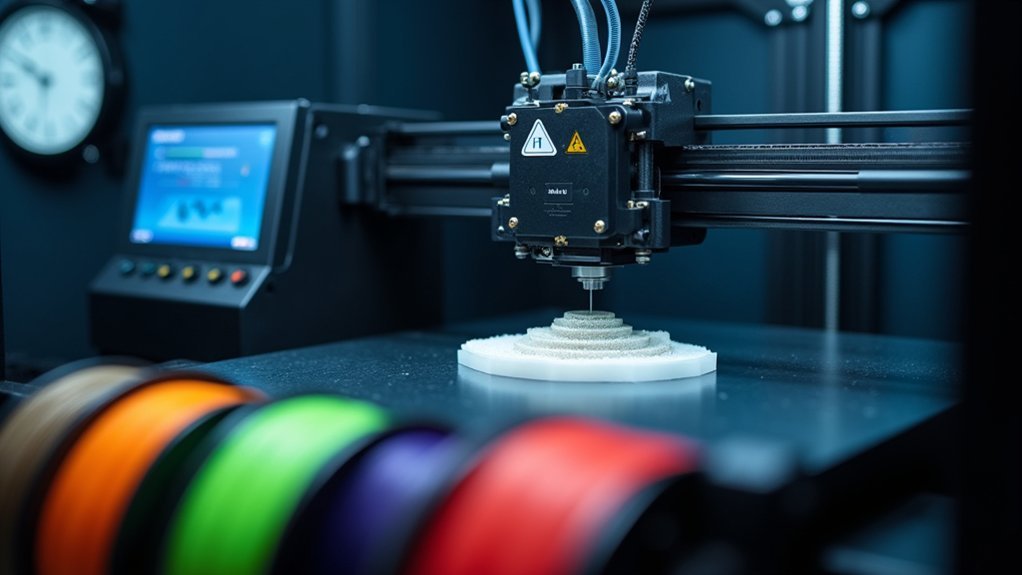
While traditional manufacturing locks you into lengthy production schedules, 3D printing transforms your time-to-market strategy by compressing development cycles from months to weeks.
You’ll achieve considerable lead time reductions by producing prototyping components in-house, eliminating overseas shipping delays that traditionally add weeks to production timelines.
Additive manufacturing enables rapid design modifications without expensive tooling changes, accelerating your project efficiency dramatically.
You can complete design revisions in days rather than weeks, enhancing responsiveness to market demands. This 3D printing technology gives you a competitive edge by launching products sooner in dynamic markets.
Your revenue potential increases remarkably when you capitalize on emerging trends faster than competitors.
Choose the Right 3D Printing Technology for Your Production Needs
How do you determine which 3D printing technology will enhance your production ROI? Start by matching additive manufacturing capabilities to your specific production needs.
FDM works best for rapid prototyping, while Selective Laser Sintering delivers precision for complex geometries. Markforged’s Continuous Filament Fabrication produces strong composite parts when mechanical strength matters most. HP Jet Fusion offers fast production speeds and eliminates support structures, boosting efficiency through complex part nesting.
Evaluate operational ease and installation requirements against your team’s capabilities. Consider design flexibility requirements – some technologies handle intricate geometries better than others.
Generate accurate cost estimates using tools like 3DP ROI calculators that factor in machine specifications and part geometry. Don’t forget to assess long-term maintenance costs and material availability when making your final technology selection for ideal 3D printing ROI.
Plan for Scalability and Future Growth Opportunities

Since successful 3D printing implementations often trigger exponential growth in internal demand, you’ll need to assess your organization’s scalability requirements before investing in equipment.
Analyze potential print requests from various departments to guarantee your additive manufacturing solutions can handle increased production capacity. Consider integrating multiple 3D printing technologies to address diverse production needs while maintaining workflow efficiency.
Develop a facility layout that accommodates future expansion and aligns with your long-term objectives.
Plan for 5-10 year growth by evaluating upcoming projects that’ll heavily utilize these technologies. Investment alignment becomes critical when balancing current requirements with future growth opportunities.
Stay informed about industry trends and technological advancements to identify new possibilities for innovation and guarantee your scalability planning remains relevant to evolving market demands.
Frequently Asked Questions
What’s a Good Profit Margin for 3D Printing?
You’ll want to target a 30% to 50% profit margin for 3D printing. This range accounts for material costs, labor expenses, and market competitiveness while ensuring you’re maintaining sustainable profitability in your business.
What Is the Most Profitable Thing to 3D Print?
You’ll find customizable products like personalized phone cases most profitable since they’re unique and cater to individual preferences. Replacement parts for hard-to-find components also command premium prices from desperate customers.
What Is ROI in 3D Printing?
You’ll calculate ROI in 3D printing by comparing your cost savings and revenue gains against initial equipment investments. You’re measuring reduced material costs, labor expenses, lead times, and tooling savings versus traditional manufacturing methods.
Is 3D Printing a Profitable Business?
You’ll find 3D printing profitable when targeting high-value geometries and custom parts. You can reduce material costs, accelerate time-to-market, and achieve typical five-year payback periods on equipment investments.