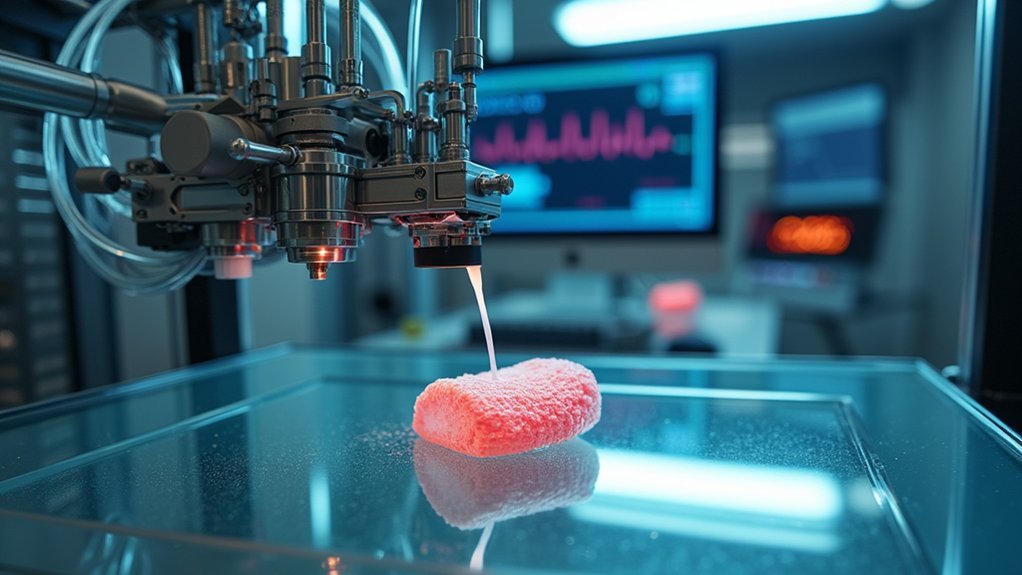
Bioprinted organ replacement becomes possible through specialized bio-ink that combines your living cells with biocompatible materials like collagen and gelatin. Advanced 3D printing techniques precisely deposit these cellular materials layer by layer, while digital blueprints from your MRI or CT scans guarantee perfect anatomical matching. Bioreactor systems then nurture the printed organs with nutrient-rich solutions and mechanical stimulation, helping them develop into functional replacements. The breakthrough lies in solving vascularization challenges through innovative printing methods that create blood vessel networks, making transplantable organs a reality that’ll transform medicine completely.
The Science Behind Bio-Ink and Cellular Materials
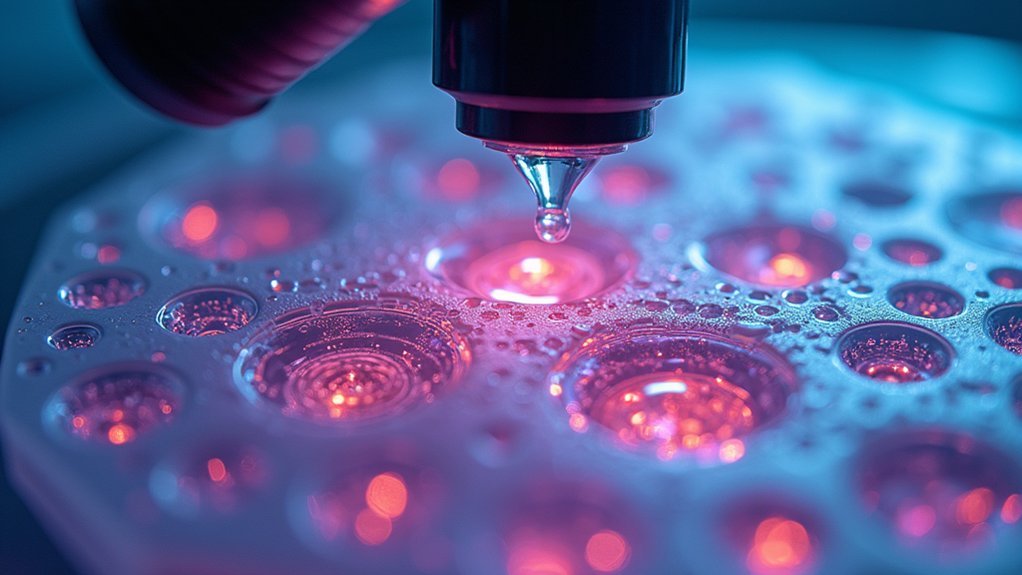
When scientists began developing bioprinting technology, they quickly realized that traditional printing materials wouldn’t work for creating living tissues. You need specialized bio-ink—a low-viscosity suspension that combines viable cells with biocompatible materials. This allows for precise deposition during 3D printing processes.
Natural polymers like collagen, fibrin, gelatin, and alginate are your go-to materials because they excel at promoting cell attachment and growth.
Natural polymers serve as ideal bio-ink foundations, excelling at cellular attachment and growth promotion in bioprinting applications.
However, you’ll find that composite bio-inks combining natural and synthetic polymers often work better, improving both printability and functionality.
The materials you choose directly impact cellular interaction and tissue functionality. Nanoscale features within your bio-ink scaffolds influence how cells attach and differentiate, ultimately determining whether your bioprinted tissues develop properly and function as intended.
Advanced 3D Bioprinting Techniques and Technologies
While traditional 3D printing revolutionized manufacturing, bioprinting takes this technology into uncharted territory by working with living cells and biomaterials to construct functional tissues layer by layer. Advanced 3D bioprinting techniques utilize specialized bio-ink containing living cells, enabling precise tissue engineering for organ transplantation applications.
| Technique | Key Feature | Application |
|---|---|---|
| Extrusion-based | Precise bio-ink deposition | Complex tissue structures |
| Laser-assisted | High-resolution cell placement | Intricate vascular networks |
| SWIFT method | Dense tissue creation | Thick functional organs |
| Continuous Optical | Rapid cell culturing | Fast organ development |
These methods create intricate vascular networks essential for organ functionality while promoting proper cell differentiation. Nanoscale scaffold features considerably influence cellular behavior, enhancing attachment and proliferation necessary for successful bioprinted organ replacement.
Digital Blueprint Creation and Patient-Specific Modeling
You’ll need precise digital blueprints that integrate advanced medical imaging like MRI and CT scans to create accurate 3D models of your anatomy.
This personalized modeling approach guarantees your bioprinted organ matches your unique dimensions and biological requirements perfectly.
Through careful digital design optimization, you’re getting an organ that’s specifically engineered for your body’s architecture and cellular composition.
Medical Imaging Integration
Precision drives every successful bioprinting endeavor, and that precision begins with capturing the exact anatomical blueprint of your organ through advanced medical imaging. MRI and CT scans create detailed digital models that reveal your organ’s geometry, size, and structural complexity.
These patient-specific models enable clinicians to customize bioprinted organs matching your unique biological requirements, potentially improving transplant outcomes.
Medical imaging integration enhances 3D bioprinting’s ability to replicate essential vascular networks, addressing tissue engineering’s major challenge of organ viability. The detailed blueprints guide precise placement of blood vessels throughout the printed structure.
Continuous advancements in imaging technologies streamline the workflow from diagnosis to organ printing, accelerating bioprinted organs’ movement from laboratory research to clinical settings where they’ll save lives.
Personalized 3D Modeling
Building on these imaging foundations, personalized 3D modeling transforms your captured anatomical data into a precise digital blueprint that serves as the roadmap for bioprinting. This bioprinting technology creates customized organs tailored to your anatomical and physiological needs, dramatically improving transplant success rates.
| Traditional Approach | Personalized 3D Modeling |
|---|---|
| Generic organ sizing | Custom-fitted dimensions |
| Higher organ rejection risk | Reduced rejection with patient’s own cells |
| Limited compatibility | Enhanced biological integration |
| Standard architecture | Patient-specific structure |
Your digital blueprint guides the precise layering of bio-ink containing your patient’s own cells, creating living tissue that closely matches your natural organ structure. This personalization minimizes organ rejection while accelerating the development timeline, bringing viable bioprinted organs closer to clinical reality within the next decade.
Digital Design Optimization
Once your personalized 3D model captures the anatomical foundation, digital design optimization transforms this raw data into a sophisticated blueprint that directs every aspect of the bioprinting process.
You’ll find that this optimization guarantees anatomical accuracy by refining the layer-by-layer construction parameters that guide bioprinting technologies.
Through patient-specific modeling, you’re creating a blueprint that enhances biological compatibility, dramatically reducing rejection risks and improving transplant outcomes.
The optimization process integrates complex features like vascular network pathways, which are essential for proper nutrient and oxygen distribution throughout your bioprinted organ.
As software and modeling technologies advance, you’ll see increasingly sophisticated digital design optimization that brings us closer to successfully bioprinting complex organs for life-saving transplantation procedures.
Bioreactor Systems for Organ Maturation and Growth
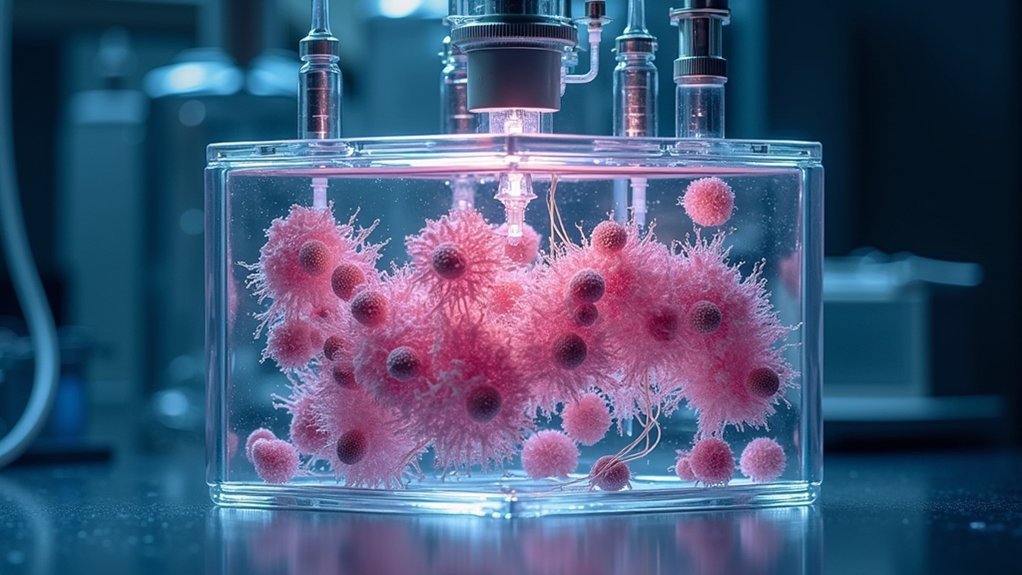
Once you’ve created your bioprinted organ, you’ll need sophisticated bioreactor systems to nurture it into a functional replacement.
These systems pump nutrient-rich solutions through your developing tissue while applying carefully controlled mechanical forces that mimic natural body conditions.
You’re fundamentally creating an artificial womb where your bioprinted organ can mature, develop proper cell networks, and gain the structural integrity needed for successful transplantation.
Perfusion Systems for Nutrients
When bioprinted organs move beyond simple tissue constructs, they’ll need sophisticated perfusion systems to survive and mature into functional replacements.
These systems address bioprinting’s biggest challenge: keeping cells alive in thick tissues where nutrients can’t naturally diffuse.
Perfusion bioreactor technology creates continuous flow networks that mimic your body’s vascular system. The controlled circulation delivers oxygen and essential nutrients while removing cellular waste, maintaining ideal cell viability throughout tissue development.
Advanced perfusion systems offer three critical advantages:
- Dynamic flow patterns that enhance nutrient delivery to dense tissue regions
- Continuous waste removal preventing toxic buildup that kills cells
- Scalable vascularization enabling larger, more complex organ structures
Research demonstrates that bioprinted tissues in perfusion bioreactors remain functional considerably longer than static cultures, making organ replacement increasingly viable.
Mechanical Stimulation Methods
While perfusion systems deliver essential nutrients, bioprinted organs require mechanical stimulation to develop the structural integrity and functional properties needed for successful transplantation.
You’ll find that bioreactor systems employ cyclic stretching and shear stress to mimic natural organ movement, promoting cellular alignment within engineered tissues. This bioprinting method enhances your tissue’s functionality by influencing gene expression and improving tissue development.
When you apply dynamic mechanical loads, bioprinted constructs produce increased collagen and develop stronger mechanical properties.
Advanced bioreactor systems create complex tissue architectures with embedded vascular networks, optimizing the extracellular matrix formation.
You’ll achieve better integration with host biological systems through these mechanical stimulation techniques, ensuring your bioprinted organs develop the durability required for successful transplantation.
Overcoming Vascularization and Functionality Challenges
Although 3D bioprinting has made remarkable strides in recent years, creating functional organs that can truly replace damaged human tissue requires solving one of the field’s most complex puzzles: vascularization.
Without proper vascular networks, your engineered tissues can’t survive beyond a few millimeters thick.
Scientists are tackling this challenge through innovative approaches:
- Sacrificial bioinks that dissolve to create hollow channels mimicking natural blood vessels
- Coaxial bioprinting techniques that form intricate vascular pathways during the printing process
- Composite bioinks blending natural and synthetic polymers to enhance cell attachment and functionality
These breakthroughs have enabled successful bioprinting of living heart tissues and complex liver structures, proving that overcoming vascularization challenges makes viable organ replacement increasingly achievable for future medical applications.
Current Applications and Future Timeline for Clinical Implementation
Beyond laboratory breakthroughs, bioprinting technology has already begun shifting from experimental research to real-world medical applications.
You’ll find that 3D bioprinting has successfully created functioning heart tissues, heart valves, and complex liver structures. In June 2022, 3DBio Therapeutics achieved a major milestone by implanting a bioprinted ear in a clinical trial, demonstrating real-world viability.
You can expect simpler living organs to enter clinical trials within the next decade, while complex organs requiring sophisticated vascular networks may take 15-20 years.
These advances in tissue models are driving a rapidly growing market, valued at $2 billion in 2022 with projected 12.5% annual growth. This timeline offers hope for addressing organ donation shortages through engineered organ replacement solutions.
Frequently Asked Questions
Could Bioprinted Organs Be Used for Transplants?
You’ll likely see bioprinted organs used for transplants, but you’re looking at waiting another 10-20 years. They’re showing promise in reducing rejection since they’d use your own cells.
What Problem Does This Solution Address Bioprinter Organs Made to Order?
You’re facing a critical organ shortage crisis where over 104,000 people await transplants and 17 die daily. Bioprinted organs eliminate waiting lists, reduce rejection risks, and provide personalized solutions using your own cells.
What Organs Have Been Bioprinted Successfully?
You’ve seen successful bioprinting of skin tissues for burn patients, heart valves using umbilical cord cells, living heart tissues with cardiomyocytes, complex liver structures with hepatocytes, and complete rabbit-sized hearts with chambers and vessels.
Why Can’t They Make Artificial Organs?
You can’t create artificial organs because current technology struggles to replicate complex vascular networks, maintain cell viability, and develop suitable biomaterials that mimic natural tissue environments effectively.