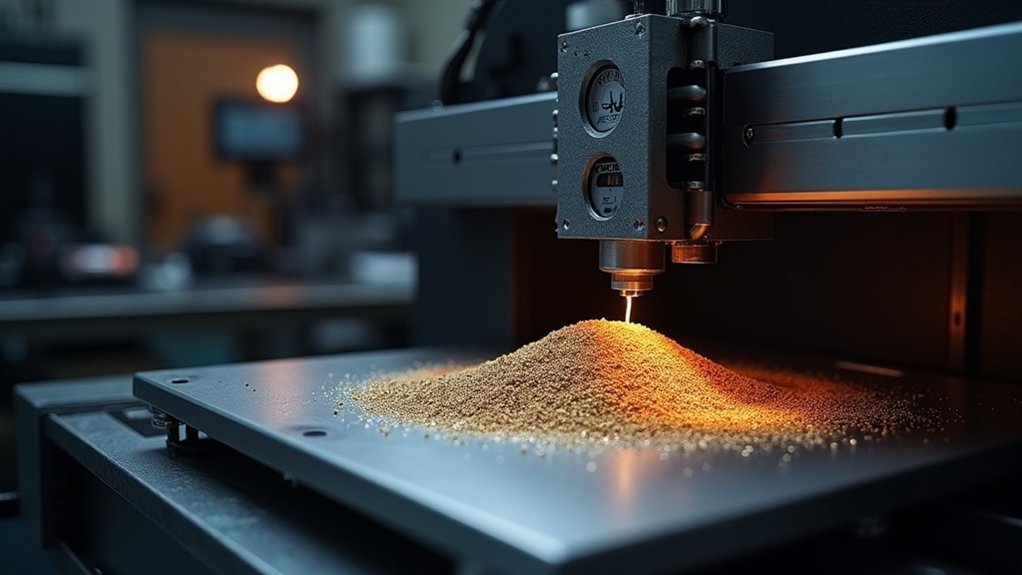
You’ll need ideal temperature control around 500°C to guarantee proper particle flow and strong layer bonding in your metal printing process. Uniform heat distribution across the entire powder bed is essential to prevent quality-degrading thermal gradients and achieve consistent sintering results. Additionally, you must maintain an inert atmosphere through argon flooding to prevent oxidation that can compromise your metal powder’s flowability and chemical stability. Master these fundamentals to release advanced thermal management strategies.
Optimal Temperature Control for Enhanced Particle Flow and Layer Bonding
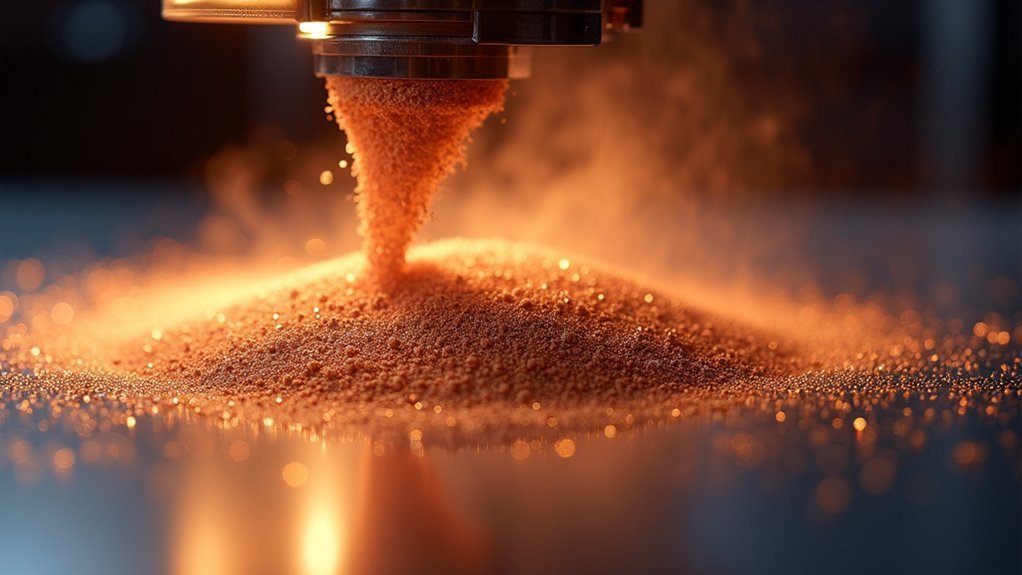
When you’re preheating your powder bed for metal printing, achieving ideal temperature control around 500°C dramatically improves particle flow and creates the thermal conditions necessary for superior layer bonding.
Optimal temperature control reduces thermal gradients that can compromise your part’s integrity during additive manufacturing. By maintaining consistent preheating temperatures, you’ll enhance powder particles’ consolidation, resulting in higher density components with mechanical properties that match conventionally manufactured parts.
This controlled thermal environment minimizes pore formation while ensuring uniform sintering across your entire powder bed. Additionally, effective preheating strategies greatly reduce residual stress and distortion in your final parts.
You’ll find that proper temperature management is particularly essential when producing complex geometries where thermal inconsistencies can severely impact part quality and dimensional accuracy.
Uniform Heat Distribution Across the Powder Bed Surface
Building on proper temperature control, uniform heat distribution across your powder bed surface becomes the foundation for consistent sintering results in Electron Beam Powder Bed Fusion (EB-PBF).
Traditional line-ordering approaches in your preheating scheme often neglect previously built layers, creating heterogeneous temperature distribution that compromises sintering quality.
Neglecting thermal history of existing layers during preheating results in uneven temperature zones that degrade final part quality.
You’ll need to implement local energy input adjustments that compensate for varying thermal conductivity across different areas.
GPU-parallelized thermal models can optimize your temperature distribution during preheating, tailoring energy delivery for maximum efficiency.
- Adjust energy input based on thermal conductivity variations
- Use GPU modeling to predict temperature patterns
- Modify preheating schemes to account for existing layers
- Monitor heat distribution continuously during powder bed fusion
- Optimize process performance through targeted thermal management
This approach enhances your additive manufacturing outcomes, producing higher-quality metal parts.
Oxidation Prevention and Chemical Stability During Processing
Why does your carefully preheated powder bed still produce inconsistent results despite achieving uniform temperature distribution? The answer lies in oxidation and chemical stability issues that compromise your metal powders during processing.
When reactive metals encounter oxygen and moisture, they’ll form oxide layers that dramatically affect flowability and bonding characteristics, leading to poor layer formation and reduced part quality.
You’ll need to implement argon flooding in your process chamber to maintain an inert gas environment. This approach considerably reduces residual oxygen and moisture content, preserving the chemical stability of your metal powders.
Additionally, store your powders in sealed containers with inert gas purging, and regularly test oxygen levels after recycling cycles. These processing parameters guarantee consistent powder performance and ideal printing results.
Frequently Asked Questions
What Are the Atomization Processes of Metal Powders for 3D Printing?
You’ll encounter four main atomization processes: gas atomization creates spherical particles using high-pressure gas, water atomization produces irregular shapes, mechanical atomization uses physical forces, and plasma atomization generates high-quality spherical powders.
What PPE Is Needed for Metal Powder?
You’ll need safety goggles, N95 respirators, cut-resistant gloves, long-sleeved clothing, and lab coats when handling metal powders. Don’t forget proper ventilation systems to remove airborne particles and protect yourself from inhalation risks.
Which Metal Powders Is Commonly Used in Powder Bed Fusion 3D Printing Processes?
You’ll commonly use titanium alloys like Ti-6Al-4V, aluminum alloys such as AlSi10Mg, stainless steels like 316L, and nickel-based superalloys including Inconel 718 in powder bed fusion processes.
How to Make Metal Powder for 3D Printing?
You’ll create metal powder through atomization by dispersing molten metal with gas or water jets. Then you’ll sieve particles to achieve 15-100 micron sizes and store them in inert environments.