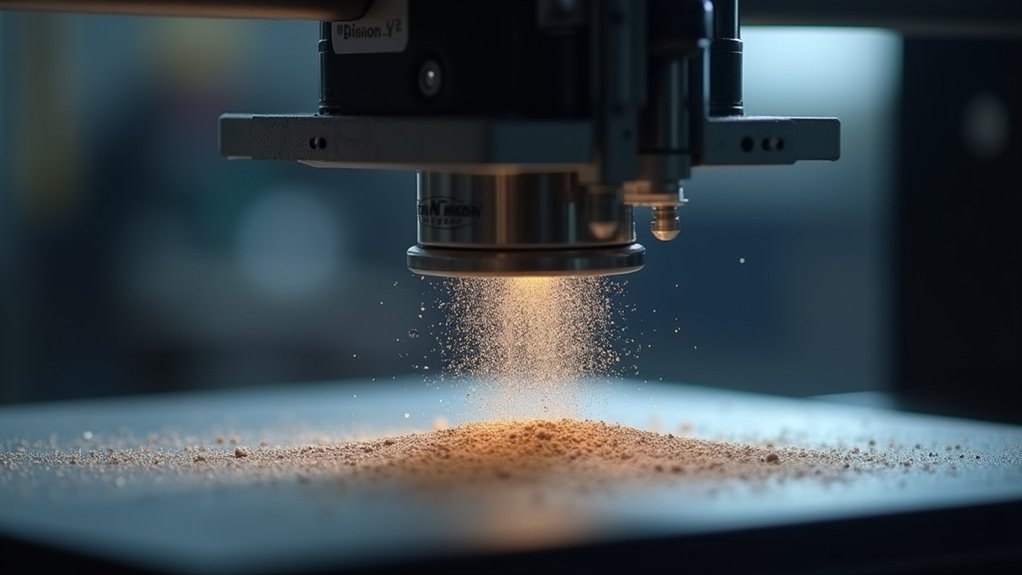
You’ll achieve superior metal 3D printing results by maintaining consistent powder bed height through precise recoater gap adjustments, controlling humidity below 40% with sealed storage solutions, and optimizing spreading mechanism speed between 0.2-0.5 bar pressure. Monitor for powder clumps during recoating, calibrate equipment regularly using measurement tools, select finer particle sizes for improved coverage, and store powders in airtight containers with desiccants. Master these techniques to discover advanced strategies for flawless powder distribution.
Maintain Consistent Powder Bed Height for Uniform Distribution
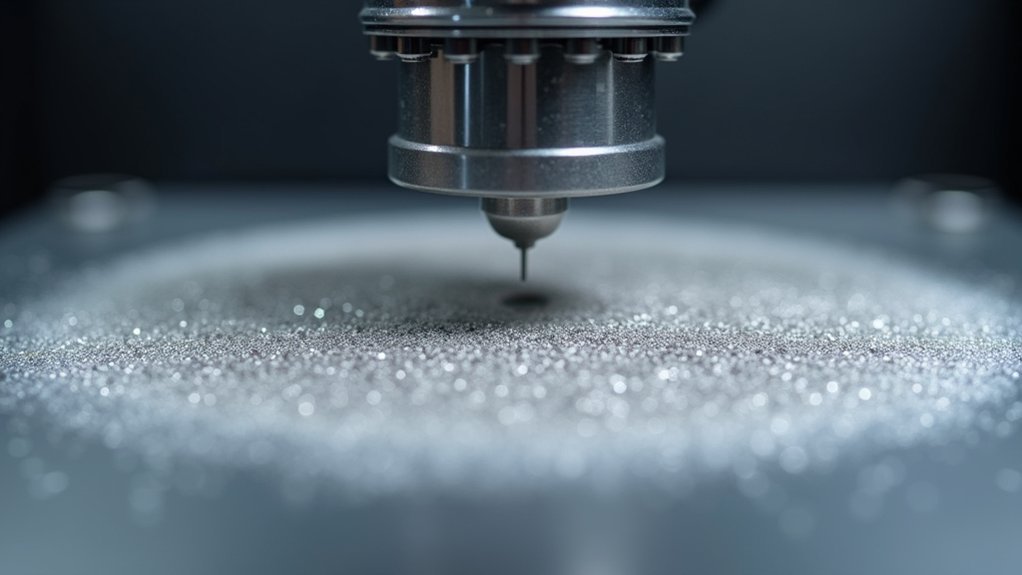
When you’re operating a metal 3D printer, maintaining consistent powder bed height stands as one of the most critical factors for achieving uniform distribution across your build platform.
Variations in your powder bed create uneven coverage that directly impacts part density and compromises print quality. You’ll need to refine the ideal height based on your metal powder’s particle size distribution and specific material properties to guarantee effective spreading.
Powder bed inconsistencies directly compromise part density and print quality, requiring height optimization based on particle distribution and material properties.
Focus on implementing precise recoater gap height adjustments to manage your powder bed effectively and facilitate better flow coverage.
Monitor surface roughness carefully, as it must align with your best powder bed height to enhance spreading performance. Rougher surfaces often require tailored recoating strategies to maintain consistency throughout the printing process.
Control Environmental Conditions to Prevent Moisture Absorption
You’ll need to actively monitor humidity levels in your printing environment to keep them below 40% and prevent powder clumping.
Store your metal powders in airtight containers with desiccants to block moisture exposure between print jobs.
Consider installing a dehumidification system in your workspace to maintain consistent environmental conditions that preserve powder flowability.
Humidity Level Monitoring
Although metal powders appear stable at room temperature, moisture in the air silently sabotages their flowability and spreading characteristics.
You’ll need to actively monitor humidity levels to maintain ideal printing conditions. Install hygrometers throughout your workspace to track real-time moisture levels and guarantee they stay below 40% relative humidity.
Regular monitoring allows you to catch humidity spikes before they affect your metal powder performance. When levels climb above recommended thresholds, moisture absorption causes powder clumping and inconsistent spreading patterns.
You should also test your metal powder’s moisture content directly using specialized equipment.
Deploy dehumidifiers strategically around your printing area to maintain stable environmental conditions. This proactive approach prevents costly print failures and guarantees consistent part quality throughout your additive manufacturing process.
Sealed Storage Solutions
Since moisture remains the primary enemy of metal powder quality, implementing robust sealed storage solutions becomes your most effective defense against contamination.
You’ll need airtight containers equipped with desiccants to maintain consistently low humidity levels around your metal powders. This approach proves especially critical when working with materials like Ti-6Al-4V, which readily absorb moisture and lose flowability.
For maximum protection, consider vacuum-sealed bags or nitrogen-purged environments that eliminate both moisture and oxidation risks.
You should regularly monitor moisture content in your storage areas, as even minimal dampness causes powder clumping and creates inconsistent spreading layers.
Proper sealed storage solutions don’t just preserve powder integrity—they directly improve your final parts’ dimensional accuracy and density.
Desiccant Usage Methods
Two primary desiccant types dominate metal powder storage: silica gel and molecular sieves, each offering distinct advantages for moisture control.
You’ll want to place these desiccants inside airtight containers alongside your metal powders to prevent moisture absorption that causes clumping and degrades print quality.
Monitor your storage area’s humidity levels continuously, keeping them below 30% relative humidity for peak performance.
You should replace or recharge your desiccants regularly since their absorption capacity decreases over time. Don’t let diminished effectiveness compromise your powder quality.
Consider investing in advanced desiccant systems featuring humidity indicators.
These visual tools let you assess moisture levels instantly and determine when replacement’s necessary, ensuring your metal powders remain perfectly conditioned for consistent spreading performance.
Optimize Spreading Mechanism Speed and Pressure Settings
When you’re fine-tuning your metal 3D printer’s spreading mechanism, speed and pressure settings directly determine whether you’ll achieve uniform powder layers or face costly print failures.
Your recoater speed greatly impacts powder distribution—slower speeds allow better coverage, while faster speeds create uneven layers. Pressure settings must be refined to spread thin, uniform layers without compacting particles.
Balancing recoater speed with proper pressure creates optimal powder layers while avoiding particle compaction that ruins print quality.
Key enhancement guidelines:
- Maintain pressure between 0.2 to 0.5 bar for best results
- Start with slower recoater speeds and gradually increase
- Test different combinations for each powder type
- Keep consistent, calibrated gap height throughout
You’ll need to experiment with various speed and pressure combinations since different materials exhibit unique spreading behaviors.
Fine-tuning these parameters improves part density and prevents defects that compromise print quality.
Monitor for Powder Clumps and Flow Inconsistencies
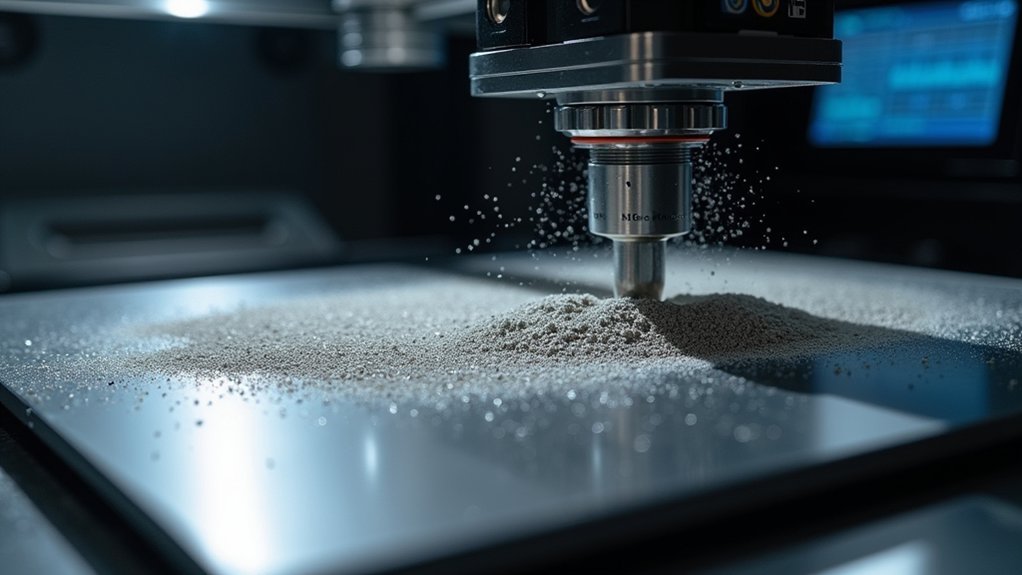
You’ll need to actively watch for particle agglomeration that can disrupt your powder’s flow characteristics and create defects in your final parts.
Monitor the spreading patterns across your build platform to identify areas where powder isn’t flowing smoothly or consistently.
Check for surface coverage gaps that indicate flow problems, as these spots will likely produce weak points or dimensional inaccuracies in your printed components.
Detecting Particle Agglomeration Issues
How can you spot particle agglomeration before it sabotages your print quality? You’ll need to implement systematic monitoring approaches that catch issues early. Start by examining your powder bed visually for clumps or irregular formations that disrupt layer uniformity.
Key detection strategies include:
- Visual inspection – Check for visible agglomerates during recoating processes
- Flow analysis – Use calibrated non-spherical particle Discrete Element Models to simulate behavior
- Real-time monitoring – Install systems that detect flow inconsistencies immediately
- Interfacial Area Ratio tracking – Monitor variations that indicate surface roughness effects
Regular particle size distribution assessments are essential since finer powders typically spread more effectively and resist agglomeration better than coarser alternatives.
These proactive measures help you identify potential powder flow problems before they compromise part density and overall quality.
Assessing Powder Flow Patterns
Monitoring powder flow patterns during the recoating process reveals critical insights about your printing system’s health.
You’ll need to watch for clumping that creates uneven coverage and affects part density as powder is spread layer by layer. Use a calibrated non-spherical particle Discrete Element Model to simulate particle interactions during spreading.
Surface roughness greatly impacts flow behavior—rougher surfaces trap smaller particles, creating clusters that can enhance coverage.
However, you must guarantee appropriate layer thickness, as thicker layers worsen size segregation and create inconsistent distribution.
Regularly evaluate your Particle Size Distribution of deposited powder.
This assessment helps you understand how size segregation affects final part quality and microstructural properties, enabling proactive adjustments.
Identifying Surface Coverage Gaps
Surface coverage gaps become apparent when you observe how powder distributes across your build platform, revealing where clumps form and flow patterns break down.
You’ll notice that surface roughness directly impacts powder coverage, with smoother areas showing more pronounced gaps where particles can’t grip effectively.
Monitor these critical indicators:
- Particle inertia effects – Watch for uneven spreading on flat surfaces where powder momentum creates skip patterns
- Agglomeration zones – Identify areas where finer powders cluster together instead of filling exposed regions
- Size distribution changes – Track how spreading narrows particle ranges, affecting coverage uniformity
- Interfacial area relationships – Use surface texture analysis to predict coverage performance
You can optimize spreading by adjusting blade speed and recognizing that rougher surfaces naturally enhance powder clustering in grooves.
Calibrate Equipment Regularly for Enhanced Performance
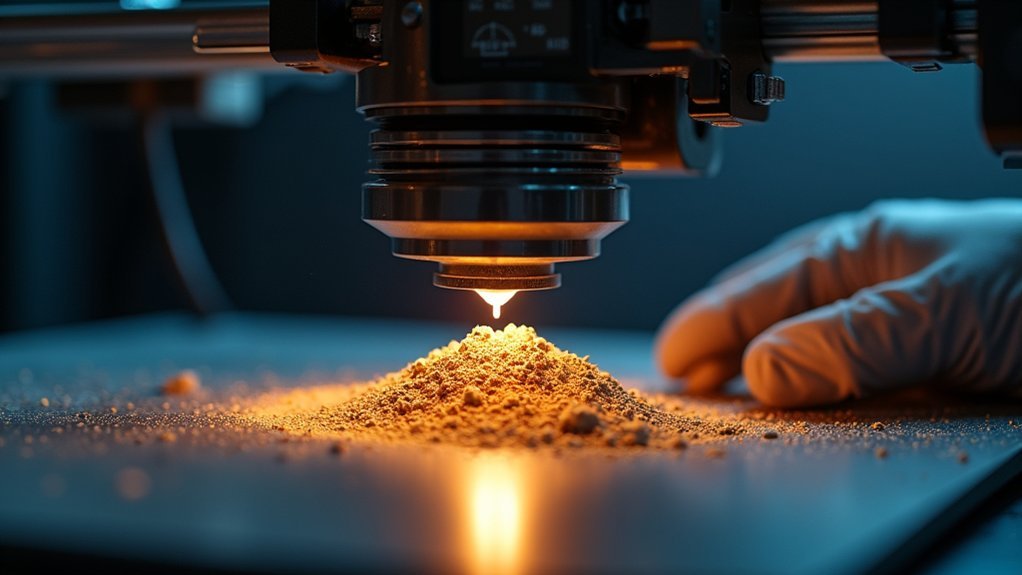
Precision forms the backbone of successful metal 3D printing, and you’ll achieve it by calibrating your equipment regularly.
Start by calibrating your recoater blade and powder feed mechanisms to guarantee consistent powder layer thickness, which directly impacts dimensional accuracy. Monitor and adjust the recoater gap height to maximize powder spreading, as variations create uneven layers that affect part density.
Proper recoater blade calibration and gap height adjustment are essential for achieving consistent powder layers and optimal part density.
Use precise measurement tools to verify your powder layer thickness after recoating, ensuring uniformity that aligns with your metal 3D printing process specifications.
Check particle size distribution regularly to confirm compatibility with your recoating process, as improper PSD hinders effective spreading and creates part defects.
Establish a routine maintenance schedule for cleaning and calibrating powder spreading equipment, preventing contamination while maintaining peak flow characteristics.
Select Appropriate Powder Particle Size and Morphology
While equipment calibration establishes the foundation for quality printing, you’ll maximize your results by selecting powder with the ideal particle size and morphology for your specific application.
Finer powder particle size provides superior coverage and fills surface gaps effectively, enhancing layer density and overall part quality.
Enhance your powder selection with these strategies:
- Choose smaller particles to improve packing efficiency and flowability
- Consider cohesive powders for better coverage on rough surfaces
- Select non-spherical particle morphology to enhance interlocking during spreading
- Match recoating gap height to your chosen particle sizes for best deposition
Your particle morphology choice greatly impacts layer adhesion and porosity reduction.
Avoid size segregation by maintaining proper particle size distribution during recoating processes for consistent results.
Implement Proper Storage and Handling Procedures
The quality of your metal powder directly depends on how you store and handle it throughout the printing process.
Store metal powders in cool, dry environments using airtight containers to prevent moisture absorption and oxidation, which can severely impact flowability and spreading performance. Implement a FIFO inventory system to use older powder before newer batches, maintaining consistent material characteristics.
When handling metal powders, always wear appropriate PPE including gloves and masks to protect against inhalation and skin contact. These materials pose significant health risks if proper precautions aren’t followed.
Regularly inspect your stored powders for clumping or agglomeration, as these issues will hinder proper spreading and negatively affect your final part quality during the metal 3D printing process.
Frequently Asked Questions
What Is the 45 Degree Rule for 3D Printing?
You’ll need support structures for overhangs or angles less than 45 degrees from horizontal. This rule prevents collapse during printing, ensuring structural integrity and better surface finish while minimizing sagging or warping issues.
What Is the Market for 3D Printing Metal Powder?
You’re looking at a rapidly expanding market that’s projected to grow substantially through 2031, driven by aerospace, automotive, and medical industries demanding lightweight, complex parts traditional manufacturing can’t produce.
What Is the Most Profitable Thing to 3D Print?
You’ll find medical implants and specialized aerospace tooling most profitable to 3D print. They command premium prices due to customization requirements and critical applications where you’re solving urgent problems for clients.
Is There Anything Illegal to 3D Print?
You can’t legally 3D print firearms, copyrighted items, explosives, fake IDs, or drug-related equipment. These violate federal laws, intellectual property rights, and safety regulations that’ll land you in serious legal trouble.