
You’ll need to start with a homogeneous 50-100 gram sample and arrange sieves from largest to smallest mesh openings in a stack. Apply consistent vibration for adequate separation time, then weigh the powder retained in each sieve layer to determine particle size distribution. For sub-micron classifications, use air classification methods like Elbow Jet systems that utilize the Coanda effect. Choose stainless steel equipment to prevent contamination and maintain controlled environments throughout processing. Advanced techniques below reveal how to optimize your classification efficiency.
Understanding Particle Size Distribution in Metal Powders

When you’re working with metal powders, particle size distribution (PSD) becomes the foundation that determines your final product’s quality and performance.
You’ll find that tighter distributions lead to improved consistency and greatly reduced waste in your manufacturing process.
Understanding PSD means you’re analyzing how particles are spread across different size ranges within your powder sample. This distribution directly impacts everything from flowability to packing density in your final applications.
When you examine particle size distribution data, you’ll use frequency plots to identify the mode value—the peak showing your most common particle size. Additionally, cumulative graphs help you determine mean values, giving you thorough insights into uniformity and size range.
This analysis enables you to assess whether your powder meets specifications for your intended application.
Essential Equipment for Metal Powder Sieving Operations
Selecting the right sieving equipment transforms your metal powder operations from guesswork into precision manufacturing. Your choice of sieves directly impacts particle classification accuracy and production efficiency.
Consider these essential equipment options for your facility:
- Hi-Sifter screeners – Feature tensionless screen cloth that eliminates blinding and contamination while classifying particles down to 10 microns.
- Elbow Jet Air Classifiers – Use airflow and density separation to achieve sub-10 micron classifications with three product grades in single passes.
- Multi-deck configurations – Choose single, double, or triple deck setups to optimize throughput rates for your specific production requirements.
- Stainless steel frames – guarantee durability and international compliance standards for metal powder testing applications.
You’ll achieve consistent particle size distribution when you match equipment capabilities to your powder specifications and production volumes.
Hi-Sifter Screener Technology for Fine Separations
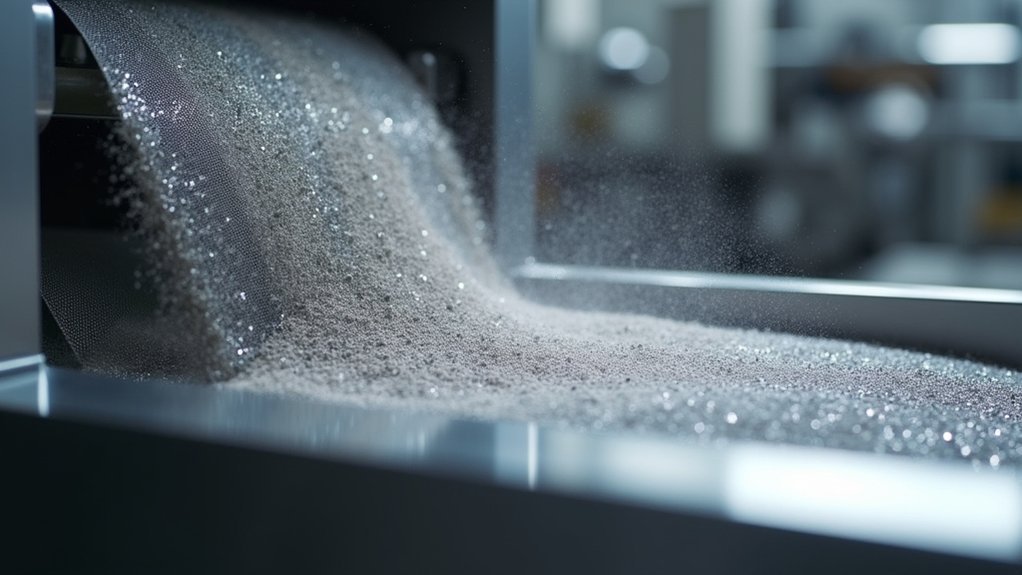
You’ll achieve superior fine separations with Hi-Sifter Screener technology’s innovative tensionless screen cloth design, which eliminates traditional mesh tension issues that compromise classification accuracy.
The equipment’s strong vertical energy effectively prevents blinding, allowing continuous operation without screen blockages that typically reduce throughput in powder metallurgy applications.
This advanced technology delivers yield increases exceeding twenty percent in additive manufacturing processes, making it essential for operations requiring precise particle size distributions.
Tensionless Screen Cloth Design
Innovation in screen cloth design has revolutionized fine metal powder separation through the Hi-Sifter Screener’s tensionless technology. The tensionless screen cloth design eliminates blinding issues that plague traditional screening methods, ensuring your metal powders flow consistently through the mesh without clogging or interruption.
This breakthrough technology delivers exceptional benefits for your powder processing operations:
- Prevents mesh blockage – particles can’t wedge into openings, maintaining continuous flow
- Eliminates cleaning devices – self-clearing action reduces contamination risks and maintenance costs
- Enables tight classifications – precise particle size separation for demanding applications
- Increases production yields – vertical energy enhancement boosts output by over 20%
You’ll achieve superior screening performance while reducing operational complexity, making this tensionless screen cloth design ideal for high-purity metal powder applications requiring consistent, reliable separation results.
Vertical Energy Prevents Blinding
When fine metal powders encounter traditional screening methods, blinding becomes an inevitable obstacle that disrupts your production flow and compromises separation accuracy.
The Hi-Sifter Screener’s vertical energy technology eliminates this critical problem by maintaining continuous particle movement across the screen surface. Unlike conventional horizontal motion that allows particles to settle and block mesh openings, this strong vertical force keeps your metal powders actively moving, preventing accumulation that causes blinding.
You’ll notice immediate improvements in your sieve performance as the vertical energy maintains ideal screening conditions throughout operation.
This technology guarantees consistent particle flow without requiring cleaning devices that could introduce contamination risks. The result is uninterrupted processing that delivers precise classifications while maximizing your equipment’s throughput capacity and maintaining the integrity of your fine metal powder separation processes.
Twenty Percent Yield Increases
Twenty percent yield increases represent the tangible advantage you’ll achieve when implementing Hi-Sifter screener technology for your fine metal powder separations. This breakthrough performance stems from the system’s ability to deliver precise classifications while maintaining powder integrity throughout the process.
The yield increases translate into measurable improvements across your additive manufacturing operations:
- Your production costs drop considerably as you recover more usable powder from each batch.
- Material waste decreases considerably, maximizing your expensive metal powder investments.
- Processing time reduces as you eliminate multiple re-screening cycles.
- Quality consistency improves with tighter particle size distributions.
You’ll find these yield increases particularly valuable in powder metallurgy applications where material costs represent major operational expenses.
The Hi-Sifter’s tensionless screen cloth guarantees continuous high-efficiency separations without compromising powder quality.
Elbow Jet Air Classifier for Sub-Micron Classifications
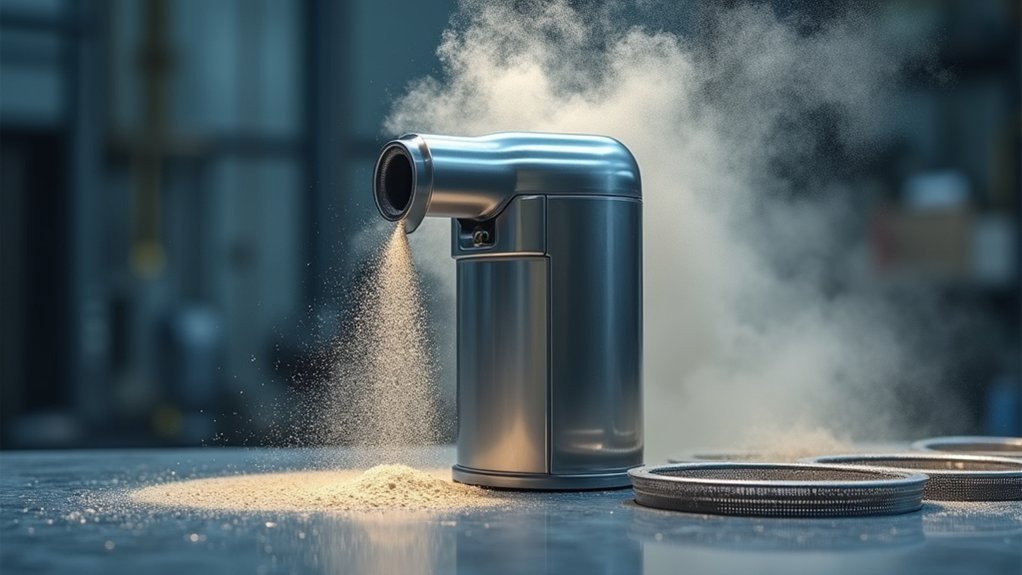
When you need to classify particles below ten microns, the Elbow Jet Air Classifier harnesses the Coanda effect to achieve precise separations that conventional classifying wheels can’t match.
You’ll produce three distinct product grades in a single pass while maintaining completely contamination-free operation since there aren’t any rotating parts to introduce impurities.
This technology eliminates the “tails” that plague traditional air classification methods, giving you higher yields and superior product quality.
Coanda Effect Technology
Although traditional screen cloth methods fall short when classifying metal powders below ten microns, Coanda effect technology offers a breakthrough solution through the Elbow Jet Air Classifier.
This innovative approach harnesses air flow patterns that naturally curve around surfaces, creating precise separation zones without mechanical components.
You’ll eliminate contamination risks since there aren’t any rotating parts to introduce impurities into your metal powders.
The technology delivers exceptional results through:
- Three-grade separation – producing distinct product classifications in a single pass
- Consistent particle distributions – eliminating the “tails” problem of conventional classifiers
- Contamination-free processing – maintaining powder purity without mechanical contact
- Enhanced precision – achieving tighter size distributions for advanced manufacturing requirements
You’ll achieve superior classifications by leveraging air density and flow dynamics, meeting demanding specifications for fine particle applications.
Three Grade Separation
Since metal powder applications demand increasingly tighter particle size distributions, you’ll find the Elbow Jet Air Classifier’s three-grade separation capability transforms your classification process.
Unlike conventional methods requiring multiple passes, this system produces three distinct product grades simultaneously, dramatically improving your throughput efficiency.
The Coanda effect enables precise particle size analysis by creating controlled airflow patterns that separate particles with exceptional accuracy.
You’ll achieve coarse, intermediate, and fine fractions in one operation, eliminating the time and costs associated with sequential processing steps.
This single-pass approach particularly benefits aerospace and additive manufacturing applications where you need consistent, contamination-free results.
Contamination-Free Operation
Zero contamination risk sets the Elbow Jet Air Classifier apart when you’re processing sub-micron metal powders for vital applications. Unlike traditional classifiers with rotating parts that can introduce wear particles, this contamination-free operation relies solely on airflow and the Coanda effect.
You’ll achieve pristine metal powder quality through:
- Rotating-part elimination – No mechanical components contact your powder stream
- Sealed air chambers – Controlled environments prevent external particle intrusion
- Precise flow geometry – Strategic design channels prevent cross-contamination between grades
- Clean separation zones – Distinct collection areas maintain product integrity
This contamination-free operation becomes essential for additive manufacturing applications where even microscopic impurities can compromise part quality.
You’re getting three distinct grades without introducing foreign particles that could affect your final product’s metallurgical properties.
Sieve Selection and Mesh Size Considerations
Success in metal powder classification hinges on selecting the right sieve with proper mesh specifications for your specific application. The sieve number directly indicates mesh size—higher numbers mean smaller openings. For instance, a 200 mesh sieve allows particles under 75 microns to pass through, perfect for fine powder work.
Follow ASTM International’s 1.414 ratio for consecutive sieve openings when building your sieve stack. This standardized approach guarantees accurate particle size classification.
Choose frame sizes between 10 cm to 1 m diameter based on your volume needs. Opt for brass frames for testing applications or stainless steel for production use to assure durability and corrosion resistance.
Always position sieves with largest mesh openings at the top, creating a tiered separation system for best classification results.
Step-by-Step Sieving Process for Metal Powders
With your sieve selection complete, you’re ready to execute the actual sieving process that transforms raw metal powder into precisely classified fractions.
Start by obtaining a homogeneous 50-100 gram sample of your metal powder. Arrange your sieves in a stack from largest to smallest mesh openings, creating distinct particle size range categories.
Begin with a representative 50-100 gram metal powder sample, then stack sieves from largest to smallest mesh for optimal particle classification.
- Place the powder sample on the top sieve of your assembled stack.
- Apply consistent vibration to facilitate particle movement through openings.
- Allow adequate sieving time for complete separation into size fractions.
- Carefully weigh the powder retained in each sieve layer.
After sieving, measure the weight retained in each layer to calculate particle size distribution. This quantitative data reveals your powder’s characteristics through frequency or cumulative plots, showing the mode, mean, and spread essential for quality control compliance.
Air Classification Methods for Ultra-Fine Particles
When you’re working with ultra-fine metal particles below ten microns, traditional sieving methods won’t cut it, and that’s where air classification becomes your go-to solution.
You’ll find that Elbow Jet technology leverages the Coanda effect to create precise separations without rotating parts, eliminating contamination risks that plague other methods.
This approach lets you achieve sub-micron classification while producing three distinct grades in a single pass, dramatically improving your processing efficiency and product consistency.
Elbow Jet Technology
Ultra-fine metal powders below ten microns present unique classification challenges that conventional screening methods can’t handle effectively.
The Elbow Jet Air Classifier leverages the Coanda effect to overcome these limitations, delivering precise separations without screen cloths.
This innovative technology offers several advantages for metal powder processing:
- Three-grade separation – You’ll achieve multiple product grades in a single pass, maximizing operational efficiency.
- Zero contamination risk – No rotating parts means you’ll maintain high purity levels throughout the process.
- Tail elimination – You’ll eliminate the unwanted particle distributions that plague traditional air classification methods.
- Enhanced yield control – You’ll achieve precise particle size distribution critical for additive manufacturing applications.
The Elbow Jet’s contamination-free operation makes it ideal for high-purity metal powder requirements.
Coanda Effect Separation
The Coanda effect forms the scientific foundation behind the Elbow Jet’s remarkable separation capabilities. You’ll harness airflow to create strategic low-pressure zones that classify ultra-fine particles without rotating parts, eliminating contamination risks. This technique achieves separations down to ten microns—far beyond traditional sieving limitations.
| Feature | Coanda Effect | Traditional Methods |
|---|---|---|
| Particle Size | Down to 10 microns | Limited by screens |
| Product Grades | Three per pass | Single grade |
| Maintenance | Virtually zero | High wear parts |
| Contamination Risk | Minimal | Higher risk |
| Tail Elimination | Yes | No |
You’ll produce three distinct grades in one pass while leveraging density principles to eliminate conventional classification “tails.” Without rotating components, you won’t face wear issues, reducing maintenance costs and extending equipment lifespan considerably.
Sub-Micron Classification Advantages
Precision becomes paramount when you’re working with metal powders below ten microns, where traditional sieving methods fail entirely.
Air classification delivers sub-micron classification advantages that revolutionize how you handle ultra-fine particles, utilizing airflow and density differences to achieve what mechanical separation can’t.
The sub-micron classification advantages transform your powder processing capabilities:
- Enhanced purity – Eliminates contamination risks during separation
- Superior precision – Classifies particles at sub-micron levels with consistent accuracy
- Streamlined efficiency – Produces three distinct grades in one single pass
- Elimination of tails – Removes unwanted particle distribution commonly found in conventional methods
This air classification technology greatly improves your product quality and consistency, making it indispensable for additive manufacturing and aerospace applications where particle uniformity directly impacts performance.
Quality Control Standards and Testing Procedures
When you’re sieving and classifying metal powders, maintaining rigorous quality control standards becomes critical for ensuring your final products meet industry specifications. You’ll need to follow established protocols like the Indian Pharmacopoeia standards, which categorize powders into five distinct types based on particle size distribution.
Your quality control process should include systematic testing using calibrated test sieves with standardized mesh sizes. This approach provides quantitative data by measuring powder weight retained on specific meshes, ensuring repeatability and preventing adhesion issues.
| Testing Method | Frequency | Quality Parameter |
|---|---|---|
| Vibrating Sieves | Daily | Particle Distribution |
| Air Classification | Weekly | Contamination Level |
| Mesh Analysis | Per Batch | Size Consistency |
| Weight Retention | Continuous | Product Integrity |
Regular monitoring throughout production prevents contamination and maintains consistency across batches.
Preventing Contamination During Powder Processing
Since metal powder processing involves multiple handling stages, you’ll need to implement extensive contamination prevention strategies that protect your product integrity from start to finish.
Choose equipment like the Hi-Sifter that eliminates screen cleaning devices, reducing contamination risks considerably. The Elbow Jet Air Classifier produces three product grades in a single pass with virtually zero contamination risk due to its lack of rotating parts.
Essential contamination prevention measures include:
- Constructing all equipment from polished stainless steel to minimize oxidation and contamination risks
- Using ultrasonic sieves and sealed containers during handling and storage procedures
- Maintaining controlled environments throughout the entire processing workflow
- Implementing rigorous particle size analysis and regular equipment maintenance schedules
Proper handling techniques and controlled storage environments further reduce exposure to contaminants during metal powder processing operations.
Optimizing Yield and Efficiency in Powder Classification
Although contamination prevention forms the foundation of quality powder processing, maximizing your yield and efficiency requires strategic equipment selection and process optimization.
Strategic equipment selection and process optimization are essential for maximizing powder processing yield and efficiency beyond basic contamination prevention.
You’ll achieve over 20% yield increases by implementing advanced sieving technologies like Elcan’s Hi-Sifter, which prevents blinding and enhances separation efficiency for powder in each sieve.
For particles below ten microns, air classification methods such as the Elbow Jet Air Classifier enable you to produce three product grades in a single pass with minimal contamination risk.
High-energy sieving machines deliver 98% throughput rates while maintaining precise particle size distributions essential for additive manufacturing applications.
You can optimize performance further by using tensionless screen cloths, which allow tighter classifications and reduce cleaning requirements.
Regular particle size analysis reduces material waste and improves overall powder quality.
Frequently Asked Questions
What Are the Different Types of Metal Powder?
You’ll find five main types of metal powder: coarse, moderately coarse, moderately fine, fine, and very fine. Each type’s classified by particle size distribution and governed by Indian Pharmacopoeia standards for quality consistency.
What Is the Sieve Test for Powder?
You’ll place metal powder on test sieves and use mechanical vibration to separate particles by size. Different mesh layers collect various particle sizes, letting you calculate distribution by weighing each layer’s powder content.
What Is the Sieve Number of Very Fine Powder?
You’ll find very fine powder has a sieve number of 125, meaning it passes through a 125 µm mesh. This classification guarantees you’re working with particles meeting pharmaceutical standards for uniformity.
What Powder Size Indicates a Very Coarse Powder?
You’ll identify very coarse powder when particles pass through a 1.7 mm sieve but don’t exceed 40% passing through a 355 mm sieve, typically ranging from 1.7 mm to several millimeters in diameter.