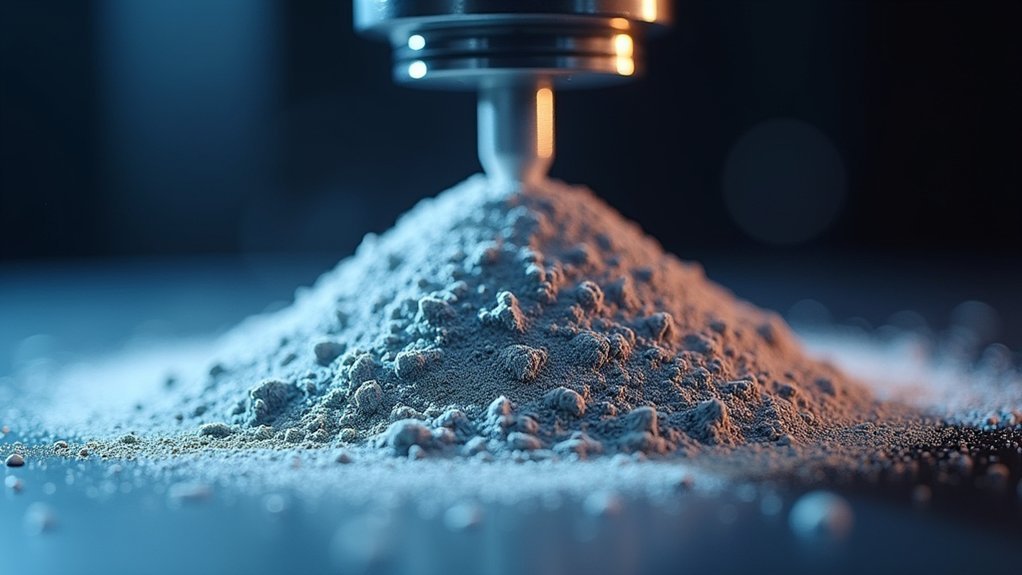
SLM powder properties directly determine your metal 3D printing success because particle size controls melting efficiency and surface finish, while spherical shapes guarantee uniform layer deposition and ideal packing density. You’ll face defects like porosity and weak components if your powder has poor flowability or irregular particles. Proper powder density enhances thermal conductivity for better fusion, and managing oxidation levels prevents degradation that compromises part strength. Understanding these critical relationships will transform your printing outcomes.
Understanding the Core Properties of SLM Metal Powders
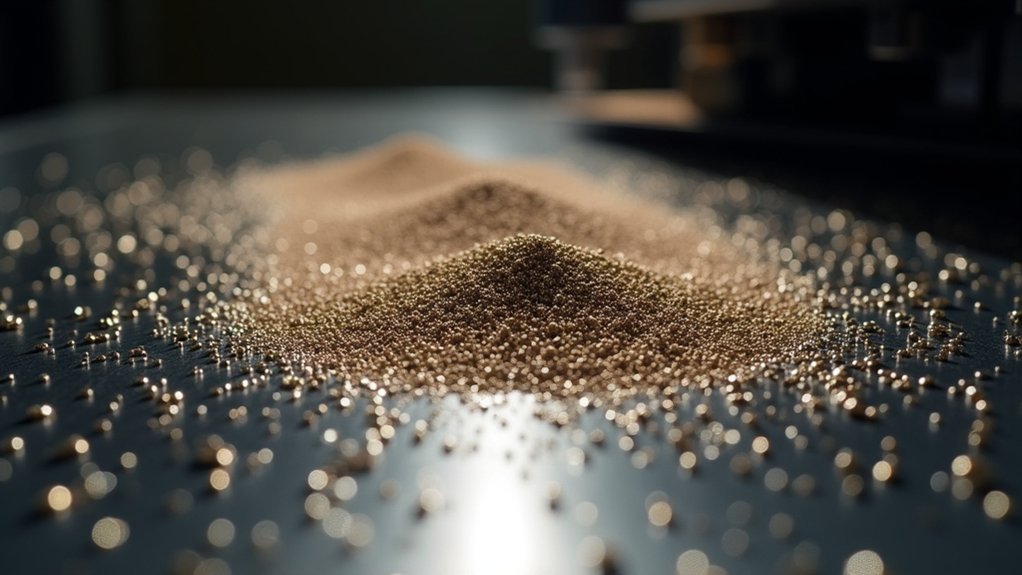
Success in Selective Laser Melting hinges on understanding three fundamental powder properties: particle size, shape, and flowability.
When you’re working with metal powders in this printing technique, these characteristics directly impact your results. Particle size controls melting efficiency and surface finish—finer powders deliver superior detail resolution.
Shape affects packing density, with spherical particles creating ideal layer uniformity throughout the SLM process. Flowability determines whether you’ll achieve consistent powder distribution or encounter defects like porosity.
Poor flow characteristics lead to irregular layers that compromise mechanical properties in your final parts. You’ll find these factors especially critical when manufacturing aerospace components, where precision and reliability can’t be compromised.
Understanding these fundamentals guarantees successful metal printing outcomes.
Particle Size Distribution and Its Impact on Print Quality
When you optimize particle size distribution (PSD) in your SLM powder, you’re directly controlling the packing density that determines how effectively your material absorbs laser energy.
You’ll achieve better flowability and uniform layer deposition when you maintain particles between 20-50 microns, minimizing defects in your final parts.
If you use coarser particles, you’ll create larger inter-particle gaps that cause incomplete melting and compromise your component’s mechanical properties.
While fine powders below 10 microns help you produce intricate features, they’ll introduce oxidation risks and poor flow characteristics that complicate your Selective Laser Melting process.
Fine powders under 10 microns create oxidation risks and flow problems that complicate your SLM process despite enabling intricate details.
A narrower PSD gives you the best balance—ensuring consistent energy absorption while maintaining the flowability essential for reliable layer formation and superior print quality.
Powder Sphericity and Flow Characteristics in Layer Formation

Beyond achieving ideal particle sizes, the geometric shape of your powder particles fundamentally determines how well they’ll flow and pack during layer formation. Powder sphericity directly enhances flowability, enabling uniform spreading and optimal packing density across each layer.
| Characteristic | Spherical Particles | Irregular Particles |
|---|---|---|
| Flow Properties | Superior flowability, smooth spreading | Poor flow, clumping tendency |
| Packing Density | Higher density, fewer gaps | Lower density, more voids |
| Layer Formation | Consistent thickness, uniform distribution | Uneven layers, surface irregularities |
| Final Quality | Reduced internal defects, better mechanical properties | Compromised structural integrity |
Your powder’s flow characteristics considerably impact energy absorption during laser melting. Well-graded particle size distribution combined with spherical geometry minimizes inter-particle gaps, ensuring layer consistency and superior surface quality while preventing internal defects that compromise your component’s mechanical properties.
Adhesion and Cohesion Forces Affecting Powder Spreading
When you’re working with SLM powder spreading, you’ll encounter Van der Waals forces that create weak attractions between particles at extremely close distances, affecting how smoothly your powder layers form.
You’ll also need to manage electrostatic charge effects that can build up during powder handling and transport, causing particles to either repel or attract each other unpredictably.
These forces directly influence whether you’ll achieve the uniform layer density that’s critical for successful metal printing outcomes.
Van Der Waals Forces
Since van der Waals forces operate at the molecular level between metal powder particles, they’ll directly impact how your powder spreads and packs during the SLM process.
These forces create both adhesion between different particles and cohesion within particle clusters, directly affecting your powder’s flowability and packing density.
When adhesion forces become excessive, you’ll experience agglomeration, creating larger particle clusters that form troublesome inter-particle gaps in your powder bed.
This uneven distribution reduces the uniformity needed for consistent laser melting. Similarly, strong cohesion promotes particle clumping, decreasing the effective surface area available during processing.
You’ll need to optimize your powder characteristics by balancing these forces.
While controlled adhesion enhances powder bed homogeneity, excessive forces reduce packing density and surface smoothness, ultimately compromising your final part quality.
Electrostatic Charge Effects
Electrostatic charge buildup fundamentally alters how your metal powder particles interact during the spreading process, creating adhesion and cohesion forces that’ll either enhance or disrupt your powder bed formation.
High electrostatic charge levels increase particle adhesion, reducing flowability and causing clumping that compromises uniformity. These intensified cohesion forces create satellite particle clusters, leading to inhomogeneous distribution and internal defects during laser melting.
You’ll need to manage electrostatic charge carefully to optimize powder behavior and maintain consistent packing density with smooth surface characteristics.
The charge dynamics vary considerably with particle size and material properties, so selecting appropriate metal powders becomes critical. Poor electrostatic control results in uneven powder beds that negatively impact your final printed components’ quality and structural integrity.
How Powder Density Influences Melting Behavior and Final Part Strength
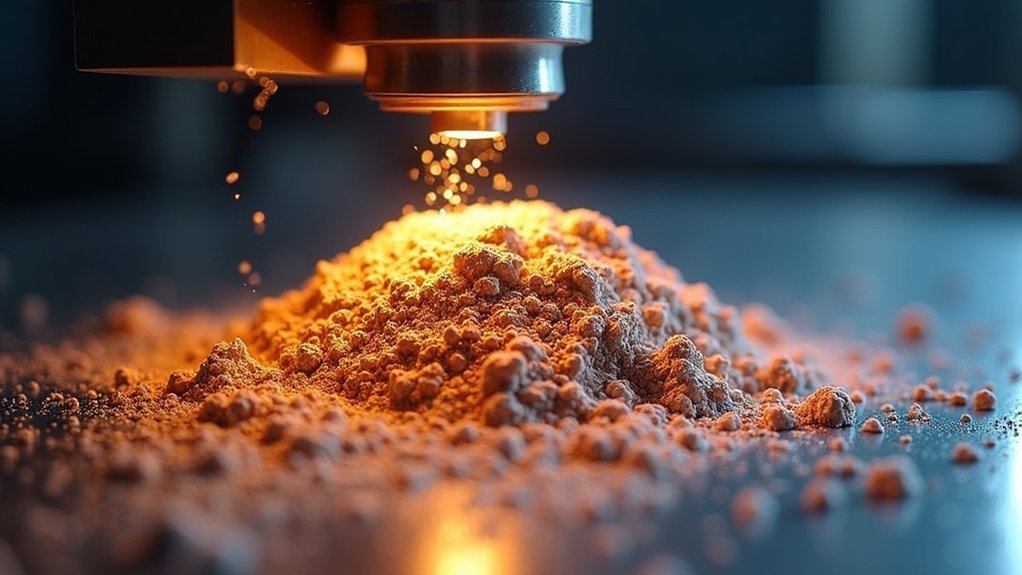
As powder density determines the uniformity of your powder bed, it directly controls how consistently each layer absorbs energy during the SLM process. When you achieve ideal powder packing density, you’ll see improved thermal conductivity that enhances heat transfer during melting, leading to better fusion of powder particles.
| Powder Density | Melting Behavior | Final Part Strength |
|---|---|---|
| Low | Inconsistent energy absorption | Reduced mechanical properties |
| Ideal | Uniform heat distribution | Maximum strength |
| Variable | Uneven layer thickness | Poor material integrity |
| High | Improved thermal conductivity | Enhanced performance |
Variations in density create inconsistencies in layer thickness, affecting melting and cooling rates. You’ll reduce voids and defects by maintaining consistent density, which improves flowability and guarantees superior mechanical properties in your final parts.
Surface Chemistry and Oxidation Effects on Powder Performance
Beyond the physical arrangement of particles in your powder bed, the chemical composition of particle surfaces plays an equally important role in determining SLM success. Surface chemistry directly affects oxidation levels, which impact flowability and packing density during the SLM process.
Surface chemistry controls oxidation levels that make or break your SLM print quality and mechanical performance.
When oxidation creates surface layers on your metal particles, you’ll notice altered melting behavior that can compromise fusion quality. Higher oxidation reduces reactivity, leading to:
- Devastating internal defects that weaken your finished parts
- Compromised mechanical properties that fail under stress
- Inconsistent layer bonding that creates unpredictable failures
Lower oxidation levels deliver superior reactivity and stronger fusion during printing. You can maintain powder quality through proper storage conditions using inert atmospheres or vacuum environments, preventing moisture exposure that degrades surface chemistry.
Powder Reusability and Degradation in Repeated SLM Cycles
You’ll need to understand how metal powders degrade through thermal exposure, mechanical stress, and oxidation as you reuse them in successive SLM cycles.
Your powder typically maintains acceptable quality for 5-10 cycles before degradation considerably impacts your part’s mechanical properties and print quality.
You must regularly monitor particle size distribution, morphology, and flowability changes to detect when your recycled powder no longer meets performance standards.
Powder Degradation Mechanisms
When you repeatedly use metal powders in SLM processes, thermal cycling gradually degrades their essential properties through several interconnected mechanisms.
The Selective Laser Melting process subjects your metal powders to intense heat cycles, fundamentally altering particle morphology and compromising their performance with repeated use.
You’ll encounter these devastating changes that directly impact your print quality:
- Severe agglomeration creates unwanted particle clusters that destroy smooth powder flow.
- Satellite particle formation reduces your packing density and creates surface defects.
- Morphological deterioration transforms spherical particles into irregular shapes, compromising layer uniformity.
Your powder’s reusability depends on implementing robust characterization protocols that monitor these degradation patterns.
Without proper powder management, you’ll experience declining mechanical properties and failed builds as thermal stress accumulates through successive SLM cycles.
Reusability Cycle Limits
Understanding these degradation mechanisms helps establish practical limits for how many times you can reuse metal powders before they become unusable. Your reusability limits depend heavily on the specific metal you’re using in SLM processes.
Stainless steel powders typically maintain effectiveness for up to 30 cycles, while titanium alloys show peak performance for 10-20 reuses before significant degradation occurs.
You’ll need to monitor particle size distribution and morphology changes throughout each cycle, as repeated processing affects flowability and creates agglomeration issues.
Contaminants and oxidation accumulate over time, directly impacting your print quality. Regular assessments of powder characteristics become essential for determining when replacement is necessary, ensuring you maintain consistent manufacturing standards while maximizing material efficiency in your metal printing operations.
Property Changes Detection
While establishing reusability cycles provides general guidelines, detecting specific property changes requires systematic monitoring throughout your SLM operations.
You can’t rely on usage counts alone—effective property changes detection demands regular assessments of your powder characteristics to identify degradation levels before they compromise your parts.
Monitor these critical indicators that signal declining powder performance:
- Flowability deterioration – When your powder doesn’t flow smoothly, you’re facing production delays and inconsistent layer formation.
- Packing density reduction – Poor density means weaker parts that could fail catastrophically under stress.
- Contamination buildup – Oxidized particles create defects that destroy your part’s integrity and waste expensive materials.
Track mechanical properties, morphology changes, and particle distribution patterns.
This proactive approach guarantees your recycled powders maintain acceptable standards while maximizing reusability without sacrificing quality in your SLM processes.
Frequently Asked Questions
What Are the Cons of SLM?
You’ll face high equipment costs, surface roughness requiring post-processing, residual stress needing heat treatment, limited material options, and complex geometries demanding support structures that increase material usage and complicate manufacturing.
What Are the Parameters of SLM Printing?
You’ll need to control laser power, scanning speed, layer thickness, and hatch spacing when SLM printing. These parameters directly affect your part’s quality, density, and mechanical properties throughout the entire printing process.
What Is SLM Metal Printing?
You’ll use SLM metal printing to create complex parts by directing a high-powered laser to selectively melt metal powder layer-by-layer, building three-dimensional components directly from digital designs.
What Are the Tolerances for SLM Printing?
You’ll typically achieve tolerances of ±0.1mm to ±0.5mm with SLM printing, though you can reach ±0.05mm precision for geometric features when you’re using ideal parameters and post-processing techniques.