
You’ll achieve ideal densification in titanium powder sintering by maintaining temperatures between 1250°C and 1380°C during your metal 3D printing post-processing operations. The critical alpha-to-beta phase transformation at 882°C enhances grain boundary diffusion, while controlled heating rates prevent excessive grain coarsening and pore expansion. Lower temperatures increase porosity and reduce strength, whereas exceeding 1380°C causes detrimental microstructural changes. Slow heating cycles through transformation zones minimize residual stresses and accommodate impurities for superior mechanical properties and thorough understanding of thermal management strategies.
Optimal Temperature Ranges for Titanium Powder Densification
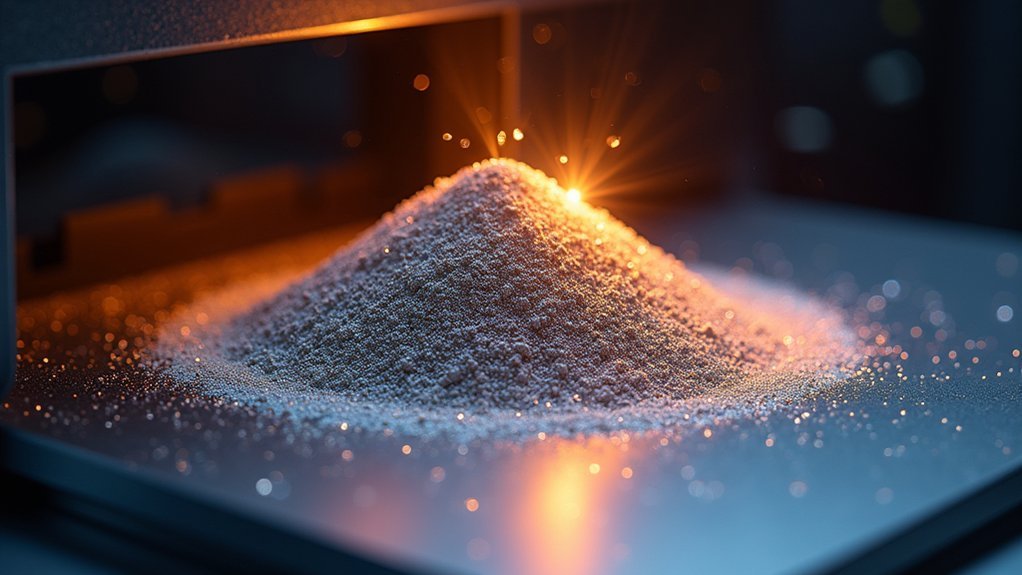
When you’re sintering titanium powder for 3D printing applications, you’ll need to maintain temperatures between 1250°C and 1380°C to achieve ideal densification.
These suitable temperature ranges activate critical densification mechanisms, including beta phase volume diffusion and grain boundary diffusion, which directly impact your final part’s mechanical properties.
You’ll notice that lower sintering temperatures increase porosity considerably, reducing your component’s strength and ductility.
However, don’t exceed the upper temperature limits, as excessive heat causes grain coarsening and pore expansion.
Your relative density improves as temperatures increase within the suitable range, but you must implement slow heating cycles to minimize residual stresses and accommodate impurities that can stabilize unwanted pores during the sintering process.
Phase Transformation Effects During High-Temperature Sintering
As titanium powder reaches the critical transformation temperature of 882°C during sintering, you’ll observe a fundamental structural change from the alpha (HCP) phase to the beta (BCC) phase that directly influences your material’s final density and mechanical characteristics.
This phase transformation greatly impacts your metal 3D printing outcomes through enhanced grain boundary diffusion and volume diffusion processes.
- Enhanced densification: Beta phase promotes superior diffusion mechanisms, reducing porosity in your titanium powders
- Temperature control: Maintaining sintering temperatures below 1250°C prevents excessive grain coarsening while preserving ductility
- Heating rate optimization: Slow heating rates through the transformation zone minimize residual pore formation
- Impurity management: Contaminants can stabilize unwanted porosity and alter transformation kinetics at high temperatures
Understanding these phase transformation effects helps you optimize mechanical characteristics for superior 3D printed components.
Microstructure Evolution and Grain Boundary Formation

During titanium powder sintering, your material’s microstructure undergoes dramatic changes that directly determine the mechanical performance of your 3D printed components. You’ll observe significant microstructure evolution as temperature increases, with particle bonding occurring through enhanced surface diffusion mechanisms. This process dissolves surface oxides and promotes densification while forming grain boundaries at particle contact points.
| Temperature Range | Microstructural Changes |
|---|---|
| 800-1000°C | Initial particle bonding begins |
| 1000-1200°C | Grain boundary formation accelerates |
| 1200-1400°C | Ideal sintering temperatures achieved |
| 1400-1600°C | Enhanced densification occurs |
| >1600°C | Excessive grain coarsening develops |
Your mechanical properties improve as grain boundaries strengthen through proper temperature control. However, you’ll need to balance ideal sintering temperatures carefully—excessive heat causes detrimental grain coarsening that compromises your titanium powder’s final performance characteristics.
Impact of Heating Rates on Mechanical Properties
While ideal temperature ranges establish the foundation for successful titanium sintering, your heating rate strategy proves equally critical in determining the final mechanical properties of 3D printed components.
The sintering process directly influences how your titanium alloys develop porosity levels and achieve final density. When you control heating rates properly, you’ll prevent grain coarsening that weakens your metal powder consolidation.
Proper heating rate control prevents grain coarsening while optimizing porosity levels and final density in titanium powder consolidation.
- Slow heating rates enable better densification, reducing porosity and increasing yield strength in your titanium components.
- Excessive heating speeds cause pore expansion and grain coarsening, compromising mechanical properties despite optimal temperatures.
- Extended hold times during sintering allow complete diffusion, maximizing final density in titanium alloys.
- Controlled heating strategies produce significant yield strength improvements across standard sintering temperature ranges.
Defect Mitigation Through Temperature Control Strategies
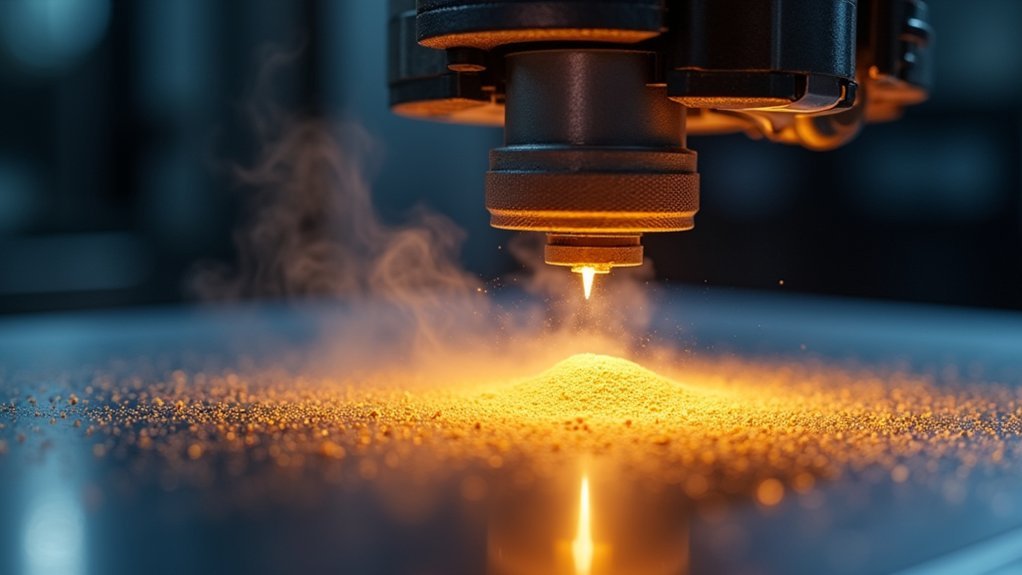
Temperature control strategies become your primary defense against defects that compromise titanium component integrity during sintering.
You’ll achieve ideal defect mitigation by maintaining sintering temperature around 1250°C, where densification maximizes without triggering grain coarsening or pore expansion that degrades mechanical properties.
Implement slow heating cycles to dissolve surface oxides effectively and promote particle bonding, reducing residual pores in your titanium components.
Control impurities vigilantly during temperature ramping, as they’ll stabilize unwanted pores and compromise final density.
Your temperature control must account for grain boundary diffusion mechanisms that drive final densification—these processes respond sensitively to thermal variations.
When printing using additive manufacturing techniques, precise thermal management ensures beta phase volume diffusion proceeds effectively, delivering superior mechanical properties in your finished titanium parts.
Frequently Asked Questions
At What Temperature Does Metal Powder Sinter?
You’ll find metal powder sintering temperatures vary by material. Steel typically sinters at 1000-1200°C, while titanium requires 1100-1400°C. You should optimize temperature based on your specific alloy composition and desired properties.
What Temperature Is Titanium 3D Printing?
You’ll typically print titanium at 1100°C to 1300°C for ideal results. Below 1250°C, you’ll get brittle properties, while higher temperatures produce elastic-plastic behavior with better mechanical characteristics for your applications.
What Is the Sintering Temperature of Titanium Nitride?
You’ll find titanium nitride’s sintering temperature ranges from 1200°C to 1400°C. You can achieve better densification and mechanical properties at higher temperatures within this range, depending on your specific processing conditions.
Can You Sinter Titanium?
You can absolutely sinter titanium by heating titanium powder between 1100°C to 1400°C. You’ll achieve ideal densification around 1380°C, but you must carefully control temperatures to prevent grain coarsening.