
You’ll optimize your metal powder particle size by achieving the right balance between fine and coarse particles. Fine particles below 60 µm enhance flowability but reduce packing density, while coarser particles fill voids for denser powder beds. Spherical shapes outperform irregular particles for smoother spreading and better flow characteristics. Use laser diffraction testing to monitor your D50 values and particle size distribution continuously. Implementing proper quality control methods will reveal the full potential of your printing parameters.
Understanding Particle Size Distribution in Metal Powders
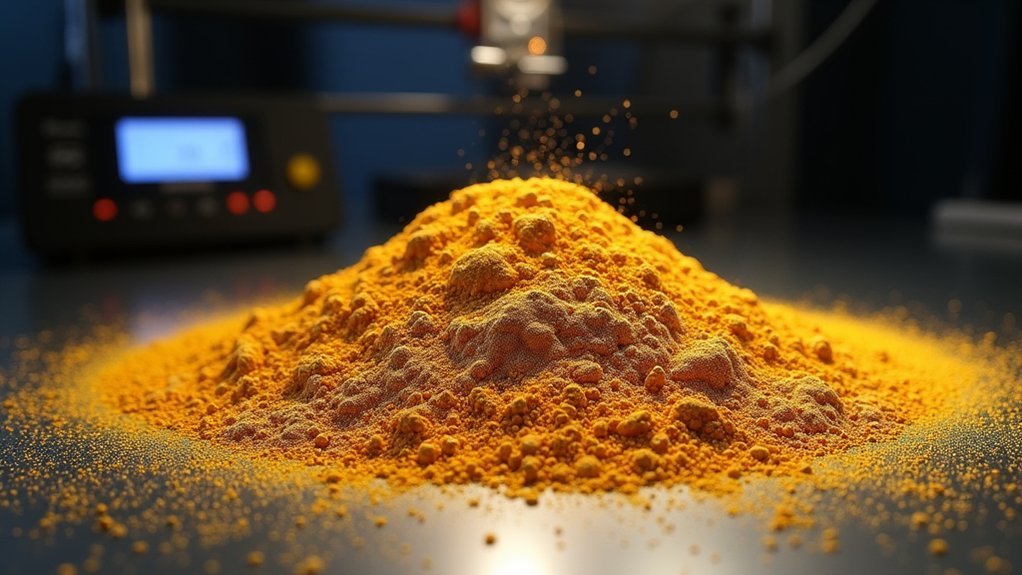
Precision in metal additive manufacturing starts with understanding how particle size distribution affects your powder’s behavior.
When you’re selecting metal powders, you’ll find that ideal particle size distribution requires a strategic mixture of fine and coarse particles to maximize both flowability and packing density. Your D50 values reveal critical insights into powder characteristics, representing the median particle size that directly influences your final component properties.
You’ll achieve better results when your distribution includes spherical particles, which offer superior flow characteristics compared to irregular shapes. A narrower particle size distribution correlates with improved flowability and fewer defects in your printed parts.
Impact of Fine Particles on Powder Bed Density
When you’re working with fine metal particles in powder bed fusion, you’ll face a critical trade-off between achieving high-resolution prints and maintaining ideal powder bed density.
Fine particles can agglomerate and compromise flowability, yet they’re essential for creating thin layers that capture intricate details in your components.
You must balance particle size distribution carefully, as too many fine particles reduce bulk density while too few limit your ability to enhance layer thickness for superior print quality.
Fine Particle Agglomeration Effects
Although fine particles below 60 µm flow readily through powder handling systems, they create significant challenges for maintaining consistent powder bed density during the printing process. Fine particles in metal powders tend to clump together, forming agglomerates that compromise packing density and create uneven layer distribution. This agglomeration directly impacts your print quality by introducing voids and inconsistencies in the powder bed.
| Particle Behavior | Impact on Bed | Result |
|---|---|---|
| Fine particle clumping | Reduced density | Poor flowability |
| Agglomerate formation | Void creation | Layer defects |
| Uneven distribution | Inconsistent thickness | Weak bonding |
You’ll need to optimize your particle size distribution by combining fine and coarse particles, balancing detail resolution against agglomeration prevention for superior mechanical properties.
Flowability Versus Density Balance
Fine metal particles create a fundamental trade-off between flowability and powder bed density that you must carefully navigate to achieve ideal print results.
While particles under 60 µm enhance flowability for intricate designs, they reduce packing density in your powder bed. You’ll find that coarser particles fill voids created by fine metal particles, promoting denser beds and improving overall print quality.
However, you can’t rely solely on fine particles since they tend to agglomerate, creating uniformity issues. The solution lies in balancing particle size distributions—combining fine and coarse particles optimizes both flowability and packing density.
This balance directly affects laser efficiency during fusion and determines the mechanical properties of your printed components.
Layer Thickness Optimization Strategies
Since layer thickness directly correlates with particle size, you’ll need to match your powder characteristics to your desired resolution requirements. Fine powders under 60 µm enable thinner layers in powder bed fusion, delivering superior print resolution for intricate printed components.
However, you must manage agglomeration risks that compromise flowability and bed uniformity.
Strategic particle size distribution enhancement involves balancing fine and coarse particles to maximize packing density. Fine particles fill gaps between larger ones, improving overall bed density while maintaining processability.
You’ll achieve ideal layer thickness enhancement by carefully controlling this distribution.
Coarser powders require thicker layers, creating staircase effects on vertical surfaces that degrade part quality. As a result, you should select particle sizes that support your target layer thickness while ensuring consistent powder spreading and avoiding agglomeration-related defects throughout the printing process.
Flowability Characteristics of Different Particle Sizes
When you’re selecting metal powder for additive manufacturing, particle size directly impacts how well the material flows through your printing system. Smaller particles under 60 µm create superior flowability by filling voids and forming uniform powder beds, which you’ll need for high-resolution prints.
However, you can’t ignore the benefits of strategic particle size combinations.
Strategic particle size combinations unlock optimal powder performance by balancing flowability, resolution, and packing density for superior additive manufacturing results.
Here’s how different powder characteristics affect your printing process:
- Fine particles enhance resolution but require careful handling to maintain consistent flow.
- Coarse powders reduce flowability and create staircase effects that compromise quality.
- Balanced mixtures optimize packing density while reducing energy requirements during melting.
- Spherical particles outperform irregular shapes by preventing uneven layers and flow disruptions.
You’ll want to use dynamic flow testing methods like HFlow 1 flowmeters to quantify these characteristics for your specific applications.
Spherical Vs Irregular Particle Shape Effects

Particle shape affects your printing outcomes just as considerably as size distribution. When you’re selecting metal powders for additive manufacturing, you’ll need to understand how spherical particles versus irregularly shaped particles impact your process.
Spherical particles deliver superior flowability and packing density, creating uniform powder layers that maximize laser efficiency. You’ll experience lower interparticle friction, enabling smoother powder spreading during printing. This translates to better layer densification and stronger mechanical properties in your final components.
| Characteristic | Spherical Particles | Irregularly Shaped Particles |
|---|---|---|
| Flowability | Excellent | Poor |
| Layer Uniformity | Consistent thickness | Uneven distribution |
| Print Quality | Higher consistency | Increased defect risk |
However, you’ll achieve ideal results by balancing spherical and irregular particles, combining excellent flowability with adequate packing density for superior print quality.
Laser Diffraction Measurement Techniques
You’ll find laser diffraction leverages light scattering principles to determine particle size by analyzing how metal powder particles scatter laser light at different angles and intensities.
The technique’s speed and accuracy make it perfect for real-time production monitoring, allowing you to track particle size distributions as powders move through your manufacturing process.
You can integrate these systems directly into production lines to catch deviations immediately and maintain consistent powder quality for ideal printing results.
Light Scattering Principles
As laser light encounters metal powder particles, it scatters in predictable patterns that reveal critical size information through angular distribution and intensity measurements.
You’ll find that smaller particles scatter light at wider angles, while larger particles create narrow-angle scattering patterns. This fundamental principle enables precise particle size analysis across the 5-150 µm range essential for metal powders.
The light scattering process delivers thorough data through:
- Angular measurements – Detecting scattering angles to determine individual particle dimensions
- Intensity analysis – Measuring scattered light strength for accurate size calculations
- Pattern recognition – Identifying unique scattering signatures for different particle size distributions
- Real-time processing – Converting optical data into actionable powder characteristics
This systematic approach guarantees your printing process receives consistently optimized metal powders with verified particle shape and size specifications.
Real-Time Production Monitoring
By integrating laser diffraction directly into your production line, you’ll achieve continuous monitoring of metal powder particle size throughout the manufacturing process.
This real-time monitoring system analyzes light scattering patterns to instantly determine if your powder quality meets specifications within the critical 5-150 µm range. When particle size deviates from target parameters, you can immediately adjust processing conditions to maintain ideal flowability and packing density.
This proactive approach prevents costly batch rejections and guarantees consistent additive manufacturing performance. The rapid analysis capability suits high-throughput environments, allowing you to maximize production efficiency while maintaining strict quality standards.
Real-time data enables precise control over powder characteristics that directly impact your final product quality.
Static Image Analysis for Shape Characterization
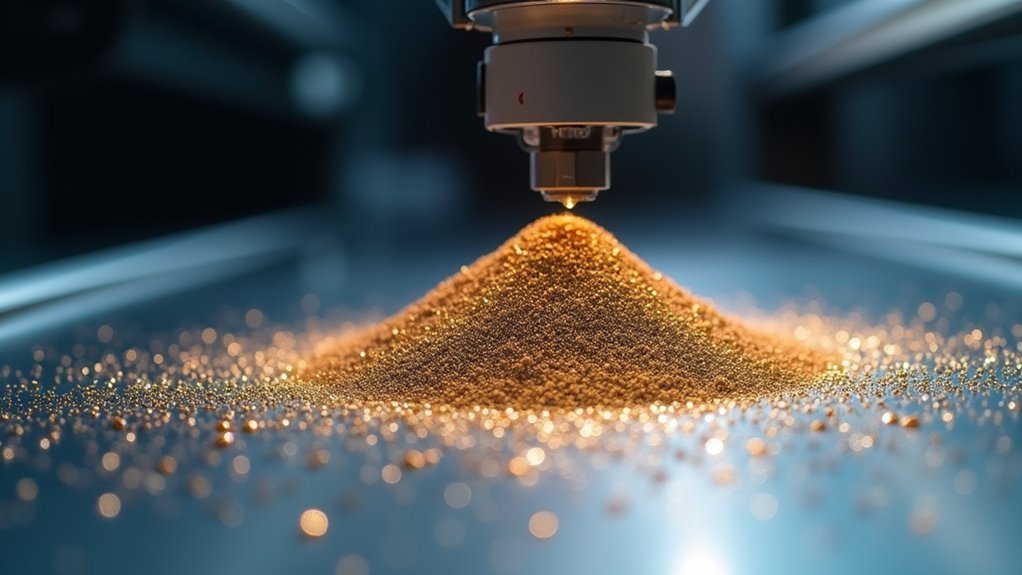
Static image analysis emerges as a powerful complement to laser diffraction by capturing detailed morphological characteristics that size distribution alone can’t reveal.
You’ll find this automated imaging technique essential for thorough powder quality assessment in metal additive manufacturing.
When you implement static image analysis for your metal powders, you’re gaining access to vital shape parameters:
- Circularity measurements that identify irregular particles affecting flowability
- Convexity analysis revealing surface roughness and texture variations
- Elongation detection uncovering needle-like particles that compromise layer uniformity
- Agglomerate identification ensuring particle size measurements reflect true individual particles
Your automated systems can analyze hundreds of thousands of particles, delivering statistically robust data for optimization decisions.
This particle shape characterization cross-validates laser diffraction results while enabling morphology refinement essential for consistent powder layer thickness.
Optimal Size Ranges for Different Metal Alloys
While particle shape analysis provides critical morphological insights, selecting the right size distribution for your specific metal alloy determines whether your powder will deliver ideal printing performance.
Each alloy material has distinct suitable size ranges that maximize both flowability and packing density.
For stainless steel powders, you’ll achieve the best balance using 15-45 µm particles.
Aluminum powders perform best at 20-50 µm, creating lightweight components with excellent detail resolution.
Titanium alloys require 20-60 µm sizing to maintain strength while ensuring efficient melting.
Nickel-based alloy powders work best within 30-70 µm ranges, promoting superior layer adhesion and minimizing porosity.
Remember that incorporating mixed particle sizes enhances maximum packing density while reducing energy requirements during the melting process across all metal alloys.
Reducing Agglomeration in Fine Powders
You’ll need to address particle surface treatments and optimize size distribution to combat agglomeration in fine metal powders.
Surface treatments like gas atomization create uniform particles while breaking up existing clusters that harm flowability.
Achieving the right size distribution prevents the interparticle forces that cause fine powders to clump together during storage and printing.
Particle Surface Treatments
Since fine metal powders naturally tend to clump together due to surface forces and electrostatic attraction, you’ll need effective surface treatments to combat agglomeration and maintain ideal flowability.
Here are four proven approaches to enhance your powder characteristics:
- Apply lubricants or surfactants to coat particle surfaces, dramatically reducing inter-particle adhesion and improving flowability throughout the printing process.
- Use mechanical milling or sieving to break up existing agglomerates and achieve consistent particle size distribution critical for print quality.
- Implement pre-treatment methods like drying or heating to eliminate moisture-related agglomeration, especially problematic for fine powders.
- Monitor with laser diffraction analysis to evaluate treatment effectiveness by measuring particle size distribution changes and identifying residual agglomerates.
Regular quality control guarantees your treated powders maintain consistent surface characteristics for peak additive manufacturing performance.
Optimal Size Distribution
When fine metal powders under 60 µm agglomerate due to surface forces, they’ll dramatically reduce your powder’s flowability and packing density, creating serious complications during the powder bed fusion process. You’ll achieve ideal performance by targeting a D50 value between 30-50 µm, which balances flowability with appropriate layer thickness. A balanced particle size distribution combining fine and coarse particles allows smaller particles to fill gaps between larger ones, maximizing packing density while minimizing agglomeration.
| Parameter | Ideal Range | Impact on Performance |
|---|---|---|
| D50 (median particle size) | 30-50 µm | Balances flowability/thickness |
| Span Value | <1.5 | Reduces agglomeration risk |
| Fine Particles (<20 µm) | <10% | Minimizes surface forces |
| Coarse Particles (>75 µm) | <5% | Prevents layer irregularities |
| Distribution Shape | Narrow span value | Enhances powder uniformity |
Balancing Packing Density and Layer Thickness
While selecting the ideal particle size for metal powder printing, you’ll need to carefully balance packing density against layer thickness requirements to achieve both structural integrity and surface quality.
Your approach should focus on these critical considerations:
Your approach should focus on these critical considerations for optimal metal powder printing results.
- Enhance powder bed composition by mixing particle sizes to improve both flowability and packing density, ensuring adequate fusion during melting.
- Control layer thickness based on your largest particles, as coarser powders require thicker layers that create staircase effects.
- Maximize packing density to improve mechanical properties and reduce defects in your printed part.
- Balance energy requirements since excessively large particles demand more melting energy, potentially causing processing inefficiencies.
You’ll find that achieving preferable packing density directly correlates with fewer defects and superior component integrity in your final printed part.
Energy Requirements for Various Particle Sizes
Because particle size directly affects melting energy demands, you’ll need to understand how different powder specifications impact your printing process efficiency.
Smaller metal powders under 60 µm offer excellent flowability but create less dense powder beds, requiring adjusted energy parameters.
You’ll find that coarser powders demand thicker layers, considerably increasing energy requirements for effective melting while creating more pronounced staircase effects in your final printed components.
Excessively large particles will challenge your system’s ability to achieve uniform melting across the powder bed, dramatically raising energy consumption.
However, you can optimize both flowability and packing density by using balanced particle size mixtures, ultimately enhancing energy efficiency during powder bed fusion while maintaining superior quality and resolution in your final printed components.
Quality Control Methods for Powder Characterization
Understanding energy requirements naturally leads to implementing rigorous measurement protocols that verify your powder meets specifications before printing begins.
Quality control guarantees consistent 3D printing results through thorough powder characterization methods.
Essential measurement techniques include:
- Laser diffraction testing – You’ll accurately measure particle size distribution in the 5-150 µm range using calibrated instruments like the Bettersizer 2600 for precise metal powder assessments.
- Automated image analysis – This combines size and shape measurements, analyzing circularity and convexity to detect agglomerates and contaminants affecting print quality.
- Flowability assessment – Regular flow testing with tools like the HFlow 1 flowmeter monitors powder behavior during printing processes.
- Bulk density monitoring – Consistent tracking of density variations helps maintain powder performance standards throughout your manufacturing operations.
Real-Time Monitoring During Production
You’ll achieve ideal powder quality by integrating laser diffraction systems directly into your production line for continuous particle size monitoring.
This real-time approach lets you implement immediate parameter adjustments when measurements drift outside acceptable ranges, preventing entire batches from becoming unusable.
Your production efficiency increases considerably since you can correct deviations instantly rather than discovering issues during post-production quality checks.
Laser Diffraction Integration
When you integrate laser diffraction systems directly into your production line, you’ll gain the ability to monitor particle size distribution in real-time during metal powder bed fusion processes.
This technology effectively analyzes metal powders in the 5-150 µm range, delivering rapid results that suit high-throughput additive manufacturing environments.
Real-time monitoring through laser diffraction integration provides four key advantages:
- Immediate adjustments – You can maintain ideal powder characteristics without production delays.
- Defect prevention – Continuous monitoring keeps particle size within specified limits.
- Enhanced process control – You’ll achieve improved flowability and packing density consistently.
- Operational efficiency – Speed and efficiency eliminate extensive downtime for testing.
Production Line Implementation
Implementation of real-time monitoring systems in your production environment requires strategic placement of laser diffraction analyzers at critical control points throughout the manufacturing workflow.
You’ll want to position these automated systems where they can continuously track particle size distribution as metal powders move through processing stages. The Mastersizer 3000+ excels in production environments requiring fast analysis of the critical 5-150 µm range.
When deviations occur, you’ll receive immediate alerts, enabling quick adjustments before quality issues affect your additive manufacturing operations. These automated systems analyze hundreds of thousands of particles per batch, ensuring thorough data collection.
Real-time monitoring directly impacts print quality while reducing waste and improving overall efficiency in your manufacturing processes.
Immediate Parameter Adjustments
As particle size deviations trigger automated alerts from your laser diffraction systems, immediate parameter adjustments become critical for maintaining print quality without interrupting production flow.
Real-time monitoring enables you to respond instantly when powder characteristics drift from specifications.
Your automated system can make these immediate adjustments:
- Layer thickness modifications – Compensate for changes in particle size distribution by adjusting powder bed height
- Flow rate calibration – Optimize powder delivery speed based on flowability and packing density measurements
- Temperature adjustments – Modify heating parameters to account for altered thermal conductivity from size variations
- Laser power optimization – Adapt energy input to guarantee proper melting across different particle distributions
These rapid corrections prevent defective parts while maintaining additive manufacturing efficiency throughout your production cycle.
Troubleshooting Common Particle Size Issues
Despite careful selection of metal powder specifications, you’ll likely encounter particle size-related problems that can compromise your print quality and efficiency.
When troubleshooting flowability issues, examine your particle size distribution using laser diffraction analysis. Poor flowability often indicates too many fine particles, requiring you to blend in coarser particles for better packing density.
If you’re experiencing pronounced staircase effects on intricate designs, your powder contains excessive large particles that necessitate thicker layers. Monitor for incomplete fusion defects, which signal that oversized particles are hindering melting efficiency and increasing energy consumption.
Regular static image analysis helps you identify distribution deviations before they impact your prints, enabling proactive adjustments to maintain peak performance.
Advanced Techniques for Powder Optimization
When you’re ready to move beyond basic powder selection, advanced enhancement techniques can greatly improve your metal powder’s performance characteristics.
Gas atomization gives you precise control over particle size distribution, enabling targeted D50 ranges that maximize flowability and packing density for your specific additive manufacturing needs.
Gas atomization delivers precise particle size control, optimizing D50 ranges for maximum flowability and packing density in additive manufacturing applications.
- Laser diffraction analysis provides rapid, accurate measurements within 5-150 µm ranges, allowing real-time monitoring during powder preparation to maintain consistent quality standards.
- Blend enhancement combines fine and coarse particles strategically, with smaller particles filling voids between larger ones to achieve maximum packing density.
- Advanced filtration and sieving techniques during powder preparation considerably reduce contamination levels while maintaining ideal particle size distribution.
- Dual analysis methods pair laser diffraction with static image analysis for extensive particle size and shape insights.
Frequently Asked Questions
How to Reduce Powder Particle Size?
You can reduce powder particle size through gas atomization by adjusting pressure and nozzle design, mechanical milling with high-energy ball mills, or jet milling using high-velocity air streams for contamination-free processing.
What Is the Particle Size of Metal Powder?
You’ll find metal powder particle sizes typically range from 5 to 150 µm. Smaller particles under 60 µm improve flowability, while D50 values commonly measure around 35-43 µm for ideal printing performance.
How to Increase Particle Size Distribution?
You’ll increase particle size distribution by combining fine and coarse powders, adjusting gas atomization parameters, using sieving methods, implementing controlled agglomeration processes, and monitoring with laser diffraction techniques.
How Do You Determine the Particle Size of Powders?
You’ll determine particle size using laser diffraction, which measures light scattering angles and intensity from particles. You can complement this with static image analysis to assess shape and detect agglomerates for thorough evaluation.