
You’ll find sustainable 3D construction printing reduces material waste by up to 90% through precision placement technology and parametric design optimization. These solutions use eco-friendly materials like CyBe Mortar, which cuts CO2 emissions by 32% while maintaining 75-year durability. You can construct entire buildings in just 24 hours using electrical power instead of fossil fuels, dramatically reducing labor costs by 80%. The technology enables circular economy practices through recycled material integration, and you’ll discover how global applications showcase even greater environmental benefits.
Understanding 3D Construction Printing Technology and Its Environmental Impact
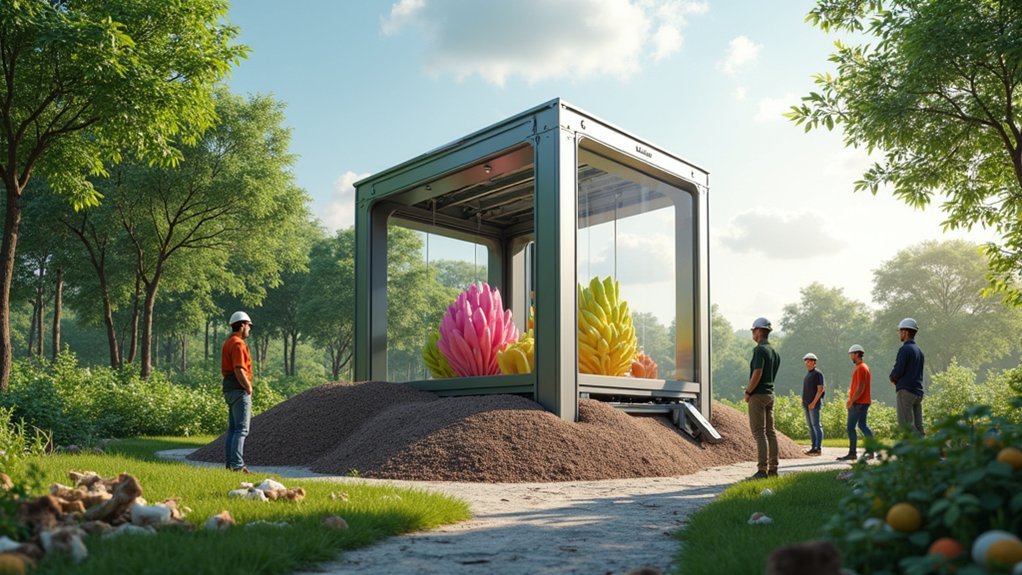
Today’s construction industry faces mounting pressure to reduce its environmental footprint, and 3D construction printing (3DCP) emerges as a revolutionary solution that’s transforming how we build.
This automated layer-by-layer additive manufacturing process considerably reduces material waste by up to 60% compared to traditional methods. You’ll find that 3D printing enables precise material placement, minimizing waste by as much as 90% through meticulous planning and parametric design.
The environmental impact becomes even more favorable when you incorporate sustainable materials like CyBe Mortar, which emits 32% less CO2 during production.
Sustainable materials like CyBe Mortar significantly reduce environmental impact, cutting CO2 emissions by 32% during production processes.
Unlike conventional construction that relies heavily on fossil fuels, 3D printing operates solely on energy, lowering overall consumption.
Integration with CAD and BIM technologies further enhances efficiency and accuracy.
Eco-Friendly Materials: CyBe Mortar and Sustainable Concrete Alternatives
While traditional concrete production accounts for approximately 8% of global CO2 emissions, innovative materials like CyBe Mortar are revolutionizing sustainable construction practices.
You’ll find that CyBe Mortar reduces CO2 emissions by up to 32% during production compared to standard mortar. This eco-friendly material contains minimal chloride and sulfate, ensuring durability with a 75-year lifespan while minimizing environmental impact.
You can also explore sustainable concrete alternatives that integrate recycled materials into 3D printing mixtures, promoting circular economy practices.
CyBe Mortar’s precise formulation provides necessary workability during printing while maintaining structural integrity.
Reducing Material Waste Through Parametric Design and Precision Printing
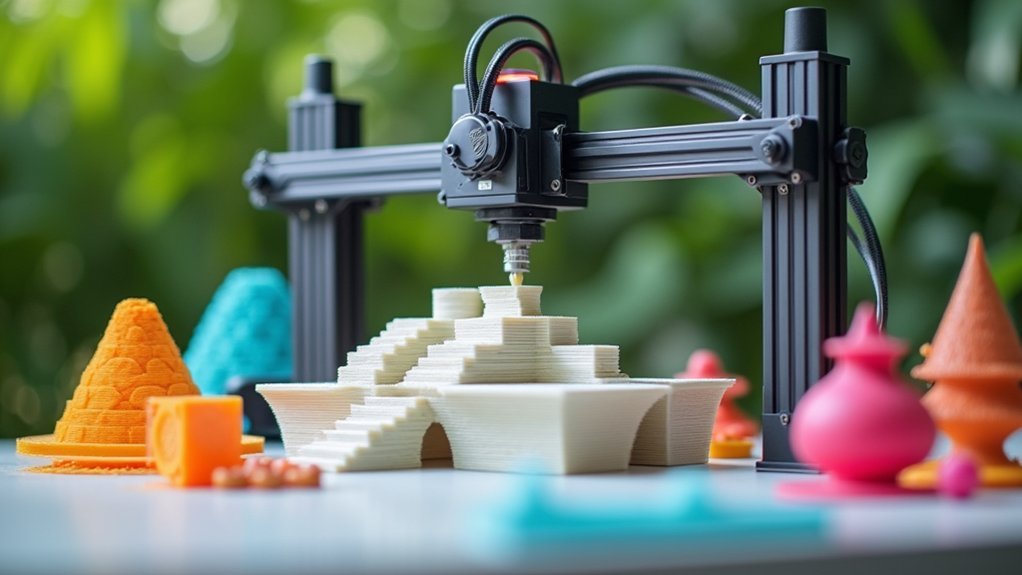
You’ll find that parametric design optimization transforms how you approach material usage in 3D construction printing, allowing you to create customized models that use only what’s structurally necessary.
Your precision material placement technology guarantees exact amounts of concrete go exactly where needed, eliminating the excess waste that plagues traditional construction methods.
You can track your environmental impact through specific waste reduction performance metrics, with studies showing material waste decreases by up to 90% compared to conventional building techniques.
Parametric Design Optimization Benefits
As construction demands shift toward greater environmental responsibility, parametric design emerges as a game-changing approach that dramatically reduces material waste in 3D printing applications. You’ll find that parametric design utilizes advanced algorithms to create optimized geometric structures, minimizing excess materials by up to 90%. This approach enables precise material deposition exactly where needed, eliminating traditional construction’s wasteful practices.
| Traditional Construction | Parametric Design 3D Printing |
|---|---|
| High material waste | Up to 90% waste reduction |
| Limited geometric flexibility | Complex shapes achievable |
| Excess resource consumption | Precise material placement |
| Higher environmental impact | Enhanced sustainability |
Through parametric design, you’re achieving sustainable construction goals while reducing project costs. The controlled printing process guarantees material efficiency, creating intricate structures that traditional methods can’t match.
Precision Material Placement Technology
Through precision material placement technology, you’re transforming construction waste from an inevitable byproduct into an obsolete concept. This revolutionary approach uses parametric design to create customizable models that drastically reduce material usage through intricate geometric patterns.
You’ll achieve up to 90% waste reduction as the controlled printing process deposits exact material amounts precisely where needed.
Advanced algorithms guarantee you’re using only necessary materials, creating a sustainable building approach that minimizes environmental impact.
The layer-by-layer technique gives you:
- Precise control over material deposition
- Enhanced structural integrity with minimal excess
- Resource-conscious design optimization
You’ll reduce material consumption while maintaining superior construction quality.
This precision material placement technology demonstrates how sustainable building practices can optimize efficiency without compromising structural performance, showcasing construction’s environmentally responsible future.
Waste Reduction Performance Metrics
Quantifiable metrics reveal the true environmental impact of 3D construction printing’s waste reduction capabilities. You’ll find that parametric design optimization delivers measurable results, with waste reduction reaching up to 90% through precise material placement. The controlled printing process guarantees you’re using only necessary amounts of construction materials, eliminating excess that typically burdens traditional building methods.
| Metric | Traditional Construction | 3D Printing |
|---|---|---|
| Material Waste | 15-30% | 2-5% |
| Resource Consumption | 100% baseline | 30-60% reduction |
| Design Flexibility | Limited geometric forms | Complex optimized shapes |
| Cost Impact | Higher material costs | Reduced project expenses |
| Environmental Footprint | Standard industry impact | markedly diminished |
These sustainable practices don’t compromise structural integrity while dramatically reducing your project’s environmental footprint and material costs.
Energy Efficiency Benefits of Additive Manufacturing in Construction
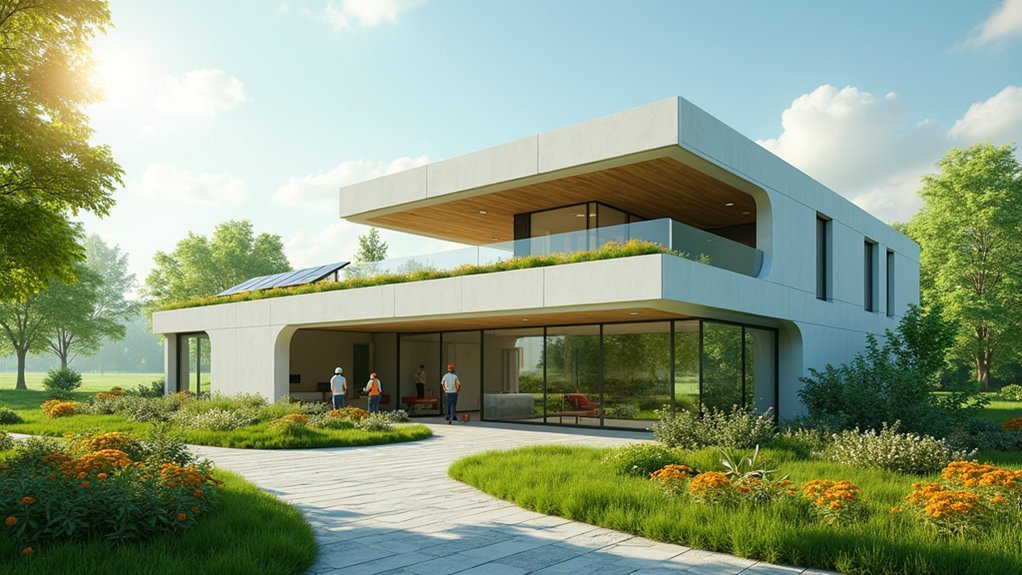
While traditional construction methods drain massive amounts of energy through heavy machinery and extended timelines, 3D construction printing revolutionizes the industry by operating purely on electrical power without fossil fuel dependency.
This shift addresses critical environmental concerns while delivering exceptional energy efficiency through additive manufacturing.
You’ll benefit from multiple energy-saving advantages:
- Reduced construction timelines allow buildings to start contributing to energy efficiency sooner after completion
- Precise layer-by-layer printing minimizes material waste, reducing energy required for production and transportation
- Advanced polymer composites provide superior insulation properties, lowering operational energy consumption
Additionally, you’ll eliminate energy needs for temporary construction facilities.
The combination of faster build times, waste reduction, and improved building performance creates an all-encompassing energy efficiency solution that transforms how you approach sustainable construction projects.
Prefabricated Prefinished Volumetric Construction (PPVC) and Modular Building Methods
Prefabricated Prefinished Volumetric Construction (PPVC) takes energy efficiency to the next level by manufacturing complete housing units in controlled factory environments before transporting them to building sites.
You’ll find this approach greatly reduces construction time while enhancing quality control through precise manufacturing processes.
These modular building methods create circular housing modules that you can reuse and refurbish, promoting sustainable construction practices.
When you integrate 3D construction printing with PPVC, you’ll achieve net-zero modular construction that considerably reduces your environmental footprint.
You’ll appreciate how these methods adapt to various architectural designs and site conditions, making them perfect for diverse residential projects.
This approach lets you easily expand or scale down your home without considerable environmental impact, aligning perfectly with sustainable living principles.
Carbon Footprint Reduction: From Cement Production to Green Building Practices
Since the construction industry generates approximately 27% of global CO2 emissions—with cement production alone accounting for 8% of these emissions—you’ll find that adopting sustainable 3D printing technologies offers a transformative solution for reducing your project’s environmental impact.
Sustainable 3D printing technologies provide a transformative pathway to dramatically reduce construction’s massive 27% contribution to global carbon emissions.
3D printing technologies deliver impressive carbon footprint reduction through:
- Lower emissions during production – Materials like CyBe Mortar emit up to 32% less CO2 compared to traditional concrete.
- Dramatic waste reduction – Parametric design and advanced printing minimize material waste by up to 90%.
- Reduced resource consumption – Sustainable building practices can decrease material usage by 30-60%.
You’ll benefit from long-term advantages including lower utility costs and enhanced weather resilience, making 3D printed homes a viable solution for future housing needs.
Robotic Arm and Gantry System Technologies for Large-Scale Sustainable Construction
You’ll find that robotic arm technologies revolutionize sustainable construction by offering unmatched flexibility for creating complex geometries while maintaining precise material deposition.
When you’re tackling large-scale projects, gantry systems provide the efficiency you need through advanced contouring methods that optimize material usage and reduce waste.
These technologies integrate seamlessly with your CAD and BIM systems, automating up to 80% of labor costs while enabling eco-friendly material applications that considerably reduce your project’s carbon footprint.
Robotic Arm Flexibility
When traditional construction methods hit their limits with complex architectural designs, robotic arm technologies break through those barriers by offering unprecedented flexibility to print intricate geometries from multiple angles.
You’ll find these systems revolutionizing the construction industry by enabling architects to realize designs that were previously impossible or prohibitively expensive.
The adaptability of robotic arms transforms sustainable construction practices through:
- Multi-directional printing capabilities that eliminate the need for traditional support structures and formwork
- On-site construction flexibility that reduces transportation emissions and minimizes your project’s carbon footprint
- Compatibility with specialized materials like CyBe Mortar, optimizing resource usage while maintaining structural integrity
You can integrate these technologies into modular construction methods, enhancing efficiency while promoting environmentally conscious design strategies that benefit both your project and the planet.
Gantry System Efficiency
While robotic arms excel at intricate geometries, gantry systems dominate large-scale construction projects through their unmatched efficiency in covering expansive build areas. You’ll find that gantry systems utilize stationary frameworks moving along defined paths, delivering high precision across massive construction zones. This systematic approach dramatically reduces construction time, with projects completing in just 24 hours using advanced printing techniques.
| Feature | Traditional Methods | Gantry System |
|---|---|---|
| Material Waste | High excess | 60% reduction |
| Construction Time | Weeks/months | 24-48 hours |
| Precision | Variable | Consistently high |
| Scalability | Limited | Expansive coverage |
You’ll appreciate how gantry systems minimize material waste through precise deposition, supporting modular construction approaches. Their adaptability enables circular housing modules that can be reused or refurbished, making your construction practices more sustainable while maintaining efficiency.
Cost-Effectiveness and Timeline Advantages of 3D Printed Sustainable Housing
Although initial investment costs for 3D printed construction equipment might seem steep, you’ll discover that sustainable 3D printing dramatically transforms both your project timeline and budget.
The cost-effectiveness becomes apparent when you consider the dramatic reductions across multiple areas. Construction timelines shrink from months to mere hours, with homes completed in as little as 24 hours.
3D printing transforms construction from month-long projects into 24-hour builds, delivering unprecedented cost savings and efficiency gains.
Your savings multiply through:
- Labor cost reduction – Automation cuts labor expenses by up to 80%
- Materials efficiency – Precise deposition reduces waste by 60%
- Long-term savings – Energy-efficient designs lower utility bills over time
The market’s projected growth from $190 million in 2021 to $680 million by 2030 reflects increasing recognition of these advantages, making 3D printed sustainable housing an increasingly viable solution.
Global Applications: Sustainable 3D Construction Projects Across Continents
From the bustling streets of Austin to the innovative landscapes of the Netherlands, sustainable 3D construction projects are reshaping how you’ll think about building across continents.
In Austin, Texas, you’ll find ICON and New Story’s groundbreaking achievement: 3D printing homes in just 24 hours using Vulcan printer technology. Mexico’s partnership with CHALE brings affordable 3D-printed housing to underserved communities, tackling housing shortages sustainably.
You’ll discover the Netherlands leading infrastructure innovation with their 3D-printed bike bridge in Gemert, proving sustainable construction extends beyond housing.
China showcases integration possibilities through their 2019 pedestrian bridge, combining traditional reinforced concrete with 3D printing elements.
These diverse global applications demonstrate that sustainable 3D construction isn’t just theoretical—it’s actively transforming communities, infrastructure, and building practices worldwide.
Regulatory Frameworks and Industry Standards for Green Construction Innovation
You’ll find that current building codes weren’t designed for 3D printing technology, creating significant regulatory gaps that slow adoption of sustainable construction methods.
These outdated frameworks can’t adequately address the unique safety requirements and material properties involved in additive manufacturing for buildings.
However, you can help bridge these gaps by supporting industry collaboration standards that bring together manufacturers, regulators, and construction professionals to develop detailed guidelines for green 3D printing practices.
Current Regulatory Gaps
While sustainable 3D construction printing offers unprecedented opportunities for green building innovation, the regulatory landscape hasn’t kept pace with technological advancement.
You’ll find that current regulatory frameworks often lack specific guidelines for 3D printing materials and methods, creating significant barriers to market entry.
The construction market faces several critical regulatory gaps:
- Absence of standardized building codes – Most regions don’t have thorough regulations addressing additive manufacturing in construction.
- Compliance uncertainty – You can’t easily determine safety standards for innovative sustainable materials.
- Project approval delays – Without clear guidelines, your development timelines extend and costs increase.
These regulatory shortcomings complicate local building code alignment across regions.
Industry leaders increasingly advocate for collaboration between regulators and construction companies to develop updated standards that accommodate emerging 3D printing technologies and sustainable construction practices.
Industry Collaboration Standards
As the construction industry grapples with regulatory uncertainty, collaborative efforts between stakeholders are reshaping how standards develop for sustainable 3D printing technologies.
You’ll find that partnerships between regulators and industry leaders create extensive frameworks supporting green construction practices while ensuring safety compliance. These collaborations integrate insights from tech startups and established construction firms, driving standards evolution and promoting widespread adoption of sustainable innovations.
When you engage in dialogue with regulators, you’re actively shaping effective industry standards that accommodate new materials and technologies.
This collaborative approach streamlines complex regulatory environments, reducing barriers to market entry for alternative construction methods. You’re fostering innovation by working together to develop updated guidelines that balance sustainability goals with safety requirements, ultimately accelerating the shift to eco-friendly 3D construction printing solutions.
Advanced Material Properties: Durability, Insulation, and Recycled Content Integration
Modern 3D construction printing leverages advanced materials that deliver exceptional performance across three critical dimensions: structural longevity, thermal efficiency, and environmental responsibility.
Advanced 3D construction materials excel in three key areas: lasting structural integrity, superior thermal performance, and sustainable environmental impact.
When you choose 3D-printed construction materials, you’re investing in proven durability that lasts at least 75 years. These materials offer superior insulation properties that considerably reduce your building’s energy consumption throughout its lifecycle.
The integration of recycled materials creates additional sustainability benefits:
- CyBe Mortar reduces CO2 emissions by up to 32% compared to traditional mortar during production
- Recycled content integration promotes circular economy practices within construction workflows
- Parametric design optimization minimizes material waste through complex geometries that use resources efficiently
You’ll find that these advanced material properties don’t just meet current construction standards—they exceed them while supporting your environmental goals.
Future Market Growth and Scaling Challenges for Sustainable 3D Construction Solutions
Though the sustainable 3D construction market shows tremendous promise with projections reaching $680 million by 2030—representing explosive growth from just $190 million in 2021—you’ll face significant scaling challenges that could slow widespread adoption.
High initial costs for machinery and technology create substantial barriers for many companies entering this space. You’ll also encounter a vital shortage of trained professionals capable of operating and maintaining advanced 3D printing equipment, limiting skilled labor availability.
Additionally, regulatory frameworks haven’t kept pace with technological advancements, creating uncertainty around implementation standards. The ongoing development of specialized construction materials remains essential for overcoming these scaling challenges and achieving the market growth potential that sustainable 3D construction promises.
Frequently Asked Questions
How Is 3D Printing in Construction Sustainable?
You’ll reduce construction’s environmental impact through 3D printing by cutting CO2 emissions up to 32%, minimizing material waste by 90%, incorporating recycled materials, and creating energy-efficient buildings with superior insulation properties.
What Are the Sustainable Materials for 3D Printing?
You’ll find CyBe Mortar reduces CO2 emissions by 32% compared to standard mortar. You can also use recycled materials in printing mixtures and low-chloride formulations that last 75+ years.
How to Make 3D Printing Sustainable?
You’ll make 3D printing sustainable by using low-carbon materials like CyBe Mortar, optimizing designs to reduce material usage by 90%, incorporating recycled materials, and eliminating fossil fuels from your printing process.
What Is the Most Sustainable 3D Printer?
You’ll find gantry systems and robotic arms are the most sustainable 3D printers because they’re electric-powered, reduce waste by 90%, use materials like CyBe Mortar, and incorporate recycled materials effectively.