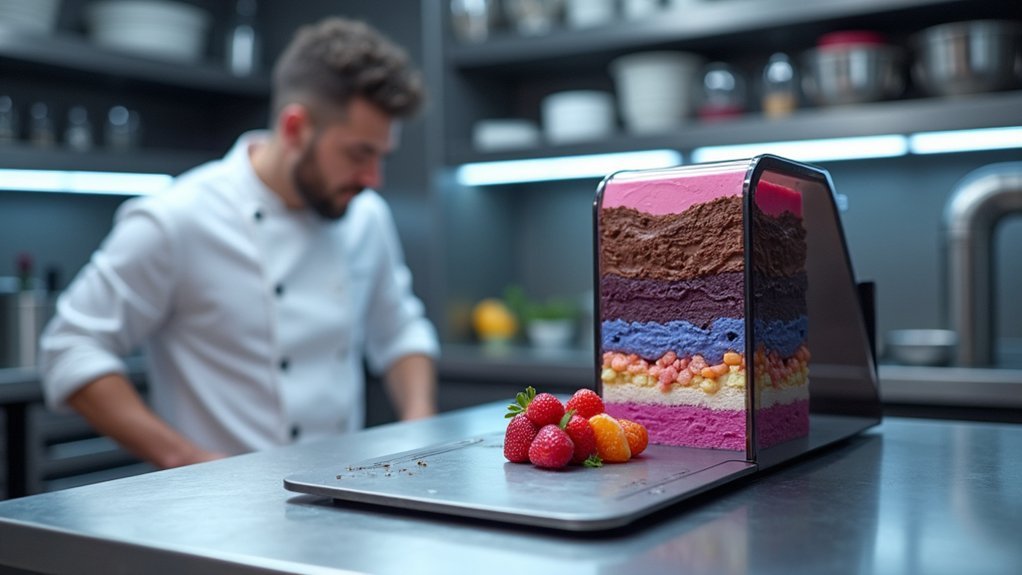
Multi-material food printing technology lets you simultaneously extrude different edible ingredients through specialized nozzles to create complex, layered food structures impossible with traditional cooking methods. You’ll find three primary approaches: extrusion-based systems for paste-like materials, laser sintering for powdered ingredients, and inkjet applications for liquid food inks. This technology addresses personalized nutrition needs, dietary restrictions, and healthcare applications like texture-modified foods for swallowing disorders. Understanding these fundamental concepts opens doors to exploring deeper applications and innovations.
Understanding Multi Material Direct Ink Writing Techniques
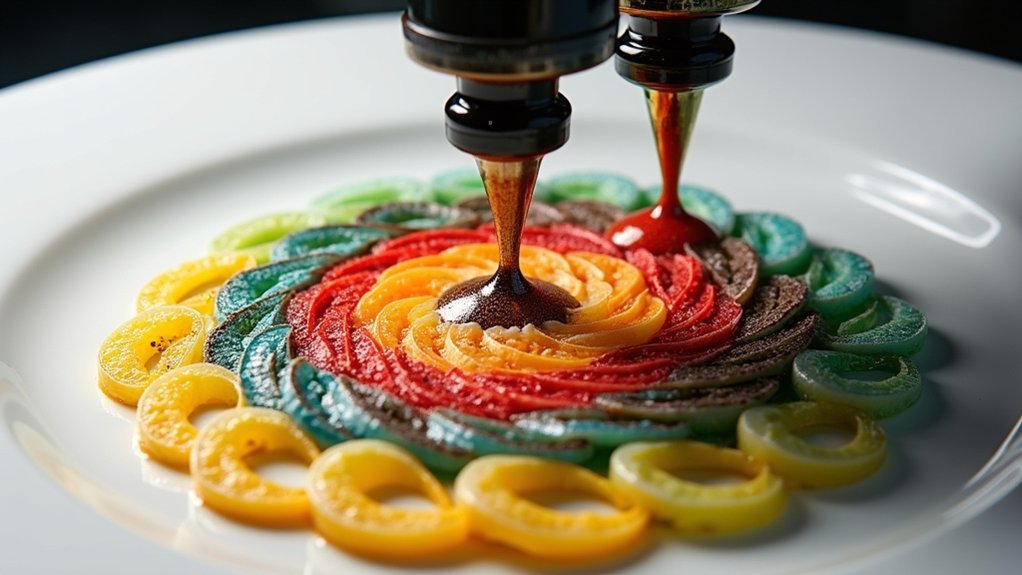
While traditional 3D food printing relies on single-material extrusion, multi-material direct ink writing (DIW) revolutionizes the field by enabling simultaneous printing with different food inks through multi-channel nozzles.
You’ll find this technology addresses seamless material shifts using an innovative Y-junction nozzle design that facilitates rapid ink switching while reducing problematic backflow issues.
The Y-junction nozzle proves particularly effective when you’re working with food inks having notably different properties.
Researchers at Singapore University of Technology and Design successfully demonstrated continuous printing with two food inks showing a yield stress difference of approximately 10.
Singapore researchers achieved breakthrough continuous printing using two food inks with dramatically different yield stress properties, demonstrating advanced multi-material capabilities.
This breakthrough allows you to create anisotropic arrangements in your 3D food printing projects, delivering enhanced textural and aesthetic qualities while maintaining excellent print consistency throughout the entire fabrication process.
Core Technologies and Printing Methods
You’ll encounter three primary printing methods when working with multi-material food systems: extrusion-based techniques that push materials through specialized nozzles, laser sintering that uses heat to fuse powdered ingredients, and inkjet applications that precisely deposit liquid food inks.
Each method offers distinct advantages for creating complex food structures with varying textures and nutritional profiles. Your choice of printing technology will determine the types of materials you can use and the final product’s quality.
Extrusion-Based Printing Methods
When you’re exploring 3D food printing technologies, extrusion-based printing methods stand out as the most widely adopted approach in the industry.
You’ll find these systems use a three-axis stage with computer-controlled extrusion heads to build food structures layer by layer using paste-like ingredients like purées, frosting, and melted chocolate.
You’ll need to carefully adjust parameters including nozzle diameter, printing speed, and material viscosity to guarantee proper deposition and structural integrity.
Hot-melt extrusion slightly heats materials above their melting point for easier manipulation.
Alternative techniques like selective laser sintering and binder jetting bond powdered ingredients using lasers or liquid binders.
This technology enables you to create complex food structures while achieving customized food aesthetics and nutritional profiles tailored to specific dietary requirements.
Laser Sintering Techniques
Laser sintering in food printing represents a precision-driven approach that employs focused laser beams to selectively fuse powdered ingredients into solid, edible structures.
You’ll find this technique particularly effective with materials like sugar and protein powders, which bond seamlessly under controlled laser parameters. Unlike traditional food printing methods, laser sintering enables you to create intricate details and complex geometries that would otherwise be impossible to achieve.
You’ll need to carefully control laser power and speed to guarantee proper layer adhesion without overheating your materials.
The process builds printed structures layer by layer, offering exceptional design flexibility. What makes this technology especially valuable is its potential for mass customization, allowing you to produce unique, personalized food items tailored to specific preferences and dietary requirements.
Inkjet Food Applications
While laser sintering builds structures through material fusion, inkjet food printing takes a fundamentally different approach by depositing low-viscosity ingredients like sauces and colored food inks directly onto surfaces.
You’ll find this non-contact method excels at creating intricate designs and patterns without disturbing your food’s underlying structure. When you’re using a multi-material 3D printer for food printing, inkjet technology becomes invaluable for surface decoration and detailed imagery on customized cakes and chocolates.
The ink formulations you’ll work with require careful development to maintain flavor and safety standards.
Modern innovations focus on natural, edible food ingredients that meet consumer demands for sustainable food options, making this technology increasingly versatile for commercial applications.
Compatible Edible Materials and Ingredients
Although multi-material food printing technology accommodates various printing methods, each technique requires specific ingredient properties to achieve ideal results. You’ll find that extrusion-based systems work best with medium-viscosity materials like jelly, frosting, cheese, and mashed potatoes through a multi-channel nozzle. These food materials maintain shape retention during printing.
For selective laser sintering, you can use powdered ingredients including sugar, flour, and protein powders to create intricate structures. Inkjet applications require low-viscosity ingredients such as sauces and colored food inks for surface decoration.
| Printing Method | Compatible Materials | Key Properties |
|---|---|---|
| Extrusion | Purées, gels, frosting | Medium viscosity |
| Laser Sintering | Sugar, protein powders | Fine particle size |
| Inkjet | Sauces, food inks | Low viscosity |
Successfully combining different ingredients enables you to create complex printed foods with enhanced visual appeal and functionality.
Applications in Personalized Nutrition and Healthcare
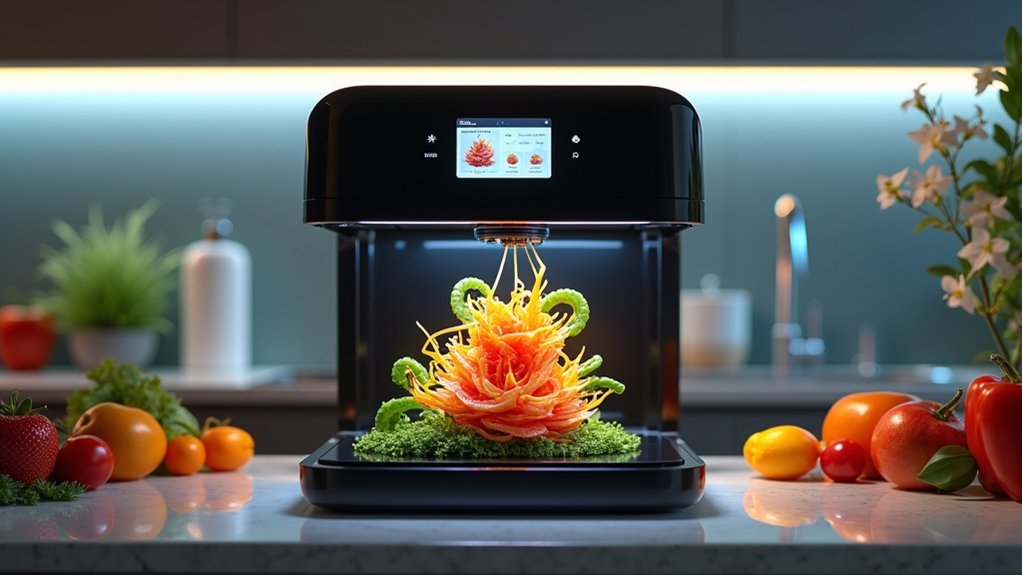
You can leverage multi-material food printing to address your specific dietary restrictions, whether you’re managing food allergies, nutritional deficiencies, or unique texture requirements due to medical conditions.
This technology enables healthcare providers to create customized meals that meet your exact nutritional needs while ensuring the food remains appealing and safe for consumption.
You’ll find that 3D-printed solutions can transform challenging ingredients like protein powders or therapeutic compounds into palatable, personalized nutrition that supports your health goals.
Customized Dietary Requirements
Because each person’s nutritional needs differ based on health conditions, allergies, and dietary preferences, multi-material food printing technology revolutionizes how we approach personalized nutrition.
This innovation enables you to create personalized meals by combining various ingredients with distinct nutritional profiles, ensuring your specific dietary needs are met precisely.
Consider how 3D food printing transforms nutrition through:
- Targeted health solutions – You’ll receive customized nutritional gummies tailored to your survey responses, addressing specific health requirements.
- Adaptive textures – Softer, appealing food options accommodate elderly individuals with chewing difficulties while maintaining adequate nutrition.
- Ingredient transformation – Unattractive but nutritious sources like insect protein become visually appealing meals, improving your dietary habits.
Multi-material food printing seamlessly shifts between food inks, creating meals that match your unique health conditions and preferences.
Medical Nutrition Solutions
When medical conditions like diabetes, kidney disease, or heart failure restrict your food choices, multi-material food printing technology transforms therapeutic nutrition from a burden into an accessible solution.
You can receive customized meals that precisely control sodium, protein, carbohydrates, and other nutrients based on your specific medical requirements.
This technology addresses swallowing disorders like dysphagia by creating texture-modified foods that maintain nutritional value while remaining safe to consume.
Through 3D printing, you’ll access personalized nutritional solutions that would be impossible with traditional food preparation methods.
Multi-material food printing enables healthcare providers to design meals that meet strict dietary protocols while preserving taste and visual appeal, ensuring you maintain proper nutrition without compromising your treatment plan.
Commercial Implementation and Market Development
Although multi-material food printing technology remains in its early stages, several pioneering companies have successfully brought 3D-printed foods to market, demonstrating the commercial viability of this innovative approach.
You’ll find that commercial implementation has gained momentum as businesses recognize the potential to address diverse nutritional needs while creating sustainable food alternatives.
Market development showcases impressive achievements:
- Nourished produces personalized vitamin gummies, allowing you to customize supplements based on your specific health requirements.
- Revo Foods launched 3D-printed vegan salmon filets in German supermarkets, bringing plant-based seafood alternatives to mainstream consumers.
- Space exploration applications target astronaut meal customization, where you’d receive precisely tailored nutrition for extended missions.
Each food tech company demonstrates how multi-material food printing transforms personalized nutrition from concept to reality.
Technical Challenges and Current Limitations
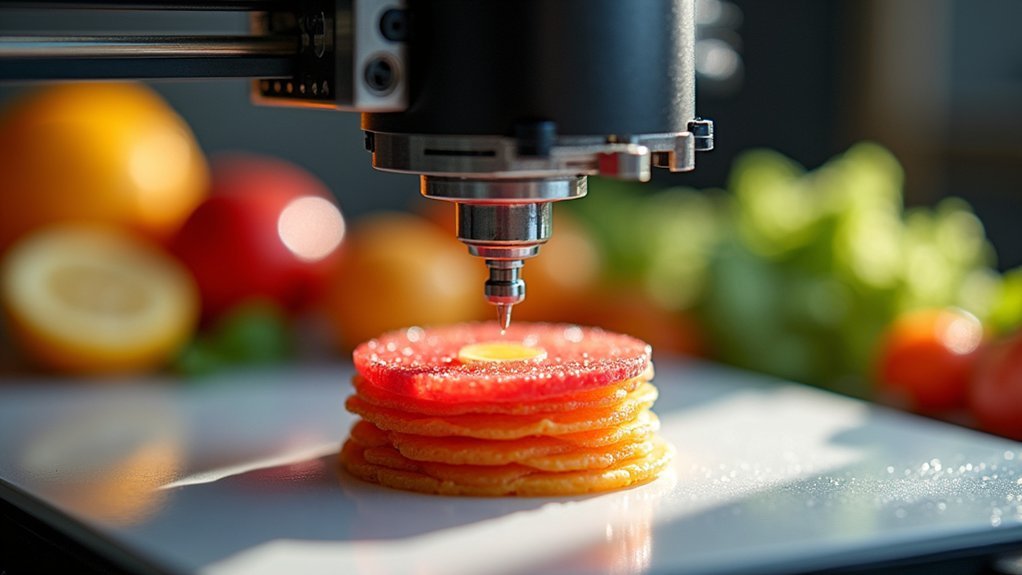
Despite promising commercial breakthroughs, multi-material food printing technology confronts significant technical hurdles that limit its widespread adoption.
You’ll encounter significant challenges when attempting seamless shifts between different materials, often resulting in fragmented prints that compromise structural integrity. Existing methods rely on independently controlled syringes, making alignment of various food inks extremely difficult and complicating continuous filament creation.
You’ll face backflow issues when higher-yield-stress fluids interfere with lower-yield-stress channels during real-time material switching, directly affecting print quality and consistency.
The critical need for precise machine design and nozzle alignment becomes apparent when discontinuous interfaces occur where materials overlap. Current solutions focus on optimizing designs like Y-junction nozzles to enhance co-laminar extrusion, yet these technical challenges continue limiting multi-material food printing’s practical implementation.
Food Safety Standards and Regulatory Considerations
As multi-material food printing technology advances beyond laboratory settings, you’ll need to navigate complex food safety standards that govern every aspect of the manufacturing process.
Regulatory bodies like the FDA require all food contact materials to meet strict safety requirements, ensuring your printed products won’t harm consumers.
FDA safety standards for food contact materials ensure 3D-printed products meet rigorous consumer protection requirements before market release.
Your 3D food printer design must incorporate three critical safety elements:
- BPA-free stainless steel components that prevent chemical leaching
- Robust sanitation protocols that eliminate bacterial accumulation
- Temperature-controlled environments that maintain microbial stability
You’ll face stringent hygiene requirements throughout printing and equipment maintenance phases.
Compliance with local and international regulations isn’t optional—it’s essential for gaining consumer trust and market approval for your 3D-printed food products.
Future Developments and Industry Trends
While today’s multi-material food printers create basic layered structures, tomorrow’s systems will revolutionize how you approach personalized nutrition and culinary presentation. Singapore University of Technology and Design’s research is advancing direct ink writing techniques, enabling seamless changes between different food inks for superior print quality.
| Development Area | Current Challenge | Future Solution |
|---|---|---|
| Ink Switching | Manual changes | Microfluidics-inspired rapid switching |
| Print Quality | Backflow issues | Optimized printing process |
| Food Structure | Basic layers | Co-laminar extrusion complexity |
| Customization | Limited options | Individual dietary tailoring |
| Market Reach | Laboratory scale | Enhanced commercial scalability |
You’ll see these innovations transform culinary creations, making personalized nutrition accessible while creating visually stunning food structures that redefine dining experiences.
Frequently Asked Questions
What Is the Meaning of Multi-Material Printing?
You’re using multiple materials simultaneously in a single printing process. You can combine different substances with varying properties to create complex structures, textures, and compositions that aren’t possible with single-material printing methods.
Are FDM Prints Food Safe?
FDM prints aren’t automatically food safe. You’ll need food-grade filaments like FDA-approved PLA or PETG, maintain printer hygiene, and apply food-safe coatings to seal micro-pores that can harbor bacteria.
Is PLA Food Safe FDA Approved?
PLA isn’t explicitly FDA-approved for food use, but it’s recognized as safe for certain applications. You’ll need to verify your specific PLA filament is marked “food-safe” by the manufacturer before using it.
What Is FDM Print Technology?
You’ll find FDM technology builds objects by heating thermoplastic filaments and extruding them layer-by-layer through a nozzle. It’s widely used in manufacturing and food printing applications for creating complex designs.