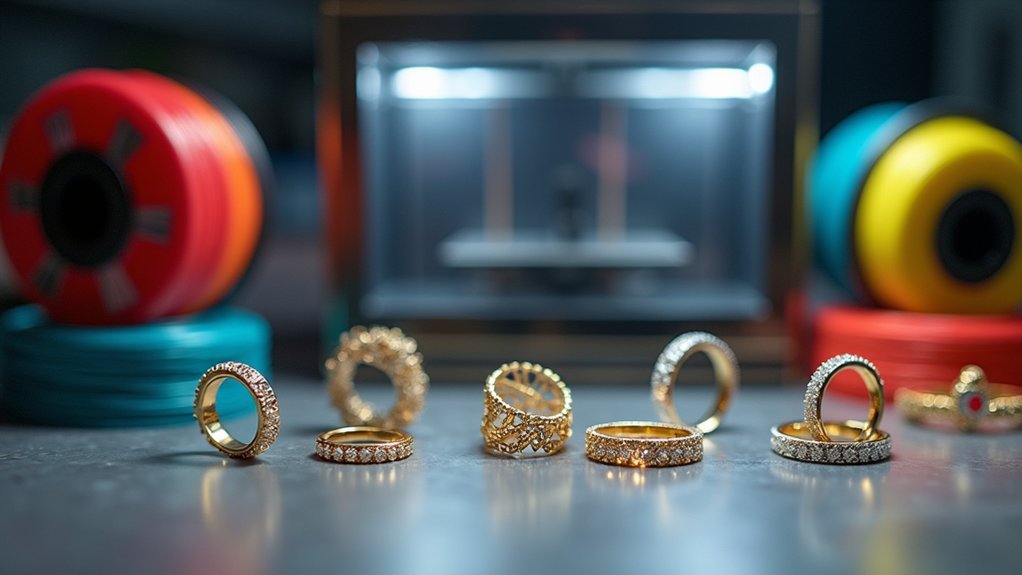
You can scale your jewelry production dramatically by leveraging 3D printing technology that produces multiple intricate pieces simultaneously with 0.2mm precision. This approach eliminates expensive tooling, reduces material waste by up to 60%, and cuts prototyping time by 80% compared to traditional methods. You’ll achieve mass customization while maintaining artisanal quality through castable resins and direct metal printing in precious alloys. The insights ahead reveal proven strategies for sustainable growth.
Understanding Production Volume Capabilities in 3D Jewelry Manufacturing
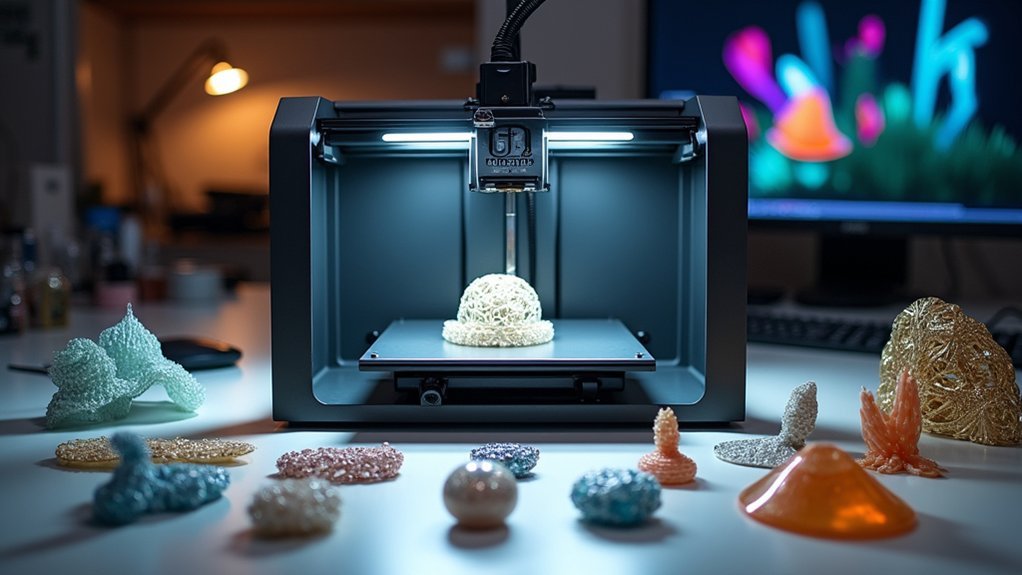
Today’s 3D printing technology transforms jewelry manufacturing by enabling you to produce multiple complex pieces simultaneously, whether you’re creating a single custom ring or hundreds of identical designs.
You can achieve mass customization at scale, producing numerous wax or resin patterns in a single print run without compromising quality.
Rapid prototyping capabilities let you shift from concept to production within hours, dramatically cutting your time to market.
The technology’s precision delivers intricate designs with details as fine as 0.2 mm, ensuring consistent replication across large batches.
Additive manufacturing processes minimize material waste, making it economically viable for both bespoke pieces and high-volume production runs, giving you flexibility to meet varying market demands.
Material Selection Strategies for High-Volume Jewelry Production
When scaling your jewelry production, strategic material selection becomes the cornerstone of operational success and cost efficiency.
You’ll need castable resins with low ash content for clean burnouts, ensuring your casting process eliminates residue that compromises quality. Powder bed fusion printing technology enables direct metal printing in precious alloys, delivering durability for intricate design elements in high-volume runs.
Consider nylon for prototyping phases—it’ll dramatically cut costs and lead times while enabling rapid design iterations.
Advanced wax-like materials with superior burnout properties streamline your casting workflow and minimize waste. You must evaluate mechanical strength during printing to support delicate structures throughout high-volume jewelry production.
These materials choices directly impact your ability to maintain consistent quality standards while meeting aggressive production timelines and cost targets.
Optimizing Workflow Integration Between Traditional and Digital Manufacturing
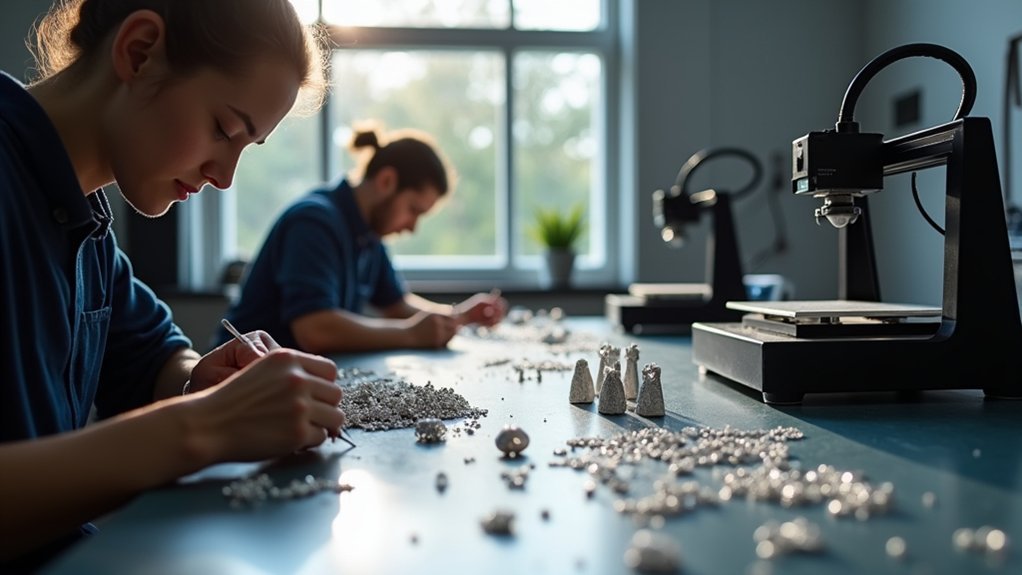
When you’re integrating 3D printing with traditional jewelry methods, you’ll need to establish clear interchange points where digital processes hand off to artisanal techniques without disrupting your production flow.
Your quality control standards must adapt to monitor both the precision of 3D-printed components and the craftsmanship of finishing work, ensuring consistency across hybrid manufacturing stages.
You can’t afford quality gaps between digital and manual processes, so build checkpoints that verify each component meets your specifications before moving to the next production phase.
Seamless Process Transitions
Although traditional jewelry manufacturing has dominated the industry for centuries, integrating 3D printing technology into existing workflows creates unprecedented opportunities for efficiency and creativity.
You’ll discover that jewelry manufacturers can achieve seamless process changes by combining digital designs with established techniques like lost-wax casting. When you implement rapid prototyping through high-resolution 3D printers, you’re able to produce intricate details down to 0.2 mm while maintaining exceptional quality standards.
Your production timeline accelerates considerably as you generate casting patterns digitally, eliminating traditional bottlenecks.
You’ll find that this hybrid approach reduces material waste and makes bespoke jewelry more accessible. By streamlining changes from design to finished product, you’re maintaining craftsmanship standards while considerably cutting production time and costs.
Quality Control Standards
Because quality control determines the success of any jewelry manufacturing operation, you’ll need to establish rigorous standards that bridge traditional craftsmanship with digital precision.
Integrating 3D printing technology into your workflow enhances quality control through precise design replication and reduced manual errors. High-resolution printers achieve intricate details down to 0.2 mm, meeting stringent fine jewelry standards.
Digital workflows enable quicker identification and correction of design flaws, dramatically improving production efficiency. You’ll maintain consistent surface finishes and accuracy by combining traditional techniques with 3D printing capabilities.
Diagnostic software and consultative services provide continuous support, helping you optimize digital manufacturing integration while preserving quality standards. This hybrid approach guarantees your scaled production maintains the exceptional quality your customers expect.
Cost-Effectiveness Analysis for Scaling Operations
As jewelry businesses evaluate scaling opportunities, 3D printing technology emerges as a game-changing investment that transforms both operational efficiency and financial performance. The cost-effectiveness becomes immediately apparent when you eliminate expensive tooling and reduce operational costs by up to 60%. High-resolution printing capabilities enable intricate designs while minimizing material waste, directly impacting your bottom line.
| Traditional Methods | 3D Printing Technology | Your Savings |
|---|---|---|
| Days for prototypes | Hours for completion | 80% time reduction |
| High material waste | Minimal waste generation | 50% material costs |
| Expensive tooling required | No tooling needed | $10,000+ upfront savings |
You’ll reduce production costs considerably while accessing previously impossible design complexity. Multiple patterns printed simultaneously maximize efficiency, making custom pieces financially viable and scaling operations profitable from day one.
Quality Control Systems for Mass Production Environments
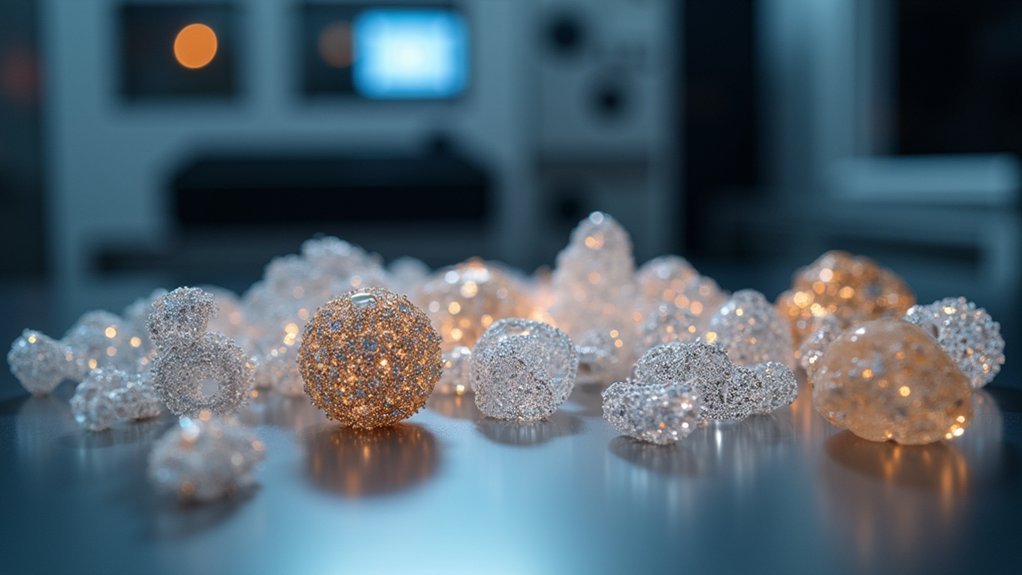
When you shift from prototype development to mass production, establishing rigorous quality control systems becomes your competitive advantage in maintaining consistent output standards.
3D printing technology delivers high fidelity and repeatability essential for jewelry manufacturing at scale.
You’ll need thorough pre-printing checks, including wall thickness verification and support structure design, to prevent structural weaknesses in delicate pieces.
LFS technology enhances precision while delivering smooth surfaces that minimize post-processing requirements.
Regular calibration and maintenance of your printers’ Light Processing Units sustain accuracy throughout high-volume production runs.
Implement continuous diagnostics through software like 3D Connect to identify issues swiftly.
These controlled processes guarantee your quality control systems maintain excellence while production scales efficiently.
Equipment Requirements for Large-Scale Jewelry Manufacturing
Three fundamental equipment categories form the backbone of successful large-scale jewelry manufacturing: high-resolution printers, specialized post-processing stations, and quality monitoring systems.
You’ll need high-resolution printers like the Formlabs Form 3, achieving 25-micron detail precision for intricate designs. Multiple 3D printing units enable simultaneous production runs, optimizing throughput while reducing lead times.
Castable resins formulated for clean burnout are vital for investment casting processes, maintaining fine detail reproduction. You should prioritize printers with heated build chambers to enhance print quality and reduce warping in high-volume environments.
Post-processing equipment including polishing and finishing stations becomes essential for achieving desired surface quality.
This extensive setup guarantees jewelry designers can consistently produce large batches while maintaining the aesthetic standards required for commercial success.
Managing Complex Designs at Production Scale
While sophisticated equipment forms the foundation of your manufacturing operation, the real challenge emerges when you’re producing intricate designs that push the boundaries of traditional jewelry making.
3D printing technology enables you to tackle complex designs with precision, achieving details down to 0.2 mm across multiple pieces simultaneously. You’ll find that advanced materials combined with additive manufacturing techniques reveal geometries impossible through conventional methods, particularly hollow and lightweight structures essential for production scale operations.
Your workflow transforms dramatically when managing intricate designs at volume.
What once required days of meticulous handwork now happens in hours, allowing you to respond quickly to market demands. This scalability in jewelry manufacturing means you can maintain design complexity while meeting commercial deadlines, ensuring each piece retains its artistic integrity throughout the production process.
Building Sustainable Growth Models With 3D Printing Technology
You can build a sustainable jewelry business by leveraging 3D printing’s ability to slash production costs through reduced material waste and elimination of expensive tooling requirements.
This technology lets you respond to market changes faster than traditional manufacturing methods, giving you a competitive edge when trends shift.
You’ll achieve scalable growth by combining these cost savings with rapid prototyping capabilities that keep your designs fresh and relevant.
Reducing Production Costs
As jewelry manufacturing costs continue to climb, 3D printing technology offers a transformative solution that fundamentally changes how you approach production economics.
You’ll dramatically cut material waste by optimizing resource utilization, making bespoke pieces economically viable for both you and your customers. Digital workflows streamline your entire production process, reducing labor costs while enhancing operational efficiency.
Through rapid design iterations, you’ll compress prototype development from days to hours, accelerating your time-to-market considerably.
When you produce multiple complex patterns in single runs, you’re supporting both customization demands and high-volume production requirements simultaneously.
This technology empowers you as an independent designer to lower capital investment and operational expenses, enabling quick responses to market trends while maintaining profitability that jewelry manufacturers need for sustainable growth.
Accelerating Market Response
When market trends shift rapidly in today’s jewelry industry, your ability to respond within hours rather than weeks determines whether you’ll capture emerging opportunities or watch competitors dominate new segments.
3D printing technology transforms your production timeline by compressing prototype development cycles, enabling you to test multiple design variations simultaneously and bring trend-responsive pieces to market before demand peaks.
Your rapid production capabilities through 3D printing let you create multiple complex patterns in single runs, supporting both customization demands and volume requirements.
The technology’s 25-micron resolution guarantees your intricate designs capture fine details that resonate with current trends.
This enhanced market response capability positions you to adapt quickly to consumer preferences, whether you’re pursuing limited-edition collections or scaled manufacturing runs that capitalize on emerging opportunities.
Frequently Asked Questions
Which Type of 3D Printing Technology Is Used in Jewelry Production?
You’ll primarily use stereolithography (SLA) and digital light processing (DLP) for high-resolution jewelry with intricate details. You can also use powder bed fusion for direct metal printing in precious alloys.
Can I Make Jewelry With a 3D Printer?
You can absolutely make jewelry with a 3D printer using castable resins or metal powders. You’ll achieve intricate details, rapid prototyping, and significant material savings while creating both custom pieces and high-volume production runs.
Is 90% of All Jewelry Made Using 3D Printing?
No, you shouldn’t believe that statistic. Currently, only 30% to 50% of jewelry uses 3D printing technology. While it’s rapidly growing and revolutionizing production, traditional craftsmanship methods still dominate the industry.
Which Technology Is Best Suited for Producing Highly Detailed Jewelry Models?
You’ll find vat photopolymerization technology, particularly SLA and DLP printers with LFS capabilities, best suited for highly detailed jewelry models. They’ll achieve 25-micron resolution with smooth finishes, minimizing your post-processing work.

Leave a Reply