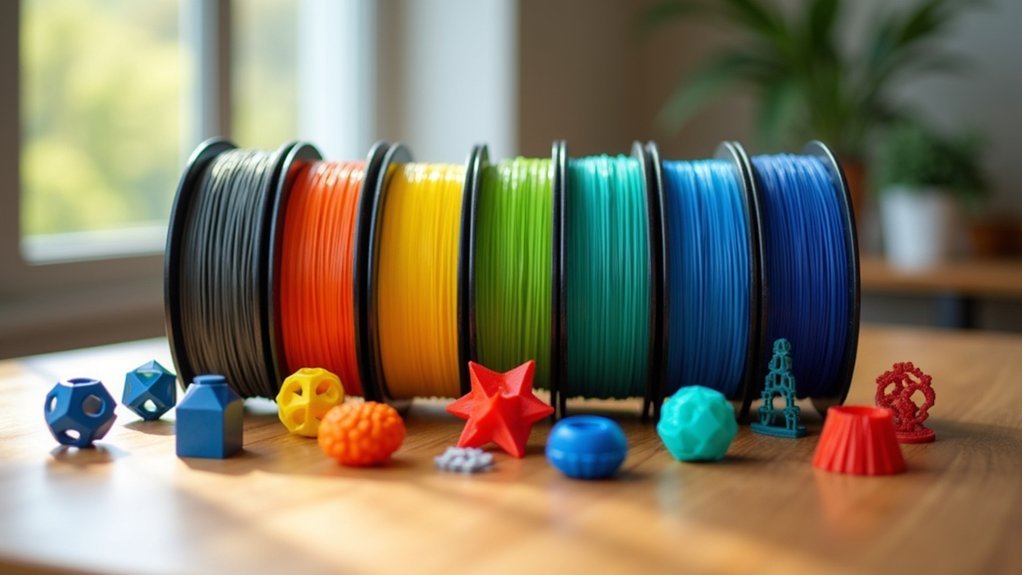
You’ll want to prioritize PLA, PLA+, and PETG as your top safe 3D printing materials since they emit minimal VOCs and print at lower temperatures. Wood-filled PLA offers natural aesthetics while maintaining safety, and bio-based TPU provides flexibility without toxicity concerns. HIPS delivers lightweight results with minimal odor, while recycled PETG teaches sustainability. For outdoor projects, ASA offers UV resistance with proper ventilation. These materials guarantee classroom safety while delivering excellent print quality and educational value for your students’ creative projects.
PLA (Polylactic Acid): The Student-Friendly Standard

When you’re starting your 3D printing journey as a student, PLA (Polylactic Acid) stands out as the most beginner-friendly material you can choose. This biodegradable thermoplastic derives from renewable resources like corn starch, making it environmentally friendly for conscious learners.
You’ll appreciate PLA’s low printing temperatures of 190-220°C, which simplify setup and reduce safety concerns in classroom settings. It adheres excellently to printer beds, preventing frustrating print failures that discourage beginners.
PLA delivers exceptional dimensional accuracy and smooth finishes, enabling you to create detailed prototypes without extensive post-processing. Unlike other filaments, it emits minimal volatile organic compounds, ensuring safer indoor use.
You can produce durable parts while choosing from numerous colors and finishes, giving your projects professional appearance and creative flexibility.
PETG: Durable and Low-Emission Option for Classrooms
If you need stronger parts for demanding classroom projects, PETG (Polyethylene Terephthalate Glycol) offers exceptional durability that surpasses PLA’s capabilities. This material provides outstanding impact resistance, making it perfect for functional prototypes and mechanical components that’ll endure student handling.
PETG’s low emissions create a safer learning environment compared to other advanced filaments, while its excellent bed adhesion reduces print failures. You’ll appreciate its UV resistance when creating outdoor models that won’t degrade under sunlight exposure.
| Property | Specification |
|---|---|
| Extruder Temperature | 245±10°C |
| Bed Temperature | 60±10°C |
| Impact Resistance | Excellent |
| UV Resistance | High |
| Emission Level | Low |
PETG bridges the gap between PLA’s ease-of-use and ABS’s strength, delivering reliable results for advanced student projects.
Pla+: Enhanced Performance With Maintained Safety

While standard PLA provides excellent safety for student use, PLA+ delivers enhanced mechanical properties that make it ideal for demanding classroom applications.
You’ll find this upgraded material offers superior strength and impact resistance compared to regular PLA, enabling students to create more durable prototypes and functional parts.
The material maintains excellent safety characteristics with low VOC emissions during printing, ensuring healthy indoor air quality.
You can use similar printer settings to standard PLA, with temperatures around 210-230°C, making shifts seamless for students.
PLA+ handles thermal stress better with a 60°C heat deflection temperature, while remaining biodegradable.
This versatility makes it perfect for educational projects requiring both performance and classroom safety standards.
Wood-Filled PLA: Natural Aesthetics With Safe Properties
You’ll find wood-filled PLA offers the perfect blend of natural aesthetics and student safety for your 3D printing projects.
This material gives your prints an authentic wood-like appearance while maintaining the low VOC emissions that make it ideal for classroom environments.
You can achieve beautiful, organic-looking results without compromising the safe printing conditions essential for educational settings.
Wood Appearance Benefits
When you’re looking to create projects with natural appeal, wood-filled PLA delivers the warm, organic appearance of real wood while maintaining all the safety benefits that make standard PLA perfect for student use.
This innovative material combines wood dust with PLA polymer, creating a natural wood-like appearance that’s both visually appealing and environmentally responsible through its biodegradable properties.
You’ll love how this filament transforms your prints with authentic wood grain textures and earthy tones.
The material’s unique aesthetic finish allows you to sand your completed projects to enhance the wood texture, then apply stains or paints for custom finishes.
These capabilities make wood-filled PLA ideal for architectural models, decorative objects, and artistic projects where natural aesthetics matter most.
Safety For Students
How can you guarantee your students work with 3D printing materials that prioritize their health and safety? Wood-filled PLA delivers exceptional protection through its reduced VOC emissions, making indoor printing considerably safer than traditional filaments.
| Safety Feature | Wood-Filled PLA | Traditional Filaments | Benefit |
|---|---|---|---|
| VOC Emissions | Low | High | Healthier air quality |
| Heated Bed Required | No | Often yes | Reduced burn risks |
| Biodegradable | Yes | Usually no | Environmental safety |
| Fume Toxicity | Minimal | Moderate-High | Safer breathing |
You’ll appreciate how this biodegradable material creates a healthier classroom environment while fostering creativity. Students can focus on their projects without concerning themselves with harmful fumes or complex printing requirements, ensuring safe educational experiences that promote innovative learning.
Bio-Based TPU: Flexible and Non-Toxic for Creative Projects
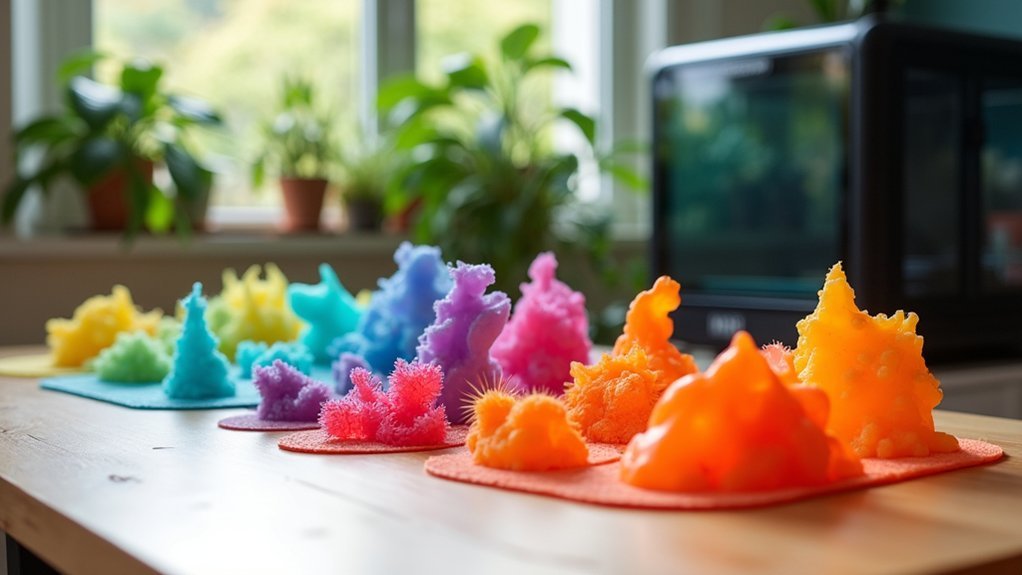
Innovation meets sustainability with bio-based TPU, a flexible 3D printing material that’s revolutionizing student projects while prioritizing safety and environmental responsibility.
This non-toxic alternative emits fewer volatile organic compounds during printing, creating a safer classroom environment for your creative work.
You’ll appreciate bio-based TPU’s exceptional flexibility, allowing your prints to stretch and bend without breaking. This makes it perfect for wearable devices, custom phone cases, and interactive toys.
The material’s moisture-resistant properties guarantee your outdoor projects withstand water exposure without degrading.
For ideal results, set your extruder temperature to 250±10°C and bed temperature to 50±10°C.
Bio-based TPU combines durability with eco-consciousness, letting you create innovative projects while supporting environmental sustainability through renewable sourcing.
PVA: Water-Soluble Support Material for Complex Designs
Complexity becomes achievable with PVA (Polyvinyl Alcohol), a revolutionary water-soluble filament that transforms how you’ll approach intricate 3D printing projects.
Revolutionary water-soluble PVA filament transforms intricate 3D printing by making complex geometries achievable where traditional supports fail.
This support material dissolves completely in water, eliminating the challenge of removing supports from delicate overhangs and complex geometries without damaging your prints.
You’ll appreciate PVA’s safety profile—it’s biodegradable and non-toxic, making it perfect for educational settings.
When paired with PLA or ABS, you’ll achieve high-quality finishes on even the most challenging designs. Set your extruder to 190-220°C and heated bed to 50-60°C for best results.
However, you must store PVA in dry conditions since it absorbs moisture rapidly, which can compromise print quality and material integrity.
HIPS: Lightweight Alternative With Minimal Odor
Versatility defines HIPS (High Impact Polystyrene) as an excellent choice for student projects requiring both strength and ease of use.
This lightweight material produces minimal odor during printing, making it perfect for classroom environments where air quality matters. You’ll appreciate its durability and flexibility balance, ensuring your projects withstand regular handling while remaining manageable for standard FDM printers.
HIPS offers three key advantages for student makers:
- Temperature compatibility – Print at 230-250°C with heated bed temperatures of 80-100°C for ideal adhesion
- Multi-material printing – Experiment safely with various filament combinations in educational settings
- Dissolvable support functionality – Remove supports from ABS prints without damaging your main structures
You’ll find HIPS enables creative experimentation while maintaining the safe printing atmosphere essential for educational environments.
Recycled PETG: Eco-Friendly Choice for Sustainable Learning
When sustainability meets education, recycled PETG (rPETG) emerges as the ideal filament choice for environmentally conscious students and educators. This eco-friendly material transforms post-consumer plastic waste into high-quality 3D printing filament, teaching students valuable lessons about circular economy principles.
You’ll appreciate rPETG’s exceptional durability and impact resistance, matching standard PETG’s performance while promoting environmental responsibility. The filament prints easily at 245±10°C extruder temperature and 60±10°C bed temperature, making it accessible for student projects.
Its UV resistant properties guarantee your outdoor prototypes won’t degrade quickly. You’ll also benefit from its moisture resistance and flexibility for diverse applications.
ASA: UV-Resistant Material for Outdoor Educational Projects
You’ll find ASA particularly valuable when your projects need to withstand harsh outdoor conditions, as it resists UV damage, moisture, and temperature fluctuations that would destroy other materials.
This durability makes it perfect for creating weather stations, garden tools, and outdoor learning equipment that students can use year-round without worrying about degradation.
While ASA requires higher printing temperatures around 240°C, it’s still safe for educational environments when you follow proper ventilation and temperature guidelines.
ASA Weather Resistance Properties
Unlike many standard 3D printing materials that quickly deteriorate outdoors, ASA filament delivers exceptional UV resistance that prevents the degradation and discoloration you’d typically see from prolonged sunlight exposure.
ASA’s weather resistance makes it perfect for student outdoor projects that need long-term durability:
- Temperature Stability – Maintains dimensional accuracy through extreme temperature fluctuations without warping or cracking
- Moisture Resistant Protection – Withstands rain and water exposure without compromising structural integrity or performance
- Impact Durability – Endures rough handling and environmental stress that outdoor educational displays often experience
You’ll find ASA particularly valuable for weather stations, garden markers, and outdoor learning tools.
Its combination of UV resistance and moisture resistant properties guarantees your students’ projects remain functional and visually appealing throughout changing seasons, making it an ideal choice for educational applications requiring long-term outdoor exposure.
Educational Outdoor Project Applications
ASA’s robust weather-resistant properties translate directly into practical classroom applications where students can create meaningful outdoor learning experiences.
You can design weather stations with ASA components that’ll withstand constant sun exposure thanks to its UV resistance. Students can construct solar system models for permanent outdoor displays without worrying about color fading or material degradation.
Garden markers, botanical identification tools, and geological sample containers become durable educational assets when printed with ASA. The material’s impact resistance guarantees playground teaching aids survive active student use.
For outdoor applications requiring long-term functionality, ASA enables students to create bird feeders, rain gauges, and wind measurement devices that maintain structural integrity through seasons of weather exposure while providing ongoing educational value.
Safe Printing Temperature Guidelines
When setting up your 3D printer for ASA filament, maintaining precise temperature control becomes critical for both print quality and classroom safety.
Following safe printing temperature guidelines guarantees you’ll achieve ideal results while protecting students from potential hazards.
ASA filament requires specific temperature ranges for successful printing:
- Extruder Temperature: Set between 230°C and 250°C for proper material flow and layer adhesion.
- Bed Temperature: Maintain 85°C to 105°C to prevent warping and guarantee first-layer adhesion.
- Enclosure: Use a heated chamber when possible to maintain consistent ambient temperature.
These controlled conditions maximize ASA’s high impact resistance and UV resistance properties, making it perfect for durable outdoor educational projects.
Proper temperature management also minimizes toxic fume emissions, creating a safer learning environment for students.
Safety Guidelines and Best Practices for Student 3D Printing
Although 3D printing offers exciting educational opportunities, you’ll need to establish clear safety guidelines to protect students from potential health risks.
Guarantee proper ventilation in all printing areas to minimize exposure to emissions during the printing process. Install enclosed printers or filtration systems to reduce fine particle exposure and odors.
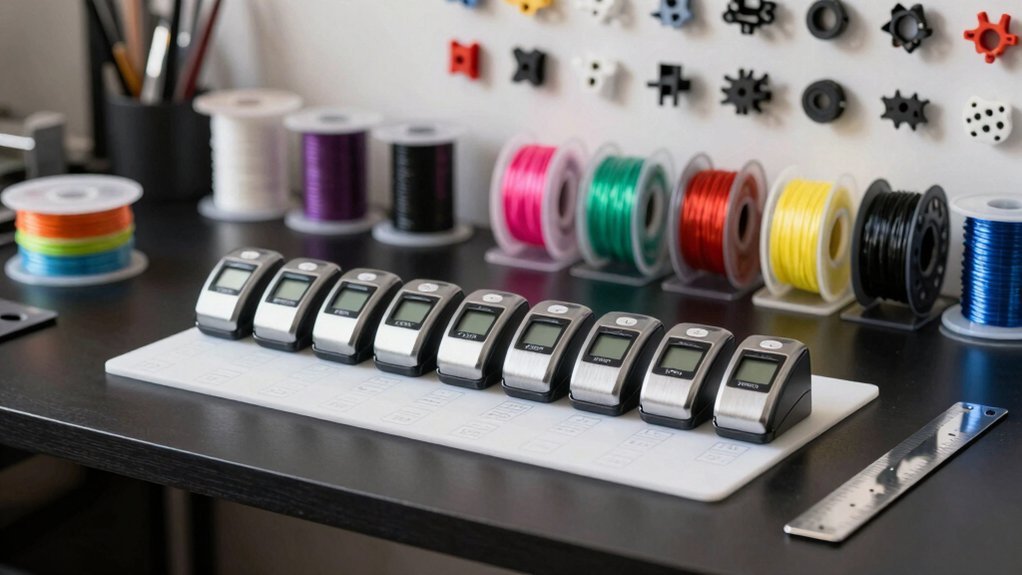
You should regularly monitor air quality using AQ meters, especially when experimenting with different materials. Train students to recognize safe materials like PLA and PETG, which produce minimal emissions compared to ASA or Nylon.
Establish protocols for material handling and storage.
Create designated printing zones away from general classroom areas. Require students to report any unusual odors or symptoms immediately.
These precautions will create a safer learning environment while maintaining the educational benefits of 3D printing technology.
Frequently Asked Questions
What Is the Safest Material for 3D Printing?
You’ll find PLA is the safest 3D printing material because it’s biodegradable and emits fewer volatile organic compounds than alternatives. It’s perfect for indoor use and won’t harm your health during printing sessions.
Is PETG Safe for Kids Toys?
Yes, you’ll find PETG safe for kids’ toys since it’s non-toxic and doesn’t contain harmful chemicals. It’s impact-resistant, water-resistant, and won’t easily deform, making it perfect for children’s playthings.
What Is the Best Type of 3D Printing for Education?
You’ll find FDM printing works best for education since it’s affordable and easy to use. You can safely print with PLA in classrooms while students learn hands-on design and engineering skills.
Is PLA Material Safe for Kids?
You’ll find PLA material very safe for kids since it’s made from renewable resources, emits minimal fumes, and has a pleasant smell when printing, making it ideal for educational environments.