3D printing transforms your educational experience through three key benefits. First, it converts abstract theories into tangible, hands-on learning experiences you can touch and manipulate, making complex concepts in biology and engineering more accessible and memorable. Second, it develops future-ready skills by familiarizing you with industry-standard processes and real-world problem-solving techniques. Third, it fosters cross-disciplinary collaboration, breaking down academic silos and encouraging innovation through diverse teamwork. These advantages prepare you for tomorrow’s dynamic workplace challenges.
Transforming Abstract Learning Into Hands-On Discovery
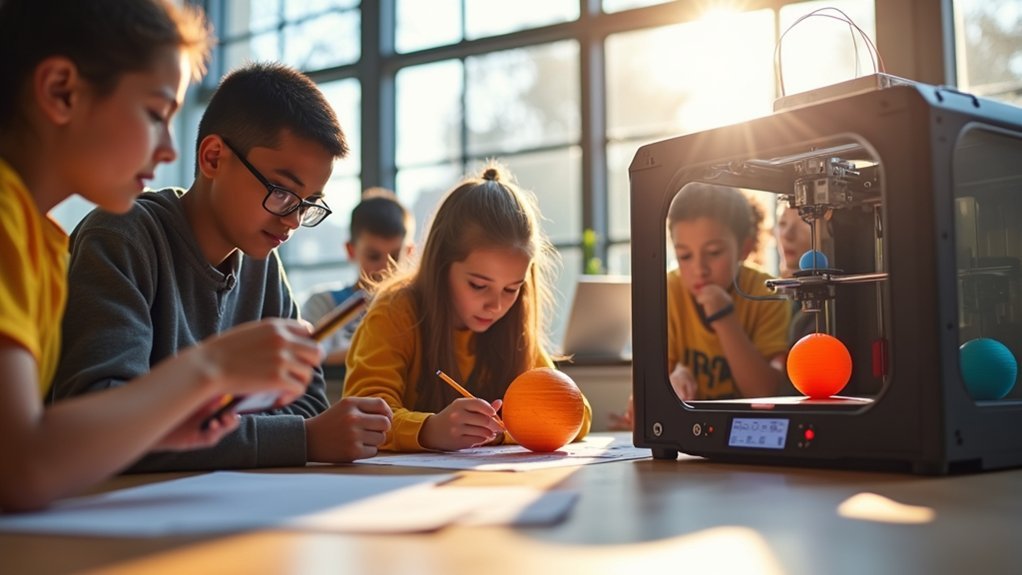
When students struggle to grasp abstract concepts through traditional textbooks and lectures, 3D printing offers a revolutionary solution that transforms theoretical knowledge into tangible, interactive experiences.
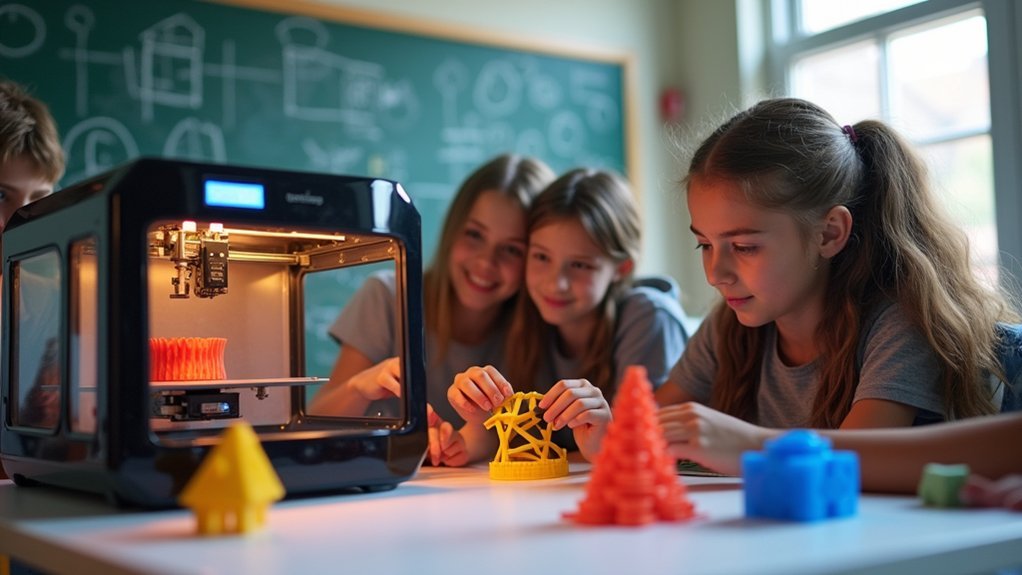
Educational institutions can engage students by incorporating hands-on learning through designing and printing physical objects that bring complex theories to life. You’ll find that students develop stronger problem-solving skills when they manipulate three-dimensional models of molecular structures, historical artifacts, or mathematical concepts.
This active participation transforms passive learning into experiential learning where you can test, modify, and redesign your creations based on real-world feedback.
Through 3D printing, abstract ideas become concrete discoveries, enabling deeper comprehension and retention across subjects from biology to engineering.
Developing Future-Ready Skills and Career Preparation
As industries increasingly adopt additive manufacturing technologies, 3D printing in education creates a direct pipeline between classroom learning and career readiness.
You’ll develop critical thinking and problem-solving skills through hands-on projects that mirror real-world challenges in manufacturing, healthcare, and design. This technology familiarizes you with industry-standard processes, enhancing your employability and providing a competitive edge.
Educational programs partnering with local industry leaders offer mentorship and internship opportunities, giving you practical experience in your chosen field.
Educational partnerships bridge classroom theory and industry practice, connecting students directly with professional mentors and real-world learning opportunities.
The iterative design process inherent in 3D printing builds resilience and adaptability—qualities essential for maneuvering evolving workplaces.
Fostering Cross-Disciplinary Collaboration and Innovation
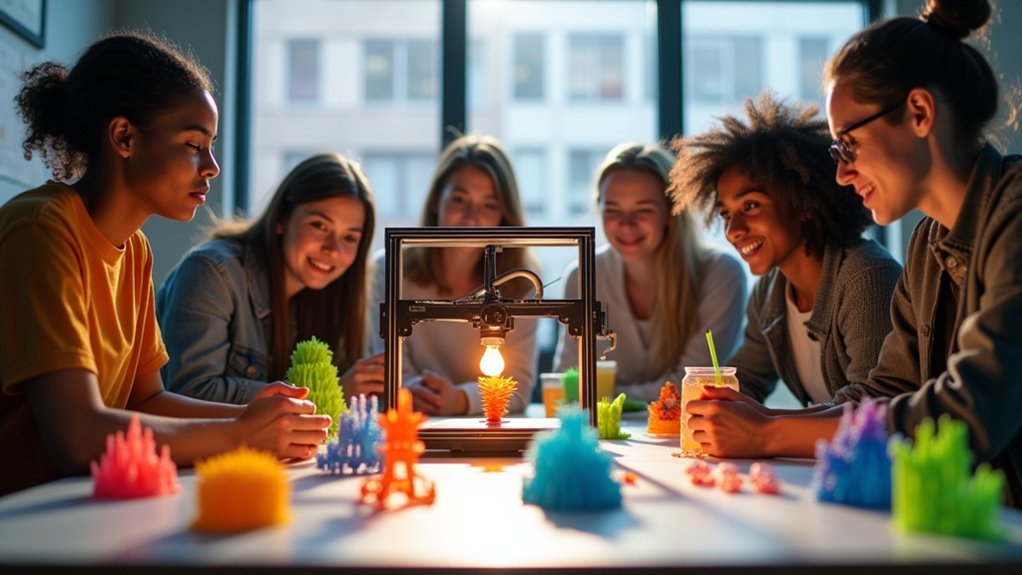
While traditional education often separates students into distinct academic silos, 3D printing breaks down these barriers by creating natural collaboration points where diverse expertise becomes essential for project success.
When students designed high-powered race cars at TU Berlin’s Formula Student competition, they demonstrated how printing technology bridges engineering and design disciplines seamlessly.
Your collaborative projects benefit from accelerated prototyping process cycles, allowing rapid iteration and improvement through cross-disciplinary teamwork.
Institutions like Drexel’s Hybrid Making Lab showcase how cutting-edge technology creates dynamic learning environments where innovation thrives.
You’ll find that 3D printing doesn’t just empower students—it transforms how they approach challenges, developing enhanced problem-solving skills through shared knowledge exchange that prepares them for tomorrow’s interconnected workforce demands.
Frequently Asked Questions
What Are the Educational Benefits of 3D Printing?
You’ll gain hands-on learning experiences creating tangible models that reinforce concepts. You’ll develop creativity, problem-solving skills, and collaboration abilities while preparing for future careers in manufacturing and healthcare through innovative project-based learning.
What Is a Major Advantage of Using 3D Environments in Education?
You’ll transform abstract concepts into tangible, interactive experiences that greatly boost understanding and retention. 3D environments let you manipulate and explore ideas hands-on, making complex subjects more accessible and memorable.
How to Use 3D Printing in Education?
You’ll integrate 3D printing by having students design tangible prototypes for real problems. They’ll create assistive devices, test bridge structures, and transform abstract concepts into hands-on learning experiences that encourage creativity and problem-solving.
What Is a Common Use of 3D in Education?
You’ll commonly use 3D printing to create tangible models that make abstract concepts physical. You can print historical artifacts, scientific structures, or geographical features, helping students better understand and engage with curriculum content.