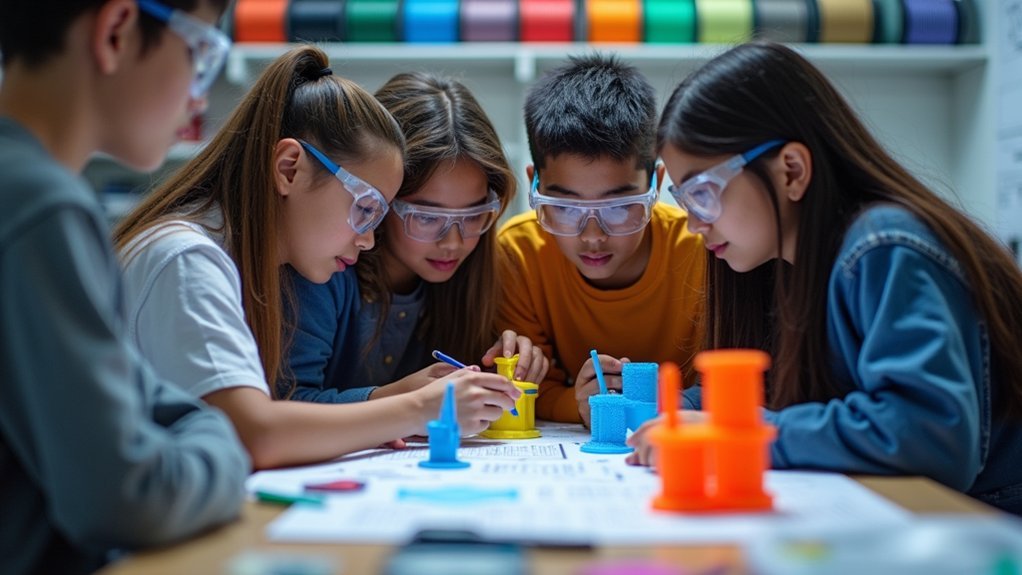
You’ll transform your STEM classroom when 3D printers turn abstract concepts into tangible models students can touch and manipulate. They’ll boost engagement up to 90%, develop critical thinking through iterative design processes, and enhance problem-solving skills by tackling real printing challenges. Your students will visualize complex scientific theories, collaborate on innovative projects, and build technical proficiency in CAD software. These tools bridge gender gaps, shift learning from STEM to STEAM, and prepare students for emerging career opportunities ahead.
Enhancing Student Engagement Through Hands-On Learning
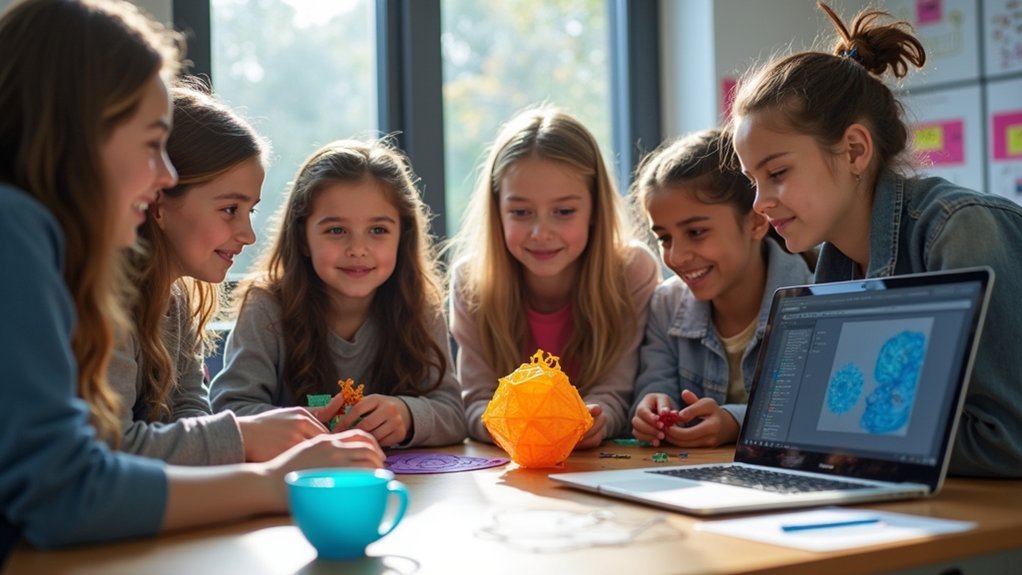
When students actively participate in 3D printing projects, they’re far more likely to stay focused and engaged throughout STEM lessons.
You’ll notice a dramatic reduction in behavior issues as hands-on activities capture their attention and channel their energy productively. These learning opportunities transform abstract concepts into tangible objects students can touch and manipulate, making STEM subjects more accessible and meaningful.
The immediate feedback from watching designs materialize creates powerful motivation that traditional teaching methods can’t match.
You’ll find that students develop stronger problem-solving skills as they troubleshoot design challenges and iterate solutions. This tactile approach particularly benefits kinesthetic learners who struggle with conventional instruction methods.
Developing Critical Thinking and Problem-Solving Skills
Through the iterative design process that 3D printing demands, you’ll watch students naturally develop sophisticated critical thinking abilities as they hypothesize, test, and continuously refine their models.
When students encounter printing challenges like parameter adjustments or error troubleshooting, they’re building problem-solving skills that transfer directly to real-world scenarios.
Collaborative projects amplify these benefits as students work together to devise solutions, strengthening both teamwork and collective critical thinking.
The hands-on creation of 3D printed objects transforms abstract concepts into tangible outcomes, helping students visualize problems more effectively.
As students adapt their designs based on feedback and functionality requirements, they learn to approach challenges from multiple perspectives, developing the analytical mindset essential for STEM success.
Visualizing Abstract Scientific Concepts
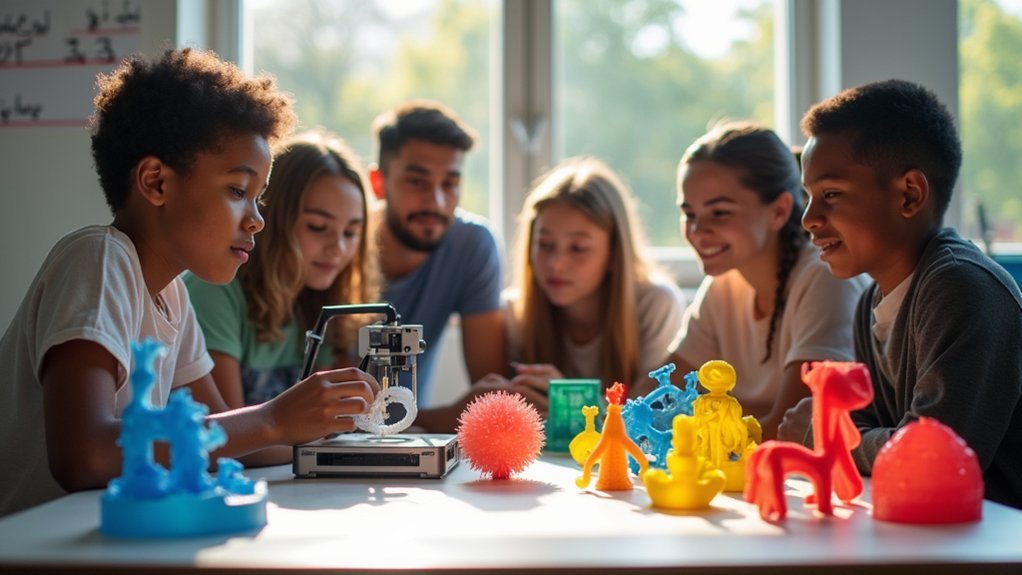
You’ve likely struggled to help students grasp abstract scientific concepts that seem disconnected from reality.
3D printing transforms these theoretical ideas into physical objects you can place directly in students’ hands.
Whether you’re teaching complex geometric theorems or demonstrating how atoms bond together, you’ll find that tangible models make even the most challenging concepts accessible and engaging.
Complex Theories Made Tangible
Although abstract scientific concepts like molecular structures and electromagnetic fields can seem impossibly complex to students, 3D printing transforms these intangible theories into physical models you can hold, rotate, and examine from every angle.
This hands-on approach dramatically improves student engagement by making theoretical concepts accessible through tangible objects.
When you can manipulate a DNA double helix or atomic structure in your hands, you’ll develop deeper understanding than traditional textbook learning provides.
Scientific concepts become memorable experiences rather than abstract ideas, particularly benefiting tactile and kinesthetic learners who struggle with conventional teaching methods.
- Students grasping crystalline structures by feeling lattice arrangements in their palms
- Chemistry learners rotating molecular models to visualize bond angles and electron configurations
- Physics students examining wave interference patterns through layered 3D representations
- Biology classes exploring protein folding by manipulating flexible printed chains
Atomic Models Come Alive
Atomic models represent one of the most challenging visualizations in science education, where students must imagine particles too small to see arranged in three-dimensional space.
3D printing transforms this abstract concept into something you can hold and examine from every angle. When you create physical atomic models, you’ll develop a clearer understanding of electron shells, molecular bonds, and chemical structures that textbooks struggle to convey effectively.
This hands-on learning approach allows you to explore spatial relationships between atoms in ways traditional methods can’t match.
You’ll grasp complex chemistry and physics theories more easily when you can manipulate actual models. STEM learning becomes more engaging and accessible, reducing anxiety while building confidence in scientific subjects through tactile exploration.
Fostering Creativity and Innovation in Design
When students design objects using 3D printing technology, they’re transforming abstract ideas into tangible creations that spark genuine innovation and creative problem-solving.
This hands-on approach enables students to learn complex design principles while developing essential technical skills through CAD software integration.
Design challenges push students to iterate and refine their models based on real-world feedback from their prints.
Real-world printing feedback drives students to continuously iterate and perfect their designs through hands-on experimentation.
These collaborative projects enhance communication abilities as students critique each other’s work and share innovative solutions.
STEM education benefits tremendously from this interdisciplinary approach, where artistic creativity merges seamlessly with scientific principles.
- Students watching their digital sketches materialize layer by layer into functional prototypes
- Teams huddled around workstations, troubleshooting design flaws and brainstorming improvements
- Complex geometric structures emerging from printers, previously impossible to create by hand
- Classrooms buzzing with excitement as abstract mathematical concepts become physical reality
Building Technical Proficiency in Emerging Technologies
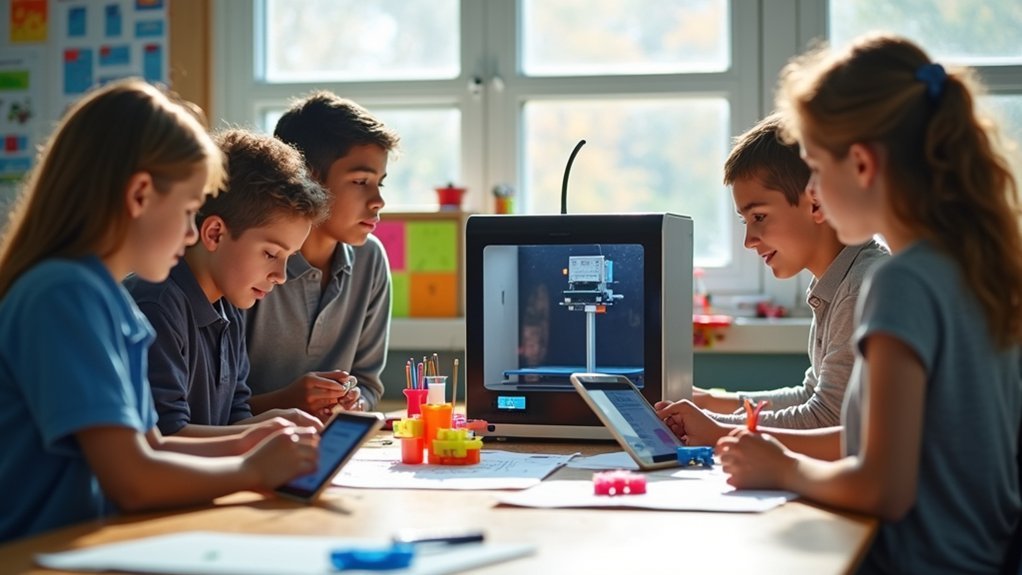
Beyond nurturing creative expression, 3D printing serves as a powerful gateway for students to master the technical skills that define today’s manufacturing landscape.
You’ll develop proficiency in CAD modeling software, creating detailed designs that translate directly into physical prototypes. Operating 3D printers teaches you to adjust important parameters like speed and layer height, skills essential for quality control across industries.
This emerging technology demands hands-on problem-solving skills as you troubleshoot printing issues and optimize designs.
You’ll learn valuable surface finishing techniques, including sanding and polishing, vital for professional-grade results.
Promoting Collaborative Learning and Teamwork
While mastering individual technical skills forms the foundation of 3D printing expertise, the most transformative learning occurs when you collaborate with peers to tackle complex design challenges.
Through teamwork, you’ll discover that 3D printing projects become powerful catalysts for developing essential communication skills as you share ideas and divide tasks effectively.
Collaborative 3D printing transforms individual technical skills into powerful communication abilities through shared creative problem-solving and effective task coordination.
When you engage in collaborative 3D printing initiatives, you’ll naturally enhance your problem-solving abilities while learning to give and receive constructive feedback.
The design process becomes richer when you respect diverse perspectives, leading to innovative solutions you couldn’t achieve alone.
- Teams huddled around workstations, sketching prototypes and debating ideal designs
- Students troubleshooting printer malfunctions together, sharing technical discoveries
- Groups presenting their creations, explaining collaborative decision-making processes
- Peers examining each other’s models, offering improvement suggestions
Bridging the Gender Gap in STEM Fields
As you explore the transformative potential of 3D printing in education, you’ll discover it’s particularly effective at creating inclusive STEM environments that encourage female participation. This technology addresses key barriers that traditionally discourage female students from pursuing STEM education by providing hands-on, creative learning experiences.
| Benefit | Impact on Female Students | STEM Outcome |
|---|---|---|
| Creative Expression | Bridges art and technology | Increased interest |
| Tangible Learning | Visual concept understanding | Enhanced comprehension |
| Collaborative Projects | Reduces negative experiences | Better retention |
| Equal Opportunities | Diverse perspectives | Balanced enrollment |
| Ownership of Learning | Motivates through engagement | Improved confidence |
Schools implementing 3D printing report increased female enrollment, successfully bridging the gender gap while fostering collaborative problem-solving skills essential for tomorrow’s diverse STEM workforce.
Transitioning From STEM to STEAM Education
You’ll discover that adding arts to your STEM curriculum through 3D printing projects transforms how students approach complex challenges.
When you integrate artistic design principles with engineering concepts, your students develop stronger creative problem-solving abilities that traditional STEM education often overlooks.
This STEAM approach lets you guide students through interdisciplinary projects where they’ll design aesthetically pleasing prototypes while mastering technical skills.
Arts Integration Benefits
When you integrate arts into traditional STEM education—creating what’s known as STEAM—you’re releasing powerful benefits that extend far beyond technical skills.
Through 3D printing and arts integration, you’ll discover that creativity becomes a catalyst for innovation, transforming how students approach technical challenges.
This enhanced STEM education approach delivers measurable advantages:
- Visual storytelling: Students design 3D models that communicate complex scientific concepts through artistic expression.
- Collaborative workshops: Teams blend engineering precision with aesthetic design, creating prototypes that are both functional and beautiful.
- Creative problem-solving: Project-based learning encourages multiple solution pathways, fostering innovative thinking.
- Inclusive engagement: Artistic elements attract diverse learners, particularly underrepresented groups who might otherwise avoid traditional STEM subjects.
You’re preparing students for interdisciplinary careers where technical expertise meets creative vision, essential skills in today’s innovation-driven economy.
Creative Problem Solving
Building on these inclusive engagement benefits, 3D printing transforms problem-solving from a linear process into an exploratory adventure where students can’t help but think creatively.
You’ll watch your students approach challenges from multiple perspectives as they design and create tangible solutions through hands-on experimentation. This technology encourages iterative thinking—students prototype, test, refine, and redesign until they achieve ideal results.
Through interdisciplinary projects, you’re fostering creative problem-solving skills that blend artistic vision with scientific principles.
Students collaborate across traditional subject boundaries, developing solutions that require both technical knowledge and innovative thinking. The immediate feedback from 3D printing allows rapid iteration, enhancing student engagement while building resilience through trial-and-error learning that mirrors real-world innovation processes.
Enabling Project-Based Learning Experiences
Since 3D printers transform abstract concepts into physical objects, they’re revolutionizing how students engage with project-based learning in STEM classrooms.
You’ll watch your students develop critical thinking skills as they design, test, and iterate their creations through hands-on experimentation. This technology bridges theory and practice, making complex mathematical and scientific concepts tangible and understandable.
When you implement 3D printing in STEM education, you’re fostering meaningful collaboration as students work together on real-world challenges.
Students master complex concepts through collaborative problem-solving when abstract ideas become tangible objects they can hold, test, and improve together.
They’ll learn from trial and error, building resilience and adaptability while meeting academic standards.
- Students designing earthquake-resistant building models, testing structural engineering principles
- Teams creating topographic maps with removable layers showing geological formations
- Groups building functional prosthetic hands for local community members
- Classmates constructing solar system models with accurate planetary scale relationships
Preparing Students for Future Career Opportunities
As industries increasingly rely on digital fabrication and rapid prototyping, students who master 3D printing technology position themselves at the forefront of tomorrow’s workforce.
When you gain proficiency in CAD software and 3D printer operation, you’re developing technical skills that engineering, manufacturing, and design companies desperately need.
Your hands-on STEM experience with 3D printing sharpens critical problem-solving abilities essential for real-world challenges.
You’ll also strengthen collaboration and communication skills through project work, preparing you for team-oriented environments.
Exposure to this cutting-edge technology helps you adapt to evolving industry standards, making you more competitive in the job market.
Most importantly, 3D printing education opens doors to emerging career opportunities in rapidly growing fields like biomedical engineering, where innovation drives success.
Frequently Asked Questions
How Does 3D Printing Relate to Stems?
3D printing transforms your STEM learning by letting you create tangible models of abstract concepts. You’ll develop technical skills with CAD software while engaging in hands-on projects that boost creativity and critical thinking abilities.
What Is the Effectiveness of Using 3D Printing Technology in STEM Project Based Learning Activities?
You’ll find 3D printing highly effective in STEM project-based learning because it boosts student motivation, enhances problem-solving skills, promotes collaboration, and provides immediate feedback that strengthens understanding of complex concepts.
How Will 3D Printing Enhance Teaching and Learning?
You’ll visualize complex concepts through tangible models, develop critical thinking via iterative design processes, and boost engagement while building valuable technical skills that prepare you for future STEM careers.
How Are 3D Printers Useful in Studying Evolution?
You’ll create tangible fossil replicas and anatomical models that let you examine evolutionary adaptations firsthand. You can print phylogenetic trees and early human tools, making complex evolutionary relationships and timelines easier to understand and analyze.