
You can revolutionize your vehicle’s audio system with custom 3D printed speaker grilles that combine personalized design with superior acoustic performance. Advanced materials like nylon and polycarbonate offer durability while precision printing technologies enable intricate geometric patterns and textures that reflect your style. These lightweight grilles optimize sound projection, reduce vibrations, and include engineered airflow channels for speaker cooling. At just $5.90-$41.38 per piece, you’ll discover how this cost-effective solution transforms your driving experience.
Design Freedom and Customization Options for Speaker Grilles

While traditional manufacturing methods limit speaker grille designs to basic patterns, 3D printing technology breaks these barriers and opens unlimited possibilities for creating personalized car speaker grilles.
You’ll discover design freedom that’s impossible with conventional manufacturing, allowing you to create complex geometries and intricate details that match your vision perfectly.
With customization options ranging from texture variations to unique patterns, you can choose designs that reflect your personality and style preferences.
Texture variations and unique patterns let you create speaker grille designs that perfectly reflect your personal style and preferences.
Whether you want geometric patterns, organic textures, or completely original concepts, 3D printing delivers precisely what you envision.
You’re no longer restricted to mass-produced options – instead, you can specify songs, styles, and visual elements that create a truly personalized audio-visual experience in your vehicle’s interior.
Materials and Technologies for Automotive Audio Components
You’ll find that advanced printing materials like nylon and polycarbonate offer the perfect combination of durability and lightweight performance for your custom speaker grilles.
These materials withstand automotive environments while maintaining their structural integrity and aesthetic appeal over time.
Precision manufacturing technologies such as Multi Jet Fusion and Selective Laser Sintering enable you to achieve intricate designs with professional-grade finishes that match your vehicle’s interior perfectly.
Advanced Printing Materials
When you’re designing personalized car speaker grilles, the material you choose fundamentally determines both performance and longevity.
Advanced printing materials like Nylon, PLA, and TPU offer distinct advantages for your Car Speaker Grill projects. You’ll find Nylon delivers exceptional strength and wear resistance, perfect for grilles facing frequent handling and environmental exposure.
PLA’s your go-to choice when you need high-quality finishes and easy printing for visually appealing components.
TPU provides excellent elasticity and impact resistance, enhancing both sound quality and durability.
These advanced printing materials work seamlessly with SLS technology, enabling you to create intricate geometries that optimize acoustics.
Each material’s unique properties let you customize performance characteristics based on your specific automotive audio requirements.
Precision Manufacturing Technologies
As precision manufacturing technologies revolutionize automotive audio components, you’re witnessing a transformation that goes far beyond traditional production methods.
You’ll find that Selective Laser Sintering (SLS) and Multi Jet Fusion (MJF) techniques enable complex geometries that enhance both aesthetics and sound quality in your speaker designs.
With 3D printing, you can achieve layer thicknesses as fine as 80 microns, delivering detailed finishes essential for automotive applications.
Advanced materials like polyamide and thermoplastics guarantee your speaker grilles maintain durability while delivering superior acoustic performance.
You’re also benefiting from customizable textures and patterns that meet specific preferences without sacrificing production efficiency, while lightweight materials reduce vehicle weight and improve fuel efficiency.
From Concept to Production: The 3D Printing Process
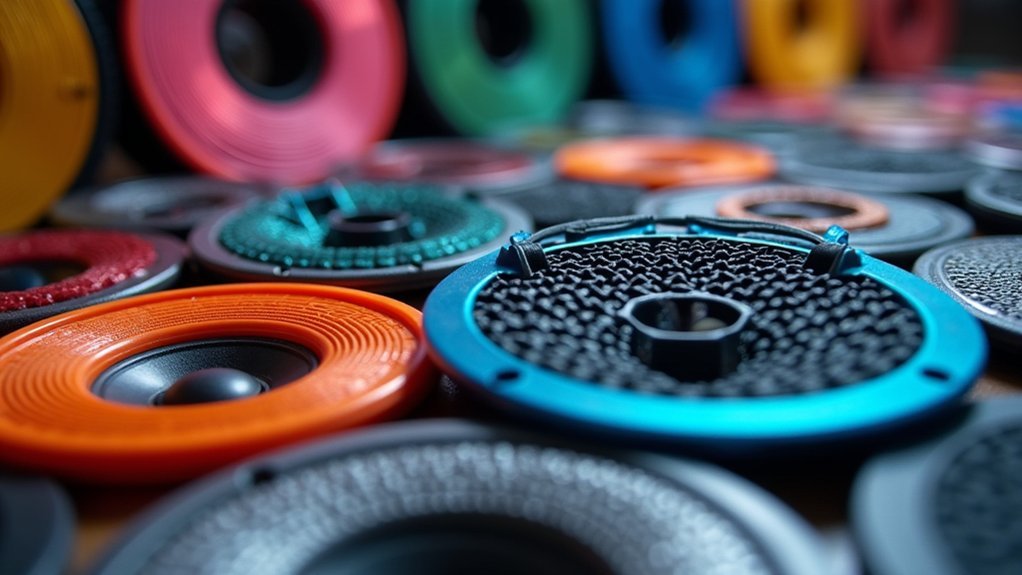
When you’re ready to bring your personalized car speaker grille vision to life, you’ll start with the design ideation phase where your aesthetic preferences meet functional requirements.
You’ll then move through prototyping and testing, where rapid iterations allow you to refine your design before committing to production.
Finally, you’ll scale up to manufacturing, where advanced 3D printing technologies transform your concept into a finished product that perfectly matches your vehicle’s style.
Design Ideation Phase
Before you commit to a final design, the ideation phase transforms your vision for personalized car speaker grilles into tangible possibilities through strategic planning and creative exploration.
During the design ideation phase, you’ll collaborate closely with engineers to check whether your creative concepts align with manufacturing feasibility and performance requirements.
You can leverage 3D printing’s unique capabilities to explore complex geometries impossible with traditional methods. The technology enables you to experiment with customizable textures and patterns that reflect your personal taste.
Through additive manufacturing, you’ll accelerate prototyping, allowing rapid iterations based on feedback. This collaborative approach guarantees your innovative ideas balance aesthetics with functionality, setting the foundation for successful production while maintaining the personalized elements that make your speaker grilles truly distinctive.
Prototyping and Testing
Once you’ve refined your design concepts, the prototyping phase brings your personalized car speaker grilles from digital files to physical reality through 3D printing’s additive manufacturing process.
Your digital designs transform into precise physical prototypes, allowing you to evaluate complex geometries and unique aesthetics firsthand. This rapid prototyping considerably reduces lead times, enabling faster feedback and design iterations based on real-world performance.
During testing, you’ll assess prototypes under actual conditions to identify functional issues and guarantee your grilles meet both aesthetic and practical requirements.
The flexibility of 3D printing lets you explore various materials and finishes throughout prototyping, expanding customization possibilities. You can quickly adjust designs based on user preferences and performance data before committing to final production, assuring ideal results.
Manufacturing Scale-Up
After validating your prototypes through rigorous testing, moving to manufacturing scale-up requires strategic planning to maintain the precision and customization capabilities that make 3D printing ideal for personalized car speaker grilles.
You’ll benefit from 3D printing’s inherent flexibility in production volumes, seamlessly shifting from single prototypes to larger batches without costly tooling changes or extensive setup modifications.
During scale-up, you can leverage additive manufacturing’s ability to produce complex geometries that traditional methods can’t achieve, ensuring your innovative designs remain intact at higher volumes.
The integration of advanced materials enhances both durability and aesthetic appeal of your finished grilles.
This streamlined approach reduces costs while maintaining the customization options your clients expect, making 3D printing the best solution for scaling personalized automotive components.
Performance Benefits of Custom Printed Speaker Grilles
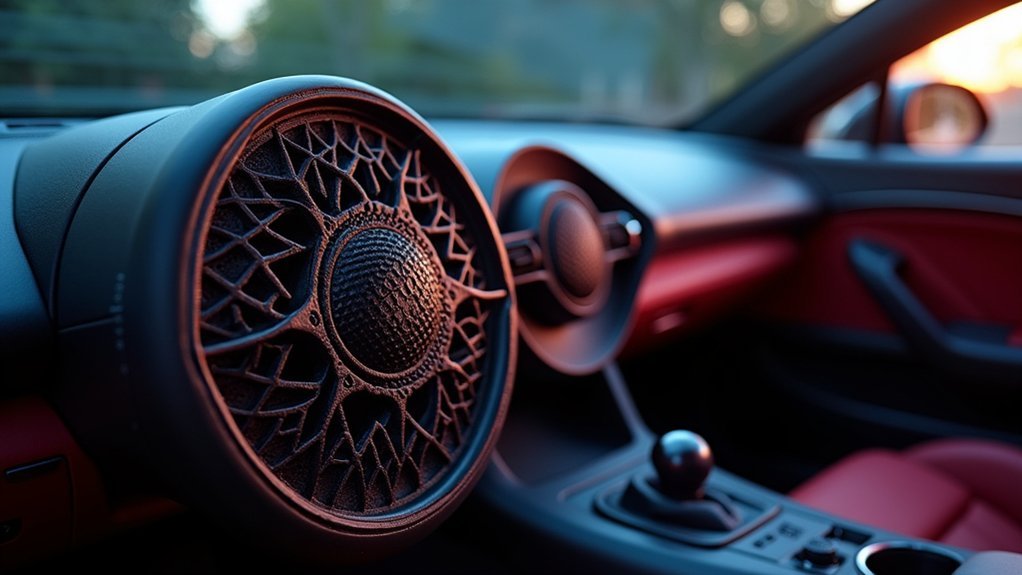
While traditional speaker grilles follow standard templates that prioritize cost over performance, custom printed speaker grilles revolutionize your vehicle’s audio system through precision-engineered designs that enhance both acoustic performance and operational efficiency.
You’ll benefit from complex geometries that optimize sound projection while lightweight construction reduces your vehicle’s overall weight. The personalized textures improve grip and minimize vibrations that compromise audio quality.
You can tailor designs for specific frequencies, ensuring grilles don’t restrict sound clarity or volume. Custom airflow channels promote superior cooling for high-performance speakers, extending their lifespan considerably.
Frequency-specific designs preserve audio clarity while engineered airflow channels deliver superior speaker cooling for extended high-performance system longevity.
These precision-engineered solutions deliver measurable improvements in sound quality, system durability, and vehicle efficiency that mass-produced alternatives simply can’t match.
Cost-Effective Manufacturing for Automotive Enthusiasts
Because 3D printing eliminates traditional tooling costs and setup fees, you can manufacture custom speaker grilles for your vehicle at prices ranging from just $5.90 to $41.38 per piece.
This cost-effective manufacturing approach makes personalized automotive parts accessible even on tight budgets. You’ll save greatly compared to conventional fabrication methods while reducing material waste and production time.
The technology’s rapid prototyping capabilities let you iterate designs quickly without expensive retooling. You can experiment with complex geometries and unique patterns that would be prohibitively costly using traditional methods.
These personalization options allow you to create distinctive grilles that reflect your individual style. Whether you’re upgrading a single speaker or outfitting your entire sound system, 3D printing delivers professional-quality results without breaking the bank.
Quality Assurance and Testing for Audio Applications
When designing personalized car speaker grilles, you’ll need to implement thorough quality assurance protocols that verify both acoustic performance and structural durability. Your testing regimen should encompass advanced acoustic measurements and extensive stress evaluations to identify potential weaknesses in 3D-printed components.
Effective quality assurance for audio applications involves these critical steps:
- Acoustic simulations during design phase to predict performance outcomes and refine geometries
- High-resolution 3D printing for precise geometries that enhance sound dispersion and minimize distortion
- Structural integrity testing through rigorous stress tests on printed components
- Post-processing enhancement including polishing and coating to improve aesthetic appeal and acoustic properties
These protocols guarantee your personalized grilles deliver optimal sound performance while maintaining durability standards essential for automotive applications.
Frequently Asked Questions
Can You 3D Print a Car Grill?
You can 3D print a car grill using materials like ABS or nylon. You’ll achieve custom designs with complex geometries while ensuring durability and proper fit for your specific vehicle model.
Do Speaker Grilles Affect Sound?
Yes, speaker grilles definitely affect sound quality. They can muffle or enhance audio depending on their mesh density, hole size, and material. You’ll notice clearer sound with properly designed grilles that promote better airflow.
Can You 3D Print a Speaker?
You can’t 3D print complete functional speakers since they require electronic components like magnets and voice coils. However, you can 3D print speaker enclosures, grilles, and housings using materials like PLA or ABS.
How to Mount Speaker Grilles?
You’ll secure speaker grilles using provided screws or mounting clips, ensuring compatibility with speaker size first. Check mounting hole alignment, apply gasket sealant if needed, and regularly tighten hardware to prevent vibrations.