You’ll dramatically transform your medical device manufacturing when you adopt 3D printing for tooling, achieving up to 91% reduction in lead times and cutting costs by 86% compared to traditional methods. You can rapidly prototype patient-specific solutions, create complex geometries impossible with conventional manufacturing, and iterate designs in days rather than months. This technology enables custom surgical guides, tailored implants, and accelerated product development while maintaining FDA compliance standards. The following insights reveal how to optimize your entire tooling strategy.
What Is 3D Printed Medical Device Tooling?
This technology transforms how you approach medical device manufacturing by enabling rapid prototyping of custom tools tailored specifically for healthcare applications.
You’ll find that 3D printed tooling offers unprecedented design flexibility, allowing you to create intricate internal channels, undercuts, and geometries that would be impossible or cost-prohibitive with conventional machining.
Whether you’re developing molds for surgical instruments or fixtures for patient-specific implants, this approach lets you iterate quickly and customize solutions for unique medical requirements while maintaining the precision critical in healthcare applications.
Accelerated Product Development Cycles
When traditional tooling methods once stretched development timelines for months, 3D printed medical device tooling now compresses these cycles into mere days or weeks.
3D printing transforms months-long medical device tooling processes into rapid development cycles completed in just days or weeks.
You’ll experience dramatically reduced lead time as 3D printing eliminates lengthy conventional tooling processes that previously bottlenecked your product development cycle.
This rapid iteration capability transforms your medical device development approach. You can quickly modify designs, test prototypes, and validate concepts without waiting for traditional manufacturing schedules.
The technology’s ability to create complex geometries enables innovative solutions that meet specific patient needs faster than ever before.
You’ll gain significant competitive advantages through this accelerated timeline. Some manufacturers report up to 91% reductions in production tooling lead times, allowing you to bring life-saving medical devices to market with unprecedented speed and efficiency.
Cost Reduction in Medical Device Manufacturing

Beyond the speed advantages, 3D printed medical device tooling delivers substantial cost savings that reshape your manufacturing economics.
Traditional tooling expenses become obsolete when you can rapidly produce custom tools on-demand, eliminating the financial burden of conventional manufacturing processes.
The cost reduction benefits of 3D printing in medical device manufacturing include:
- Dramatic savings potential – You can achieve cost reductions up to 86% compared to traditional tooling methods.
- Eliminated design modification costs – Rapid iteration cycles let you adjust designs without additional tooling expenses.
- Reduced upfront investment – Custom tools require minimal initial capital compared to conventional manufacturing setups.
- Sustainable manufacturing practices – Lower waste and resource consumption further decrease your overall production costs.
These economic advantages make 3D printing an essential strategy for competitive medical device manufacturing.
Enhanced Customization for Patient-Specific Solutions
When you’re creating medical devices with 3D printed tooling, you’ll discover unprecedented opportunities to develop patient-specific anatomical models that precisely match individual physiological characteristics.
You can design tailored implants that account for unique bone structures, tissue densities, and anatomical variations that traditional manufacturing simply can’t accommodate.
This customization capability allows you to optimize personalized treatment plans by creating devices that integrate seamlessly with each patient’s specific medical requirements and physical constraints.
Patient-Specific Anatomical Models
As surgeons face increasingly complex procedures, 3D printing revolutionizes their preparation by creating patient-specific anatomical models derived directly from CT scans and MRI imaging data.
This customization transforms surgical planning by providing tangible representations that match individual patient anatomy precisely.
These anatomical models offer a “looks-like, feels-like, and works-like” approach, enabling surgeons to visualize and practice procedures beforehand. The technology considerably reduces complication risks while improving surgical accuracy through enhanced preparation.
Key advantages include:
- Rapid production – Models ready within hours versus traditional fabrication methods
- Precise visualization – Surgeons can examine complex anatomical structures before surgery
- Tailored strategies – Customized surgical approaches based on individual patient needs
- Improved outcomes – Enhanced accuracy leads to shorter recovery times and higher satisfaction
Tailored Implant Design
While anatomical models excel at surgical preparation, 3D printing’s impact extends further into creating tailored implants that transform patient care through unprecedented customization.
You can now manufacture patient-specific implants that perfectly match each individual’s unique anatomy, delivering superior functional outcomes and enhanced tissue integration.
This customization enables you to produce implants with complex geometries that traditional manufacturing can’t achieve.
You’ll dramatically reduce lead time while maintaining cost-effectiveness, eliminating extensive tooling requirements.
Advanced biocompatible materials guarantee your implants meet diverse medical specifications across orthopedic and dental applications.
Most importantly, you’ll minimize surgical complications through precise fitting, resulting in higher patient satisfaction rates.
Tailored implants represent the future of personalized medicine, where every device matches the patient’s exact anatomical requirements.
Personalized Treatment Optimization
Beyond individual implant creation, personalized treatment enhancement leverages 3D printing to revolutionize entire care pathways through detailed patient-specific solutions.
You’ll find that personalized medical devices dramatically improve patient care by delivering precisely tailored treatments that traditional manufacturing can’t match.
Custom tooling enables you to achieve:
- Rapid iterations based on patient feedback, allowing real-time adjustments during treatment
- Complex geometries that perfectly conform to unique anatomical structures
- Multi-material integration for enhanced biocompatibility and functionality
- Cost-effective production with considerably reduced manufacturing timelines
This thorough approach transforms how you deliver care.
From patient-specific dental devices to orthopedic implants, 3D printing guarantees ideal fit and function while reducing costs and treatment duration.
You’re not just creating devices—you’re enhancing entire treatment experiences.
Rapid Prototyping and Design Validation
When you’re developing medical device tooling, rapid prototyping through 3D printing transforms your design process by enabling full-scale model fabrication directly from CAD data within hours rather than weeks.
You’ll create looks-like, feels-like, and works-like prototypes that accelerate your design iterations and validation processes considerably. This cost-effective approach lets you produce complex geometries and patient-specific features that traditional manufacturing can’t achieve, improving your device’s functionality and effectiveness.
You’ll iterate designs based on real-world feedback, making critical adjustments that enhance performance and patient outcomes before committing to mass production.
Medical device manufacturing becomes more agile as you eliminate expensive tooling setups, reducing costs and turnaround times while maintaining the flexibility essential in today’s dynamic healthcare landscape.
Material Options for Medical Grade Tooling
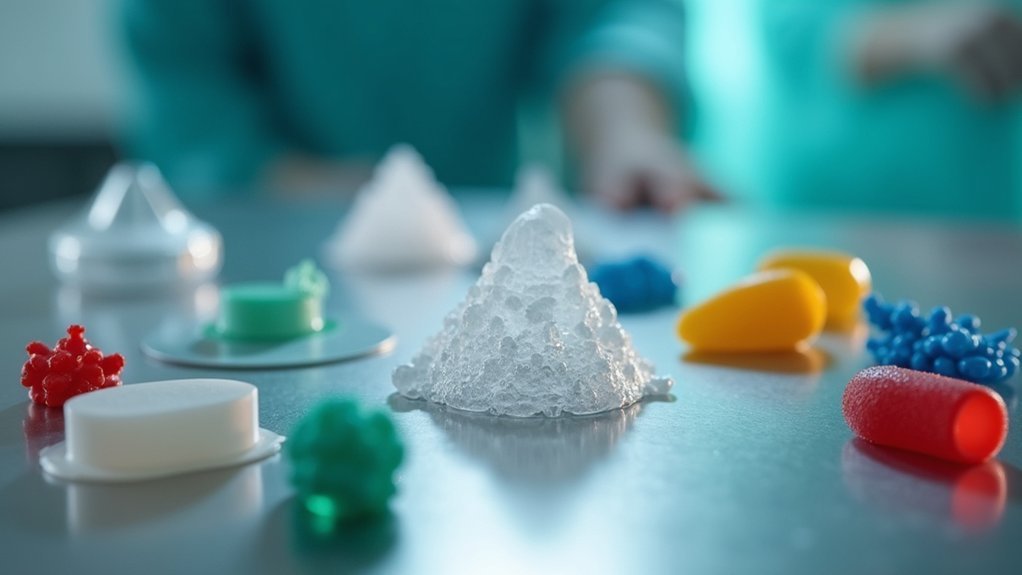
When you’re selecting materials for medical grade tooling, you’ll need to guarantee they meet strict biocompatibility standards like ISO 10993 certification.
You’ll face a critical decision between metal options such as stainless steel and titanium versus polymer alternatives like PLA, ABS, nylon, and TPU.
Your choice will directly impact the tooling’s durability, sterilization compatibility, and overall performance in medical device manufacturing.
Biocompatible Material Standards
Material selection forms the foundation of successful medical-grade 3D printed tooling, where biocompatible standards determine both regulatory compliance and patient safety.
You’ll need to navigate ISO 10993 requirements, which evaluate biological safety for medical device materials. These stringent standards guarantee your biocompatible materials won’t cause adverse reactions when producing patient-specific medical devices.
Key biocompatible material categories include:
- High-performance polymers – PEEK offers exceptional mechanical properties and chemical resistance.
- Medical-grade thermoplastics – PLA and TPU provide versatile processing options.
- Metal alloys – Titanium and cobalt-chromium deliver superior strength for surgical instruments.
- Specialized composites – Custom formulations for specific anatomical requirements.
Your material choice directly impacts the effectiveness of 3D printed tooling while guaranteeing regulatory compliance throughout the manufacturing process.
Metal Vs Polymer
Beyond understanding biocompatible standards, you’ll face a fundamental decision between metal and polymer materials for your medical-grade tooling applications. This choice greatly impacts your 3D printing strategy for medical device tooling.
| Factor | Metal Tooling | Polymer Tooling |
|---|---|---|
| Strength | Superior durability for high-volume production | Lightweight, cost-effective solution |
| Applications | Titanium implants, long-term biocompatibility | Rapid prototyping, custom devices |
| Thermal Properties | Excellent conductivity (stainless steel) | Variable thermal characteristics |
| Investment | Higher initial costs, stringent compliance | Lower upfront investment |
| 3D Printing | DMLS enables complex geometries | FDM allows patient-specific designs |
Metal tooling excels in demanding applications requiring exceptional biocompatibility and durability. Polymer tooling offers flexibility for prototyping and short-run production while maintaining necessary safety standards.
Regulatory Compliance and Quality Management Systems
Two fundamental pillars support successful 3D printing of medical device tooling: regulatory compliance and robust quality management systems.
You’ll need to navigate FDA regulations under 21 CFR Part 820 and achieve ISO 13485:2016 certification for EU markets. Your Quality Management System must document every aspect of your manufacturing process to demonstrate adherence to medical device regulations.
Essential compliance requirements include:
- Detailed quality records – Document production processes, materials, and testing results
- Biocompatibility testing – Conduct ISO-standard testing based on device contact type and intended use
- Validated printing protocols – Follow manufacturer instructions for post-processing and material handling
- Continuous improvement processes – Implement systematic quality monitoring and enhancement procedures
These ISO standards guarantee your 3D printed tooling meets regulatory expectations while maintaining patient safety throughout development.
Direct Manufacturing Vs Traditional Tooling Methods
When you’re evaluating manufacturing approaches for medical device tooling, the choice between direct 3D printing and traditional methods represents a fundamental shift in production philosophy. You’ll find that 3D printing delivers rapid production capabilities, eliminating lengthy setup processes that plague conventional approaches. This technology enables custom tools with intricate geometries impossible through traditional tooling methods.
| Aspect | 3D Printing | Traditional Methods |
|---|---|---|
| Lead Times | Hours to days | Weeks to months |
| Setup Costs | Minimal CAPEX | High steel tooling investment |
| Design Complexity | Complex geometries achievable | Limited geometric capabilities |
| Iteration Speed | Immediate modifications | Costly redesign process |
| Customization | Fully customizable | Standardized solutions |
Medical device manufacturing benefits greatly from this flexibility, allowing you to respond quickly to market demands while reducing financial barriers associated with permanent tooling investments.
Applications in Surgical Instruments and Implants
When you’re producing surgical instruments and implants through 3D printing, you’ll find that custom surgical guide production transforms how surgeons approach complex procedures.
You can create patient-specific guides that precisely match individual anatomies, ensuring more accurate incisions and implant placements.
This technology also enables you to manufacture patient-specific implants that integrate seamlessly with each patient’s unique bone structure and tissue characteristics.
Custom Surgical Guide Production
As surgical precision becomes increasingly critical in modern medicine, 3D printing has revolutionized the production of custom surgical guides that adapt to each patient’s unique anatomy.
You’ll find these patient-specific models, derived from CT or MRI scans, dramatically improve visualization of complex anatomical structures while enhancing surgical planning accuracy.
Custom surgical guide production through 3D printing offers several key advantages:
- Enhanced implant placement – You’ll achieve precise positioning of dental fixtures and orthopedic devices, reducing surgical complications.
- Rapid prototyping capabilities – You can iterate designs quickly, shortening development cycles from conception to clinical application.
- Cost-effective solutions – You’ll experience lower costs and reduced lead times compared to traditional manufacturing methods.
- Improved patient outcomes – You’ll deliver more accurate procedures with reduced risk and enhanced precision.
Patient-Specific Implant Manufacturing
Beyond surgical guides, 3D printing has transformed how medical professionals approach implant manufacturing by creating patient-specific implants that perfectly match individual anatomical requirements.
You can now produce orthopedic implants with complex geometries that weren’t possible through traditional manufacturing methods. These custom devices integrate more naturally with your patients’ anatomy, improving surgical outcomes and comfort.
The technology enables you to develop surgical instruments alongside implants through rapid prototyping, enhancing precision during complex procedures.
Patient-specific models created from CT scans and MRIs greatly improve your preoperative planning, reducing complications and accelerating recovery times.
3D printing has particularly revolutionized orthopedic and dental applications, dramatically cutting lead times and costs while delivering superior patient outcomes through perfectly fitted, anatomically optimized implants.
Biocompatibility Requirements for 3D Printed Tools
Since 3D printed medical device tools may directly contact biological tissues or bodily fluids during procedures, you must guarantee they meet stringent biocompatibility requirements to prevent adverse patient reactions.
Your printing materials selection becomes critical, as biocompatible polymers and metals must demonstrate tissue compatibility without causing inflammation or toxicity.
Selecting biocompatible printing materials is crucial for ensuring tissue compatibility and preventing inflammatory responses in medical device applications.
You’ll need to navigate complex regulatory requirements to achieve FDA clearance:
- ISO 10993 Testing – Conduct thorough biological evaluation testing across multiple endpoints including cytotoxicity, sensitization, and irritation.
- Material Documentation – Maintain detailed records of all printing materials and their safety profiles.
- Validation Processes – Implement rigorous testing protocols that comply with 21 CFR Part 820 quality standards.
- Safety Verification – Partner with experienced manufacturers like Formlabs who’ve already validated biocompatibility for medical applications.
Optimizing Your Medical Device Tooling Strategy
Five key factors will determine your medical device tooling strategy’s success: speed, customization, cost efficiency, iteration capability, and sustainability.
3D printed tooling delivers on all fronts, cutting your production costs by up to 86% while reducing lead times dramatically. You’ll create medical device components faster than traditional methods, with some manufacturers printing mold halves in just 9 hours.
Your strategy should prioritize customized tool designs that enhance device functionality and patient outcomes.
Rapid iteration capabilities let you respond quickly to market demands and implement design changes efficiently.
By embracing sustainable manufacturing practices, you’ll reduce waste and resource consumption while maintaining quality standards.
This thorough approach positions your medical device manufacturing for competitive advantage in today’s fast-paced healthcare market.
Frequently Asked Questions
Why 3D Printing Is Used for Custom Medical Devices?
You’ll benefit from 3D printing’s ability to create patient-specific devices that match your exact anatomy, delivering better fit, comfort, and effectiveness while reducing production time and costs compared to traditional manufacturing methods.
Why Is 3D Printing Important in the Medical Field?
You’ll revolutionize patient care through 3D printing’s ability to create personalized treatments, accelerate device development, and manufacture complex geometries impossible with traditional methods, while reducing costs and improving medical outcomes markedly.
What Are the Benefits of Using 3D Printing in Prosthetics?
You’ll benefit from customized prosthetics that fit your anatomy perfectly, cost considerably less than traditional options, weigh lighter for better mobility, and can be quickly prototyped and refined for ideal comfort and functionality.
What Is the Main Advantage of Using 3D Printing in Surgical Simulation?
You’ll gain the main advantage of practicing complex procedures on patient-specific anatomical models before actual surgery, allowing you to understand unique anatomy and reduce complications during real operations.