
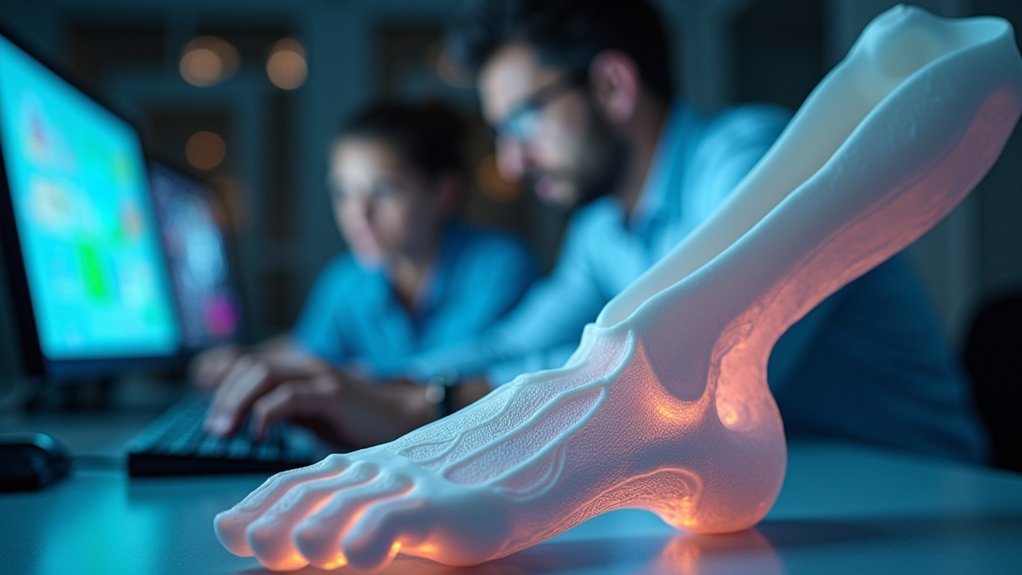
You’re experiencing a manufacturing revolution where 3D printing drastically reduces medical device costs from thousands to under $50 while enabling unprecedented customization for patient-specific implants and prosthetics. This technology eliminates supply chain bottlenecks, reduces surgery times by 62 minutes through precision surgical guides, and creates personalized drug delivery systems tailored to individual anatomy. The transformation extends from bioprinting living tissues to producing FDA-approved orthopedic implants that save $3,720 per surgical case, fundamentally reshaping how healthcare solutions reach patients who need them most.
Revolutionary Manufacturing Capabilities in Medical Device Production
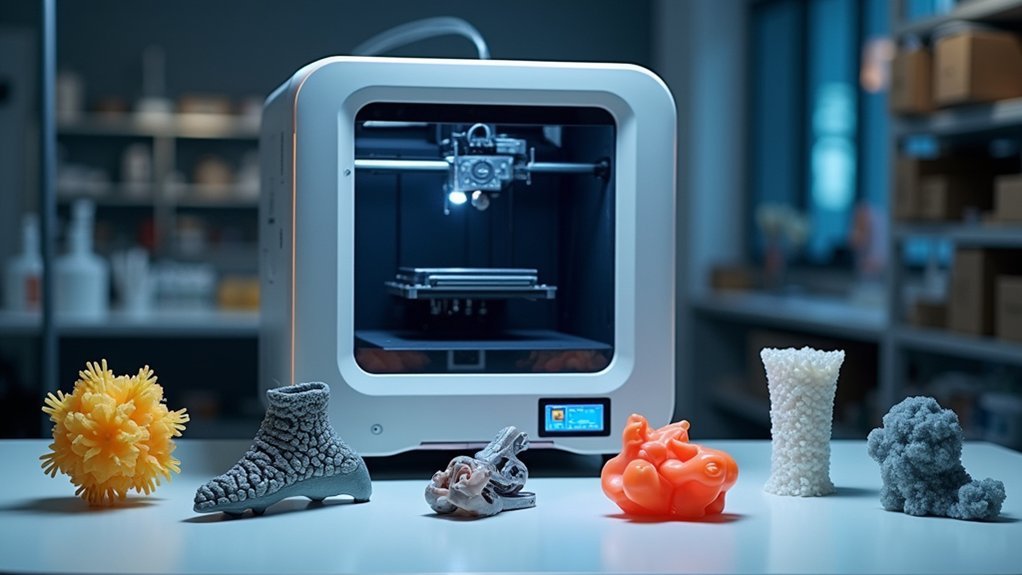
When you consider the transformation of medical device manufacturing, 3D printing stands out as a game-changing technology that’s revolutionizing how we create patient-specific solutions.
You’re now witnessing unprecedented capabilities in producing customized implants and prosthetics that perfectly match individual anatomical requirements, dramatically improving fit and function for patients.
3D printing delivers unprecedented customization in medical implants, creating perfect anatomical matches that dramatically enhance patient outcomes and device functionality.
This manufacturing breakthrough lets you create complex geometries like intricate bone scaffolds essential for tissue engineering applications.
You’ll find that production costs have plummeted, with some prosthetic biomedical devices costing merely $50 compared to thousands using traditional methods.
The technology’s responsiveness allows you to modify designs quickly based on surgeon feedback, enabling on-demand production that eliminates supply chain bottlenecks and delivers precisely what patients need when they need it.
Customized Prosthetics and Orthopedic Components Through Additive Manufacturing
Among the most transformative applications of these revolutionary capabilities, customized prosthetics represent where 3D printing’s patient-specific advantages truly shine.
You’ll find that additive manufacturing enables production of prosthetics tailored to your unique anatomy and preferences, greatly improving fit and comfort over traditional options. The e-NABLE community has created over 8,000 affordable prosthetic hands and arms globally, proving accessibility potential.
When you need orthopedic components, you’ll benefit from rapid prototyping that allows design modifications based on surgeon feedback.
FDA-approved 3D-printed orthopedic implants showcase complex structure capabilities for enhanced bone restoration. Your customized medical devices reduce surgical time and costs considerably, with reported savings of approximately $3,720 per case when utilizing 3D anatomical models as surgical guides.
Patient-Specific Implants and Surgical Hardware Design
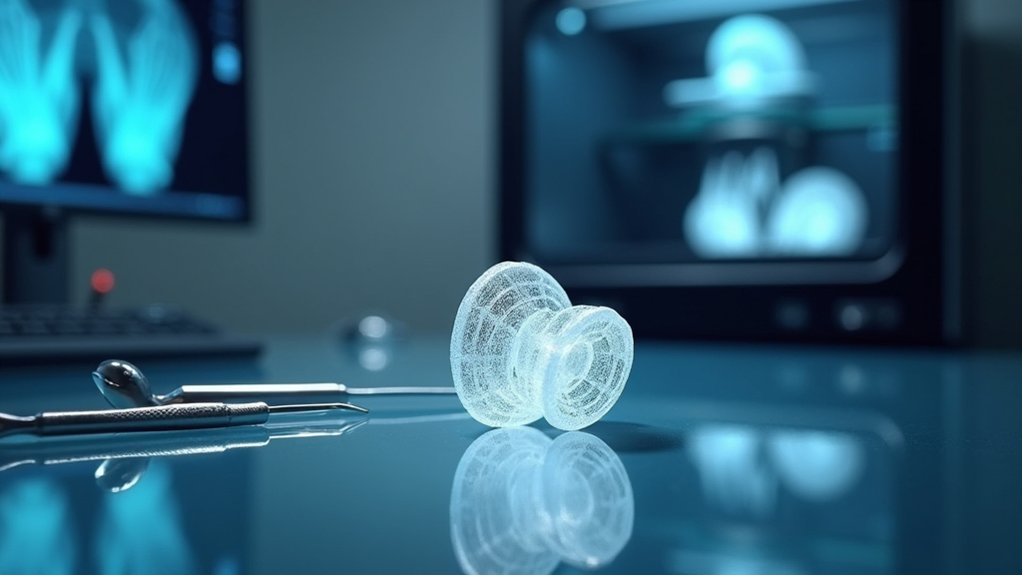
Beyond prosthetics and standard orthopedic components, 3D printing’s precision manufacturing capabilities enable surgeons to create implants and surgical hardware that perfectly match your individual anatomy. This patient-specific surgical approach transforms how medical devices integrate with your body, ensuring ideal fit and functionality.
| Application | Benefit |
|---|---|
| Custom Implants | Perfect anatomical matching |
| Surgical Guides | 62-minute reduction in surgery time |
| Dental Components | FDA-approved personalized solutions |
3D printing technology revolutionizes biomedical applications by producing complex orthopedic implants that promote superior bone integration. You’ll experience enhanced restoration of functionality compared to traditional manufacturing methods. Customized dental implants demonstrate proven success, while surgical guides dramatically improve operating room efficiency, benefiting both patients and healthcare providers through reduced procedure times.
Advanced Bioprinting Technologies for Tissue Engineering
While patient-specific implants represent a notable advancement in medical technology, bioprinting techniques push the boundaries even further by creating living tissues from your own cells.
You’ll witness layer-by-layer deposition of living cells and biomaterials constructing functional tissues that directly address organ transplantation shortages.
These patient-specific solutions offer transformative medical applications:
- Customized scaffolds – 3D printed hydroxyapatite structures tailored to your anatomical data promote live cell cultivation
- Personalized drug delivery – Complex bilayer tablet formulations create tailored medication regimens
- Disease modeling – Realistic organ and disease cell models enable safer treatment testing
- Transplant optimization – Organs produced from your cells notably reduce rejection rates and wait times
You’re experiencing bioprinting’s revolutionary impact on tissue regeneration and pharmaceutical development.
Personalized Drug Delivery Systems and Pharmaceutical Applications
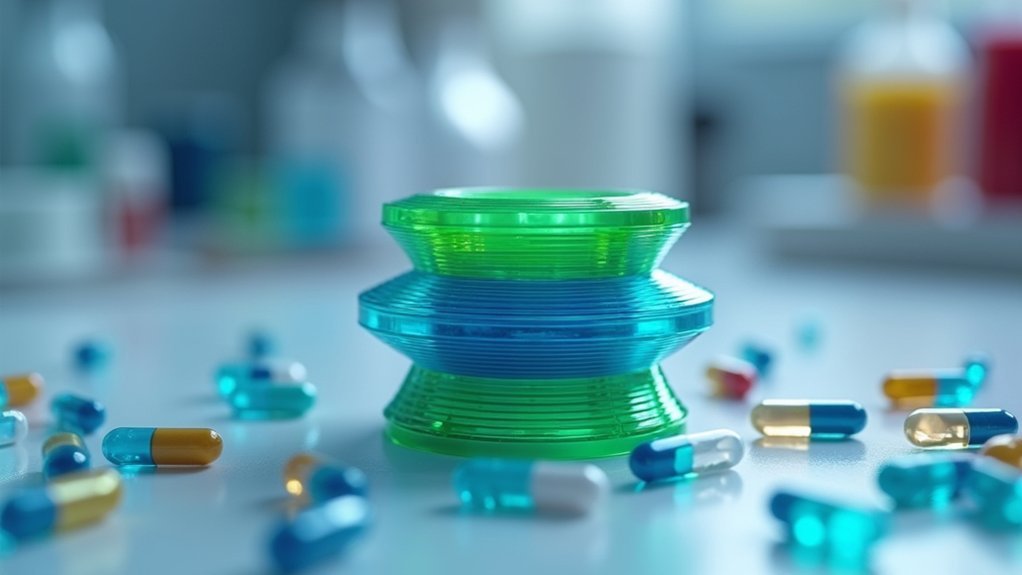
You can now create medications precisely tailored to your individual needs through 3D printing technology’s breakthrough in personalized drug delivery systems.
This innovation lets you consolidate multiple medications into a single polypill that’s customized for your specific dosing requirements and health profile.
You’ll benefit from complex release mechanisms that deliver medications exactly when and how your body needs them, improving both treatment effectiveness and your adherence to therapy.
Tailored Medication Dosing
As healthcare moves toward increasingly personalized treatment approaches, 3D printing revolutionizes how medications are designed, manufactured, and delivered to patients.
You’re witnessing a transformation where drug delivery systems can be precisely tailored to your individual needs, moving beyond the one-size-fits-all pharmaceutical model.
This technology enables you to receive personalized treatments through several key innovations:
- Polypill consolidation – Multiple medications combined into single, customizable tablets designed for your specific requirements.
- Complex bilayer formulations – Advanced osmotic pump designs that provide sustained-release medications tailored to your metabolism.
- Patient-specific dosing – Customized medication regimens that improve adherence to complex schedules.
- Risk reduction – Personalized testing on bioprinted organ replicas minimizes potential side effects before treatment begins.
Polypill Technology Advances
One of the most promising developments in personalized medication involves polypill technology, which transforms how you manage complex treatment regimens. This innovation consolidates multiple medications into a single customizable tablet, dramatically improving your adherence and convenience when managing various health conditions.
3D printing enables the creation of sophisticated bilayer tablet formulations with controlled release profiles tailored specifically to your needs. You’ll benefit from personalized drug delivery systems designed to address your specific medical requirements, optimizing therapeutic outcomes while minimizing side effects.
Advanced osmotic pump designs, facilitated by 3D printing, deliver sustained-release medications customized to improve your compliance and treatment effectiveness. This technology eliminates the complexity of managing multiple pills daily, streamlining your medication routine into one all-encompassing solution.
Complex Release Mechanisms
While traditional pharmaceutical manufacturing limits drug release to basic patterns, 3D printing revolutionizes how medications deliver their active ingredients through intricate, patient-specific mechanisms.
You can now create drug delivery systems with complex geometries that weren’t possible before. These sophisticated designs enable precise control over how medications release within your body, optimizing therapeutic outcomes while minimizing side effects.
Advanced release mechanisms you’ll benefit from include:
- Bilayer tablets with distinct release profiles for combination therapies
- Osmotic pump designs that maintain consistent drug concentrations over extended periods
- Multi-compartment systems that deliver different medications at predetermined intervals
- Patient-specific geometries that accommodate individual anatomical requirements and metabolic rates
3D printing transforms pharmaceutical manufacturing by enabling personalized medications that adapt to your unique therapeutic needs rather than forcing you to adapt to standardized formulations.
Precision Surgical Instruments and Medical Tools Development
Sixty-two minutes—that’s how much surgical time 3D-printed surgical guides can save on average, transforming operating room efficiency and patient care.
You’re witnessing 3D printing revolutionize biomedical engineering by enabling rapid production of precision surgical instruments tailored to specific requirements. These surgical guides enhance accuracy while dramatically improving patient throughput.
You can now design customized forceps and clamps based on real-time surgeon feedback, allowing immediate adjustments for unique procedural needs. This technology addresses supply chain challenges by producing essential tools at lower costs with quicker turnaround times—particularly valuable during crises like COVID-19.
Additionally, you’ll benefit from lifelike anatomical models that enhance surgical training and preparation, creating safer practice environments that lead to better surgical outcomes for both medical professionals and patients.
Anatomical Models and Pre-Surgical Planning Solutions
Every surgical procedure benefits when you can hold, examine, and practice on an exact replica of your patient’s anatomy before making the first incision.
3D-printed anatomical models transform pre-surgical planning by providing surgeons with precise, patient-specific replicas that reveal complex anatomical structures in unprecedented detail.
When you integrate 3D printing into pre-surgical planning, you’ll achieve remarkable outcomes:
- Reduced surgical time – Save an average of 62 minutes per procedure through enhanced preparation
- Cost efficiency – Generate approximately $3,720 in savings per case
- Perfect accuracy – Achieve 100% precision in predicting surgical interventions with robotic spine models
- Rapid customization – Modify designs quickly based on your feedback for ideal adaptability
These anatomical models revolutionize how you approach complex procedures, delivering measurable improvements in efficiency and patient outcomes.
Dental Applications and Orthodontic Device Manufacturing
The dental industry has embraced 3D printing as a transformative force that’s revolutionizing how you design, manufacture, and deliver oral healthcare solutions. You can now produce customized dental prosthetics like crowns and bridges in hours rather than weeks, while 3D-printed orthodontic devices deliver enhanced treatment precision with patient-specific designs.
| Application | Traditional Time | 3D Printing Time |
|---|---|---|
| Crowns/Bridges | 2-3 weeks | Few hours |
| Orthodontic Aligners | 1-2 weeks | Same day |
| Dental Models | 3-5 days | 2-4 hours |
With 98% dimensional accuracy, these dental applications enable precise surgical planning and improved patient outcomes. You’ll benefit from biocompatible materials that minimize rejection risks while reducing costs considerably. This cost-effectiveness makes advanced orthodontic devices more accessible, expanding treatment options for diverse patient populations.
Cost-Effective Production Methods for Medical Equipment
You’ll find that 3D printing transforms medical equipment production by slashing manufacturing costs from thousands to mere dollars, as seen with prosthetics dropping from expensive traditional models to $50 alternatives.
Your supply chain becomes more resilient when you can produce ventilators for under $10 during shortages, eliminating dependency on complex global networks.
You’re making life-saving equipment accessible to underserved populations who previously couldn’t afford traditional medical devices due to prohibitive costs.
Manufacturing Cost Reduction
When you compare traditional manufacturing methods to 3D printing in medical equipment production, the cost savings become immediately apparent.
Manufacturing cost reduction transforms how you develop medical products through rapid prototyping capabilities that eliminate expensive tooling and inventory overhead.
You’ll achieve substantial savings through:
- Material efficiency – Layer-by-layer construction minimizes waste compared to subtractive manufacturing
- Customization without penalties – Patient-specific devices don’t require costly retooling like traditional methods
- Reduced production cycles – Faster build times accelerate time-to-market for critical equipment
- Elimination of inventory costs – On-demand production removes storage and stock management expenses
Consider prosthetic hands costing $50 versus thousands for traditional alternatives, or COVID-19 ventilators produced for under $10.
You’re looking at surgical case savings of $3,720 when using 3D-printed anatomical models and guides.
Supply Chain Efficiency
Beyond cost reduction, 3D printing revolutionizes supply chain efficiency by enabling you to produce medical equipment exactly where and when it’s needed.
You can manufacture critical devices like ventilators and surgical tools on-demand, eliminating lengthy procurement cycles and reducing dependency on external suppliers.
During supply chain disruptions, such as the COVID-19 pandemic, you’ll maintain operational continuity by producing equipment in-house rather than waiting for shipments.
This localized manufacturing approach lets you rapidly adjust designs based on real-time surgeon feedback without extensive retooling.
You’ll minimize inventory costs while ensuring essential medical equipment remains available when emergencies strike, transforming your facility from a passive recipient into an active producer of customized healthcare solutions.
Equipment Accessibility Solutions
3D printing transforms medical equipment accessibility by dramatically reducing production costs across healthcare applications.
You’ll find that this technology democratizes access to essential medical tools that were previously prohibitively expensive for many healthcare facilities and patients worldwide.
The cost savings from 3D printing medical equipment create unprecedented opportunities:
- Emergency ventilators – You can produce functional ventilators for under $10, compared to thousands for traditional models.
- Prosthetic devices – You’ll access 3D-printed prosthetic hands for $50 versus thousands for conventional alternatives.
- Surgical instruments – You can manufacture customized forceps and clamps on-demand without expensive tooling.
- Global outreach – You’ll enable organizations like e-NABLE to distribute over 8,000 affordable prosthetics worldwide.
This technology guarantees you can provide quality healthcare solutions regardless of budget constraints.
Quality Control Standards and Regulatory Compliance in 3D Medical Manufacturing
As medical devices shift from traditional manufacturing to additive processes, you’ll find that regulatory bodies have established stringent quality control standards that directly impact how 3D-printed medical products reach patients.
These regulatory compliance requirements demand thorough documentation covering material biocompatibility, manufacturing processes, and device performance evaluations.
You’ll encounter significant challenges with additive manufacturing’s layer-by-layer approach, which creates variability in material properties. This necessitates advanced monitoring techniques and standardized protocols throughout production.
The FDA requires rigorous testing and validation processes before market approval, often including clinical evaluations.
To succeed, you’ll need collaborative partnerships between manufacturers, regulatory agencies, and academic institutions.
These relationships help establish extensive frameworks that accommodate 3D printing’s unique characteristics while maintaining patient safety and ensuring consistent product quality across all manufacturing batches.
Material Innovation in Biocompatible Printing Substances
While regulatory frameworks establish the safety parameters for 3D medical manufacturing, the foundation of successful biomedical applications lies in the continuous innovation of printing materials themselves.
You’ll find that today’s biocompatible materials go far beyond basic polymers, incorporating advanced reinforcements that dramatically improve performance.
Modern material innovations you can leverage include:
- Carbon and glass fiber composites that enhance mechanical strength and stiffness for load-bearing implants
- Nanoparticle-enhanced polymers that improve toughness while maintaining biocompatibility
- Bio-inks containing living cells that enable functional tissue creation for transplantation
- Semi-crystalline polymers offering tailored properties for specific biomedical applications
These materials address critical challenges in biomedical engineering, allowing you to create devices that meet stringent clinical requirements while advancing patient care capabilities.
Integration of AI and IoMT Technologies in 3D Printed Devices
Once you’ve established biocompatible materials for your 3D printing applications, you’ll discover that integrating artificial intelligence and Internet of Medical Things (IoMT) technologies transforms these static devices into intelligent, responsive medical solutions.
AI algorithms optimize your design and manufacturing processes, ensuring higher accuracy while reducing prototyping costs. You’ll achieve personalized treatment plans through enhanced decision-making and predictive analytics tailored to individual patient needs.
AI-driven optimization delivers precision manufacturing and personalized healthcare through intelligent algorithms that reduce costs while enhancing patient-specific treatment outcomes.
IoMT enables real-time monitoring of your 3D-printed devices, improving patient outcomes through timely data collection and analysis.
Your AI-enabled devices adapt to patients’ physiological changes over time, offering dynamic solutions in prosthetics and implants. This integration creates smart medical devices that provide continuous feedback and seamlessly integrate into healthcare systems, enhancing overall treatment effectiveness.
Scalability Challenges and Manufacturing Efficiency Improvements
You’ll encounter significant production volume limitations when scaling 3D printing for biomedical devices, as current technologies can’t match traditional manufacturing speeds for mass production.
Quality control standardization becomes critical since you’re dealing with life-saving devices that must meet strict regulatory requirements across every unit produced.
However, you can achieve remarkable cost reductions through additive manufacturing, as demonstrated by $10 ventilators developed during COVID-19, making medical devices more accessible globally.
Production Volume Limitations
Although 3D printing excels at producing customized biomedical devices, you’ll encounter significant challenges when scaling up production volumes.
While additive manufacturing transforms patient-specific medical solutions, traditional mass production methods often outpace 3D printing for high-volume manufacturing.
Key production volume limitations include:
- Layer-by-layer construction speed – Sequential building processes inherently limit throughput compared to injection molding or machining.
- Machine capacity constraints – Most 3D printers accommodate limited build volumes, restricting simultaneous part production.
- Post-processing requirements – Support removal, surface finishing, and quality control add time between production cycles.
- Material preparation overhead – Powder handling, resin curing, and material changeovers create bottlenecks.
However, you’ll find 3D printing remains ideal for low-volume, high-complexity applications where customization outweighs speed concerns in biomedical engineering.
Quality Control Standardization
When scaling 3D printing operations for biomedical applications, establishing consistent quality control standards becomes your most critical challenge.
You’ll face hurdles in material consistency, accuracy, and regulatory compliance that directly impact patient safety. Without standardized protocols, you can’t achieve reliable, reproducible biomedical devices at scale.
You’ll need to integrate real-time monitoring systems during printing to enhance manufacturing efficiency and guarantee safety adherence. These efficient quality control methods greatly improve your production reliability.
Industry standardization for 3D-printed biomedical devices is imperative for regulatory approval and broader healthcare adoption.
Automation and AI technologies will streamline your quality control processes, improving scalability and efficiency.
You’ll find these continuous advancements essential for transforming biomedical manufacturing operations successfully.
Cost-Effective Manufacturing Solutions
While traditional manufacturing methods for biomedical devices can cost thousands of dollars per unit, 3D printing technology dramatically slashes these expenses and transforms accessibility across healthcare systems.
You’ll find that cost-effective manufacturing solutions through 3D printing revolutionize how medical professionals approach device production and patient care.
Consider these manufacturing efficiency improvements:
- Prosthetic costs drop from thousands to $50 – making advanced limbs accessible worldwide
- Surgical case savings reach $3,720 through 3D-printed anatomical models reducing preparation time
- Crisis response capabilities enable $10 ventilator production during emergencies like COVID-19
- Rapid design modifications allow immediate feedback integration from medical professionals
Despite scalability challenges, you’re witnessing widespread hospital adoption that’s transforming healthcare delivery through enhanced manufacturing efficiency and unprecedented cost reductions.
Future Trends in Additive Manufacturing for Healthcare Applications
As additive manufacturing continues to evolve, you’ll witness groundbreaking advancements that promise to transform healthcare delivery and patient outcomes.
Advanced biomaterials integration will enhance mechanical properties and biocompatibility of medical devices, enabling truly personalized patient care solutions.
You’ll see 4D printing technology create dynamic biomedical structures that respond to environmental stimuli, advancing patient-specific treatments.
Innovative techniques like continuous liquid interphase printing (CLIP) will dramatically increase production speeds while improving material properties for medical applications.
Personalized drug delivery systems, including customizable bi-layer tablets, will revolutionize pharmaceutical manufacturing.
However, you’ll need collaborative efforts among hospitals, academic institutions, and regulatory bodies to overcome challenges in material selection, quality control, and regulatory compliance for successful healthcare implementation.
Frequently Asked Questions
What Are the Advantages of 3D Printing in Biomedical Engineering?
You’ll achieve rapid, cost-effective production of customized prosthetics and implants. You can create patient-specific surgical models, develop bioprinted organs using personal cells, and design personalized drug delivery systems while enhancing medical training.
How 3D Printing Has Changed the World of Biomedical Engineering Because It Is?
You can personalize medical solutions like never before. 3D printing customizes prosthetics, surgical instruments, and implants specifically for individual patients. You’ll reduce costs dramatically while improving precision, surgical outcomes, and accessibility to advanced medical devices.
How Is 3D Printing Changing the Manufacturing Industry?
You’re witnessing 3D printing revolutionize manufacturing by enabling rapid prototyping, reducing material waste, lowering production costs, and allowing mass customization. You can now produce complex designs that weren’t possible with traditional methods.
How Has 3D Printing Changed the Medical Industry?
You’re seeing 3D printing revolutionize medicine through customized prosthetics costing just $50, patient-specific surgical models reducing operation times, bioprinted organs from your own cells, and personalized drug delivery systems consolidating complex medications.

Leave a Reply