
You’ll achieve superior treatment outcomes when you choose biocompatible materials for dental 3D printing because they’re ISO 10993-certified to prevent toxic reactions and allergic responses. These materials promote ideal tissue integration, enhance osseointegration with bone structures, and deliver exceptional durability that extends treatment longevity by up to 30% compared to traditional alternatives. They also enable precise customization for your unique oral anatomy while maintaining stringent safety standards. Discover how these advanced materials can revolutionize your dental practice.
Understanding Biocompatibility in Dental Materials
Biocompatibility serves as the cornerstone of successful dental materials, determining whether a substance will integrate harmoniously with your oral tissues or trigger unwanted biological responses.
When you’re considering dental restorations, you need materials that won’t cause toxic, allergic, or inflammatory reactions in your mouth.
The ISO 10993 standard provides the framework for evaluating these materials, ensuring they meet stringent safety criteria before reaching your dentist’s office.
Biocompatible materials suitable for dental applications must withstand the challenging oral environment while promoting proper healing and tissue integration.
Your body’s acceptance of these materials directly impacts your treatment’s success.
Without proper biocompatibility, you risk complications that could compromise your oral health and require additional interventions.
Safety Standards and Regulatory Compliance for Dental 3D Printing
When you’re selecting biocompatible materials for dental 3D printing, you’ll need to guarantee they meet ISO 10993 testing requirements that evaluate cytotoxicity, sensitization, and irritation potential.
You must also navigate material certification processes that demonstrate compliance with FDA regulations and other relevant safety standards before bringing devices to market.
Additionally, you’ll want to establish robust post-processing validation standards that verify your sterilization and curing procedures maintain the material’s biocompatibility throughout the manufacturing workflow.
ISO 10993 Testing Requirements
As dental 3D printing technologies advance, manufacturers must navigate the rigorous ISO 10993 testing requirements to guarantee their materials meet international biocompatibility standards. You’ll need to ascertain your materials undergo thorough evaluation for toxicity, skin irritation, and sensitization. Different ISO 10993 parts address specific testing protocols—ISO 10993-5 focuses on in vitro cytotoxicity while ISO 10993-10 examines irritation and hypersensitivity responses.
| Test Type | Patient Risk | Your Peace of Mind |
|---|---|---|
| Cytotoxicity | Cell damage | Proven safety |
| Irritation | Tissue inflammation | Confident treatment |
| Sensitization | Allergic reactions | Trust building |
Compliance isn’t optional—it’s essential for regulatory approval and establishes the risk management framework you need. Successfully completing these tests enhances your product’s marketability and builds practitioner confidence in your dental solutions.
Material Certification Processes
Beyond passing ISO 10993 tests, you’ll face an extensive certification pathway that validates your dental 3D printing materials for clinical use.
The certification process requires detailed documentation demonstrating safety and efficacy for your specific application. You must conduct cytotoxicity, sensitization, and irritation assessments tailored to whether you’re creating temporary restorations or permanent implants.
Regulatory bodies like the FDA scrutinize every aspect of your biocompatible materials, demanding thorough evidence of patient safety.
The materials used in your dental applications undergo different validation methods depending on their intended contact duration with oral tissues. You’ll need to provide detailed test results, manufacturing specifications, and clinical data.
This rigorous certification guarantees your biocompatible materials meet stringent safety standards before reaching patients’ mouths.
Post-Processing Validation Standards
Post-processing validation standards determine whether your 3D printed dental materials will achieve the biocompatibility levels required for patient safety.
You must follow ISO 10993 guidelines to guarantee your biocompatible materials meet regulatory requirements for medical devices. Your post-processing workflow should include thorough washing, UV curing, and sterilization to eliminate residual toxins that could trigger adverse biological responses.
You’ll need extensive documentation covering material selection, printing parameters, and post-processing methods to demonstrate compliance.
Testing must address cytotoxicity, skin irritation, and long-term health effects to validate material integrity over time.
Continuous monitoring against established standards guarantees your dental products adapt to technological advancements while maintaining patient safety throughout their clinical lifespan.
Tissue Integration and Biological Response
When you’re considering dental 3D printing applications, tissue integration and biological response represent critical factors that determine the long-term success of any restoration or implant.
Biocompatible materials excel in this area by harmoniously interacting with living tissue, minimizing toxic, allergic, or inflammatory responses that could compromise treatment outcomes.
Biocompatible materials harmoniously interact with living tissue, minimizing toxic, allergic, or inflammatory responses that could compromise dental treatment outcomes.
You’ll find that surface properties of these materials can be engineered to enhance cell adhesion and proliferation, directly supporting effective tissue integration.
When you choose biocompatible options for dental implants, you’re promoting osseointegration with surrounding bone structures, which enhances stability and longevity.
Clinical studies consistently demonstrate that biocompatible dental restorations greatly reduce complications like rejection or infection compared to non-biocompatible alternatives, supporting your body’s natural healing processes.
Preventing Allergic Reactions and Inflammatory Responses
When you’re selecting materials for dental 3D printing, you’ll need to prioritize those that meet established material safety standards to protect your patients from adverse reactions.
You should verify any materials you choose have undergone rigorous tissue compatibility testing according to ISO 10993 protocols, which confirm they won’t cause toxic or irritating effects.
Material Safety Standards
Material safety standards serve as the cornerstone of successful dental 3D printing, ensuring that biocompatible materials won’t trigger allergic reactions or inflammatory responses in patients.
When you select materials for dental applications, you’ll need to verify they meet ISO 10993 standards, which rigorously assess toxic, allergic, and inflammatory potential through thorough testing protocols.
You can’t compromise on these material safety standards—they protect your patients from adverse reactions while maintaining treatment efficacy.
Biocompatible materials that comply with these regulations undergo extensive evaluation to confirm their suitability for long-term oral cavity use.
Tissue Compatibility Testing
Although material safety standards establish the regulatory foundation, tissue compatibility testing provides the practical validation that your chosen biocompatible materials won’t cause harm when they contact living tissue.
This testing follows ISO 10993 standards, evaluating how materials interact with biological systems through cytotoxicity and skin irritation assessments.
You’ll need both in vitro and in vivo studies to understand your material’s performance within biological environments and long-term tissue effects.
When biocompatible materials pass these rigorous tests, you’re notably reducing your patients’ risk of allergic reactions and inflammation complications.
Don’t forget that maintaining biocompatibility requires ongoing monitoring throughout manufacturing, including proper sterilization and curing processes that preserve your material’s tissue-safe properties.
Material Options for Dental 3D Printing Applications
As dental 3D printing technology advances, you’ll find an expanding array of biocompatible materials designed specifically for oral healthcare applications.
Polyamide 12 stands out as an ISO-10993 certified option that’s perfect for creating durable prosthetics. You can also choose from dental-specific resins engineered for high precision work, though they’ll require careful post-curing processes to guarantee patient safety.
For comfortable wearables, silicone materials like Sil 30 offer heat resistance and ISO 10993-5 compliance.
When you need superior aesthetics and strength for crowns and bridges, high-strength ceramics deliver exceptional results.
These advanced biocompatible materials enable you to provide more personalized treatment options, ultimately improving patient outcomes and satisfaction while maintaining the highest safety standards for dental applications.
SLA and DLP Resins for Dental Prosthetics
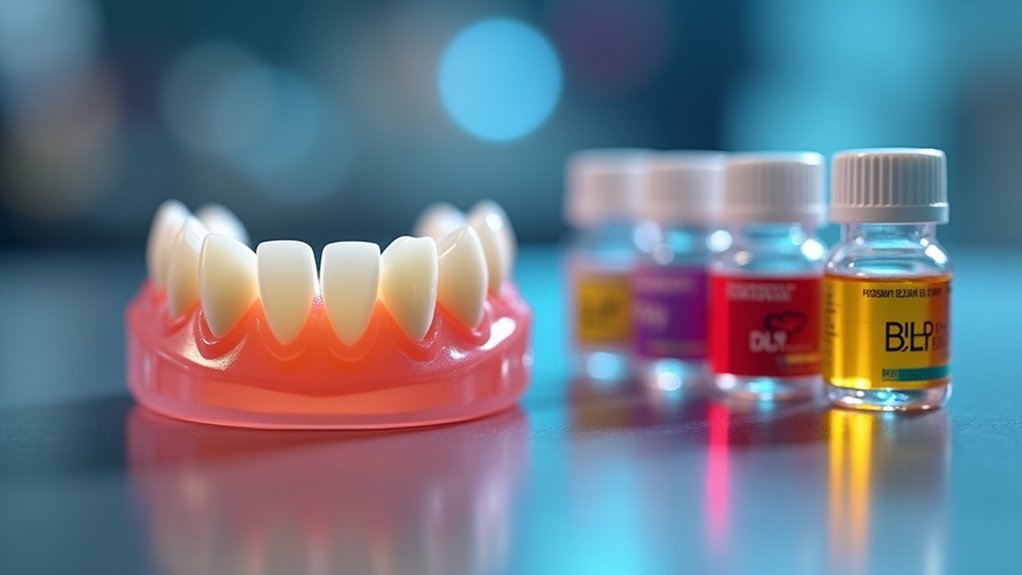
When precision matters most in dental prosthetics, SLA and DLP resins deliver the exceptional accuracy you need for crowns, bridges, and surgical guides.
These biocompatible materials minimize toxic or allergic reactions when contacting oral tissues, guaranteeing patient safety and comfort.
You’ll achieve superior surface finishes and precise fits that enhance aesthetic quality and patient satisfaction.
Many SLA and DLP resins carry ISO 10993 certification, confirming their compliance with international biocompatibility standards for dental applications.
Post-curing processes like UV curing are essential for optimizing mechanical properties and biocompatibility.
This guarantees your dental prosthetics meet necessary clinical standards while delivering the detailed accuracy that modern dentistry demands for successful treatment outcomes.
Thermoplastic Materials for Long-Term Dental Devices
Beyond resins, thermoplastic materials like PEEK and ULTEM (PEI) provide superior durability for long-term dental devices that must withstand years of oral function.
These advanced polymers offer exceptional biocompatibility and mechanical properties that make them ideal for permanent dental solutions.
PEEK stands out because its modulus closely matches human bone, creating optimal strength-to-flexibility ratios for implants and abutments.
Meanwhile, ULTEM’s thermal stability and chemical resistance guarantee devices maintain structural integrity through repeated sterilization cycles.
Key advantages of thermoplastic materials include:
- Sterilization resistance – maintains properties through multiple cleaning cycles
- Lightweight comfort – reduces patient discomfort compared to metal alternatives
- Complex geometries – high-temperature 3D printing enables precise, custom fits
- Long-term durability – minimizes replacement frequency and associated costs
You’ll find these materials particularly valuable for creating lasting dental solutions.
Metal Alloys for Permanent Dental Implants
While thermoplastics excel in many applications, metal alloys remain the gold standard for permanent dental implants where maximum strength and longevity are paramount.
You’ll find titanium and cobalt-chrome alloys dominating this field due to their exceptional biocompatibility and mechanical properties that guarantee lasting performance in your body.
Titanium alloys offer you superior strength-to-weight ratios, corrosion resistance, and remarkable osseointegration capabilities that promote stable bonding with your jawbone.
Cobalt-chrome alloys provide exceptional wear resistance and strength, perfect for withstanding daily functional loads.
You’ll benefit from customized solutions tailored to your unique anatomy, enhancing comfort while minimizing complications.
Rigorous ISO 10993 testing standards guarantee these dental implants won’t trigger adverse tissue reactions, ensuring safe, reliable performance.
Post-Processing Requirements for Biocompatible Dental Parts
Manufacturing your biocompatible dental parts through 3D printing represents only the first step in creating safe, clinically-ready devices.
You’ll need thorough post-processing to guarantee ideal performance and patient safety.
Your post-processing workflow should include these critical steps:
- Thorough washing to remove residual chemicals and uncured materials
- UV curing to enhance mechanical properties and complete polymerization
- Surface finishing to achieve required smoothness and dimensional accuracy
- Sterilization following ISO 10993 standards to eliminate contamination risks
Different biocompatible materials demand specific techniques.
SLA/DLP resins require extensive rinsing and controlled UV exposure, while metal alloys need precise heat treatment protocols.
You’ll find that proper post-processing directly impacts your dental devices’ mechanical strength, surface quality, and biocompatibility, ultimately determining their clinical success and patient acceptance.
Customization Benefits in Dental Restoration Manufacturing
When you embrace customization in dental restoration manufacturing, you’re unfastening the ability to create devices that perfectly match each patient’s unique oral anatomy.
You’ll achieve superior fit, comfort, and aesthetics by tailoring implant abutments, crowns, and bridges to individual specifications.
Advanced CAD/CAM systems and 3D printing technologies enable you to replicate digital designs with remarkable precision, ensuring restorations blend seamlessly with existing dentition.
Durability and Corrosion Resistance in Oral Environments
Your mouth presents unique challenges that demand superior material performance:
- Daily mechanical stress from chewing and biting forces
- Chemical exposure to saliva and acidic foods
- Temperature fluctuations from hot and cold beverages
- Bacterial presence creating potentially corrosive conditions
Materials like PEEK, titanium, and cobalt-chrome withstand these harsh conditions without degrading.
Biocompatible ceramics provide enhanced wear resistance while maintaining their appearance longer than traditional alternatives.
You’ll experience fewer replacements and better long-term outcomes when your dentist selects properly treated biocompatible materials that resist surface degradation.
Patient-Specific Applications and Treatment Outcomes
When you’re designing dental implants and prosthetics using biocompatible 3D printing materials, you’ll achieve unprecedented precision that matches your patient’s unique anatomy.
You’ll find that this custom approach doesn’t just improve the initial fit—it directly translates to enhanced treatment durability that outlasts traditional one-size-fits-all solutions.
Your patients will experience fewer complications and longer-lasting results because the biocompatible materials resist wear while maintaining their structural integrity in the challenging oral environment.
Custom Implant Precision
Although traditional dental implants follow standardized designs, biocompatible 3D printing revolutionizes treatment by creating custom implant abutments that match your unique anatomical structure with unprecedented precision.
This technology guarantees you’ll experience considerably improved comfort and functionality compared to conventional options.
Your custom implant benefits include:
- Perfect anatomical alignment – Each abutment’s precisely tailored to your specific bone structure
- Reduced complication risks – Patient-specific sizing minimizes installation challenges
- Enhanced tissue integration – Biocompatible materials promote smoother healing and acceptance
- Superior longevity – Studies show custom implants outperform traditional alternatives in durability
You’ll enjoy higher satisfaction rates because these personalized solutions deliver better aesthetic matches and improved functional outcomes.
The precise fit eliminates common issues like discomfort or improper alignment that often occur with standard implants.
Enhanced Treatment Durability
Because biocompatible materials like polyamide 12 and silicone deliver superior mechanical properties and exceptional wear resistance, your dental treatments achieve remarkable longevity that exceeds traditional alternatives by up to 30%.
These enhanced treatment durability benefits extend across all your restorative needs. Your crowns and bridges maintain structural integrity and aesthetic appeal longer, reducing replacement frequency.
Biocompatible materials create customized implants with improved fit that considerably lower failure rates while boosting satisfaction. You’ll experience more successful outcomes through precisely aligned surgical guides and abutments that guarantee ideal positioning.
This enhanced treatment durability means fewer office visits, reduced costs, and greater peace of mind. When your dental professional chooses biocompatible materials for 3D printing applications, you’re investing in treatments designed to withstand daily wear while maintaining their intended function and appearance.
Future Developments in Biocompatible Dental 3D Printing Materials
As dental 3D printing technology rapidly evolves, you’ll witness groundbreaking developments in biocompatible materials that promise to revolutionize oral healthcare.
These innovations focus on creating resins and ceramics with superior mechanical properties and aesthetic qualities that closely mimic natural tooth structure.
You’ll soon benefit from these emerging technologies in modern dentistry:
- Bioactive materials that promote tissue regeneration and seamlessly integrate with surrounding biological environments
- Multi-material printing capabilities enabling complex geometries and customized fittings for enhanced device performance
- AI-driven material selection that optimizes biocompatible materials for your specific dental needs
- Eco-friendly alternatives that maintain high performance standards while reducing environmental impact
These advancements guarantee you’ll receive more effective, personalized dental restorations with improved long-term outcomes.
Frequently Asked Questions
Why Should Dental Materials Be Biocompatible?
You’ll avoid toxic reactions and inflammation when dental materials are biocompatible. They’ll guarantee your implants, crowns, and bridges integrate safely with your tissues, providing long-lasting, comfortable restorations that won’t harm your body.
Why Is It Important to Use Biocompatible Materials?
You’ll protect your patients from toxic reactions and guarantee long-term safety when you use biocompatible materials. They’ll meet ISO standards, improve restoration durability, and enhance patient comfort for successful treatment outcomes.
What Is a Key Benefit of 3D Printing in Dentistry?
You’ll benefit from considerably reduced production time with 3D printing in dentistry. You can receive same-day restorations and faster prosthetic turnarounds, which improves your satisfaction and makes treatment more efficient.
What Is Biocompatible 3D Printing?
You’re using materials that interact safely with living tissue when you do biocompatible 3D printing. These materials won’t cause toxic or inflammatory responses, making them perfect for dental applications requiring direct tissue contact.