
You’ll need medical grade 3D printers with layer resolutions between 25-100 microns, print speeds of 30-80 mm/s, and compatibility with biocompatible materials like PC-ISO, Nylon PA 12, and titanium. Your printer must comply with ISO 13485:2016 quality management standards and FDA 21 CFR Part 820 regulations. Essential features include sterilization-resistant output, ISO 10993 biocompatibility testing support, and extensive documentation capabilities for regulatory submissions. Understanding these core specifications will help you navigate the complete landscape of medical manufacturing requirements.
Understanding Medical Grade 3D Printing Requirements
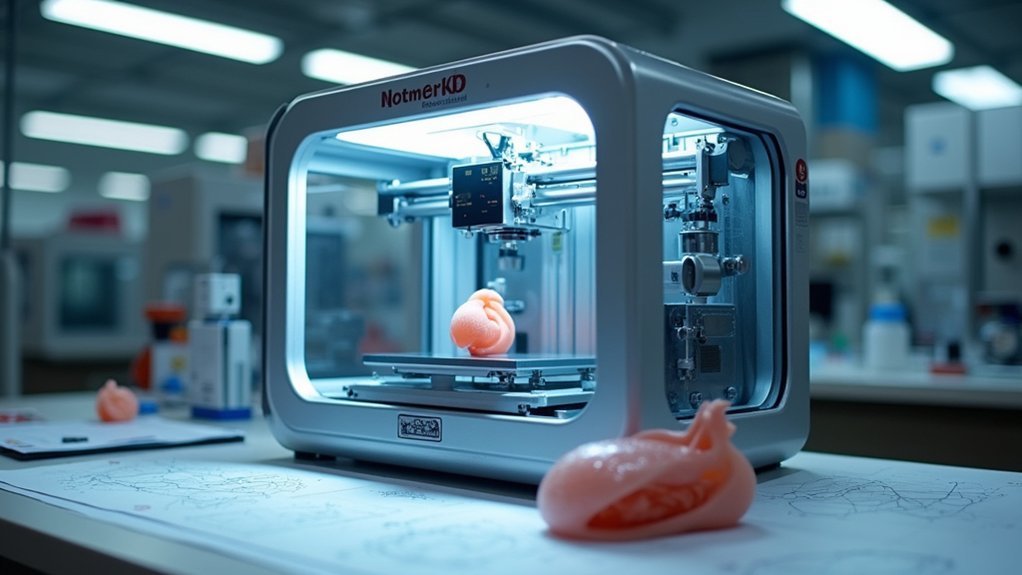
Precision defines medical-grade 3D printing, where you’ll encounter stringent regulatory requirements that govern every aspect of device production.
Medical-grade 3D printers must comply with ISO 13485 standards, ensuring your Quality Management System (QMS) maintains proper documentation and traceability throughout manufacturing.
You’ll need to prioritize biocompatibility when selecting materials used in production. Common options include PC-ISO, Nylon PA 12, and Titanium, which undergo rigorous safety testing.
Device manufacturers must validate each product for its intended use, considering sterilization requirements and bodily fluid exposure.
Your printing processes must support rapid prototyping while maintaining regulatory compliance. This enables efficient iteration of designs and creation of patient-specific solutions.
You’ll find that balancing innovation with strict adherence to medical standards is essential for successful medical device production.
Related guide: Best Dental and Medical Grade Resins for Precision Applications
Key Specifications for Medical Device Manufacturing
When selecting medical-grade 3D printers, you’ll encounter specific technical requirements that directly impact your manufacturing capabilities.
Precision and resolution measured in microns guarantee you’ll produce detailed surgical guides and implants meeting strict tolerances. You’ll need to balance print speed with quality—faster manufacturing technique improves productivity but can’t compromise accuracy.
Micron-level precision ensures your surgical guides meet strict tolerances while balancing speed with uncompromised accuracy in medical manufacturing.
Build volume determines whether you’ll fabricate multiple parts simultaneously, reducing operational time and costs. Material compatibility is essential; your printer must handle biocompatible materials like PC-ISO and Titanium for safe medical devices.
Don’t overlook quality management systems requirements—you’ll need ISO 13485 compliance to meet regulatory standards and guarantee reliable medical device production throughout your manufacturing processes.
Biocompatible Materials and Compatibility Standards
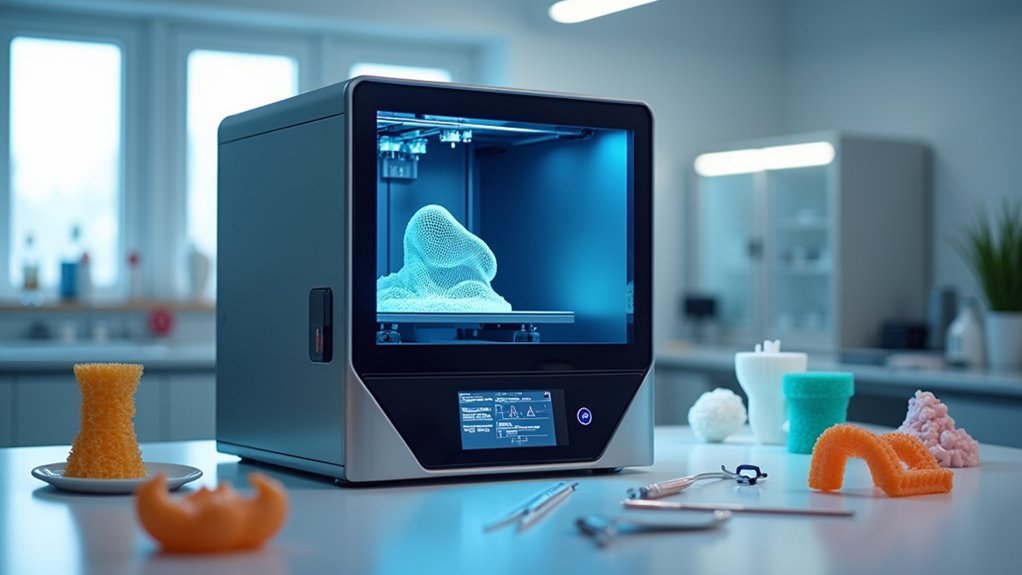
When you’re selecting materials for medical-grade 3D printing, you’ll need to understand ISO biocompatibility testing standards that govern material safety for patient contact.
Your material choices must include certified medical-grade options like PC-ISO, Nylon PA 12, ABS-M30i, Titanium, and Cobalt Chrome, each designed for specific clinical applications.
You’re also required to meet strict regulatory compliance requirements from the FDA and international standards like ISO 13485:2016 to guarantee your printed devices are safe and effective.
ISO Biocompatibility Testing Standards
As medical device manufacturers navigate the complex landscape of regulatory approval, ISO 10993 biocompatibility testing standards serve as the definitive framework for evaluating material safety in biological systems. You’ll need thorough testing evidence for FDA regulatory submissions, particularly when your devices contact tissues or bodily fluids directly.
| Test Type | Application | Contact Duration |
|---|---|---|
| Cytotoxicity | All medical devices | All timeframes |
| Sensitization | Skin contact devices | >24 hours |
| Irritation | Mucosal contact | >24 hours |
ISO biocompatibility testing standards guarantee biocompatible materials like PC-ISO and Nylon PA 12 meet stringent safety requirements. Materials used in 3D printing must withstand sterilization processes while maintaining their biocompatibility properties, ultimately protecting patient care outcomes through rigorous validation protocols.
Medical Grade Material Types
Beyond meeting ISO 10993 testing requirements, you’ll need to select the right biocompatible materials that align with your specific medical device applications.
Medical 3D printing offers several proven options for different needs.
PC-ISO works perfectly for surgical guides since it’s sterilizable and safe for direct tissue contact.
When you need flexibility with excellent surface quality, Nylon PA 12 delivers while maintaining steam sterilization compatibility.
For load-bearing medical devices like implants, Titanium provides exceptional strength and biocompatibility that surgeons trust.
Meanwhile, Cobalt Chrome offers superior corrosion-resistant properties, making it ideal for permanent implants such as joint replacements.
Each material serves distinct purposes in biocompatible materials selection, so you’ll want to match material properties with your specific device requirements and sterilization protocols.
Regulatory Compliance Requirements
Before your medical-grade 3D printer can produce devices for clinical use, you must navigate a complex web of regulatory compliance requirements that govern both material selection and manufacturing processes.
Your biocompatible materials must meet ISO standards like ISO 10993, while adhering to FDA regulations under 21 CFR Part 820.
Essential compliance steps include:
- Material Certification – Verify PC-ISO, Nylon PA 12, and Titanium meet biocompatibility requirements through cytotoxicity testing and testing protocols.
- Documentation Systems – Establish a quality management system tracking all medical devices from design through product lifecycle.
- Clinical Validation – Complete sensitization and irritation assessments for materials contacting human tissue, especially for surgical guides.
You’ll need robust documentation demonstrating compliance throughout your manufacturing process to meet regulatory standards.
Precision and Resolution Requirements for Medical Applications
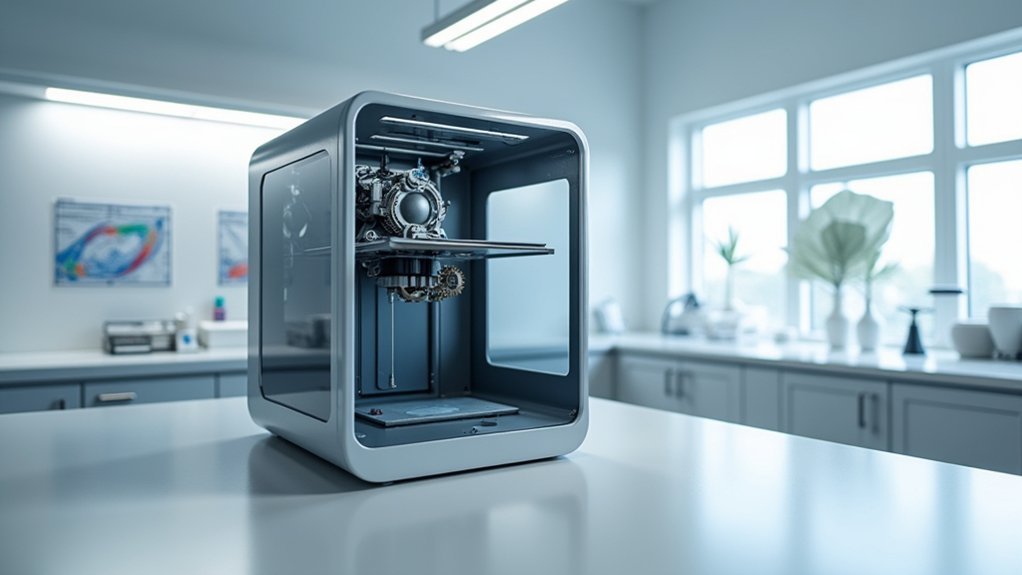
When you’re selecting a medical-grade 3D printer, precision and resolution requirements become non-negotiable factors that directly impact patient safety and treatment outcomes.
You’ll need layer resolutions between 25-100 microns for intricate medical applications like dental surgical guides and implants. SLA technology delivers the highest precision, achieving tolerances as fine as ±0.1 mm for complex geometries and functional prototypes.
This technology’s layer-by-layer polymerization creates isotropic parts with superior mechanical properties and surface finish—critical for medical device performance. You should expect print speeds of 30-80 mm/s that balance efficiency with quality.
Regulatory Compliance and Quality Management Systems
When you’re manufacturing medical devices with 3D printing, you’ll need to navigate FDA regulatory requirements outlined in 21 CFR Part 820 and establish a thorough Quality Management System that meets ISO 13485:2016 standards.
You must implement rigorous biocompatibility testing protocols that align with your device’s intended use and material composition to satisfy regulatory submissions.
Your QMS won’t just guarantee compliance—it’ll support operational efficiency while maintaining the safety and quality benchmarks essential for medical device production.
FDA Regulatory Requirements
Since medical devices manufactured through 3D printing carry significant safety implications, the FDA mandates strict compliance with 21 CFR Part 820, which requires you to establish a detailed Quality Management System (QMS) that governs every aspect of your manufacturing process.
You’ll need to align your QMS with ISO 13485:2016 standards for medical device production while implementing thorough risk management protocols per ISO 14971.
Your regulatory pathway depends on device classification:
- Class I devices – Generally exempt from premarket review if quality standards are met
- Class II devices – Some require premarket notification depending on risk assessment
- Class III devices – Require extensive premarket approval with rigorous testing
You must demonstrate biocompatibility through ISO 10993 testing and maintain continuous monitoring of manufacturing processes to guarantee ongoing compliance with FDA regulations.
ISO Certification Standards
ISO certification standards form the backbone of medical device manufacturing compliance, with ISO 13485:2016 serving as your primary framework for establishing a robust Quality Management System.
You’ll need thorough documentation of processes, procedures, and responsibilities to demonstrate your capability in providing medical devices that meet both customer and regulatory requirements.
Implementing ISO 14971 alongside ISO 13485:2016 guarantees effective risk management throughout your product lifecycle.
You’ll identify, evaluate, and mitigate risks while maintaining compliance with evolving regulatory requirements. These standards enhance product reliability and safety, which are non-negotiable in healthcare applications.
Continuous improvement processes become essential for sustaining your certification status.
You’ll monitor performance metrics and refine operations to maintain quality standards, guaranteeing your medical-grade 3D printers consistently deliver safe, reliable results.
Biocompatibility Testing Protocols
Although ISO certification establishes your quality framework, you’ll need rigorous biocompatibility testing protocols to guarantee your 3D printed medical devices meet biological safety requirements under ISO 10993 standards.
The FDA demands extensive evidence of biocompatibility for devices contacting human tissue, making these evaluations critical for regulatory requirements and market approval.
Your testing protocol must include:
- Cytotoxicity assessments – evaluating how materials affect cellular health and viability
- Sensitization and irritation studies – determining potential allergic reactions and tissue responses
- Systemic toxicity evaluations – analyzing broader physiological impacts of material interactions
Your quality management systems under ISO 13485:2016 must document all biocompatibility results with full traceability.
You’ll need continuous monitoring and periodic re-evaluation when materials or processes change, ensuring ongoing patient safety compliance.
Sterilization Capabilities and Post-Processing Requirements
When selecting a medical-grade 3D printer, you’ll need to assure the system supports materials that can withstand rigorous sterilization processes without compromising their structural integrity or biocompatibility.
Choose biocompatible materials like PC-ISO or Nylon PA 12 that survive steam, ethylene oxide, or gamma radiation sterilization methods.
Your post-processing workflow must include thorough cleaning, curing, and finishing steps to achieve surface smoothness and eliminate contamination risks.
Assure sterilization validation meets ISO 11135 for ethylene oxide and ISO 17665 for steam processes.
You’ll maintain mechanical integrity throughout these procedures while documenting every protocol step.
This detailed documentation supports regulatory compliance with ISO 13485 quality standards, assuring your medical devices meet safety requirements consistently.
Validation and Verification Processes for Medical Devices
Before your 3D printed medical devices reach patients, you must establish robust validation and verification processes that demonstrate consistent safety and performance standards.
Validation confirms your manufacturing process consistently produces devices meeting specified requirements, while verification guarantees final products match design specifications and intended use.
Rigorous validation and verification processes form the foundation of compliant 3D printed medical device manufacturing, ensuring patient safety through consistent quality standards.
You’ll need extensive documentation for FDA and ISO 13485 compliance, including:
- Process parameters and test results from each production run
- Risk assessments following ISO 14971 standards to identify potential hazards
- Post-market surveillance data monitoring device performance in clinical settings
Your compliance framework requires ongoing assessment beyond initial testing.
You must conduct thorough risk assessments and maintain detailed records of any deviations encountered during production to guarantee continued safety and regulatory approval.
Comparing 3D Printing Technologies for Healthcare Applications
Your technology choice forms the foundation of your validation and verification success, as different 3D printing methods deliver vastly different capabilities for medical device manufacturing. Each 3D printing technology offers distinct advantages for healthcare applications, affecting mechanical properties and biocompatibility requirements.
| Technology | Best Applications | Key Advantages |
|---|---|---|
| SLA | Dental guides, intricate models | High resolution, precision |
| SLS | Complex prototypes, functional parts | Versatile geometries, durability |
| FDM | Cost-effective prototypes | Affordable, accessible |
| DMLS/SLM | Implants, surgical tools | Metal components, strength |
| All Technologies | Medical devices | Customization capabilities |
Consider your specific requirements when selecting technologies. SLA excels in precision for surgical guides, while DMLS and SLM produce robust metal implants. SLS handles complex functional prototypes, and FDM provides cost-effective solutions for preliminary development phases.
Frequently Asked Questions
What Specs Do You Need for a 3D Printer?
You’ll need print resolution under 100 microns, adequate build volume for your projects, material compatibility with your filaments, reliable connectivity options, decent print speed, and strong manufacturer support for troubleshooting issues.
What Is the 5mm Rule in 3D Printing?
You’ll follow the 5mm rule to maintain minimum wall thickness for structural integrity. This guideline prevents part failure, reduces material waste, and optimizes print time while ensuring your printed objects can withstand intended stress loads.
What Materials Are Used in 3D Printing for Medical Use?
You’ll use biocompatible materials like PC-ISO for sterilizable surgical guides, Nylon PA 12 for flexible applications, Titanium for strong implants, and Cobalt Chrome for durable joint replacements in medical 3D printing.
Can You 3D Print Medical Grade Silicone?
You can 3D print medical-grade silicone using specialized techniques like direct ink writing and bioprinting, but it requires specific equipment and formulations since traditional printing methods can’t handle silicone’s flexible properties effectively.