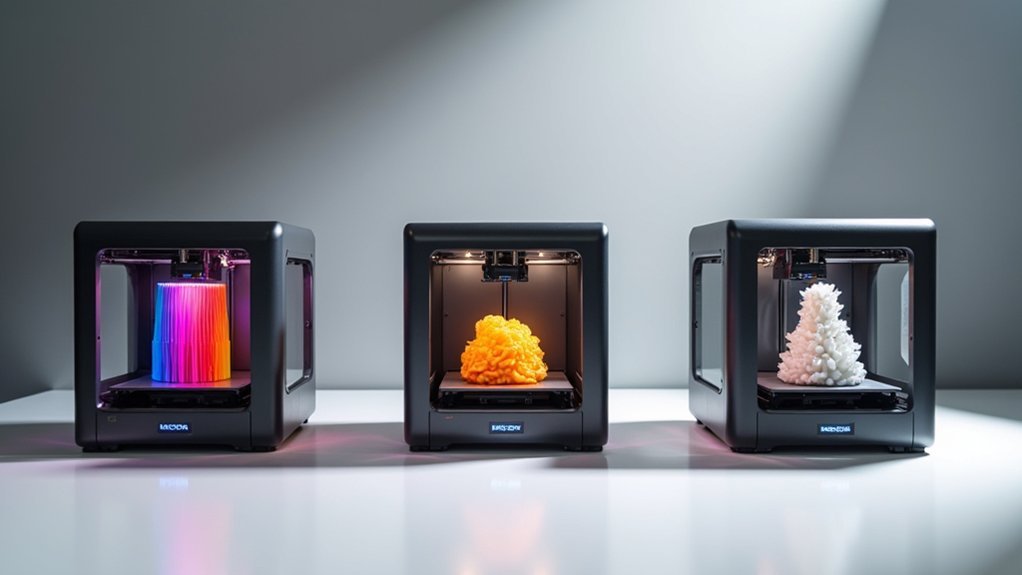
You’re standing at the crossroads of creative possibility, where vibrant multi-color 3D printing can transform your wildest design concepts into tangible reality. The technology has evolved dramatically in 2025, offering unprecedented color accuracy and print quality that’ll make your projects pop with professional-grade results. But here’s the challenge: with so many options flooding the market, choosing the right multi-color printer becomes essential for your success.
QIDI PLUS4 3D Printer, Max 600mm/s High-Speed Printing
The QIDI PLUS4’s 600mm/s maximum printing speed transforms how you approach large-scale projects, making it an ideal choice for creators who need professional-quality results without the traditional time investment. You’ll appreciate the 12×12×11-inch build volume and heated chamber reaching 65°C, enabling you to work with advanced materials like PPS-CF and PPA-CF for vibrant, durable prints.
The integrated filament cutter supports seamless multi-color printing when paired with the QIDI BOX automatic feeding system. You can monitor progress remotely through the mobile app and HD camera while the CoreXY structure maintains precision at high speeds. Though initial setup requires patience, the exceptional print quality rivals higher-end models once configured properly.
Best For: Creators and professionals who need high-speed, large-format 3D printing capabilities with advanced material compatibility for demanding projects like cosplay, prototyping, and industrial applications.
Pros:
- Exceptional 600mm/s printing speed with 12×12×11-inch build volume for large-scale projects
- Advanced material support including PPS-CF and PPA-CF with heated chamber up to 65°C and hotend temperatures reaching 370°C
- Comprehensive remote monitoring and control through mobile app with HD camera and integrated multi-color printing capabilities
Cons:
- Initial setup can be challenging and time-consuming, requiring patience to configure properly
- Firmware update issues and connectivity problems reported by users during early operation
- Quality control concerns with some users recommending waiting for improved future production runs
QIDI MAX3 3D Printer, High-Speed Large Size with Auto Leveling
When you need a 3D printer that combines impressive speed with professional-grade capabilities, QIDI’s MAX3 stands out as an exceptional choice for creators seeking vibrant, high-quality prints. You’ll appreciate its massive 325 x 325 x 315mm build volume and blazing 600mm/s printing speeds with 20,000mm/s² acceleration.
The enclosed chamber maintains 65℃ heat for consistent results with advanced materials like PA12-CF, PET-CF, and carbon fiber filaments. Its ultra-stable all-metal frame features hardened steel linear shafts and dual cooling fans for precision printing. With Klipper firmware, auto-leveling, and QIDIslicer software, you’re equipped for professional-quality vibrant creations.
Best For: Professionals, advanced hobbyists, and makers who need high-speed printing capabilities with large build volume for creating functional parts, prototypes, and complex designs using advanced materials.
Pros:
- Exceptional speed with 600mm/s printing and 20,000mm/s² acceleration combined with large 325 x 325 x 315mm build volume
- Supports wide range of advanced materials including carbon fiber, PA12-CF, and PET-CF with enclosed 65℃ heated chamber
- Ultra-stable all-metal frame with hardened steel components, auto-leveling, and Klipper firmware for professional-grade reliability
Cons:
- Heavy weight at 66.6 pounds makes it difficult to move and requires dedicated workspace
- Large footprint of 21.77 x 21.77 x 23.66 inches takes up significant space
- Higher price point may be excessive for basic printing needs or casual users
Anycubic Kobra S1 Combo 3D Printer with ACE PRO
For creators seeking professional-grade multicolor printing capabilities, the Anycubic Kobra S1 Combo 3D Printer with ACE PRO delivers exceptional versatility with its ability to print up to 8 colors using dual Anycubic Ace Pro units. You’ll appreciate the 250×250×250mm build volume and impressive 600mm/s printing speed powered by CoreXY construction. The full metal hotend reaches 320℃, handling diverse filaments like ABS and ASA. Built-in camera monitoring and the Anycubic App provide remote control capabilities. While customers rate it 4.0 stars for ease of setup and print quality, some report filament reading issues with the Ace Pro components.
Best For: Professional creators and enthusiasts who need multicolor 3D printing capabilities with high-speed performance and advanced features like remote monitoring and intelligent drying technology.
Pros:
- Impressive multicolor printing capability with up to 8 colors using dual ACE PRO units and large 250×250×250mm build volume
- High-performance features including 600mm/s printing speed, 320℃ hotend temperature, and CoreXY construction for enhanced accuracy
- Advanced monitoring and control options with built-in camera, mobile app integration, and intelligent drying technology during printing
Cons:
- Mixed customer feedback regarding ACE PRO component reliability with reported filament reading and jamming issues
- High price point at 56.9 pounds weight suggesting this is a significant investment for hobbyists
- Relatively new product (available since July 2024) with limited long-term user reviews and only 11 customer ratings available
Factors to Consider When Choosing Multi-Color 3D Printers for Vibrant Creations
When you’re selecting a multi-color 3D printer for vibrant creations, you’ll need to evaluate several critical factors that directly impact your printing success. Your choice should balance print volume and size requirements with the printer’s color mixing technology and filament compatibility range. Don’t overlook the importance of speed and precision capabilities alongside setup and maintenance demands that’ll affect your long-term printing experience.
Print Volume and Size
Although print volume might seem like a straightforward specification, it’s actually one of the most critical factors that’ll determine your creative possibilities with multi-color 3D printing. Larger dimensions, such as 12.8 x 12.8 x 12.4 inches, reveal substantial and complex creations that smaller printers simply can’t accommodate. You’ll need to balance this against the printer’s physical footprint—models requiring 21.77 x 21.77 x 23.66 inches demand significant workspace.
Larger build areas present unique challenges for multi-color printing. You’ll want advanced cooling systems to maintain detail and precision across extensive surfaces. The increased print volume pairs well with high-speed capabilities like 600mm/s, enabling faster production of intricate, colorful designs without quality compromise. Consider your available space and intended project scale when evaluating print volume specifications.
Color Mixing Technology
Beyond physical dimensions, the color mixing technology inside your printer determines how vibrant and seamless your multi-color creations will look. Advanced systems supporting up to 8 different colors give you exceptional design flexibility and enable smooth color shifts that bring your models to life.
You’ll want a printer with intelligent drying technology and anti-tangling systems to maintain filament quality throughout the mixing process. These features prevent common issues that can ruin your prints and waste materials.
CoreXY construction enhances the precision needed for accurate color mixing, ensuring your final output matches your intended color scheme without artifacts. When combined with high-speed capabilities reaching 600mm/s, you’ll achieve professional-quality results while greatly reducing production times.
Filament Compatibility Range
Five key filament types separate basic multi-color printers from professional-grade machines that release your creative potential. You’ll want compatibility with common thermoplastics like PLA, ABS, and ASA for everyday projects, plus high-temperature materials such as PC and PA for advanced applications. Carbon fiber composites like PPS-CF and PA12-CF enable stronger, lightweight prints with superior structural integrity.
Look for printers featuring integrated filament cutters that create seamless color shifts during multi-material printing. Intelligent feeding systems prevent tangling while maintaining consistent material flow—critical for flawless multi-color results. This broad compatibility doesn’t just expand your creative possibilities; it dramatically improves both the aesthetic finish and mechanical properties of your printed objects, transforming your printer into a versatile manufacturing tool.
Speed and Precision
When selecting a multi-color 3D printer, you’ll find that speed and precision form a delicate balance that determines the quality of your vibrant creations. Modern multi-color printers like the QIDI MAX3 and Anycubic Kobra S1 achieve impressive speeds up to 600mm/s while maintaining exceptional accuracy. CoreXY structures minimize vibrations during high-speed printing, ensuring your detailed multi-color designs don’t lose their intricate features. You’ll benefit from advanced cooling systems with dual fans and intelligent drying technologies that prevent warping during rapid jobs. User-friendly slicing software optimizes settings automatically, allowing you to maintain vibrant colors and fine details even at maximum speeds. This combination lets you produce stunning multi-color prints efficiently without compromising quality.
Setup and Maintenance
Although multi-color 3D printers offer exciting creative possibilities, their setup and maintenance requirements deserve careful consideration before making your purchase. Look for models with integrated filament cutters and automatic feeding systems, which streamline setup time and reduce manual intervention during prints. Remote monitoring features let you track progress and identify issues without being physically present, simplifying maintenance tasks.
Intelligent drying technology during printing enhances filament performance and reduces moisture-related maintenance, essential for achieving vibrant colors. Regular firmware updates and user-friendly slicer software improve operational efficiency and make maintenance easier. However, high-speed printers reaching 600 mm/s may require more frequent calibration and maintenance to guarantee consistent print quality across multi-color projects.
Frequently Asked Questions
How Much Do Multi-Color 3D Printer Filaments Typically Cost per Kilogram?
You’ll typically pay $20-40 per kilogram for standard multi-color filaments like PLA or PETG. Premium materials such as specialty composites or dissolvable supports can cost $50-100 per kilogram depending on quality.
Can I Use Regular Single-Color Filament in a Multi-Color 3D Printer?
You can absolutely use regular single-color filament in multi-color 3D printers. They’re compatible with standard PLA, ABS, and PETG filaments. You’ll just print single-color objects instead of multi-colored ones.
How Long Does It Take to Print a Multi-Color Object?
Multi-color printing takes 2-5 times longer than single-color prints. You’ll experience frequent pauses for filament changes, purging, and tool switching. Complex designs with many color shifts can extend your print time to several days.
Do Multi-Color 3D Printers Require Special Software for Color Design?
You’ll need specialized slicing software that can handle multiple materials or colors. Most multi-color printers work with standard CAD programs, but require compatible slicers to assign colors to different extruders properly.
What’s the Maximum Number of Colors I Can Print Simultaneously?
You can typically print 2-5 colors simultaneously, depending on your printer’s extruder count. High-end models support up to 8-16 colors, while most consumer multi-color printers handle 4 colors maximum.